
Forney Charities
Improving communities by helping residents, one person at a time.
To a Far Country
When I was a young boy and I would insist that other kids were far better off than I – “Jimmy doesn’t have to mow the lawn. He doesn’t have to waste his whole Saturday. How come I have to? He has a much better family.” My father would always say, “The grass is always greener on the other side of the fence.” I wasn’t sure, in my tender years, what that meant. For one thing, I knew it meant that I would have to mow the grass and I better get to it. Otherwise my whole Saturday would be shot. The same with washing the car. Only years later would I have a more adequate understanding of my father’s saying.
Joshua 5:9-12; Psalm 32; II Cor. 5:16-21; Luke 15:1-3,11b-32
Fourth Sunday in Lent, Year C, 2019
The Rev. Dr. John C. Forney
Preached at St. Francis Episcopal Mission, San Bernardino
The genius of Jesus is that he didn’t teach by the logic of rational argument. No syllogisms for him. He taught by story, sayings and by example. Today, we get one of the most familiar stories in all of Scripture. My friend, Paul Clasper, would say that if we had lost almost all of our written scriptural heritage but we had only a few bits left, this story being one of them, would have had enough to understand the whole thing. We would have had enough to redeem the world.
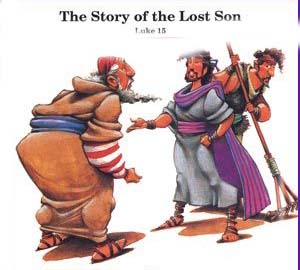
So, we have this story of a father and two sons. One son is sick and tired of mowing the lawn every Saturday. He’s, like, “I’m outta here. If Jimmy doesn’t have to mow the lawn, why should I? It’s stupid.” So, he goes to his father and demands that he give him his half of the livelihood. And he will just leave, thank you. So, the father, in sadness hands him a bag of coins, half of the inheritance and bids the younger son farewell. As the boy disappears down the road, a tear rolls down the father’s cheek.
The boy, gleefully heads off to big city where he will never have to mow the grass. In fact, he will never have anymore irksome chores. He heads off to a mythical far country where every day is nothing but a big party – just like those commercials for Carnival Cruises, or the excitement of a Morongo Valley Casino. No one mows the lawn as far as he can see. For this kid, the whole world is a twenty-four/seven party. He’s the high roller at the table. Glamorous women cluster around him and the action is hot.
But as the days roll on, like the die at the craps table, his bag of coins isn’t so full anymore. As he gets down to the nubbins, he begins to wonder why he’s always the one having to buy the beer. Where are those other Big-Time Spenders? In a flash, he’s out of chips. Outta money. Outta luck. The barkeep is now insisting the tab be paid. And all the beautiful women are standing around some other guy.
As hunger settles in and he wakes stiff and cold on a park bench, it’s beginning to dawn on him – something his father said about the grass on the other side of the fence. He comes to his senses in a far country that is cold and inhospitable, the faint glow of flashing neon a few blocks away. A far country that is little better than death itself. Diving through Dumpsters behind the casino restaurant, all he ends up with is stale, dried-out, tough pizza crusts and food poisoning. Retching in the weeds, it dawns on him that even the lowliest of his father’s servants had it better than this.
He comes to himself in a far country and doesn’t like what he is finding. All is desolation and abandonment.
In America, we now find ourselves in a Far Country, a country that many of us don’t recognize.
The opioid crisis ravaging our nation is certainly desolation and abandonment. Addiction is a very far country. We have abandoned our most vulnerable to the tender mercies of Perdue Chemical and their ilk. Last year we had some forty-seven thousand deaths from opioid overdose, though various stats give somewhat different numbers – but it’s in that ballpark. More than all the years of the entire Vietnam War.
I heard from an Episcopal colleague in West Virginia that Bishop Mike Klusmeyer had called all the West Virginia clergy and laity together for a conference on opioids. He has mandated that every parish will have the antidote to opioids, Naltrexone, on site with some people in each congregation trained to administer it. It will stop an overdose cold in its tracks. Instantly.
Now, here comes that other brother, you know the responsible one. The older one who always did his chores without complaint. Yeah, the one who was always willing to step in and mow the damn grass and do whatever. Mr. Responsibility. If we’re honest with ourselves, there’s a bit of that stuffed-shirt, self-righteous brother in each of us. I know that brother lurks in me. That’s right – I am the older brother. And I’m sure my brother Tom would say at times I could be a real jerk.
In the Episcopal clergy, I discovered we had a number of those older brothers who stayed home and mowed the grass. Now what these “jerks” said was, “Bishop, why should we bother? If we’re going to save them from this one-time overdose, won’t they just go out and do the same thing all over again? Why bother? We’re just wasting our time.” Classic, Blame the Victim. Older brother types can really be insufferable. Why save them? Really!? What part of the gospel didn’t you understand?
 Forney Charities