
Forney Charities
Improving communities by helping residents, one person at a time.
On Wings of Grace
We’ve always had someone who believed in us. If we hadn’t, we wouldn’t have made it this far through all the trials and tribulations of this life. We wouldn’t have made anything of ourselves.
As a hymn puts it, “Blessed are the feet of those who bring glad tidings.” Messengers of Grace. On such wings we are buyoed up and develop our wings. In scripture such are angelos, angels in English. Messengers.
Though my father thought I’d never amount to anything, I had an English teacher in the eleventh grade, Mrs. Reiner, who had high hopes for me.
I remember one day in her class. As usual I hadn’t done the reading. When called upon, I had nothing to say. And, as usual, I felt like a complete dolt. As the class was leaving after the bell had rung, Mrs. Reiner pulled me aside. She gently said, “John, I know you are capable of much more than what you’re doing.”
That was it. As simple and as sincerely as that. I knew deep down, she actually meant it. She was the first teacher who had believed in me. Knew that I was capable of so much more. Delivered by a blessed messenger of God.
It was later in my senior year, based on my remembered encouragement of her words, that I signed up for a class in world literature. And loved it. I actually think I would have lived up to her expectations.
Mrs. Reiner was the messenger of good news, of possibility I needed at that point in my life.
Jonah is such a messenger to ancient city of Ninevah. I suspect his admonishments were not quite so gentle as those of Mrs. Reiner. I suspect that he breathed fire, smoke and thunder on the wickedness of that people.
And they listened. And amended their evil ways. God did not destroy that city as Jonah had said God would. God did not bring calamity down on those wayward people.
Now, Jonah being very human, felt he had been dissed by God. He feels himself to be in such disgrace that he would rather die.
Jonah retreats to a barren hill to sulk. Still waiting to see if God would destroy that city. While he stews, a bush grows up to shade him from the scorching sun. Grows up almost overnight and was a great comfor to Jonah as he sat under its shade.
But in a short while God appointed a worm to attack the bush. It died and God took command of the elements.
“God prepared a sultry east wind,and the sun beat down on the head of Jonah so that he was faint and asked that he might die. He said, ‘It is better for me to die than to live.’”
“But God said to Jonah, ‘Is it right for you to be angry about the bush, for which you did not labor and which you did not grow; it came into being in a night and perished in a night. And should I not be concerned about Ninevah, that great city, in which there are more than anhundred and twenty thousand persons who do not know their right from their left, and also many animals?”
Some of God’s messengers cannot abide such freely given Grace. All so human. In their petulence they actually hope God will smite the wrong-doers with the threatened sword. Smite them dead to the very last one.
Again and again God sends messengers on the wings of Grace. And sometimes we actually heed their warmings. Live up to their encouragement. God’s word to the Ninevites? “You can do better than this. Now, shape up!”
The Results? There’s a “Wideness in God’s Mercy” which Jonah can’t comprehend or accept.
In the Parable of the Workers in the Vineyard, hired at different hours of the day yet all paid the same generous wage, the first hired complained about the master’s extravagance. Grace freely abounding. Same Wideness. In parable after parable, Jesus is the messenger with Wings of such Mercy and Grace.
Leymah Gbowee has been such a messenge of Grace to the nation of Liberia which had roiled in violence and turmoil since Samuel Doe overthrew the government of William Tolbert, the last Americo-Liberian president – a long line of Americo-Liberians dating from the arrival of the first American slaves on Liberia’s shores.
President Tolbert and most of his family and administration were publically executed on a beach, “murdered in front of screaming crowds” by machine gun fire.
Unrest again seized the nation when the forces of Charles Taylor, an army sergeant in bloody fighting overthrew Samuel Doe and brutally murdered him after hours of torture. The army of Taylor’s ragtag boy souldiers raped and pillaged Liberia for months on end. The full contagion of hell was soon to be unleashed on that impoverished nation.
The slaughter continued for months on end as bands of teenage boys roved the streets with AK-47s shooting at anyone and anything they took a fancy to destroy. As looting had emptied virtually all the markets, hunger was rife. Many now faced starvation.
Leymah witnessed one atrocity after another as the violence consumed Monrovia. When one armed boy at a checkpoint didn’t like the sight of a woman nursing her baby, he grabbed her and with a knife sliced off her breast.
Mighty be our Powers is Leylah’s powerful and redeeming story[1]
When thousands, including Leymah Gbowees’s family had taken refuge in the main Lutheran church in Monrovia, Taylor’s boy-soldiers raped and hacked to death or shot the hundreds taking refuge in that church. Fortunately, Leymah’s family had left only days earlier. U.S. Marines just stood by and did nothing to prevent the slaughter.
Finding herself in an abusive relationship with Daniel, a man who didn’t respect her, Leymah lost all self confidence. Beating and shouted insults went on endlessly. “Stupid, stupid, stupid.” He used it so often that even her children picked it up and called her that.
Attempting to keep her three children alive and pregnant with a fourth, the walls had closed in. Depression overwhelmed her. Virtually disowned by her own father as just a “baby machine,” and unable to provide food for herself or her children, Leymah shut down.
Leymah and Daniel were now living with her parents as looters had destroyed her former house, and pretty much everything else in the old neighborhood.
One evening her mother asked her the question she had been dreading. Gently, she asked, “Leymah, what are you want to do with your life”[2]
“’Let me tell you something,’ she said. ‘I’ve endured those nights of listening to your dad say terrible things about what you’ve become. But I know that’s not who you are, and I know you can do better, I want to make a vow to you. If you decide you want to do something for yorself, if you decide to go back to school—I will tie my waist.” By now I couldn’t see the beauty of that night, because my tears were flowing.
“If an African woman tells you she will tie her waist, it means she will do anything for you, give you everything she has. ‘I will support you Leymah. I wil take care of your kids. Until you make something of your life.’”[3]
Previously she had been a social worker at the local office in Monrovia of Lutheran World Federation. Her mother, speaking those precious words of Grace and faith in her daugher were the wings on which Lehmah’s
courage would rise. Yes, as upon eagle’s wings. That unbounded faith of her mother gave her the courage to approach the director she had previously known before the carnage that had pulled Liberia into the darkest of nights.
The director, Tunde, this gentle man, also expressed an unbounded faith in Leymah. When she entered his office, he rejoiced. “I’ve been asking people about you.” When he saw her one day with a bruised arm and she let him know that Daniel had done that, he urged her to leave that abusive relationship.
Later, when she told Tunde that she had finally left Daniel, Tunde beamed, “Good for you. Don’t worry, you’ll find someone else one day.” Right now, she didn’t want anyone else.
She found that Tunde was easy to talk with. He was polite and respectful and valued her ideas and opinions. And while he had grown up in an abusive house and bore the scars of whippings, he was the gentlest person she had ever met. He offered encourage that chipped away at her feelings of inferiority, of being stupid and useless.
When she said she certainly couldn’t go back to school as he kept encouraging her to do, he lifted her confidence in herself insisting. “Yes, you can.” “I’ve lost my old abilities,” Leymah countered. Tunde again insisted, “No you haven’t…You have too much potential. Don’t throw it away. You know this isn’t the life you want for yourself.” She was afraid, but deep down she knew Tunde was right. Actually, before the war she had been a very good student. Long, long ago.
When her fourth child was about to arrive, Leymah was scared and confided to Tunde how vulnerable she felt. So trapped. He responded, “What if I told you thatI would be there for you and this child? What would you say?”[4]
“I would say that you’re lying. Men are not to be trusted.”
Yet on delivery day, there he was. He had rushed to her part of the city, forgetting to take anything with him that he might need. “I was so excited,” he exclaimed.
“’This gentle giant,’ I thought. ‘This was someone I could love.’” Wings of Grace. Wings of Mercy.
Leymah did go back to school and earn her A.A. degree. She would go on to found an army of women of faith that would stare down Taylor’s maurading boy souldiers. God’s Grace working through Leymah, the people who encouraged and suppored her. Such abounding Grace would eventualy bring peace to Liberia through the united effort of millions of Liberian women. But more about that later.
But here’s the secret. Each of us has the same promise of being messengers of Mercy and Grace. It’s our baptismal vow. Each of us daily is present with opportunities to bring hope and promise to be bearers of Mercy on Wings of Grace. If your life has been annointed by the Spirit, you have been given the gift to bring comfor, to bring restoration, to bring redemption. If not you, who else?
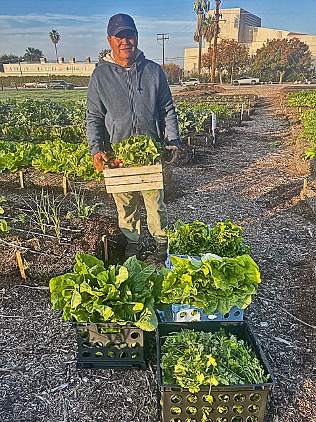
Grace abides at the food banks where we provide veggies and fruit. Grace happens when you gave a fiver to the fellow by the freeway, and then demanded to know why is he there. And what will we do about it? And vote for folks asking that very same question, folks who could do a lot about it. Grace happens when you give encouragement to a grandchild, or just sit down and listen to them with an open heart.
Grace descends on healing wings in manifold ways. Ways that the Spirit opens to our imaginations. Call a friend. Be a friend. Visit a shut-in can do wonders for them and for your soul. Work in the Garden of Hope or St. John’s Food Bank. That will do wonders for your health. And on October 17th, Grace will arrive on soaring outstretched wings all across the nation at No Kings Day demonstrations. Millions will be out in the streets proclaimng to America, “We Can Be Better Than This.” And on Sunday, November 1st, it will be “Souls to the Polls.” All of us claiming our right as citizens to make our voices heard. Grace abounding. Let’s be the Change we Seek. Pure unadulterated Grace that will “Pray the Devil back to Hell,” as Leymah and her sisters put it. Each one of us, Wings of Grace. Amen.
[1] Leylah Gbowee, Mighty be Our Powers: A Memoir, with Carol Mithers (New York: Beast Books, 2011).
[2] Op cit., 69-70.
[3] Op.cit., 72.
[4] Op. Cit., 79.
September 20, 2026
Pentecost 17, Proper 20
“On Wings of Grace”
The Rev. Dr. John C. Forney
Jonah 3:10-4:11 Psalm 145:1-8
Philippians 1:21-30; Matthew 20:1-16
To Forgive and Reconcile
My next-door neighbor Tom – the one who taught me how to drive a big rig — told me one afternoon that his brother had gone to collect the rent at one of the houses he owned. His brother knocked on the door, it opened and the occupant shot him point blank in the head.
The family was distraught for months on end. The murderer got off with a relatively light sentence. The youthful shooter was “just a kid,” they said. “Just a kid.” The family wanted blood. How does forgiveness carry any weight in such circumstances? How is it possible?
Yet in faith, by the Grace of God, it is possible. Let me tell you the story of Azim Khamisa. Azim Khamisa is a father awakened to the news that his only son Tariq had been shot by a 14-year-old gang member, Tony Hicks, over a slice of pizza. In the bitter days that followed it would have been natural for Azim to have been consumed by anger. That would have been the end of Khamisa’s life. Bitterness ending only at the grave.
But something happened to intervene. After a number of weeks when bitterness subsided, Azim began to think, in reality, there were two sets of victims. There was also the family of the gang member who had shot his son. After a while Azim was prompted by all that is Holy and all that is Reconciliation –prompted to reach out to the killer’s family. It was a grandfather. This man had raised the other boy.
That two families not be devastated, the two men, Azim and Ples Felix, Tony’s grandfather and guardian, began meeting. Azim finally went to visit Tony in jail, where he was serving a 25-to-life sentence.[1]
When Azim looked deeply into Tony’s eyes, he didn’t see a killer. He saw a very wounded human being, pretty much like himself. Wounded.
“Since the beginning of this tragedy, Tony confessed to his crime and has continuously sought to better his life. He has apologized to the Khamisa family, shares his remorse, and plans to join Mr. Khamisa and his grandfather, Mr. Felix, in their efforts to teach children accountability, compassion, forgiveness, and peacemaking.”[2]
“From prison, Tony has written numerous blogs responding to questions from youth participating in the TKF (Tariq Khamisa Foundation) programs. He has also earned his GED and is working towards his AA degree in Social Work. Tony participates in Gang members Anonymous, Alcoholics Anonymous, Toastmasters, and has done rigorous self-inventories to identify his character defects.”[3]
Through the efforts of Azim, Tony is now out of prison and has a job at the Tariq Khamisa Foundation.
On the foundation’s web site are many stories of forgiveness. From perusing them, it became clear to me that there’s no automatic formula. Nothing’s more unrealistic than the teacher demanding of two boys who had been in a knockdown-dragout fight than to say, “All right, you boys shake hands now and be friends.” The muttered response of one would surely be, “See you after school.”
Forgiveness is a spiritual gift as much as anything, born of calmness and a softening of the heart. It is nothing to be demanded. It is at best an endeavor by both parties. It can’t be compelled in the heat of the matter. Perhaps, later, much later, those harmed and traumatized by the tragedy of September 11th will be able to let it go, or at least get beyond disabling grief. To “let go and let God.” But probably not today.
One more story from the Azim’s foundation from the “Forgiveness Project.” This is the story of two fathers, one Israeli and the other Palestinian. The conflict that has endured for generations. I share the story of the Israeli father.
“I was on my way to the airport when my wife called and told me Smadar was missing. When something like this happens, a cold hand grabs your heart. You rush between friends’ houses and hospitals, then eventually you find yourself in the morgue and you see a sight you’ll never forget for the rest of your life. From that moment you are a new person. Everything is different.
“At first, I was tormented with anger and grief; I wanted revenge, to get even. But we are people – not animals! I asked myself, “Will killing someone else release my pain?” Of course not. It was clear to my wife and me that the blame rests with the occupation. The suicide bomber was a victim just like my daughter, grown crazy out of anger and shame.
“I don’t forgive and I don’t forget, but when this happened to my daughter, I had to ask myself whether I’d contributed in any way.
“The answer was that I had – my people had, for ruling, dominating and oppressing three-and-a-half million Palestinians for 35 years. It is a sin and you pay for sins.[4]
Getting back to my Facebook political posts, the other day two of us had sharp disagreement and some harsh words over how our president has handled his responsibilities. Commenting on my rant about his calling our fallen, “losers” and “suckers,” he responded that I didn’t know who I was talking to.
In his next post, seconds later, he announced that he was a vet and had twenty years of service. At that moment my heart softened a bit and I thanked him for his service, letting him know that I also had served. Two years as an Army medic.
Surprise, he also had been an Army medic in Afghanistan. And thanked me as well for my service.
Then he let me know that the main reason he had voted for Trump was that he was fed up with elite politicians who just talked and had done nothing for people like him. I said I understood. Understood completely. That’s why I had supported Bernie.
We ended in agreement that the politics of this nation are pretty screwed up and agreed to a virtual toast, that no matter how things turned out on November 3rd, we would hoist a virtual beer “To the Constitution and to the Declaration of Independence.’ We bid each other, “Good night.”
When we consider the pain and suffering brought on by the 9/11 attacks twenty-five years ago, what does forgiveness mean? We are now in the territory that time and God alone can enable us to cope.
Is there forgiveness for so much pain, so much loss? There’s no alternative. Eventually. The early church knew our failings and the damage we do to one another.
The Gospels tie God’s Grace in with forgiveness. Forgiveness is front and center in the Parable of the Lost Son and Forgiving Father. An essential part of the Lord’s Prayer. Hear this admonishment from today’s gospel.
Upon hearing Jesus’ teaching on forgiveness, Peter approached him with a question. This was an inquiry based upon the teachings of the Torah – “Lord, if another member of the church sins against me, how often should I forgive? As many as seven times?” This was the standard proscribed. Jesus said to him, “Not seven times, but I tell you seventy-seven times.”
Forgive seven times seventy? The natural man, the natural woman, says, “I don’t think so.” Yet here is this implacable demand: “Seventy times seven times.”
To back it up, Jesus tells the parable of a man forgiven a great debt by a generous king who receives most distressing news. The slave recently forgiven an enormous debt is shaking down his fellows for what they owed him. Seizing one debtor by the throat, the slave demanded, “Pay what you owe.” This is a debtor who was owed only a fraction of what had been forgiven him by the king. Hearing this news, the king was enraged. He had that slave tortured until he should pay his entire debt — hundreds of thousands of dollars owed the king. As the slave was led away, the king raged, “Should you not have had mercy on your fellow slave, as I had mercy on you?”
I’m wondering how many Americans this past week hearing or watching those tapes on TV replay, listening to still grieving family members, replaying in our own memories like an endless loop – asked what can forgiveness mean? What can reconciliation mean in the face of such horrendous evil?
The wrong done is beyond the pale. So much pain. So much pain.
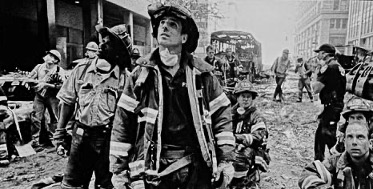
As I wandered a few weeks ago through the 9/11 Museum at Ground Zero, heavy of heart, the enormity of the sacrifice of so many was overwhelming. The firefighters rushing up those stairs of doom as fleeing office workers stampeded down. Those workers who risked their lives on those stairs in aiding handicapped colleagues get down. Sometimes physically carrying them. It was overwhelming as I realized those stairs preserved in that exhibit were Holy Ground. Tears clouded my vision.
Looking at the crushed fire engine on display — seeing again the videos of those jumpers who would rather die in that manner than be burned to death. Often holding hands with a colleague as they plummeted to their deaths. The story of a women standing on the ledge attempting to preserve her modesty by straightening her skirt before jumping.
I began to understand that it will only be through the awesome Grace of God that I am able to move on. That we as a nation will regain our humanity. We must absolutely refuse to blame all Muslims for this act of perfidy. I must claim all the more strongly this people of Abraham as my brothers and sisters, all of us sharing a common humanity.
As the day closes, I can only fall back on the spiritual wisdom of Reinhold Niebuhr’s Serenity Prayer:
“God grant me the serenity to accept the things I cannot change,
The courage to change the things I can,
And wisdom to know the difference.”
And St. Francis:
Lord, make me an instrument of your peace.
Where there is hatred, let me sow love;
where there is injury, pardon… Amen.
[1] https://www.virtuesforlife.com/father-forgives-sons-killer/
[2] https://tkf.org/tony-hicks/
[3] Ibid.
[4] Rami Elhanan, “The Forgiveness Project,” Stories of the Tariq Khamisa Foundation
September 13, 2026
Pentecost 16, Proper 19
“To Forgive and Reconcile”
The Rev. Dr. John C. Forney
Genesis 50:15-21; Psalm 103:8-13
Romans 14:1-12; Matthew 18:21-35
Holy Persistence
When I ran an ecumenical fair housing project for the San Gabriel Valley, I could always count on four faith communities: the Quakers, the Universalist Unitarians, Disciples of Christ and Catholics who believed in the social teachings of the Catholic Church.
But day-in and day-out it was the Quakers who inspired me. They never gave up. Social justice ministries were their cup of tea. If we needed someone to follow up on a complaint of housing discrimination, they would be at the ready.
I first encountered them when I put together my application to be a conscientious objector to the Vietnam War. I explained to my contact that I was not willing to kill anyone over this unjust, immoral war but I would be willing to help patch up some poor soul who had been shot or blown up. With his guidance, the draft board accepted me under that condition and I served my two years in the Army as a conscientious objector medic.
At the church we attended in San Francisco, Jai and I were enlisted to help provide a Sunday dinner at the halfway house run by Quakers for those returning from incarceration. This allowed a free day off for the couple who were caretakers and mentors for their housemates.
These Quakers were what the gospel looks like in action. All around the globe their impact is felt. Holy Persistence.
The persistence of this faith community mirrors the faithful persistence of God – the Hound of Heaven. When the people of Israel have strayed, God sends prophet after prophet to bring them back. To speak warning. To speak justice. To speak forgiveness. All to woo them back to the life-giving path of Torah Righteousness.
Ezekiel speaks to that wayward people. Yes, God will offer forgiveness but repair comes only after accountability. Ezekiel’s words are a harsh warning. If this community continues on the path of wickedness, surely it will come to ruin. As sure as night follows day. In the same harsh tones of a parent warning a child not to run out into the street without looking. The parent is responsible for that warning every much as Ezekiel is responsible to speak truth to power.
What is also clear is the persistence, Holy Persistence, commanded by God. Ezekiel is to repeat and repeat the message no matter its reception. Whether the wicked repent and turn to God, that is on them. But Ezekiel is to be a faithful messenger no matter their decision. Wash, rinse, repeat. Wash, rinse, repeat. That’s Ezekiel’s appointed mission.
“So you, mortal, I have made a sentinel for the house of Israel; whenever you hear a word from my mouth, you shall give them warning from me. If I say to the wicked, ‘O wicked ones, you shall surely die,’ and you do not speak to warn the wicked to turn from their ways, the wicked shall die in their iniquity, but their blood I will require at your hand.”
Whether the wicked heed the warning or not, if Ezekiel lets the truth die in his throat before it is heard, Ezekiel will have failed God.
Holy Persistence is demanded of him. As it is of us all who would live in the Kin-dom of Torah Righteous and Gospel Goodness. Holy Persistence.
And down through the ages we have splendid, life-giving witnesses to that calling. Yes, the Quakers do come to mind.
Also do those who serve to bind up the wounded in combat. One such was Clara Barton, who served in the Union ranks as a nurse. Nurse and a most I came across this from the Library of America readings from the Civil War – a letter that Clara Barton had written of her experiences amidst that bloody carnage. Holy Persistence for sure.
In the volume, The Civil War: The Second Year Told by Those Who Lived It[1] there is a wonderful letter of Clara Barton to a friend, John Shaver. With the outbreak of hostilities, she left her job as a clerk in the Patent Office to begin nursing the wounded on the front lines. She became know as the “Angel of the Battlefield.” Her ministrations to the wounded were one of Holy Persistence.
In that letter of 1862, she writes (I have not changed any of the spelling or grammar in the original) of the evacuation of the wounded from the battlefield at Manassas. In it she describes the chaos and the inept attempts to get the injured onto trains for transport to safety:
“I can not tell you the scenes which awaited our eyes, –the wounded were constantly arriving—but no hospitals this time, only God’s great one under the blue canopy. The men were brot down from the field and laid on the ground [that] was ‘littered’ like ‘bedding’ for the horses, — they came till dark and then it was dark indeed…
“…the men lay so thick we could not take one step in the dark, by midnight there must have been three thousand helpless men lying on that hay.
“…My one stew pan which I remembered to take, and this made coffee for them, all night we made compresses and slings and bound up and wet wounds when we could get water, fed what we could, travelled miles in the dark over these poor helpless wretches, in terror lest some ones candle fell into the hay and consume them all, at length morning came, and we sent up the train with 1250, next 1000, next 1100, next 950, and so on. Still the ambulances came down, and cars went out and we worked on, took the meat from our own sandwiches & gave it to them and broke the bread into wine and water to feed the poor sinking wretches as they lay in the ambulances.
“On Monday the enemies Cavalry appeared in the wood opposite & a raid was hourly expected…On Monday PM all the wounded then were sent off, and the danger became so eminent that Mrs Fales begged to be excused from accompanying her, as the ambulances were up to the field for more, and I knew I should never leave a wounded man there if knew it, though I were taken prisoner 40 times.
“At 6 clock it commenced to thunder and lightning, and all at once the artillery began to play joined by the musketry about two miles distant, we sat down in our tent and waited to see them break in but Reno’s forces held them back. The old trusted 21st Mass. lay between us and the enemy and they couldn’t pass. God only knows who is lost…the next day all fell back…Poor Kearney, Stephens & Webster were brought in…and in the PM Kearney’s and Heintzleman’s divisions fell back through our camp on their way to Alexandria. We knew this was the last. We put the thousand wounded we had then into the train. I took one car load of them, Mrs M another. The men took to horse, we steam off, and two hours after there was no Fairfax Station (the aid station at that railway juncture, soon abandoned to onrushing Confederate forces), reached Alexandria at 10 oclock at night.
“Our forces are all back again in the old places around the city. McClellans army here again and he in command of it all…I have told you nothing of the old friends who met me among the wounded and dying on that bloody field. I have no heart to tell it to day but will some time.
Clara Barton, over those dreadful days, exhibited heroic Holy Persistence like few others. She and just a handful of other nurses to tend some 5,000 wounded. And would again and again for the duration of that war.
Later she would go on to found the Red Cross and bring many reforms to the medical treatment of the wounded and those beset by natural disasters. Often against the strident opposition of doctors who objected to a woman knowing anything about anything.
She and those who waged that bloody struggle were themselves that “terrible swift sword” bringing freedom to over half the population of our southern states. Freedom that has brought liberty and a future to half my present family. A most righteous cause.
Now we suffer not under a great wartime leader as Lincoln or Roosevelt, but under a petulant man-child who knows nothing of the havoc he reeks. Again, we find ourselves in an interminable, senseless war. The kind he promised to keep us out of.
Open the daily paper. Atrocity upon atrocity. In Iran a girl’s school is bombed with the result of hundreds of deaths, mostly young students and their teachers.
The other day it was a wedding at a private home.
That day began like any traditional wedding day. Woman had arrived early with their hands elaborately decorated with henna. Children played in the courtyard. A festive meal was cooking as enticing aromas wafted through the compound.
It ended when a bomb brought down the roof, turning the event into a jumble of sandals, dust-coated rubble and blood-soaked rugs.
Dozens of guests had already arrived. A woman who had come a day early for the henna party reports on a blog post, “Tonight was supposed to be a night of love and laughter…But the wedding turned into mourning, and a sweet night will forever be bitter.”[2]
Five wedding guests killed including a six-year-old boy, some 67 others wounded. Another American disaster in a war of choice by the most ignorant Commander in Chief that we have ever had. Not knowing in this tragic, misguided carnage he will have earned the bitter enmity of Iranians for generations to come. Not a clue.
A war without notice to Congress or any accounting to the American people. A war with no end in sight.
As the ballad of the 60s puts it, we citizens of this republic are called to “hammer out danger…hammer out warning.” Like the message to Ezekiel, if we lose this democracy, it’s on us. We will have only ourselves to blame. If I do not share the Word I have also received, it’s on me. I have no right to stand in this pulpit.
And the perpetrators of this autocracy will give no quarter. They will not quietly fold up their tents and vanish into the desert sands of the coming American desertscape brought on by global warming. Yeah, drill, baby, drill.
Fredrick Douglass cautioned us when dealing with such as this ilk:
“Power concedes nothing without a demand. It never did and it never will. Find out just what any people will quietly submit to and you have found out the exact measure of injustice and wrong which will be imposed upon them, and these will continue till they are resisted with either words or blows, or with both. The limits of tyrants are prescribed by the endurance of those whom they oppress.”[3]
And this wise counsel from one of our most intrepid legislators, Barbara Jordan:
“As a first step, we must restore our belief in ourselves…Let each person do his or her part. If one citizen is unwilling to participate, all of us are going to suffer. For the American idea, though it is shared by all of us, is realized in each one of us.”[4]
We wring our hands. We toss about restlessly at night. We tune out, drop out. Yes, I know how you feel as we witness the slow-motion train wreck of this republic. As we witness the destruction of cherished dreams of yore and dashed hopes for a livable tomorrow. I know. I feel it too.
But when I consider the sacrifices of those gone on before: Clara Barton, those hundreds of thousands of dead of the Grand Army of the Republic – their Holy Persistence. Their holy sacrifice. What right do I have to get depressed and throw up my hands in surrender to the deadly imbecility of this current administration? No, I will not go quietly into that dark night! Nor should you.
Consider the valiant struggles of Gloria Steinem whom we recently lost. Her Holy Persistence for the cause of her sisters of this nation. And that, even in the face of recent rollbacks of victories previously won — she never tired. Holy Persistence. She never tired nor will I. Nor should you.
If I do not honor in word and action the sacrifices, the toil of those gone on before, yes, and those who now assemble at the battlements of this present struggle to preserve the soul of this nation — what right to I have to stand at the Pledge of Allegiance to the Flag? It would only be an empty performative stunt. Signifying nothing.
Each is now summoned by a Divine Word of Warning, implanted in hearts and minds. Each summoned to action. We find ourselves, ordinary people now living in extraordinary times.
“We have to acknowledge that there is no cavalry coming to protect us. No knight in shining armor to save us from the situation we are in. It’s up to us. We are the people who decide what happens next. While daunting, it can also be empowering to know how essential we are in the fight for freedom and our democracy.”[5]
The Most Holy Spirit presently summons us, each and every one, to the greatness that God has created us to be. To Holy Persistence in the struggle before us. And our efforts, no matter how great or small, in and through the Grace of God, shall be sufficient. We can retire to bed after this November 3rd, knowing we have done our part for the future of this nation and our grandchildren to come. Amen.
[1] Stephen W. Sears, The Civil War, The Second Year Told by Those Who Lived it (New York: The Library of America, 2012), 413-415. Spelling and grammar are as in the original text.
[2] Christiaan Triebert, Malachy Browne, Farnaz Fassihi, Erika Solomon, “Bomb Turned Wedding in Iran into Tragedy: Evidence It was U.S., New York Times, September 4, 2026.
[3] Quoted from, Ordinary People, Extraordinary Times: A Guide for all of us, How to Reclaim Your Power, Fight for Freedom, Reimagine Democracy, Skye Perryman, Ten Speed Press, 2026. 7.
[4] Ibid.
[5] Op cit., 12.
September 6, 2026
Pentecost 15, Proper 18
“Holy Persistence”
The Rev. Dr. John C. Forney
Ezekiel 33:7-11; Psalm 119:33-40
Romans 13:8-14; Matthew 18:15-20
In the Arena
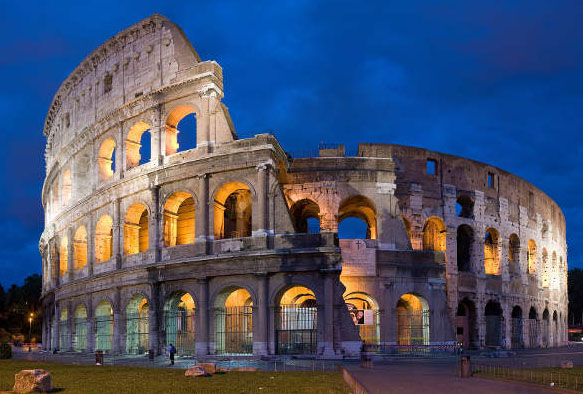
Many of our presidents have been bigger than life. I suppose that just putting oneself forth in such a contest requires a fairly strong ego. It requires the conviction that you can win and it requires the conviction that you can do the job, that you have something to offer. That you can meet the unknown challenges that will come during the four years of your presidency. A task not for the timid, the indecisive or the uninformed.
Though every now and then a ringer slips through the electoral system. Like now. I dare say that a bland personality like Calvin Cooledge or Warren G. Harding would never make it in this overheated media environment, in this era of blogs and internet barrage of conspiracy and lies. It is true that the Orange Voldemort at 1600 Pennsylvania Ave. is certainly a puffed-up personality uniquely suited to this cutthroat reality show media age.
Looking back, one of the presidents that has always captured my interest is Theodore Roosevelt. No saint he. He was an imperialist from the word go. Sorely misguided in his expansionist vision for America. Yet he brought a moral sense of duty and fairness to his life in the political arena. A sense sorely lacking today.
Here is that famous quote that has inspired resiliency and perseverance from his speech, “Citizenship in a Republic”, delivered at the Sorbonne, in Paris, France on 23 April, 1910. Often referred to “Man in the Arena.” [1]
“It is not the critic who counts; not the man who points out how the strong man stumbles, or where the doer of deeds could have done them better. The credit belongs to the man who is actually in the arena, whose face is marred by dust and sweat and blood; who strives valiantly; who errs, who comes short again and again, because there is no effort without error and shortcoming; but who does actually strive to do the deeds; who knows great enthusiasms, the great devotions; who spends himself in a worthy cause; who at the best knows in the end the triumph of high achievement, and who at the worst, if he fails, at least fails while daring greatly, so that his place shall never be with those cold and timid souls who neither know victory nor defeat.”
Roosevelt, for his many shortcomings on the international stage, was an intrepid leader of the Progressive movement. He was notorious for his late-night prowling through the streets of the City of New York when he was police commissioner. Often, late at night, a sleeping officer would be rudely awakened to find Commissioner Roosevelt in his face.
At the time Roosevelt cleaned up the force, which had been no better than a shake-down operation. When he went after those taking kickbacks from the brothel operators and their patrons, he got a huge amount of blowback. Yet he persisted. He joyfully took his place in the arena of duty and action.
TR was raised in a Presbyterian/Reformed faith. As a young man he taught Sunday school. This faith tradition inculcated in him the sense of purpose and duty. His was an active faith that joyfully engaged the world. He relished his role in whatever political office he held. He genially was “Deeeelighted!” This exclamation was no mere affectation. In his role as public servant, he was genuinely “Deeeelighted!” Whomever he met, he was “Deeelighted!”
Jesus instructs his followers in a similar path of discipleship. They are not to have warm, cozy spiritual feelings. Not to sing kumbaya praise songs. They are not to be an exclusive club. No, their path is into Jerusalem. In the arena. To bear one’s cross, where need meets one’s calling.
“Jesus began to show his disciples that he must go to Jerusalem and undergo great suffering at the hands of the elders and chief priests and scribes, and be killed…And Peter took him aside and began to rebuke him, saying, ‘God forbid it, Lord! This must never happen to you.’ But he turned and said to Peter, ‘Get behind me, Satan!’ You are a stumbling block to me…’” This is definitely a faith lived in the arena. Jesus’ entire ministry was in the arena.
If you wear a shiny cross around your neck or on your lapel, it had better stand for something – an active, sacramental faith grounded in today’s figurative Jerusalem. We should find you in the arena.
Martin Luther, the 16th century church reformer, instructed his followers on the duty of the laity of the church. Their duty was twofold: to their families and to their vocation. Today, I would add, also to the political life of their nation. In a republic, we are entrusted with its care that it provides for all its citizens. We have the stewardship responsibility to correct and reform it when it neglects the will and needs of its citizens. Especially when it gets wrapped up in its own self-aggrandizement.
Having subbed in some special ed classes, I understand the full commitment of those teachers who have chosen that specialty. They are totally in the arena.
This past week my son Christopher has been subbing in a special ed class. He tells this story of one of his first days on the job. Definitely in the arena of our contemporary Jerusalem. He shared this story.[2]
“It was my second day on the job, subbing for a Special Ed aide role. I
had my schedule printed out for the day, and the first class went by
without incident. That was the last normal thing that happened.
I walked into my second class to help a sweet third grader named Theo, but the moment I stepped into the room, the school psychologist, Ms. E, let out a sigh of relief and pulled me into a different problem: Brayden, a big kid, easily six inches and several dozen pounds bigger than his classmates, was refusing every instruction and rampaging around the room, kicking over chairs and flipping tables. Ms. E tried to physically restrain him, and he lost it completely, charging for the door, nearly bowling over several other kids on his way out. For his safety and theirs, we had to stop him. I dropped low into a power position (which I’d last used in high-school football and wrestling) braced for the impact, and wrapped Brayden up. That’s when he started bawling. Once he’d calmed down enough, Ms. E and a second teacher walked him out, one arm each, toward the office.
“I’d barely caught my breath when Roger, a first grader with a
full-time 1-to-1 aide, burst into the room mid-meltdown. His aide, Ms. B, quickly put him in a full-body hold and needed help. I grabbed his top half, she had his legs, and we carried him back to his classroom
together. Once there, the two of us tried to talk him down, and got
middle fingers and “F you” for our trouble, along with a smack across
the face that sent my glasses flying across the room.
“Before I could even find my glasses, the door flew open again. One of the office staff said they needed me back in the main office
immediately. Brayden was there, alternately crying, screaming, and
kicking Ms. E. Another male teacher and I held him while she worked to calm him down. Somewhere in the middle of trying to settle in for what I figured would be a long wait; Roger was brought into the same office, sobbing, and begging not to be sent home. He’d kicked his aide, Ms. B, in the throat hard enough to knock her off a climbing structure and send her to the hospital. Before too long, the police showed up to have a talk with him.
“So, there I was, in the middle of that — Roger facing a police visit
crying in one corner, Brayden still simmering in another — and I just
sat with Brayden and talked. WWE (that’s World Wrestling Entertainment for those not into such pugilistic delights). Knott’s Berry Farm. Michael Jackson.
“Whatever he wanted to talk about, for about forty minutes, until his
grandmother arrived. By the time she picked him up, we’d established a little bit of a rapport.
“And this was all before lunch.”
Definitely in the arena.
Down into Jerusalem with all its attendant problems and suffering we followers in the Jesus Movement are called to go. In that arena of strife and chaos we will discover who Jesus is for us today. Same with our political responsibilities. Today just voting is not enough. As our nation’s founders, Madison and Jefferson insisted, a democracy depends on an educated citizenry. And in the struggle and the exhausting effort, we will discover the blessing of a peace that passes all our poor understanding. A taste of eternity.
Those in the St. Francis Garden of Hope and serving at St. John’s food bank are definitely in the arena. Especially given these scorching summer days of weeks past.
I close with the wise spiritual counsel of Mother Teresa, a woman definitely in the arena. She writes on our call as Jesus followers when the arena is difficult and painful. When we are assaulted by nagging self-doubts:
Mother Teresa’s Anyway Poem
People are often unreasonable, illogical and self-centered;
Forgive them anyway.
If you are kind, people may accuse you of selfish, ulterior motives;
Be kind anyway.
If you are successful, you will win some false friends and some true enemies;
Succeed anyway.
If you are honest and frank, people may cheat you;
Be honest and frank anyway.
What you spend years building; someone could destroy overnight;
Build anyway.
If you find serenity and happiness, they may be jealous;
Be happy anyway.
The good you do today, people will often forget tomorrow;
Do good anyway.
Give the world the best you have, and it may never be enough;
Give the world the best you’ve got anyway.
You see, in the final analysis, it is between you and your God;
It was never between you and them anyway.
Mother Teresa gets the “Last Word.” She was most definitely in the arena.
Amen.
[1] Often better known as the “Man in the Arena” speech from the line, “It is not the critic who counts; not the man who points out how the strong man stumbles, or where the doer of deeds could have done them better. The credit belongs to the man who is actually in the arena.”
[2] Names of students changed to protect privacy.
August 30, 2026
Pentecost 14, Proper 17
“In the Arena”
The Rev. Dr. John C. Forney
Jeremiah 15:15-21; Psalm 26:1-8
Romans 12:9-21; Matthew 16:21-28
What Say You?

I have returned from three marvelous adventures: San Francisco where Jai and I celebrated our 60th wedding anniversary; West Virginia where we held our 9th annual Wounded Warrior event; and the City of New York where Alexis’s aunt Charlene was married. With a great family BBQ, the day afterwards hosted by her Aunt Sojo.
In New York, I also had given myself a number of days to take in the delights of that city. The wedding was a grand family gathering. I was joined by Christopher, Alexis and her mother Denise. Oh yeah, and Luther who’s now walking. Soon after the ceremony folks were on the dance floor. If I had tried to bust a move like some of those young people, call 911. And I would have been in traction for a number of weeks.
I was most impressed with how enterprising New Yorkers are. On the sidewalk, move right along or you’ll end up causing a lot of consternation among the pedestrians. Maybe not so much if you’re an old guy with a walker.
It is a most industrious city. There were hardly any vacant storefronts. Often there were 3 to 4 restaurants or quick food joints. All small businesses – many opened by immigrants bringing their own unique cuisines. A lot of hustle for sure.
The traffic is no less rushed. It would seem that lane markings are only considered suggestions. The traffic weaved in and out like spaghetti. A couple of cab rides would have been rated an “E-coupon ride” in the old days at Disneyland.
And then that poignant reminder of 9/11. I went to the museum which told a most moving story of that day. An ordinary day with a cloudless cobalt blue sky. Folks just arriving at work at what looked to be a most ordinary of days.
Like virtually everyone reading this or hearing it delivered, if we are old enough we remember exactly where we were and what we were doing when we first heard the news.
At the time I was running my family’s construction company. I was just about to head to the office next to the house when I got a call from my oldest son. Jonathan’s urgent voice told me something was wrong. “Dad, do you have the TV on?” “Why, what’s happening?” “Go, turn it on. Someone’s bombed the World Trade Tower in New York.”
He closed with the warning, “Dad, I don’t think we can let this slide.”
My fear was later somewhat different. Yes, we would respond. And probably do something very stupid. Which is what we soon did, the result being two endless wars in Afghanistan and Iraq. And we still had not captured the mastermind, Osama Bin Laden.
What wisdom does scripture offer in these chaotic moments? What are the choices?
As Jesus and his disciples were walking through the district of Caesarea called Philippi, he asked his disciples, “Who do people say that the Son of Man is? They replied, “Some say John the Baptist, but other Elijah, and still others Jeremiah or one of the prophets.” But who do you say that I am?” Many engage in idle speculation, but when it comes down to the wire, this Gospel inheritance, What’s it to You?
In the midst of the New York City hustle and bustle, I suspect Jesus’ question to Peter was furthest from folk’s minds. For those of us watching that unfolding disaster on 9/11, it was probably not on our minds. And for those trying to escape those burning towers, probably not on their minds.
Yet, in the midst of the carnage and flames, many heroes responded with an unspoken answer. They answered with their aid. These were the people rushing into those blazing infernos to aid their fellow human beings. The Christ in them propelled them forward through the choking dust. Responding to the distressed Christ in neighbors they never knew. The Living Christ was in full display in the midst of a living hell.
One of the books I purchased at the museum store was Ordinary Heroes: A Memoir of 9/11 by Joseph Pfeifer, the first FDNY chief to arrive on the scene at the World Trade Tower.[1]
Most of those firefighters Chief Pfeifer led had been deeply rooted in their Irish Catholic faith. The Christ inculcated in them as none questioned the duty to run towards that inferno as others fled. As the first commander on the scene, overall responsibility became Pfeifer’s.
After the second plane hit the South Tower, the fire department had the biggest catastrophe in New York history on their hands. More and more units arrived on the scene, including one led by Chief Pfeifer’s younger brother, Kevin. Kevin’s assignment was to take those under his command into the South Tower. The last Joseph would ever see of his brother was as he turned and led a force up the steps of that building as more and more workers were fleeing down the steps from the flames and smoke.
Later, as both buildings collapsed, Joseph found himself sitting on a bench covered with dust, barely able to breathe. He fervently hoped that somehow Kevin had made it out after Joseph had been the command for all fire personnel to leave the buildings.
Then he began to second guess his decision to send his brother up those stairs (of which there is a portion on display at the museum).
Meanwhile, his wife Ginny, a nurse, had planned to take the children to a park with a friend on her day off. As soon as she heard the news she turned on the TV.
Joseph, continues his story:[2]
“She knew I was assigned to Battalion 1 in lower Manhattan and would be the first fire chief to arrive at the WTC, since I was on duty. Ginny was not too concerned since I had twenty years of experience fighting big fires and I had taught about high-rise fires to new chiefs at the academy.
“But when the South Tower collapsed, she went numb.
“’This can’t be happening,’ she told herself. The nightmare Ginny never allowed into her thoughts erupted into anxiety. By the time the North Tower collapsed, she was in full-fledged panic. What if her husband of seventeen years didn’t come home?
“Was she a widow?
Were her children safe? She couldn’t get through to their school. Cell towers were overloaded by desperate callers. She finally got through to her brother, Frankie, a priest. She told him that she thought her husband was dead. She was at her wits end. Consoled in prayer by the same Christ, they devised a plan.
She was soon reunited with her children as they hugged one another through sobs and tears in the entryway.
Throughout that day and in the days to follow, in acts of selfless courage, in moments of consolation many, many that day answered Jesus’ question. “You are the Christ.” And in their actions, heroic and ordinary, was the living sacramental answer. “You are the Christ.” The Christ in me and the Christ in you, the Christ in stranger and coworker and family alike.
When Kevin’s death became apparent, the most difficult task before Chief Pfeifer was to later inform Kevin’s family that he would not be coming home. Christ crucified on the twisted steel beams of those towers.
Later, as firefighters returned to their firehouses and shared stories of what they had experienced that day and the next several days, Chief Joseph learned that Kevin had remained behind, trying to get as many as possible down that staircase. He had literally given his life for people he would never know. And how many are still alive due to his efforts, no one will know. Joseph found much comfort in hearing of Kevin’s selfless actions that dread morning. A Christ for others.
And in the midst of our daily busyness, maybe not as frantic as on the daily streets of New York, What Say You? What is this story of Jesus to you in the rush of your daily priorities? What is the visible witness of your confession of faith?
At that hallowed memorial and the 9/11 Museum, I encountered the living Christ in the sacrifices that so many made that morning when the sun refused to shine through the choking clouds of smoke and dust of that living hell.
May we in times of danger and distress, in moments of perplexity and periods of calm discover and rediscover the living Christ that moves in and through our being. Our life, our courage, our hope. Amen.
[1] Joseph Pfeifer, Ordinary Heroes: A Memoir of 9/11 (New York: Portfolio/Penguin, 2021).
[2] Op cit., 82.
August 23, 2026
Pentecost 13, Proper 16
“What Say You?”
The Rev. Dr. John C. Forney
Isaiah 51:1-6; Psalm 138
Romans 12:1-8; Gospel: Matthew 16:13-20
A Glory that Transfigures You and Me
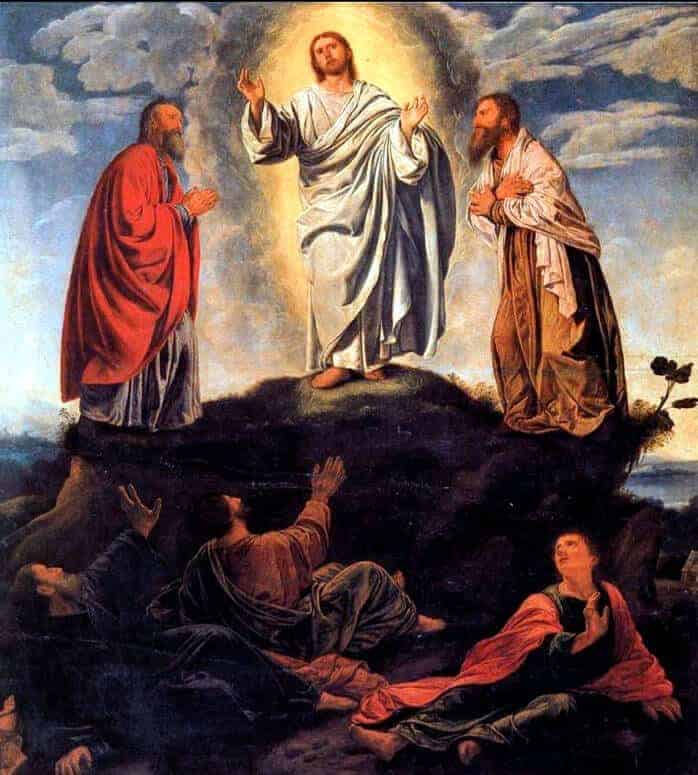
Transfiguration Sunday, in the eyes of many, is a one-off miracle testifying as to just how great Jesus was. That understanding sells Transfiguration Sunday short. Far, far short. Christ bathed in the radiance of the Torah tradition of Love of God and of neighbor. Allowing this Christ to transform us is a life-time adventure. With a bit of rain amidst the sunshine.
Luminosity is in what happens afterward. Same as in the transfiguration of Moses as he bears the radiance of his encounter with God on Mount Sinai. What does he find upon returning? Apostasy and idolatry. Yet his leadership shines forth for the tribes of Israel.
From our ancestor on my mother’s side of the family, Julia Ward Howe, we get the significance of this transfiguration. “…with a glory in his bosom that transfigures you and me.”
Transfiguration in Christ is an ongoing event. Echoing down through the halls of human history, working itself out generation after generation. Down to you and me; and all others who claim the sweet embrace of Our Lord.
It works itself out in the lives expended for others, those who engaged in bitter strife that half my family might be free.
As St. Irenaeus proclaimed, “The Glory of God is a man, a woman fully alive. “As he died to make men holy, let us die to make men free.” That was the price exacted to free one half of those living in abject misery in the South.
One who has never been in combat can grasp the enormity and tragedy of that struggle through Shelby Foote’s novelistic presentation of what was maybe the determining battle of our Civil War, Shiloh.[1] It presents the fruits of historical scholarship and the narrative pace of lively writing.
To those escaping to join the ranks of the approaching Union armies, it was a taste of being fully alive like none other. In appreciation, former enslaved persons would regularly gather in cemeteries where Union soldiers were buried to lay flowers – a simple but moving show of gratitude for freedom won. Transfiguration changing an entire society.
Transfiguration brilliance outshining Jim Crow, outshining this racist and bigoted administration. That same Transfiguration strengthening the souls of today’s Holy Resistance.
If you prefer a more irenic interpretation to the phrase, “…let us die to make men free,” one might understand it as an admonition to fully expend your life as a transfigured person up to the day of death, however that comes. As Oscar Wilde remarked, so I also strive, “When I die, I want to be all used up.” Leaving nothing on life’s field.
As one reflecting the insecurities of having grown up in a rather dysfunctional family, I’ve also experienced the same Transfiguration. Through the course of years and under the influence of the living Christ in my life as presented by the Church, pastors, and just ordinary folks of the Jesus Movement, I, too, have been changed. Certainly more fully alive.
Part of that change was evident on our recent trip to San Francisco to celebrate our 60th wedding anniversary with a good part of my family.
First, I’ve become much more appreciative of those people on this trip who went out of their way to show a little kindness. It was a number of Uber drivers who took care to handle my walker and dialysis bag on those trips at 5:00 in the morning.
It was the kind woman at the United check-in counter at the San Franscisco Airport who saw that Jai and I needed assistance with all our luggage and figuring out the computerized check-in procedure. She arranged extra help with our luggage and ticketing. She was a delight as was her supervisor who assisted Jai with 6 pieces of luggage. (Yes, we don’t travel light with all I need for dialysis and sleep apnea.)
What should have been airport hell was transfigured into a very human and rewarding experience. A little bit of sunshine on a rather daunting ordeal. A Transfiguration of my attitude.
Having Alexis, Christopher, Luther and Denise with us made the trip a delight. Part of my little smidgen of Transfiguration is the increasing value I put on family. This group certainly made this return after 60 years a fantastic San Francisco experience.
Watching little Luther marvel at the delights of Muir Woods, his infectious smile, playing la-la-la-la-la with him at the snack shop. Seeing him with his parents and their loving care and encouragement of his entire being. All a delight – the Glory of God manifest in this natural spender of delight. My heart softened and a bit more aware to the joys of life over the years, under a Divine Guiding Hand. Transfiguration of you, me and the entirety of creation, ever renewing.
Transfiguration through a growing sensitivity to the misery and deprivation witness. No longer wrapped up in my own woes and insecurities but alive to the need around me. And being able to realize my part in it all.
When I see the destruction of Gaza and Lebanon in the daily paper, I now know my culpability. The horrid temperatures in France and Spain and here in America. All part of our climate denialism. Thank God, I notice.
Transfiguration of my self-absorption. Transfiguration through working to be the change I can be. And courage to change the things I can.
Knowing that through my actions I can set a good example for others to follow. Knowing the delight in my soul in being a part of the solution with others. Even if it’s a ten spot and a little conversation with that shopping- cart lady on the corner; or writing a sermon that encourages and gives hope; or in composing a letter to the editor encouraging us all to get out and vote for change. And be the change.
Finally, allow a little humor. While at the checkout counter of one bookstore I spied a little tease, Lessons from Cats for Surviving Fascism.[2] Fascists hate unpredictability, cats are never predictable.
“Cats never let anyone know where they’ll be next, and neither should you. Cats are masters of unpredictability.
“Fascism thrives on predictability; confuse it by unexpectedly launching on to the back side of a chair, then rappelling down the curtains.
“One minute they’re curled up on the couch, radiating serenity, and the next they’ve perched on top of your fridge, judging you for your life choices. You’ve made terrible choices and cats know it.”[3]
Transfiguration delights in the unexpected as well as in duty. So, go ahead and start a ukulele jam session at three o’clock in the morning. And tell me what cat isn’t fully alive. Humor opens the door.
If you are a part of the Jesus Movement, or even have a tangential relationship to it, you’ve experienced a taste of Christ’s Transfiguration. And in the process become just a little bit more alive.
For those of us Followers of the Way, now and then we know we’ve been touched by the same light, a smidgen of brilliance of that original Transfiguration. And that shall suffice. Transfiguration one day at a time. Transfiguration together. Amen.
[1] Shelby Foote, Shiloh (New York: Barnes & Noble Books, 1992).
[2] Stewart “Brittlestar” Reynolds, Lessons from Cats for Surviving Fascism (New York: Grand Central Publishing, 2024).
[3] Op. cit., 3.
August 2, 2026 – Transfiguration Sunday
“A Glory that Transfigures You and Me”
The Rev. Dr. John C. Forney
Exodus 34:29-35; Psalm 99;
2 Peter 1:13-21; Gospel: Luke 9:28-36
Hopey, Changey People

In the 2008 election one candidate seemed to come out of nowhere. A little-known senator from Illinois. And within months after he announced his candidacy for the presidency, he had assembled an entire army of enthusiastic volunteers. A most formidable army.
As background to his political career, he had written several hugely popular books. Unlike most political autobiographies, he had actually written them himself – no ghostwriter. Part of the acclaim for these works was their high literary achievement.
One of his most wildly successful was The Audacity of Hope, an enlargement of his stirring speech to the 2004 Democratic Convention that catapulted Barack Obama to instant fame.
Faced with that unstoppable groundswell of people hungering for change, Obama’s opponent, John McCain and his campaign became more and more desperate. This young star was sucking all the oxygen out of the room. In desperate search for a game changer, he reached out to an unknown governor of Alaska, Sarah Palin.
While at times witty and quick on the rebuttal, her preparation for the national stage was pathetic. When asked what papers she read, she quipped, “I read them all. Whatever they put in front of me.” She couldn’t even think to remember the hometown paper of Anchorage, the Anchorage Daily News.
So, she was left to resort to derision and misrepresentation of Obama’s platform.
On the stump, in terrible economic times when most everyone was suffering, she would often prod her audience, “How’s that hopey-changey thing working out for you.” Her weak attempt to mock a politician who she thought promised too much.
The most delightful and insightful film of that political campaign year was, “Game Change.” An HBO 2012 political drama made for television, later released as a film for a wider audience. It was based on a book by the same name by John Heilmann and Mark Halperin. It was the portrait of a campaign in crisis. Day after day.
Like Obama, I try to stay above the political cynicism of our days. And that’s a tall order, given the audacious conspiracy theories spawned daily by the current administration. I guess I’m sort of a “hopey-changey” kinda guy.
That is the overall arc of the Jesus Movement. To keep hope always at the forefront. To allow it to pull us forward through the knothole of these excruciating times. As it did for Jesus followers.
The lessons for this Sunday urge us, in the words of Jesse Jackson, to “Keep Hope Alive.”
“Through your works you have taught your people that the righteous must be kind, and you have filled your children with good hope, because you give repentance for sins.”[1] Yes! Second and third chances. Even seventy times seventy.
St. Paul in Romans also urges his readers to keep hope alive for all creation awaits with “eager longing” the fulfillment of the promises of God.
“We know that the whole creation has been groaning in labor pains until now; and not only the creation, but we ourselves, who have the first fruits of the Spirit, groan inwardly while we wait for adoption, the redemption of our bodies. For in hope we were saved…if we hope for what we do not see, we wait for it with patience.”
It has been that same hope for things not seen that has driven people of faith forward. Sometimes pushing; sometimes pulling. Often an alure to a more bountiful future. Though God is going to trouble the waters, yet we will wade in, eyes set on that other shore.
Matthew’s multiple attempts to explicate the Parable of the Sower ends in directing his readers to that future. “Then the righteous will shine like the sun in the kingdom of their Father. Let anyone with ears listen!”
The Jesus Movement at its best has always pointed its followers to the politics of hope, not cynicism. Though there is much even in the most hopey-changey campaigns that give us reasons for despair.
After several years of the Obama administration progressives began to reflect on promises not kept, moments of political naivety, even moments of cowardice. Natural, of course. He was not divine but a mere human prone to the same foibles that bedevil the rest of us.
On health care, union support, his choice of economic advisors, much was lacking. Much of his administration was larded up with CEOs and CFOs from the corporate world. Few if any from Labor.[2] Hodge, in this work on the shortcomings and broken promises of the Obama administration details the corrupt compromises with their corporate backers.
Noam Chomsky on the back cover notes that Hodge exposes the reality of the programs “to ensure that no major stakeholder in his coalition of corporate backers will suffer significant losses, and will enjoy spectacular gains…” Not great but far better than the grift of the current den of thieves residing at 1600 Pennsylvania Avenue. We voters always hope for better despite the overwhelming evidence of our mediocre politics.
That is why, though I love the public arena of politics, I put no ultimate trust in the politics of our nation or of my own party. At best, we will muddle through with compromise and missed opportunities.
I put my trust in the One who gave workers the audacity to strive for decent wages and human dignity in work. The One who gave those miners in West Virginia the courage to stand up to the guns and brutality of Big Coal in the years of the 1890s to the 1920s until the prevailed. I put my faith in the One who in the darkness of slavery led many to follow the “Drinking Gourd”[3] to a better life in the North. Despite the dogs, the lash and the possibility of an excruciating death if caught. I put my trust in the One who led the faithful out of the Dust Bowl desolation to seek a future here in California.
It is the same hope grounded in the One who led Moses and his band through the troubled waters of the Red Sea – the same hope that daily sustains those of us working for an addiction rehabilitation center in West Virginia and also here in San Bernardino. Every day hope propels us forward, little by little. Even on those weeks when it seems that there is no forward movement and no one answers our calls.
There’s a wonderful book, All that She Carried[4], that chronicles a Black family’s discovery of a sack of items a mother, Rose, had packed for her daughter Ashley about to be sold off to another owner.
Rose took a few precious items as a token of her love for the girl and packed them in a cotton bag. Tokens of her love for this nine-year-old daughter. Tokens that would fortify memory of her mother when she was taken away to parts unknown, never to see that mother again.
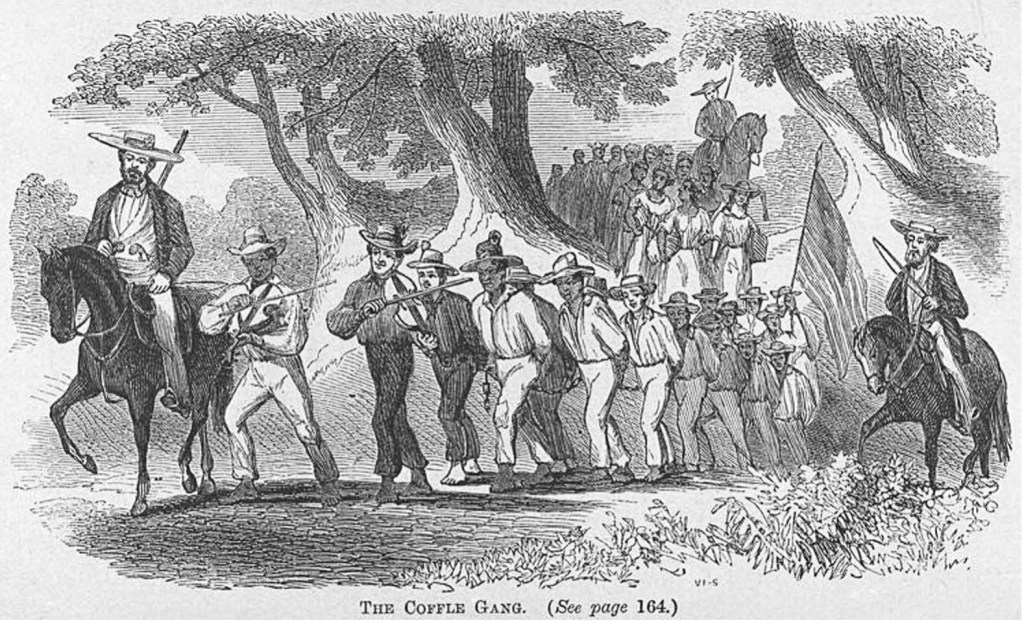
What motivated her to prepare this enduring tie between a mother and a daughter to be sold off to who-knows-where? Was it the groups of the enslaved plodding the dirt roads, the “coffle” gangs, on their way to the auction block? A coffle, sometimes called a platoon or drove, consisted of enslaved people chained together and moved from one location to another by owners or slave traders.
This book tells the story of that frail sack of mementos, passed down through the generations, one family to the next. the vivid testimony to the same hope passed down from one generation to the next.
That cherished sack would keep hope alive for Ashley whatever her future circumstances. The hope in the One who indelibly marked her a person of worth and beloved. Precious in the Lord’s sight.
“Rose would have known this state of instability as the only constant in her life. Yet she found the inner strength to meet a measureless threat with thoughtful action. In this determination to act, Rose represents a population that ‘exercised a degree of courage and will to survive that startles the imagination even now,‘ in the words of the Black feminist theorist Hortense Spillers. Out of the shadows Rose would emerge, bearing the sack as a lifeline and staking a claim for her family’s continuance amid and despite unrelenting change.”[5]
Black mothers lived in a shadowland of constant fear for themselves and their children. And yet, in hope, Rose prepared this visible token of the priceless relationship between a mother and daughter.
This sack is the treasure now passed to the current generation, our generation. Not just to a Black family, but to all of us. It is an American keepsake reminding us of the courage of previous generations, but urging us to be steadfast in keeping the same fire of hope burning. Despite all evidence to the contrary. Will we measure up to the challenge as did Rose? When I consider the fortitude of Rose, I have absolutely no right to give up.
And so we close singing, “There’ll Be Sunshine in the Morning,” God’s Son Shine drenching all our twisted history in Glory. Always propelling us forward towards as the Beloved Community, the hope of the saints down through the corridors of time. Knowing that one day, there’ll be the sunshine of freedom and opportunity, of joy and delight for all God’s children.
That’s my hopey-changey story and I’m sticking to it — for it’s the Gospel Story. Amen.
[1] Wisdom of Solmon 12:19, NRSV.
[2] Roger D. Hodge, The Mendacity of Hope: Barack Obama and the Betrayal of American Liberalism (New York: Harper, 2010).
[3] The Big Dipper, the bowl of which points to the North Star.
[4] Tiya Miles, All That She Carried: The Journey of Ashley’s Sack, a Black Family Keepsake (New York: Ransom House, 2021).
July 19, 2026 – Pentecost 8, Proper 11
“Hopey, Changey People”
The Rev. Dr. John C. Forney
Wisdom 12:13, 16-19; Psalm 86:11-17;
Romans 8:12-25; Gospel: Matthew 13:24-30, 36-43
Plenitude
There are just some folks you can count on. Their word is as good as gold. And others? In the building business we have a saying: “Money talks and cow manure (or something like that) walks.
Some subcontractors will be Johnny-on-the-spot on the agreed date and time. Others, you might as well take off your speed-dial.
As we conclude the celebrations of our 250th birthday this Fourth, too many are left holding a bad check, marked “insufficient funds” when they attempted to redeem the promises of our Declaration of Independence.
God’s Word does not return marked “insufficient funds.” Hear the promise from Isaiah:
“As the rain and the snow come down from heaven and do not return there until they have watered the earth, making it bring forth and sprout, giving seed to the sower and bread to the eater, so shall my word be that goes out from my mouth, it shall not return to me empty, but it shall accomplish that which I propose, and succeed in the thing for which I sent it.”
And to the best of the ability of the good people of this nation, the promises grounded in that ethic shall not be null and void, but over the generations accomplish the purposes our founders intended.
Yes, they did not comprehend the full ramifications of that promise – for those without property, for the enslaved, for women, for our LGBTQ community. They had absolutely no idea what they were setting forth. What they opened to future generations was a nation of expansive opportunity.
Now, we haven’t gotten there. We’re still on the journey. But as the clouds break and brilliant sun shines through, the dreams of unlimited possibility become reality. Plenitude.
Ignatius reminds us that the Glory of God is a man fully alive, a woman fully alive. We’re talking here about a theology of abundance – plenitude. Too many, even in our churches, have a theology of scarcity.
In my church budgets I would always insist on an income category labeled “faith.” Faith because I believed we were always capable of stretching beyond what we thought possible. In Anchorage I had a hard-nosed, green-eyeshade treasurer who worked to keep us within the budget. Chuck would always insist on knowing the specifics of each and every budget item.
So, he was quite skeptical when I showed up and stuck this new category into the income side of the church budget. “Just how much is this going to bring in to pay the bills, Pastor Forney?” I’d ballpark it with a figure that while not completely beyond reality, would cause us to stretch. Faith, if you will.
And every year I was there we exceeded the budget total. Yes, with “faith” thrown into the match. That is because God’s Word does not return empty.
Like the story of the seeds cast in faith, I always believed that enough seeds would fall on good soil. There might be rocks, gophers, brambles and roly-poly bugs. But enough seeds would fall on good soil without pests.
I’m learning that this seed business is very tricky. When my family took me to the California Botanic Garden, I saw a plant that was about six feet high covered with white blossoms that the bees absolutely loved. Looking around, I saw a sign that said California White Sage.
When I went to their store, they had many seeds of California natives for sale, including California White Sage. So, I bought one packet of them. It said it contained over 100 seeds and told me how to plant them. It also warned that the seeds of this plant had a low germination rate. I figured that with 100 or so seeds, I couldn’t miss. Wrong.
I planted several in each little planter space of this large group of spaces all connected together. It said to wait 4 or 5 weeks. I did. Nothing.
Then I got serious and ordered a heat mat for starting plants from seed. Replanted all the sections again. Our garage is perfect for what the seed packet said was required – warmth, my grow-lights and heat-mat. So far in only one tiny section two small seedlings have sprouted. Out of some 40 or 50 seeds sown, only two tiny sprouts? And I discovered Saturday morning that they had died. Not over an eighth of an inch tall. That’s why Miguel runs the Garden of Hope and not I.
Yes, this seed business is very tricky.
Jesus knew that when he told the Parable of the Sower. But in hope, he had faith that enough of the seeds would land on good soil with the right amount on sun and rain.
My favorite science fiction writer Octavia Butler, in her wildly popular work, Parable of the Sower, nails it.[1] In this dystopian tale we are the seeds.
A recent book I am reading in dialysis, Mattering. It speaks to one of our deepest needs, to feel that we matter.[2] We matter to ourselves. We matter to others. That the contribution we offer to the public good matters. We sow mattering in how we treat people.
To sow the seeds of Grace, is to nurture this need in others. And as we do, we also nurture it in ourselves. Where others feel they matter, God’s Word has found fertile ground. Good soil.
Let me tell you a couple stories of how this transpires.
The author, Jennifer Breheny Wallace, opens her book, “It all began with a clementine.” I didn’t know what that was so Googled it. A clementine is a hybrid of mandarin and sweet oranges.
Jennifer arrived at the Harlem train station early one morning. The hustle of the crowds filled the senses as did the odors drifting from the various shops selling bread, breakfast items, coffee. The screech of arriving trains on the platform above and the fumes were almost overpowering.
She noticed a small bodega, brightly lit, on a corner of the station. She stopped in to browse and overheard the following conversation.
“A man with gray hair called to me from behind the counter. ‘Ah, welcome,’ he said. “It’s wonderful to see you.’ He spoke with the warmth of someone greeting a regular, though I wasn’t. As I browsed, I overheard his conversation with another customer, someone who clearly was a regular, about the clementines he had picked up at the market that morning. ‘I remembered how much you liked them last time,’ the shopkeeper said. ‘When I saw them, I knew I had to bring them in again for you.’ The customer thanked him for always being so kind and thoughtful.”[3]
The author also noticed those clementines, how the bright orange contrasted with the drab gray of the station. But what stayed with her as her train pulled out of the station was the care in the exchange. The way the shopkeeper’s thoughtfulness did more than provide fruit, but paid attention and remembered – a small matter but it contained a large portion of Grace – you matter.
This shopkeeper was a seed of Grace bringing forth connection. Enhancing worth. God’s Word had deeply taken root in the soil of that man’s soul. And there was flourishing.
In looking through the current issue of Newsweek magazine, one first notices the section, “250 Great American Heroes.” Spread in those opening pages are an array of many who might be accounted heroes. Unfortunately, it is limited to people connected to our military struggles. I’m thinking, what about teachers, what about doctors and inventors? What about those who resisted many of the fruitless, tragic conflicts of our history? My friends who served as conscientious objectors in hospitals and in forestry work? What about those whose witness against senseless wars was their flight to Canada and beyond?
As I was arguing in my mind with this narrowness of this piece, I came across a woman whom I would in fact regard as a true hero, Mary Edwards Walker, April 10, 1854. Yes, the Civil War.
The piece was entitled, “She Crossed to Heal.” It recounted how she had crossed enemy lines numerous times because the Confederate soldiers on the other side were not her enemy – suffering was.
Dr. Walker had a contract with the Union Army of the Cumberland and frequent traversed the front line to treat wounded civilians in northern Georgia who had no access to healthcare. The military refused to grant her a commission. Of course not – she was a woman. She served anyway.
With a cobbled together outfit of trousers and a modified coat, she went about her mission, no matter the politics or allegiances. She was eventually captured deep in enemy territory after assisting a Confederate surgeon in preforming an amputation. She was finally exchanged for a captured Confederate surgeon. Though never given the respect of rank, she was the only woman of that war to receive the Medal of Honor, which she wore every day until she died in 1919. In Dr. Walker, God’s Word did not return empty. Good soil she was.
Her message to those she healed and attended to was, you matter. Dr. Walker was God’s good seed planted in one of our most excruciating conflicts.
To instill mattering was one of the most important items in Dr. Walker’s little black doctor’s bag. Mattering is “so deeply ingrained in us that after basic survival needs like food and shelter are met, it is the need to matter that drives human behavior.”[4]
That was the divine touch of Jesus. “You matter” — to the leper, to the dunderhead disciples to whom he showed infinite patience. To the woman of ill repute at a well in Samaria.
To you and me when down and out of sorts.
It is the message to those who receive our fresh produce every week at the food banks that St. Francis Garden of Hope serves. It may even be the small act of kindness to the driver in front of us attempting to change lanes. You matter. Go on ahead of me, and have a nice day. In all such acts, large and small, there is the plenitude of Mercy. An overflowing fountain. God’s “faith” budget item.
Such a life of generosity is the indwelling of eternity. God’s sign that we matter. As my fictional hero Detective Harry Bosch notes, “Unless everyone counts, no one counts.” That’s our mission in the Jesus Movement, to instill and foster mattering. In God’s big picture I count. You count. We all count. And can I get an Amen for that?
[1] Octavia Butler, Parable of the Sower (New York: Seven Stories Press, 2016). This edition includes a marvelous introduction by Gloria Steinem.
[2] Jennifer Breheny Wallace, Mattering (New York: Portfolio/Penguin, 2026), 1 ff.
[3] Op. Cit., 1-2.
[4] Op. cit., 5.
July 12, 2026 – Pentecost 7, Proper 10
“Plenitude”
The Rev. Dr. John C. Forney
Isaiah 55:10-13; Psalm 65:1-14;
Romans 8:1-11; Gospel: Matthew 13:1-9, 18-23
Higher Ground

As we pass another landmark milestone for this republic, many are sincerely wondering, where are we heading? What is left of worth? What is our duty as citizens in the present moment?
No, the Forneys are not going to Canada, though having ancestors from that wonderful maple leaf land, we are now eligible for citizenship. No, we’re staying put. The work to be done is here.
So, what might we celebrate this Fourth? My mind goes to the natural beauty of the land.
When in college two friends and I would head to Yosemite as soon as summer began. One of us, Bill, would usually have a job lined up at the lodge washing dishes. The deal with his supervisor, if the other two of us pitched in, Bill could get released early by midmorning.
John Muir in his nature writings has a marvelous piece on how to spend one day in Yosemite, if all you have is only one day. Yes, head for the Vernal Falls.[1] Give yourself an hour there to take it all in.
We’d soon be hitting the trail to Vernal Falls and beyond. One summer we went rock climbing up the Thumb of Mount Hoffman. Bill was the expert and had all the equipment – ropes, carabiners, pitons – the whole kit.
Earlier the day before, we newcomers to the sport, Ron and I practiced rappelling down some steep cliff faces. We learned the correct way to tighten our harnesses, hook in the rope so we could gently lower ourselves down a 150-foot cliff. I soon got the hang of it, or thought I had until we got to the real thing the next day.
The Thumb is the highest rock spire on the peak of that mountain. It offers spectacular views in all 360 directions. And it is only accessible by circling around from the path leading to it to the 1500-foot cliff on the other side. Yes, it was a long, long, very long way straight down. Vertigo was a real possibility.
We pounded pitons into the cracks of that sheer face, hooked in our carabiners and our ropes with loops tied in for our feet to begin the climb straight up. No, don’t look down. Definitely, don’t look down.
Well, I finally made it to the top with Bill giving me some extra pull at the end of the ordeal – he was the belay man. And, yes, the view was spectacular. To celebrate, we had taken a flask of Wild Turkey whiskey. Just a few sips – we wanted to be stone-cold sober for the climb down. I made it down okay, which was quite a bit easier, made it safely down. I’m still here, am I not?
That venture was definitely to “higher ground.” And spiritually, it was. The majesty filled the soul.
That is the grandeur I celebrate this Fourth, as other memories come flooding back – Grand Canyon at sunrise, the Aurora Borealis at night in the wilds of Alaska, that immense golden eagle soaring only a couple feet over my head when on a float trip down one of Alaska’s wild rivers.
I will celebrate the grandeur of our heritage through the words and legacy of those who are part of the warp and woof of the fabric of this republic. I am brought to those like Frederick Douglass and Sandra Cisneros[2] who through adversity and persistent witness kept the hope of America alive. I celebrate those who speak to our generous spirit. Those abolitionists and suffragists like my great ancestor Julia Ward Howe. Yes, she made it onto the cover of this July issue of the Atlantic magazine – “The Battle Hymn of the Republic.”
The Spirit moving through countless witness to our common humanity is derivative from the one same Spirit flowing through our lessons for this morning.
Hear the Spirit speaking in Matthew’s Gospel:
“You have heard that it was said, ‘You shall love your neighbor and hate your enemy.’ But I say to you, Love your enemies and pray for those who persecute you, so that you may be children of your Father who is in heaven. For he makes the sun rise on the evil and on the good, and sends rain on the just and unjust. For if you love those who love you, what reward do you have? Do not even the tax collectors do the same?”
From time to time this generosity has erupted forth from us, even for our former enemies. Having learned the disastrous lesson of the punitive Treaty of Versailles, (signed on June 28, 1919), we rebuilt West Germany, Italy and Japan. The Marshal Plan even went further to rebuild much of Europe.
After the Cold War, in many ways we bent over backward to assist Russia in recovering from the economic disaster left by the downfall of Communism.
Through USAID and the Peace Corps we have sent emissaries of good will through the world, sometimes in the most dangerous and neglected places with food aid, economic assistance, medicines for HIV and common childhood diseases. That is until the current administration had totally destroyed this signature humanitarian work leaving already over 500,000 children to die. The American spirit enshrined in those past years of benevolent aid. Yes, not always completely altruistic, but then what of our human motives are completely pure? Search your conscience on this.
The nonprofits in America have also reflected the same Spirit. Rotary, begun in America in February 23, 1905 by the businessman Paul Harris, has through its world-wide campaign against polio, virtually wiped out that dreaded disease. Their workers are often the only outsiders accepted in places often unaccepting of westerners – Afghanistan, Pakistan, Myanmar. This campaign of Rotary International has led to a historic, global campaign to eradicate polio since 1985.
As a founding core partner of the Global Polio Eradication Initiative (GPEI), Rotary’s PolioPlus program has helped immunize over 3 billion children and contributed more than $2.9 billion toward global eradication. It has led through international partners to a 99.9% reduction of cases for this dread disease.
This is the America I celebrate this Fourth. An expansive version of Rotary’s motto: “Service beyond self.” This is the volunteerism that Alexis de Tocqueville celebrated in his book, Democracy in America, in 1835. Higher ground indeed! For such I will toss back a cold one this Fourth.
This Fourth I celebrate those liberties and rights enshrined in the Bill of Rights, the first amendments to our Constitution – the right to peaceable assemble in protest especially.
With this current mendacious and corrupt administration, we have not only the right but the duty to be the Gospel Resistance to the evil they do. Yes, we do ask our blessing every Sunday on “those we must resist,” but resist we must with all the soul force at our command.
Resistance is Higher Ground. In the streets, in the editorial pages of our papers, in our daily prayers and charitable and political contributions.
Just as we will join in the effort to assist in Venezuela after this horrendous earthquake. Much of Caracas looks like Gaza after the Israeli genocidal war there. We at St. Francis will play our part. Check out Episcopal Relief and Development or the denominational agencies of your own church. Most denominational agencies get well over 90% of your money to the targeted need. Higher Ground!
For us Episcopalians, the site is www.episcoaplrelief.org. Once you’re there, an immediate popup will direct you to: Earthquake Relief for Venezuela.[3] BTW, I tried it out and found that it works easily. Your receipt will say, directed to International Disaster Fund, the international agency through which we are working for earthquake relief there.
The very same Spirit manifested in your gift is to be found in Torah Righteousness – pure Grace. Hear this witness from our Torah heritage:
“For the Lord your God is God of gods and Lord of lords, the great God, mighty and awesome, who shows no partiality and accepts no bribes. He defends the cause of the fatherless and the widow, and loves the foreigner residing among you, giving them food and clothing. And you are to love those who are foreigners, for you yourselves were foreigners in Egypt.” Higher Ground.
The plan of those who would rule over us, Project 2025, continues to roll over our laws, the Constitution and common human decency. Rolling on, reducing voting rights, cutting off food stamps to 700,000 children as of last week. Throwing folks off their health care. Their toadies on the Supreme Court in rejecting the protection given to Hattians and Syrian migrants opens the door for some 400,000 to be immediately deported to the worst hell-hole places on the planet. Deportations to war-torn places, gang-infested countries. Certain death for many. Resist we must. America is better than this.
We have much Higher ground to celebrate this Fourth. The fact that we can be out in the streets that day, loud and proud, proclaiming with our bodies that America means ALL – gay and straight, black, brown, white and all the other colors of our mélange of this big disparate assemblage we label “e pluribus unum.” A street party welcoming the “huddled masses” still yearning to be free.
That’s a beauty the greedy grifters can’t deny. It will be “Youuuuugggge” as Senator Bernie Sanders would bellow. My prayer that day is for over ten millin in the streets all across this great nation. Yes, our marching feet are our prayers. And those marching feet are the greatness of America we celebrate that day.
I close with the admonition from one whose feet were often weary, that tireless suffragist, Susan B. Anthony
“It was we, the people; not we, the white male citizens; nor yet we, the male citizens; but we, the whole people, who formed the Union. And we formed it not to give the blessings of liberty, but to secure them; not to the half of ourselves and the half of our posterity, but to the whole people – women as well as men.”[4]
Yes, All means All on this Higher Ground. And we’re still struggling to make it a reality for the whole of this republic. Onward to Higher Ground. Can I get an Amen here?
[1] John Muir, Selected Writings (New York: Everyman’s Library, 2017) 461 ff.
[2] Sandra Cisneros, The House on Mango Street (New York: Knopf, 1984).
[3] ERD mailing address is: P.O. Box 5121, Boone, IA, 50950-0121. Make checks out to Episcopal Relief and Development and in the memo line put Venezuela Earthquake Relief.
[4] Susan B. Anthony, from a speech at New York 1873. From The Patriot’s Bible: A Bicentennial Anthology of Love and Justice, John Eagleson and Philip Scharper, eds. (Maryknoll, New York: Orbis Books, 1975), 76-77.
July 5, 2026 – Pentecost 5
Independence Day Propers
“Higher Ground”
The Rev. Dr. John C. Forney
Deuteronomy 10:17-21; Psalm 145:1-9;
A Reading from Baldwin; Gospel: Matthew 5:43-48
We Must Cry Out

As our 250th birthday approaches we are seduced into an orgy of nostalgia and kitsch. The banality of the recent cage fight on the White House lawn being the least of what’s to come.
In preparation for the events around the 4th of July, the racists at 1200 Pennsylvania Ave. in D.C. have released an 85-page document rewriting black history. How “white” of them.[1]
In this sanitized version, “slavery” and “slave” each only appear once. “Racism” not at all. These folks have long failed to reckon with America’s divided history. The journey down nostalgia lane ignores the sordid legacy of slavery and Jim Crow – only one of America’s original sins.
As we celebrate Juneteenth, the date the proclamation of freedom belatedly reached those held in bondage in Galveston, Texas, June 19, 1865.
The Juneteenth celebration marks the delayed arrival of the proclamation of freedom from slavery for those held on bondage when Federal agents arrived in Galveston, Texas, June 19, 1865, after local officials failed to share word of the national end of slavery.
Despite Emancipation, America yet remains mired in this tragic history that blighted the lives of millions – and continues to do so.
Point! Secretary of Defense (War?) Hegseth has twice summarily stripped promotion rolls of black and women senior officers simply because of race and sex. Twice — with no explanation to Congress or the American public.
Point! With the efforts to eliminate programs promoting diversity, equity, and inclusion (DEI), this racist administration has corrupted our civil service, our military, our universities. They blatantly don’t want to include half my family in the dream. Not back to the separate water fountains of the old Jim Crow era, but back to a not-so-subtle newer version of exclusion. Just as covert and pernicious as it was under President Wilson when the KKK virtually ran the Democratic Party.
Point! Growing up in a privileged white family, I remained oblivious to much of this history through my teen years and into young adulthood. Oh, there were a few instances when the curtain was pulled back on this ugly underbelly of our history.
I remember the Mexican American boy in my third-grade class in Compton, California. The only person of color in our class. My parents gave me explicit instructions not to play with him. He was dirty. He would give us a disease. He was not nice. End of story. I don’t think he had many friends in our class because I suspect other white parents gave their children the same message.
What puzzled me was the disparity of what I was learning in my Sunday school class taught by my mom and what my family was teaching. This attitude did not comport with the song we sang about Jesus loving all the little children.
Jesus loves the little children
All the children of the world
Red, brown, yellow
Black and white
They are precious in His sight
Jesus loves the little children
Of the world
This double mindedness of our history on race is a grotesque distortion of the promises of the Declaration of Independence and the guarantees enshrined in the Constitution (as revised by the 14th, 15th, 16th and 19th amendments). The oppression of people of color came into full view when I was in junior high.
A Black dentist and his family had moved into our neighborhood. While they were on vacation our “nice” white Christian neighbors ran a hose into the second story of their house and turned on the water. When they returned a couple weeks later, the house was virtually destroyed, and most of everything in it. What the water didn’t ruin, the mold did.
And my church uttered not a peep. That began my estrangement from my faith, my class, my family. Finally reaching a peak during the Vietnam War when my father and I did not speak to each other for almost 8 years.
Jeremiah, in the face of national corruption and faithlessness, is assaulted by the Word of Justice implanted in his heart. He cannot resist it. Fire in his bones.
“O Lord, you have enticed me, and I was enticed, you have overpowered me, and you have prevailed.”
Given this unpopular prophecy to deliver, he has become a pariah.
“I have become a laughingstock all day long; everyone mocks me. For whenever I speak, I must cry out, I must shout, “Violence and destruction.”
And in these fraught times of societal breakdown and chaos we must cry out. While we mint new trillionaires and scads of new billionaires leaving us common folk in the dust – we must cry out! Only the apostate will remain silent.
You might say we’re sometimes impolite. We violate the norms of decorum. I say, there is no longer any decorum when voting rights of the poor and minorities are fed wholesale into the woodchipper. Politeness does a disservice to the Word of God, to the Gospel of Jesus Christ. What we presently are doing to “the least of these” is most impolite.
Now the disaster that daily befalls our nation is not just a matter of corrupt politics. With the inclusion of a wonderful, new addition of an African-American daughter-in-law and a brand-new biracial grandson Luther it’s existential. No longer an abstract concept of fairness and equity, but a matter of survival, belonging and thriving.
And as it’s said in West Virginia, you mess with one of us and you’re messing with all of us. “All of us,” with the enlargement of my family, has taken on a whole new meaning. Yeah, Trump, you and your GOP apologists — you’re messing with all of us now.
Like I felt upon hearing of what had happened to our Black neighbors down the street in my early teens, a smoldering fire had begun burning in my bones.
We need clergy enticed and assaulted by this burning Word in their bones. Lay folks also virulently infected with this living Word – for in it is our salvation. In it is the open door to any sort of life worth living – our only alternative to being just a dumb, senseless part on the Darwinian food chain.
And sometimes such impolite outbursts are pure Grace. They open the door to God’s Justice and Peace. Even open the door to repentance.
I remember my friend Charlie Clark, the pastor of a Lutheran church in Temple City when I ran my ecumenical fair-housing project.
When it came to Tough Grace, Charlie was extraordinary.
Pastor Clark used to fulminate against those in his church who had no vision. “Do not quench the Spirit,” he would demand, voice raised. That church had had five pastors in six years before he had arrived.
There was a reason he was well into his seventh year when I knew him. He had no tolerance for cynical nay-sayers, the faithless who had no vision. “Do not quench the Spirit.” He gave as good as he got for Gospel Righteousness’s sake.
I’m still not sure how he kept from being fired, but under his leadership that congregation was a part of our fair housing effort, Project Understanding – though many there absolutely refused to understand that “Good Neighbors Come in All Colors.” God’s demand for Justice was shut up in Charlie’s bones, and he would not be quiet.
I still remember his secretary telling me of one Sunday, when Pastor Clark was putting out our Project Understanding newsletter in the literature rack. One of the nay-sayers of stunted charity passed through the narthex and noticed this: “Pastor, how long do we have to have this crap in our church?” he whined.
Charlie wheeled about on him, bellowing, “Don’t ever let me hear you call the Gospel of Jesus Christ CRAP!” And his contract was renewed for another year. Truly, like Jeremiah, he had committed his cause to the Lord.
Such indomitable strength of character lies as a possibility within each one of us. This Torah decency and sense of justice is shut up in all of us, but that we only excavate our souls to discover it. We each hold the possibility of having the decency and courage to follow its lead.
It’s not just about my immediate family anymore. This malignant administration is messing with all of America. All of us!
Yet, through persistence. Gentle and otherwise, the Word of God finds a way where there was no way. That’s our doing.
The other day at our “beer summit” at Back Abbey my friend told me this story of his family and the growth to Gospel Inclusion.
Dick’s father was a rock-ribbed conservative Presbyterian in Palo Alto. When it came to his church, he was a stalwart participating member. But his understanding of the Gospel of Jesus Christ was somewhat limited when it came to what he saw as his personal prerogatives.
Case in point. A California ballot proposition to repeal our fair housing laws, the Rumsfield Fair Housing Act, was on the ballot one year. Dick and his father were on opposite sides of the issue. Vociferously so. They argued back and forth. “I don’t want the government telling me what to do with MY property,” was the father’s objection. Even on the way to the voting location the disagreement raged.
After each had cast his ballot and they were back in the car, there was absolute silence as they began the drive back home. Finally, Dick’s father spoke. “I just couldn’t do it. I couldn’t vote for repeal.”
No, the government hadn’t told him what to do with his property. The guidance of the Gospel of Jesus Christ did. Through the persistence and witness of his son. Now that’s pure, unadulterated Grace in action. Such Grace is our only hope. Only such Tough and Gentle Grace can overcome our divisive history of race, class and partisan politics as we approach our 250th birthday. It is our final and only hope.
Time to scrap the impulse to mesmerizing nostalgia for the “good ol’ days” because, in reality, they weren’t so good for many of us. Time for a reality check.
It’s the witness of courageous Republicans who are true conservatives upholding our Constitution and the ethic of the Declaration. Time for Republicans that value their soul more than their ephemeral jobs. Time for upholding the notion that in America we all have of right to be self-determining and enjoy the benefits of the nation we have created. Republicans who are willing to fight for “All means All.”
It’s the witness of Democrats who refuse to continue their acquiescence to the unconstitutional illegality of this administration. Who will stand up to the worst of the worst of their self-serving policies. Democrats who will welcome into the discussion and join with those on the other side of the aisle of good will.
It’s the witness of average citizens who will be out in the streets all across this republic for the largest “No Kings” demonstration in history. It’s those willing to risk malicious prosecution as conspirators for demonstrating against ICE raids and their cesspool detention centers.
It’s about us of the Jesus Movement boldly proclaiming in word and deed the Gospel Goodness we hold dear – ALL MEANS ALL! This Grace will indeed lead us home.
We must cry out.
Time for Tough Grace, Costly Grace. Time for telling it like it is. Only in such boldness is our hope, is the wide-open door to eternity to be entered. As I’m wont to say, “that’s my story and I’m sticking to it.” Because it’s grounded in the much larger story of God’s love for all of us. Full of Grace and full of Glory. Amen.
[1] Nathalie Baptiste, “Trump is Completely Rewriting Black History – With Devastating Consequences,” Huffpost, June 18, 2026.
June 21, 2026 – Pentecost 4, Proper 7
“We Must Cry Out”
The Rev. Dr. John C. Forney
Jeremiah 20:7-13; Psalm 69:8-11, 18-20;
Romans 6:1b-11; Matthew 10:24-39

