
Forney Charities
Improving communities by helping residents, one person at a time.
The Summons of the Via Dolorosa

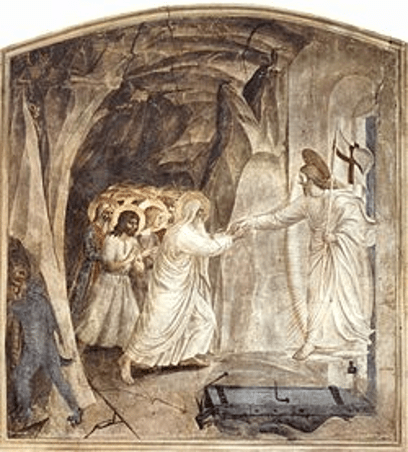
Today, my issue of the Living Church arrived and on the front cover was a picture of the “Harrowing of Hell.” This image is from the Icon Museum in Recklinghausen, Germany, artist unknown.
In the Apostles Creed, one line reads, “he descended to the Underworld” – which we interpret to mean “to the dead” – or to “Hell.” This is taken from the verse in 1 Peter, 4:6. The Harrowing of Hell is commemorated on Holy Saturday.
I take this observance to mean that, ultimately, no one is beyond the saving grace of the Good News. Yes, even Judas.
When Jai and I were in Jerusalem, that city was so commercialized that It was difficult to get into the mind of the auspicious and seminal events of Holy Week. Among all the stalls offering everything from tourist trinkets to lentils, dates and melons, nothing seemed to have remained from the time of Jesus’ last days.
It wasn’t until we got to the Wailing Wall – the only remains of the second temple wall begun by Herod the Great — and the Church of the Holy Sepulchre that I began to feel some of the ambiance of that ancient City of David. Yet I had no idea where the path of sorrow was which Jesus took from his trial to the Cross on Golgotha — the Via Dolorosa –I had no idea of how it might have wended its way through the city to that fateful end.
It is during this time of Holy Week, beginning with Palm Sunday, that even the non-believing world becomes aware of the Christian story. With the reenactment of the pageantry of the processions of the palms around the world, the world becomes acutely aware of that Man for Others. The one who “humbled himself and became obedient to the point of death—even death on a cross.”[1]
In our milieu of hyper-partisan Christianity, many – especially our younger generations — are repulsed by the vulgar sensationalizing of the message by right-wing Christian Nationalists. Whatever their mental picture of Jesus, THIS IS NOT IT.
In his book, Evangelism in the Age of Despair,[2] Andrew Root makes the point that the substance of the Good News can mostly be conveyed by those who come to others as a servant, in humility, entering the suffering of this age.
The only Christ that neighbor might ever encounter is in that neighbor, friend, who becomes vulnerable to their pain, their great despair. Just as Christ descended to the dead with Good News – for in his or her despair, overwhelming grief, that friend was indeed dead to themselves and those around.
Dr. Root tells a prototypical story, drawn from a number of experiences of such a contemporary encounter.[3]
The story begins with Mary Ann, who had landed a job with a trucking company outside of San Diego, California. Her new boss, Bud, the owner, of this small operation, was most supportive, though a somewhat gruff personality.
As the company grew, Bud realized that he needed someone to manage personnel, a Human Resources manager. He offered the new position to Mary Ann, though she’d had no experience in such work. But Mary Ann was a quick learner even though she had no college background. By attending conferences, seminars and through reading, she was soon up to speed. The company was still small and the demands for the new HR position were not overwhelming.
It finally looked like everything in her life was clicking. She had two wonderful children, a home in a nice neighborhood and a great job she loved.
Until, out of the blue, her husband announced he wanted a divorce.
She might have seen this coming. She and her husband more and more frequently bickered over money and pretty much everything else. Mary Ann figured that more money from her increased salary would resolve the tension. Not so.
There she was, now on her own with two children under ten without a father. Grief, self-doubt and depression became the order of her days. The emotional pain shook her to her core. She could barely be there for her children or her job.
She poured herself into her job and that helped somewhat. But busyness could not take away the shame, the anxiety and the sorrow. The sorrow, more than anything else, settled about her as a dense fog. No sunshine to her days.
Mary Ann’s father, like many from the 60s counter culture had drifted to the West Coast. Some in Los Angeles, others to the Bay Area around San Francisco and Berkeley. Unlike her father, she didn’t hate the church, she just never gave it much thought.
Her father was a “tough-it-through” kind of guy. Never admit your hurt.
One day, a coworker, Valentina, who had been noticing Mary Ann’s slow decline into despair, approached her and asked her if she was okay. “I’ve noticing that you seem to be carrying a lot of weight on your shoulders – a pretty heavy load.”
Those words caused an emotional dam to burst in Mary Ann. She, for the first time, unloaded her burden. For two hours they talked. Mary Ann felt that she had been held in a way she never had before. Yes, she needed a friend.
Valentina, also, had known loss. Her son had been arrested and sentenced to jail for theft, which led to addiction. She told Mary Ann how the people of her church had come to the courtroom and sat with her during the trial. They fed her for three weeks afterward.
Because of that experience Valentina was walking a nearby horse-trail with Mary Ann three times a week.
Valentina’s pastor was constantly telling the congregation that the followers of Jesus know sorrow. She saw that example through the depths of her own depression. Because of that, she was now out on this horse-trail with Mary Ann three times a week.
Valentina may be the only image of Christ that Mary Ann would ever know. And that is sufficient. In that friendship was born the entire message of the Gospel. Now vibrantly alive in Mary Ann’s heart as well as she walked her own Via Dolorosa.
I never found out where that ancient trail of tears led through Jerusalem, but I am well acquainted with that Via Dolorosa in my own heart. And it has been a saving grace at needed times to have had trusted companions along that way.
Yes, together we navigate that path as it has wound its way through our lives, through the lives of friends and family for in faith we know it leads to an Easter Sunrise.
That’s my story and I’m sticking to it, for Christ in our friends will join us along the way to lift and to sustain. Just as Christ does three times a week on that horse-trail in the guise of Mary Ann’s dear friend. Amen.
[1] Philippians 2:8, NRSV.
[2] Andrew Root, Evangelism in an Age of Despair: Hope Beyond the Failed Promise of Happiness (Grand Rapids, MI: Baker Academic).
[3] Ibid, the story which follows is from pages 4-7.
March 29, 2026
Palm Sunday, 2026
“The Summons of the Via Dolorosa”
The Rev. Dr. John C. Forney
Liturgy of the Psalms: Matthew 21:1-11
Isaiah 50:4-9a; Psalm 31:9-16;
Philippians 2:5-11; Matthew 26:14-54
 Forney Charities