
Forney Charities
Improving communities by helping residents, one person at a time.
Was You There, Charlie?
My grandfather, Charles Gross, was quite a raconteur, noted for his tall tales and elaborate embroidering of things that had actually happened. He was a master storyteller. With a wry grin and a twinkle in his eye he would launch into relating something that had happened at the funeral home where he worked after retirement from the Lodi post office. Or a story about someone at his Odd Fellows meeting the other night, or a rumor that someone had passed along.
My grandmother, Edna Mae, had become accustomed to such far-fetched stories. Sometimes in disbelief she would interrupt his narration with, “Was you there, Charlie? Was you there?”
He had quite a way with words, and his letters to the editor were frequently published in the Lodi Sentinel. I am fortunate that my mother saved many of these pieces. They bring back fond memories of the two of us walking down to a small corner grocery store where he would buy me an ice cream or soda – something absolutely forbidden in our house as my dad was a dentist. On the way there I loved to hear his commentary on the events of the day or the local news. And couldn’t wait to get back to their house where Grandma was bound to say at some point, “Was you there, Charlie?”
Despite her skepticism, she took it all in good stride. Their fondness for one another always impressed me. I didn’t witness much of that emotion in our house.
And I can picture her skeptical questioning of the disciples’ tales of having seen the Risen Lord — Was you there, Peter?” Was you there, Mary? Was you there, John? Was you there?
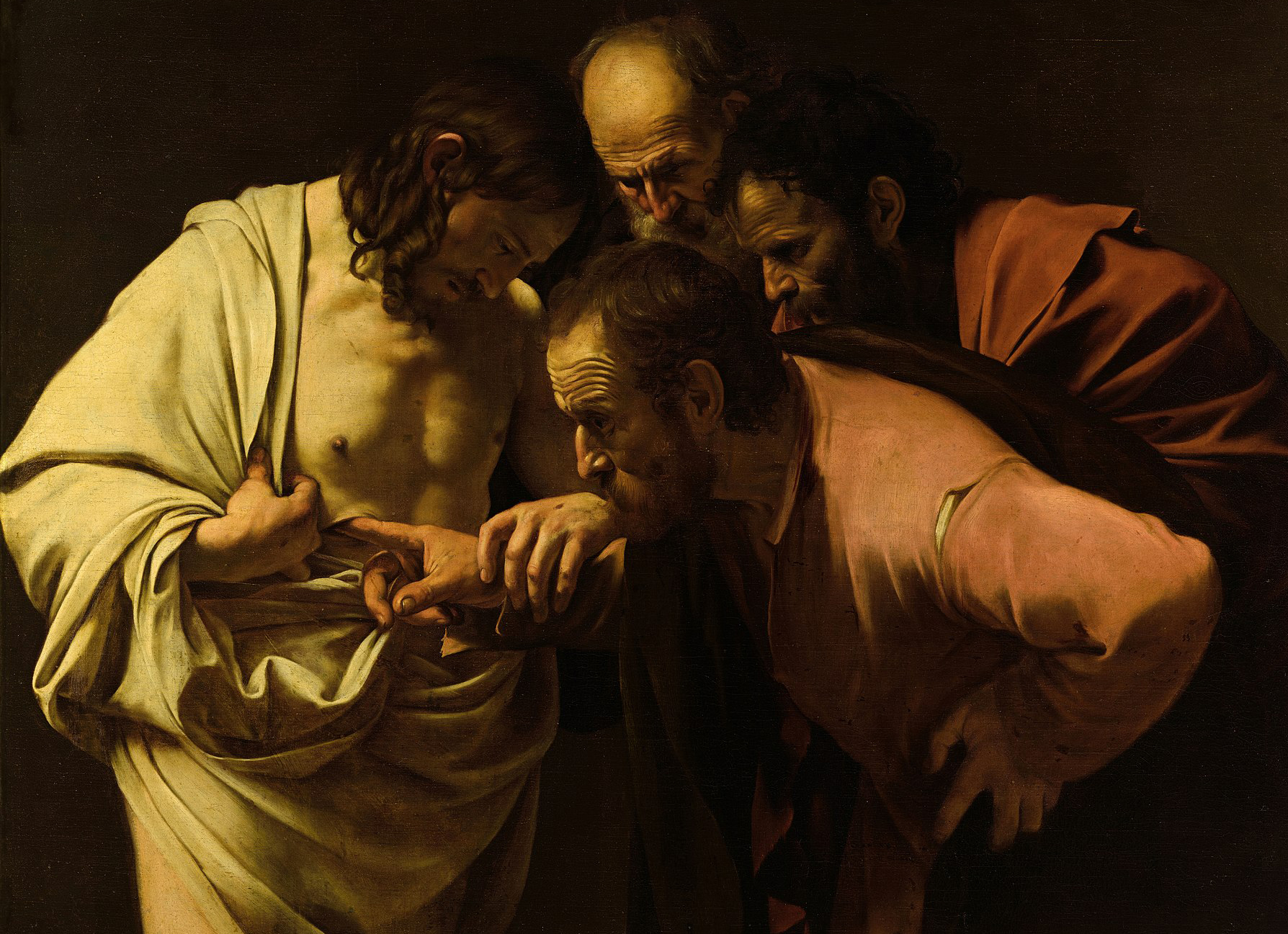
And of course, this is Thomas’s question. He doubts that any of what the other disciples are saying could possibly be true. What have they been smoking? Dead and buried, Jesus was. There’s no use in talking about it anymore.
When he appears in that upper room where Jesus followers were huddled in fear of the authorities, Thomas cannot comprehend the story they tell. He demands proof. “Unless I see the mark of the nails in his hands and put my finger in their mark and my hand in his side, I will not believe.”
A week later, Thomas receives his proof as Jesus again appears although the doors of the house are shut tight. Jesus’ parting words to Thomas – “Have you believed because you have seen me? Blessed are those who have not seen and yet have come to believe.”
Doubt is the proper order of the day. As Frederick Buechner said about religious doubt, “Doubt is the ants in the pants of faith; they keep it alive and moving.”
Unfortunately, the great growth of the church, beginning in the 50s after WWII was, by and large, the church of the “comfortable pew.” Sunday was the most segregated hour in America and what parishioners expected of the church was assurance. Velvety complacency was the order of the day.
Such a complacent and inoffensive Christianity was mocked by that song out of the 60s, “Plastic Jesus.” “I don’t care if it rains or freezes / Long as I got my plastic Jesus / Sittin’ on the dashboard of my car.”
Yet there lurked in the background of our mainline congregations a small group of radical folks whose souls had been infected by the gospels. A group yearning for more than pious platitudes and sappy hymns. They wanted a church that entered into the messiness of a wounded world. A church that would bear the burdens of Christ Crucified in the struggles for civil rights, racial reconciliation.
These folks would see Christ, would know him by his wounded body – the Church that bears the wounds of us all. This Sunday, in many churches is what is known as Thomas Sunday. Thomas wants to see Jesus before he will believe. And how will he know that the one he gazes upon is the real McCoy? By the wounds in his hands and feet. By the gash in his side where he was pierced by a Roman spear. He wants the real thing. By his wounds – that is exactly how he will know.
We will know the authentic representation of Christ – for the Church is the Body of Christ incarnate – when we see the wounds. Authentic Christianity enters into the struggle, the heartache of “the least of these.” It bears the wounds, the worry, of the homeless, the incarcerated, the addicted and the defeated.
Christ is the face of thousands.
The authentic, wounded Christ is yet among us still today. Christ is that despairing man in the pew beside you whose wife has just received a terminal diagnosis of cancer.
Do you now see, Thomas?
Christ is that immigrant who has been detained by ICE. Separated from his wife and one-year-old daughter. Picked up as he arrived at his required check-in under the DACA program.[1]
Do you now see, Thomas?
In the recent COVID-19 pandemic Christ was that nurse working 12-hour shifts, sometimes seven days a week to the point of exhaustion.
Do you now see, Thomas?
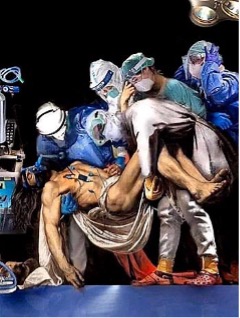
I recall a Facebook post I put up of a contemporary rendition of the Pietà. You remember the artist’s portrait of Mary receiving the tortured body of Christ from the Cross. The Wounded Christ of the Coronavirus Ward.
In this rendition the Christ of the Coronavirus Ward is portrayed as bearing the disfiguration of that disease. His virus-ravaged body is being lowered from a gurney by doctors, nurses and paramedics. Attached to his chest are still the leads of a heart monitor. He wears a face mask and little else to hide his nakedness.
Do you now see, Thomas?
This modern Pieta is not a pleasant picture. Not what you’d probably want hanging on your living room wall. Not the décor of a sanitized, inoffensive spirituality.
I remember also one woman writing back, not so much as in disgust or indignation – but what seemed an honest question, “Why did you post this?”
I explained that as followers of Jesus we need to enter into the hurt and pain of this world, just as Christ did. As Christ still does today.
For Christ takes on the wounded humanity yet today. In Lebanon where over 250 were killed in less than ten minutes by Israeli indiscriminate bombing of downtown Beirut. This Wounded Christ cries out from the ruins of destroyed homes, from the grief-stricken mother pawing through the remains for her dead children and husband.
Do you now see, Thomas?
Unless I see those wounds in the Church, the Body of Christ, I refuse to believe. Without those verifying wounds, it’s all Plastic Jesus.
When I hear Grandma’s question, “Was you there?” I strive to answer, yes, I was there. Yes, I am still there.
Thomas, here is your answer. In the nursing homes and in ICU wards. In ICE concentration camps. In the suffocating silence of a home ravaged by addiction. In the rubble of Gaza, Lebanon, and Iran.
Do you now see, Thomas?
Christ is in the face of that desperate family that has lost their medical insurance for a child with muscular dystrophy who needs around-the-clock care. Lost their insurance to pay for this senseless war of choice in Iran and Lebanon – a war of untold suffering now engulfing the entire Middle East.
Christ is that man languishing in an overcrowded jail simply because he could not afford competent legal advice or bail.
And Christ is the face of that Legal Aid worker toiling hours for little recompense to free him.
Christ is the face of those who blow their anti-ICE whistles, warning all that government thugs are about. At the risk of brutality, arrest or even death.
Christ is the face of that person who writes postcard after postcard urging infrequent voters to get to the polls. The face of millions in the No Kings Day demonstrations across our nation, from shore to shore. And up in Alaska, Hawaii and Puerto Rico. All advocating for a government that respects the dignity and rights of all its citizens.
This Sunday I ask the skeptic in all of us – that Doubting Thomas – might you, in a blind leap of faith, join those folks on the food distribution line, help in a homeless shelter or even greet an unhoused person on the sidewalk with a smile, and maybe a few greenbacks?
Might you now be the face of Christ, putting aside your niggling hesitations and lend a hand to receive his broken body?
Might you be the hands and feet, dare I say the wallet and sweat in our Garden of Hope and Food Bank?
In such generosity of Spirit there is the blessing to be found. Found beyond measure. A smidgen of life eternal.
Oh, Thomas, was I there? Yesterday, today and tomorrow, all of us — we of St. Francis’ and St John’s will be present – bearing the imprint of the wounds of Christ. Touch. Feel.
Do you now see, Thomas?
Amen.
April 12, 2026
2 Easter
“Was You There, Charlie?”
The Rev. Dr. John C. Forney
Acts 2:14a, 22-32; Psalm 16;
1 Peter 1:3-9; John 20:19-31
[1] Deferred Action for Childhood Arrivals. The program that protected undocumented persons brought to America when they were children and who have known no other country than the United States.
 Forney Charities