
Forney Charities
Improving communities by helping residents, one person at a time.
At All Costs

My wife has a saying she came up with shortly after our first child was born, “When the going gets tough – lower your standards.”
She had kept our house immaculate. Everything in its place and a place for everything. EXCEPT IN MY OFFICE. She just closed the door and didn’t let visitors in there.
It was the sanity decision.
When the second child came along, it was the only decision.
Similarly, COVID-19 has forced most of us to hunker down, reassess priorities. That and inflation. I noticed that balancing my checkbook is a lot easier these days because I’m not going anywhere. I’m not buying stuff.
When Jai and I arrived back home from our trip East to meet prospective in-laws, (yes! Christopher and Alexis have set the date)….we both came back with COVID. The one good aspect of this experience is that nobody expects you to do much of anything. And I didn’t feel like doing much of anything. Life gets stripped to the essentials. Lower your standards. Plowing through at all costs is insanity.
But how often out of anxiety, out of fear, out of just plain greed do we strive after the wind? And as the title of Margaret Mitchell’s novel puts it, it’s all GONE WITH THE WIND.
The passages assigned this week all raise the question, What Makes for a Godly Life? What really counts? What is the taste of the eternal to be had in this life?
In the opening chapter of Ecclesiastes, we read of striving after things of no account.
“Vanity of vanities, says the Teacher, vanity of vanities! All is vanity.
“I, the Teacher, when king over Israel in Jerusalem, applied my mind to seek and to search out by wisdom all that is done under heaven; it is an unhappy business that God has given to human beings to be busy with.
“I saw all the deeds that are done under the sun; and see, all is vanity and a chasing after wind. I hated all my toil in which I had toiled under the sun, seeing that I must leave it to those who come after me.”
Remember the lesson of last week: The Good Life – Eternity if you will, is wrapped up in love of God and Neighbor. One and the same.
It’s not the bumper sticker: “He who dies with the most toys wins.” That’s a lie. Vanity, all that bunkum is vanity and a chasing after the wind. Material gain, political ambition, fame – pursued “At All Costs” is nothing but futility.
Martin E. Marty captured the excessive ethos of this age in a proposed alternative bumper sticker: “In case of rapture, I have dibs on your Bugatti.”[1]
The political thing pursued at all costs might actually get the Former Guy 20 years of government housing. The fame thing at all costs can get you on the Hollywood divorce roster or into drug rehab. And ask Bugsy Siegel or Michael Milken where the money thing pursued at all costs leads. And, we won’t go into the book thing.
It’s not hoarding up more and more and more stuff. This lesson hits close to home as the Forney’s have an over-active packrat gene.
Maybe I’ve mentioned my wife’s dream of defrosting the freezer. In her dream she opens the door only to find that it’s full of books.
That morning when she shared her Good Housekeeping nightmare, I told her that she was lucky to be married to a biblical scholar who could interpret the dream.
The interpretation? She needed to buy a new freezer — for the food.
Now, I admit, my library is a little over the top. I assuage my guilt by comparing it to Carnage’s library we visited in New York City. The ceilings were at least sixty feet high. There were three levels of books along the walls. It was huge!
This grand collection was housed in over-the-top opulence. Mine, not so much.
When I mentioned to Jai that, at least, my library wasn’t THAT out of control, she quipped something to the effect, “That’s only because you don’t have the billions Carnage had.” Touché!
Yes, we do have the Forney packrat gene. I can’t tell you how many cans of dried paint I cleaned out of my dad’s storage room. There must have been fifty or sixty cans. A lifetime accumulation. I’m sure some dated back sixty years to when we had lived in Compton and I was in the second grade. All as dry as a Cambrian fossil.
I remember a film we used to show at church camp on the stewardship of creation. The title was, “More.” In the opening minutes is a baby screaming, “More, more, more” as it grasps for everything around it. The film ends with the earth buried under mounds of stuff and more stuff.
That’s where we’re headed with our insatiable appetites. More, more, more. And the planet is getting buried under a toxic cloud of carbon dioxide, the “greenhouse gas.” To my friends in the Midwest – is it hot enough for you yet? Yeah, as the movie says, “Some Like it Hot,” but that was about Marilyn Monroe, not the planet!
So, where then might we better expend our effort? If it’s not building bigger and more barns to store our stuff. St. Paul frequently offers good counsel on what makes for a good, well-lived life. Godly counsel, if you will.
To paraphrase St. Paul, “Excel in doing good. meekness, self-control; against such there is no law. … Humility, endurance; the law is not set against these things.
The planet can handle such good works without burning up. Store up such charity in abundance. You won’t need a new barn or larger library. Toss those cans of desiccated paint.
Consider this path if you are driven at “All Costs” to excel at something. There is no law against such generosity of spirit. John Wesley said do all the good you can to as many as you can as long as you can. Jesus would second that. That’s what the Spirit inspires.
I think of my friend Nancy Mintie who founded Uncommon Good right here in the Pomona Valley after working in poverty law in downtown Los Angeles. Nancy Mintie is the best of Catholic social teaching in practice. She and Uncommon Good do a lot of good for kids. Against such generosity of Spirit there is no law.
Let me share one story from Uncommon Good’s latest newsletter. It’s about a young man already making a difference in his community.
Luis Limon Sr. came from Mexico and began supporting himself in the U.S. at the age of fifteen. A young woman from Mexico’s breadbasket Sinaloa came for a visit and stole his heart. In due course Luis Limon Jr. was born.
His parents brought young Luis to Uncommon Good, hoping that they could show him the way to get an education and make a life for himself in their adopted country.
Luis has taken advantage of all that Uncommon Good has had to offer. He was paired with a mentor from one of our Claremont Colleges. He joined the sister organization of Uncommon Good, Gente Organizada. After attending writing programs, and math camp he broadened his horizons.
He became a student leader, inspired by his parent’s journeys, he lobbied the Pomona City Council to establish a Youth Commission. In the face of withering, racist criticism by one of the council members – a Latino at that — Luis persisted. With the support of his friends at Uncommon Good, Luis then took on the issues of mental health in his community, creating a yearly conference, Healthy Young People – holding their conferences by Zoom after Covid hit.
Uncommon Good helped Luis apply for, and be accepted by a mentoring program at Pomona College, PAYS, the exclusive college preparation program at one of our top liberal arts colleges on the West Coast.
As a high school senior, Luis has been accepted at one of our more prestigious and selective colleges, Kalamazoo College in Michigan. Scholarship to boot! They have a 4.4% acceptance rate. Compare that with Harvard’s rate of 5%. Now that’s selective.
That’s the kind of GOOD that Nancy Mintie has excelled in. She certainly walks the talk of her church. Nothing wasted here.
So, to St. Paul in Colossians. Uncommon Good, its staff and volunteers embody the spirit of this teaching:
“So, if you have been raised with Christ, seek the things that are above, where Christ is, seated at the right hand of God.
“Set your minds on things that are above, not on things that are on earth, for you have died, and your life is hidden with Christ in God.
“When Christ who is your life is revealed, then you also will be revealed with him in glory.”[2]
Here’s Paul’s point — This same Spirit indwelling in Jesus has now been let loose in you, and inhabits all in the Jesus Movement. It is the same life-giving force that brings us “Frozen Chosen” to daring acts of justice and reconciliation. Through it, we are transfigured to joy incarnate, the Glory of the living God.
Yield to that summons – that’s LIFE ABUNDANT. Free for the asking. No barn’s required. No extra bookshelves needed.
Here we discover the true riches of life, where treasure is to be had.
Micheala Bruzzese sums it up: In and through such living we find that our “profound hunger to love and to be loved is satisfied.” We are enfolded into the “unconditional and all-consuming love of God. …this treasure does not trap us, but liberates us, giving us the strength and courage to be liberators in the world.”[3]
Amen.
[1]Martin E. Marty, “Wheels of Fortune: ‘In Case of Rapture, I Have Dibs on Your Bugatti,’” M.E.M.O, Christian Century, July 25, 2006.
[2] Colossians 3:1-11, New Revised Standard Version.
[3] Micheala Bruzzese, “Possessed by Love Alone,” Sojourners Magazine, May 1, 2004.
July 31, 2022, 8 Pentecost, Proper 13
“At All Costs”
The Rev. Dr. John C. Forney, St. Francis Episcopal Mission
Ecclesiastes 1:2, 12-14, 2:18-23; Psalm 49:1-12; Colossians 3:1-11
Luke 12:13-21
When you pray, say…

Friday night bright lights. The football team, their coaches and handlers trotted out onto the field of the stadium to the uproarious cheers of the hometown crowd. There they all paused on the fifty-yard line, assembled in a clump, with bowed heads as their coach led them in prayer.
Anne Lamott, hearing of this pious spectacle was horrified. She, a believer, considers such sanctimonious demonstrations of religiosity nothing short of blasphemy. They diminish and demean the faith when it is so trivialized. Not what Jesus had in mind.
She objects — when we consider the real problems of the world – the hellish difficulties women now face concerning their health care – the incineration of our natural world under the embers of global warming – the intolerable pain of places like Uvalde, Highland Park, the list goes on beyond remembering – when we read daily of the horrors in Ukraine, starvation and disease in Third World countries – when one takes all this into her soul, what the hell is a football game that God should be concerned?! That God, that we, believers and non-believers should be concerned? Such pious blather borders on blasphemy.
Here’s Anne’s rant:
“It offends me to see sanctimonious public prayer in any circumstance – but a coach holding his players hostage while an audience watches his piety makes my skin crawl.”[1]
And on such self-serving expressions of righteousness, remember Jesus’ story of the Pharisee and the Publican. “I thank God I am not like…”
I remember long ago; our congregation was involved in a church volleyball league. Before the opening game of the season, one of the pastors proceeded to lead us all in prayer. He muttered something to the effect of…”Lord, we know it’s only a little piece of metal at stake…Not much of any consequence…”
Now, all the while, in my mind, I’m subverting the pious thoughts of this sanctimonious prayer… “Yeah, pastor — just a little piece, just a scrap of metal this league trophy…Right! We’re going to go out there and KILL FOR IT. Egos, elbows…they’ll be out in full force in service of coming out “King of the Hill for this little, bitty inconsequential scrap.” And that’s pretty much how it went that evening. Not quite Marquis of Queensbury sportsmanship on display.
As Jesus was concluding his prayers, he was approached by one of his disciples. “Lord, teach us to pray, as John taught his disciples.” He said to them. “When you pray, say: Abba, Father – Daddy, really – (and here we recite this familiar prayer in the words and thought forms of the spirituality of New Zealand Anglicans, as heavily influenced by Māori and Polynesian culture):
Eternal Spirit,
Earth-maker, Pain-bearer, Life-giver,
Source of all that is and shall be,
Father and Mother of us all,
Loving God, in whom is heaven:
May the hallowing of your name echo through the
universe; the way of your justice be followed by the
peoples of the world; your heavenly will be done by all
created beings; and your commonwealth of peace and
freedom sustain our hope and come on earth.
With the bread that we need for today, feed us.
In the hurts we absorb from one another, forgive us.
In times of temptation and test, strengthen us.
From trials too great to endure, spare us.
From the grip of all that is evil, free us.
For you reign in the glory of the power that is love,
now and forever. Amen.
This essential prayer of the Christian faith is widely prayed throughout the world by almost all faithful followers of Jesus. And also, by many outside the faith. I associate it with the summons to attention by one of my first teachers:
“FOCUS, JOHN. FOCUS.”
This prayer directs us to what we need to sustain life, and invites us into the process – to what opens a window to eternity.
We need to acknowledge that life is not just about us. There’s an overarching summons beyond our limited cares and petty grievances. We need forgiveness because of the hurt we cause, and likewise we need to let go of the hurt others cause. We need daily sustenance. We need relationship with one another and the verities that make for a life worth living.
Without this life orientation, our existence is the slow circling of a Final Drain. Jesus is telling us in these brief few words – FOCUS ON WHAT MAKES IT ALL WORTHWHILE. What brings joy, what brings life abundant.
Don’t squander the splendor of it all in trivia. We only go around once. FOCUS, John!
Martin Buber, grasping at the idea of the unknowable divine, settled on an expression of that reality in relationship. In his work, I and Thou, he fleshes out how it is that we are drawn into relationship wherein we are valued, and value others.
When Moses asks for the Holy Name at Mt. Sinai, all that is revealed is: “I am who I am.” Or “I am becoming who I am becoming.”
We are, further, told that this reality is bound up with neighbor. “You shall love the Lord Your God with all your soul, and all your heart, and with all your strength, and with all your mind; and your neighbor as yourself.”
Neighbor and the Great Mystery – that’s about as close as any of us will get.
It is this simple prayer Jesus taught his followers that centers mind and heart on what is necessary for this love ethic – the final requirement of Torah.
Love of God, love of neighbor – one and the same. Do this and you are very near to the Reign of the Divine.
It was for this reason that I was so overjoyed when our son Christopher shared his new vocational direction. Being a PhD student at Yale, I always thought he’d end up a professor at some prestigious college. But lately he began drifting from that direction towards thinking he might want to teach high school or maybe community college. But then he surprised me with a revised vocational goal: He wanted to teach in a prison.
“Dad, these people really need the education, not some pampered, elite, rich kids.” I thought, maybe all that he got from home, from church has put down some very deep roots. Well, glory be!
Not far from what matters!
I told him that I had a friend who actually teaches college-level classes in prisons. Chris Hedges, a Presbyterian pastor and a Pulitzer-Prize-winning war correspondent for the New York Times, has seen some of the worst of the worst prisons in many far-off, war-torn lands. He’s taught classes for a number of years in a New Jersey prison.
“Would you like to me to call him? He certainly has some incredible experiences to share.” Our Chris said that would be great. I was surprised I still had Hedges on speed dial. He said he would love to talk with our son. Maybe our son should first read Chris’s recently published book, Our Class, a work about his classes behind bars which doesn’t sugar-coat prison life in the slightest.[2]
As these classes are college level, these students are bright and capable of difficult material. To enable them to draw from their life experiences, Hedges has introduced a number of playwrights that open up prison life, notably August Wilson. His play, Joe Turner’s Come and Gone, set in 1911 in a boarding house, refers to a song by W.C. Handy about “Joe Turner’s Blues.”[3]
Like prayer – the real thing – deep listening – Wilson’s plays draw these men into their interior lives. Into what most matters. Into “finding their song.”
“What is this song?” Hedges asks. “Like a prayer. Like memory,” another answers.
“It connects you to where you came from. It connects you with your ancestors. It connects you with your own history; your own story. It validates and lifts up your suffering, your dignity, your humanity, your resistance. It tells you that you will not be defeated by the troubles of this world. It affirms you and your people.”
Until we find our song, we are but dried bones. We only stand when we find our song, when we’re fully resurrected as free men and women, when we are able to shout out our song, when we can say who we are and where we came from.[4]
This brief prayer of the Jesus movement, if allowed to marinate over a lifetime, connects us with our song – the pain, the tragedy, the delight and the blessing.
“Our song is so difficult because of the pain,” one said. “Because it’s about loss, about suffering and death, about families ripped apart, about people not being treated as if they were real human beings, because that’s the story then, and it’s still the story.”[5]
Taken to heart, Jesus’ prayer becomes deep listening, not a laundry list like a superficial prayer on the fifty-yard line or at the volleyball net.
Deep listening — inspired by a hug, an unexpected kindness, the tranquility of a forest grove or the splendor of a stary night above in the desert sky.
To see both God and neighbor as an unfolding Thou, to be cherished, to be wrapped in care, to be honored. That is prayer. That is your song — your connection to the deepest Thou. It is the unfolding of heart and mind and strength. Without it, we’re just discarded bones.
“God is love, and whoever abides in love abides in God, and God in them,” is how John’s community understood the connection.[6]
Lord, teach us to pray. Simply…simply say:
“With the bread that we need for today, feed us.
In the hurts we absorb from one another, forgive us.
In times of temptation and test, strengthen us.
From trials too great to endure, spare us.
From the grip of all that is evil, free us. FOCUS, John. FOCUS. Beyond and within all outward appearance is splendor, beyond and within daily routine, we each find our own song unto eternity. Yes, “Give us this day…” Amen
[1] Anne Lamott, “I Don’t Want to See a Football Coach Praying on the Field,” New York Times Opinion, Monday, July 11, 2022.
[2] Chris Hedges, Our Class: Trauma and Transformation in an American Prison (New York: Simon & Schuster, 2021).
[3] Ibid, 78-79.
[4] Ibid, paraphrasing Wilson’s character Loomis, Joe Turner’s Come and Gone.
[5] Ibid, 79.
[6] I John 4:16b.
July 24, 2022, 7 Pentecost, Proper 12
“When you pray, say…”
The Rev. Dr. John C. Forney, St. Francis Episcopal Mission
Genesis 18:20-32; Psalm 138; Colossians 2:6-15, [16-19];
Luke 11:1-13
Just Who is Neighbor?

Upon arriving home, I noticed a flyer that slipped out of our local Claremont newspaper. It concerned a proposed development to provide housing for the neediest amongst us. Larkin Place is to be a supervised residence providing housing for the unhoused. Of course, some of these folks will have problems with substance abuse. Many will have various degrees of mental illnesses. Some will be returning from incarceration.
When I saw this broadside, it was more like “Monsters on Maple Street.” Something out of Rod Sterling’s dark imagination. Or maybe “Zombie Apocalypse.”
Our peaceful community – read WHITE – would be invaded by the most distorted forms of humanity. Druggies, the insane – insane slashers?? – an unreformed criminal element setting to prey upon our nearby school children.
Yes, right “next to kids’ soccer fields, Joslyn Senior Center, El Roble Intermediate School, a preschool…” Right! Zombie Apocalypse!
And whoever these dregs of human society might be, we CERTAINLY DON’T WANT THEM AS NEIGHBORS! Not OUR neighbors.
Send them off to Pomona. Send them off to L.A. Just keep them out of Claremont.
This was a call to “Take Action.” “Save Claremont!”
The project developer, Jamboree Housing Corporation, has a track record of successfully providing low-income housing to seniors, veterans and the homeless. Their supervised “Permanent Supportive Housing” in Orange County is exemplary. Their efforts have brought hope and ended homelessness with solutions that work.
They’ve held a number of community-wide meetings here in Claremont, but to no avail. As the Good Book says, “Those with ears to hear, let them hear.” Well, the shouters and nay-sayers seem to have heard not much of those presentations. Still – Monsters on Elm Street.
You know, we all know, the paradigmatic story of neighbors Jesus tells in Luke’s gospel. “Just then a lawyer (wouldn’t you know it – a lawyer — Had to be a lawyer!) stood up to test Jesus.” Wanting the quick and easy answer to salvation. So, what need he do to enter the Kingdom of God?
And when Jesus throws the question back at him, the man responds exactly as he had been taught in Sabbath School. “Love God and love Neighbor.”
Right. He gets an “A” from the rabbi. So, what’s the problem? Just do it.
Not wanting to look diminished in the eyes of the gathering crowd, the lawyer retorts, “Just who is neighbor?”
Whereupon Jesus launches into a story. So famous that the hero, the “Good Samaritan” lives on in legend and as moral exemplar down through the ages. Of course, it was the one who actually provided aid, who bandaged up the assaulted traveler and saw to his housing.
When folks protest the work of House of Hope to bring healing to those suffering addiction, to cries that we should locate somewhere else – anywhere else, this is my response.
These people are already here. You see them living in tents on the streets, on the bike trail, in empty lots. They’re already here.
Would you rather they be tucked safely in their beds at 9:00 o’clock at night in a supervised facility providing recovery, where they’re learning the work of sobriety? Or would you rather encounter them in your living room at 2:00 in the morning, or in a parking lot on the wrong end of a gun? They’re already here.
People, these are your neighbors. They’re here. They’re hurting. They’re desperate. Your choice.
Here’s today’s update of Jesus’ parable:
A group of city fathers and mothers on a stroll through the Village came upon a most unsightly scene. People sleeping on the sidewalks and in the parks. Actually, they noticed the smell before they saw the tents and sleeping bags and cardboard lean-tos.
Some, long established residents, fretted, “This is going to bring down property values. I worked hard for my home. This riffraff is ruining my investment. It’s unsightly. It smells. They smell.” These fine citizens called the city council demanding action.
Another group, a couple on the city council, were likewise aghast. “We aren’t going to get re-elected if these people swarm the city. We’ve got to get rid of them. Send the cops out to let them know in no uncertain terms that they’d better be gone by sundown. OR ELSE.”
“And forget that resolution the do-gooders are pushing for inclusionary housing. We definitely are NOT for including THESE people. Let’s pass an ordinance outlawing these deplorables and their shanties.” “Oughta be a Law!”
Finally, a sanitation worker and some police officers came by. “This is unsanitary. These people are using the alley and bushes for their bathroom. Their panhandling is driving away business. The crime rate is on the rise. Ship them off to Pomona. Anywhere, but not here. Definitely –“Oughta be a Law!”
Then along came some folks and when they saw the squalor, and listened to the pain and distress of those living on the sidewalks, their hearts were moved with pity. They provided shelter at a local church. When they realized that this was at best a temporary band-aid solution, they found an empty lot and convinced the owner to make it available for a more permanent solution – a solution that would address the underlying problems of addiction, mental illness, impoverishment, and flat-out bad luck.
They found a developer, drew up plans, talked and talked and talked to their neighbors. They attended meeting after meeting. They fought like hell to persuade the persuadable and rally allies. And they still are.
That’s because they recognized their neighbors as people like themselves. People deserving a break, people deserving healing, people with the same dreams, the same hopes — the same right to respect and a decent livelihood. Neighbors, in short.
As our nation is further polarized by recent political events and the rulings of our Supreme Court, the stress on national neighborliness is at the breaking poin — definitely at the fracture point. About the only thing still holding us together, the only thing we can agree on, this past Fourth of July, was the fireworks — in communities where we could actually shoot them off without fear of burning the place down.
As the January 6th Committee delves further into the potential criminality of the Former Guy, half the country is either not paying attention, or has dismissed it all as “Fake News.” Nothing to see here, folks, just move along.
So how do we put it back together? America is presently a pretty smashed-up Humpty Dumpty. Jon Mecham fears that if we break America, we won’t get it back.
If our nation is to survive, the definition of “neighbor” must be, in our global community, far more expansive than someone living up the street. Or across town.
As Hitler was marshalling his forces to subdue Europe, magazine empire oligarch — publisher of Time-Life — Henry Luce wrote an editorial destined to shape American foreign policy for the next one hundred years, “The American Century.”
Therein he assumed that America, in a unipolar world, would be the essential neighbor keeping the peace and creating a world safe for global capitalism and democracy.
We should … “accept wholeheartedly our duty and our opportunity as the most powerful and vital nation in the world and . . . exert upon the world the full impact of our influence, for such purposes as we see fit and by such means as we see fit.”[1]
Over the years, it hasn’t worked out that way. Through one intervention, one ruinous war after another, our misguided support of despots has only created more death than had we left well enough alone. The gospel of Matthew’s “City on a Hill” has morphed into an “Armed Metropolis.”[2] Such a neighbor!
The principles of this so called “liberal Internationalism,” as articulated by Woodrow Wilson, seem not to have made us any safer; only poorer and, under a despot like Trump, more isolated and feared.
Those promoting what has been called a more circumscribed foreign policy, the “Restrainers,” say it’s time for a lighter American footprint on the world’s stage. The evidence has not supported a foreign policy of robust intervention.
Daniel Bessner writes, “Since the late Seventies, Americans have been suffering the negative consequences of empire—a militarized political culture, racism and xenophobia, police forces armed to the teeth with military-grade weaponry, a bloated defense budget, and endless wars—without receiving much in return…”[3] What Chambers Johnson calls, the “Sorrows of Empire.”[4]
The historian Paul Thomas Chamberlin estimates that we have racked up over twenty million deaths in Cold War conflicts – the “equivalent of 1,200 deaths a day for forty-five years.”[5]
As pundits, in the days following the celebration of our nation’s birth, ponder our American legacy and what to make of it all, Jon Mecham and Joe Scarborough sufficiently nailed it for me. At least for the moment.
Joe, interviewing Jon, pondering the promise and hope of America, related a comment which answered his question, — on Twitter Joe had asked: “Even with all our flaws, why are you proud to be an American?” One of his favorite replies was by a Joe Reynolds: “When you’re some small person with your back against the wall – a natural disaster, a political prisoner, a pandemic, you don’t say, ‘maybe India will help us, or maybe China. You say maybe America will help.’ We don’t always live up to that, but we should.”
Joe then turned the question back to Jon who responded: “I’m proud to be an American for same reason [that] I’m proud to be a human being. I know that I am capable of great evil, and great shadow and great darkness. But I also know that there are days and moments when there’s light and life and love. If we can just get there fifty-one percent of time, then we’re having a good day.
What would be your answer? What’s your “good day?”
If we can come close to Jon’s humility, we just might become a good neighbor. And we just might recognize and treat those around with the God-given respect they deserve. On a good day — kneeling by the road’s edge at the side of the hungry, the diseased, the refugee — God’s very own.
The hymn by Lloyd Stone and Georgia Harkness, to the tune Finlandia, says all that needs to be said about being a proud American in this new era, one who wishes to walk humbly with God and neighbor:[6]
“…this is my home, the country where my heart is;
here are my hopes, my dreams, my holy shrine:
but other hearts in other lands are beating
with hopes and dreams as true and high as mine.
“My country’s skies are bluer than the ocean,
and sunlight beams on cloverleaf and pine;
but other lands have sunlight too, and clover…”
Amen.
[1]Henry Luce,quoted in Daniel Bessner, “What Comes after the American Century?” Harpers Magazine, July 2022.
[2] Ibid.
[3] Ibid.
[4][4] Chambers Johnson, The Sorrows of Empire: Militarism, Secrecy, and the End of the Republic (New York: Metropolitan Books, 2004).
[5] Daniel Bessner, op. cit.
[6]“This is My song,” United Methodist Hymnal (Nashville, TN: The United Methodist Publishing House, 1964).
July 10, 2022, 5 Pentecost
“Just Who is Neighbor?”
The Rev. Dr. John C. Forney, St. Francis Episcopal Mission
Deuteronomy 30:9-14; Psalm 25:1-9; Colossians 1:1-14;
Luke 10:25-37
For the Beauty of the Earth

Well, this Monday Jai and I head off to the East Coast to meet our future in-laws. We have a couple of other stops on this excursion. Washington, D.C. to visit the National Museum of African American History and Culture, if we can get tickets, and one of my favorite bookstores, Politics and Prose. And that’s right next to two pretty good restaurants.
The other stop is New York City to see some plays, visit Strand Bookstore and some museums.
But, HOLD ON! I read in the NY Times this week that Las Vegas-style gambling might be coming to New York City. The paper announced that their legislators, in their infinite wisdom, had opened the path for three such casinos in the area of the city. What could possibly go wrong? Here’s the opening blurb:
“Before too long, New Yorkers and the millions of tourists who visit the city every year may have a new way to test their luck — and part with their money — amid the bright lights and skyscrapers of Midtowns…all the trappings of Las Vegas, down to the incessant ringing and fluorescent flashing of a sea of slot machines.”[1]
The part that got my attention was the bit: “—and part with their money.” Only a simpleton would believe that so-called “luck” is involved.
Trust your luck? Trust your luck??? NO! Hold on to your billfold. There is no luck.
As Christopher’s Tee-shirt says. “The lottery is a tax on people who are stupid at math.”
Repeat after me: THE HOUSE ALWAYS WINS. THE HOUSE ALWAYS WINS. THE HOUSE ALWAYS WINS. (Unless, that is, it’s one of Trump’s mismanaged and looted Atlantic City casinos). But like Rick Wilson says, “Everything Trump touches dies.” Pssst – hope you saw the January 6th Committee hearing on Thursday late afternoon.
So, now, we’re clear about “luck.” The house does not leave winning up to chance. It always wins (the Trump caveat taken as an exception and its BK).
That’s not the inalterable certainty is not the brand of theology we celebrate on Trinity Sunday. The Mystery we celebrate this Sunday is an expansive God. As the SciFi author Octavia Butler proclaimed, “God is Change.” It’s a love relationship writ large we affirm.
For that reason, we look for expansive metaphors to inform our hearts and minds. However, language ultimately fails. We speak in poetry and story. Yes, I know, we have the Nicene Creed attempting to button it up. However, if this attempt had succeeded, why is it that the Church went through a bunch more councils attempting to get it right.
And had we believed that we’d succeeded in nailing it down — that God wouldn’t have been an actual God – it would have been an idol. Pilot thought he’d nailed it down on Good Friday, but it was too elusive for Imperial Rome.
Our conceptions and intellectual constructs ARE NOT GOD. That’s why Jesus spoke in parables. Not in Greek syllogisms, which would not have saved anybody. Tillich got it right. The minute we say “God,” we have created in our mind THAT WHICH IS NOT GOD. The best we can do is point and repeat the ancient story.
So, what is this Trinity? Look about. The Psalmist points to God’s handiwork. For the beauty of the earth. Sing, o sing always. The writer of the Book of Proverbs instructs – handprint of the Holy is beheld in creation’s majesty. The Divine is given witness to in THE GREAT UNFOLDING.
“The Lord created me at the beginning of his work, the first of his acts of long ago. Ages ago I was set up, at the first before the beginning of the earth. When there were no depths I was brought forth, when there were no springs abounding with water. Before the mountains had been shaped, before the mountains had been shaped, before the hills, I was brought forth…then I was beside him, like a master worker; and I was daily his delight, rejoicing before him always, rejoicing in his inhabited world and delighting in the human race.” [2]
A GREAT UNFOLDING.
The beauty is infinite, only look at the snapshots from the James Webb Telescope. Just spend a few moments in your backyard with a majestic monarch butterfly as it rides the air currents, flitting from one flower to another.
My friend Dick Bunce told me a marvelous story that captures the infinite mystery of this Triune expression of the Divine. An understanding unfolding through the long-drawn-out experiences of the Holy by the People of the Word over the generations.
So, on with Dick’s story:
Upon high school graduation, a father asks his sons what his plans might be for going forward. “What’s next for you, son?” The lad hasn’t a clue. Finally, he blurts out something like, “I guess I’m just going to have to trust God.”
“Well, let me know how that works out for you, responds his skeptical father.”
No sooner has the father left the son’s room than the boy hears God speaking. God tells the boy to pack up clothes, get his car gassed up and drive to Las Vegas.
Now it’s the boy who is skeptical, but he does as God asks. He packs up and heads out to Vegas with a full tank.
Upon coming to the main drag, God directs him to park the car at one of the casinos he passes. Upon entering the main room, God directs the boy to go over to the cashier and empty out his wallet, buying as many chips as possible.
Then he is instructed to go over to the blackjack table and lay his bet down. He receives his five cards and God tells him to discard the one that doesn’t fit an inside straight. The boy objects, the odds being almost astronomical against making an inside straight; but he does as God instructs. Amazed, he wins that hand upon completing the straight.
After following God’s prompting for the next hour or so, this young lad is sitting on top of almost a million dollars of chips. At the next opportunity God tells him to bet the whole stack.
With his heart in his throat, the boy does as God tells him. Upon receiving his cards, God instructs him to discard one and take the next. As the other players and the dealer are finished with their bets, God tells the boy to begin to lay his hand down. The boy turns over one card, then another, finally coming to the last card God had instructed him to take.
The young fellow, to his shock and surprise discovers that that last card completed a winning hand. WOW!
WOW!!! God exclaims. “I’m as surprised as you.” WOW!
All of which is to say, that all created order is the revelation of delightful surprise. Contingency has no limits. And that includes the Divine.
The only guarantee we get is that GOD IS CHANGE, and will, along with creation unfold in the most beautiful, delightful, awful and unexpected ways.
This Trinity Sunday, we must concede that this formula is only our poor human attempt to wrap our hands around a mystery, to tell a story which can’t finally be explained.
We know experiences of this mystery: Creator, Redeemer and Sustainer – in more traditional language: Father, Son and Holy Spirit. But each of those words must be provisional as my friend Rosemary Radford Ruether would remind us. Had we been fortunate enough to have had women at the Council of Nicaea, we wouldn’t have been burdened with this excessively male, patriarchal mentality – but that’s another sermon. Fact is — the surprise is always in the last card. UNTIL THE NEXT IS DEALT.
Several weeks ago, I came across a new paleontological article in the NY Times. It was about an early limbed fish which struggled ashore out of the shallows.
The creative headline writer put it, “When the Troubles of the World Ambled From out of the Ooze.” All life moves towards ever more complexity. This three-to-nine-foot-long tetrapod with both gills and nostrils on top of its head, came ashore 374 million years ago. To escape a predator, to search for prey, to leave a drying lagoon? – we don’t know.[3]
Tiktaalik rosae was a wild impossibility that came ashore. It was the surprise of that last card. And from such, or a similar creature, came all reptiles, dinosaurs, mammals – and finally us – we, its descendants. The glory and the liabilities, from Mozart to stratospheric gas prices and global warming. For the beauty of the world, sing, o sing today.
Graduate student Ben Otoo, opines; “It’s a lot of galumphing, wriggling, slithering, huffing, flopping.” The Late Devonian could be called the “flop” era.[4]
“Tiktaalik’s flat head, with two eyes resting on top like blueberries on a pancake, made it perfectly suited for gazing above the water…’it looks like a muppet,’” quipped another researcher, Yara Hardy. All radical contingency. That’s what makes up the splendor of creation – all moving to new intended and unintended configurations. That freedom is the definition of divine love.
I close with a final story that comes out of the tragedy of the Vietnam War. Most of you know that iconic photo of a young, naked girl in great anguish, running down a dirt village road amidst other fleeing refugees.
That Pulitzer-Prize-winning photo, the “napalm girl,” taken on June 8, 1972, fifty years ago, became the defining image of the horrors of that war.
Thanks to the South Vietnamese photographer, Nick Ut, who dropped his camera, covered her with a blanket, and got her medical help – that story, fifty years later has unfolded in a beautiful, life-affirming way.
Ms. Phan Thi is not that terrified nine-year-old girl any longer but a stately, competent woman in her sixties. The picture of her reclining on her sofa radiates poise — both an outward and an inner beauty of character.
“I tried to hide my scars under my clothes. I had horrific anxiety and depression. Children in school recoiled from me. I was a figure of pity to neighbors and, to some extent, my parents. As I got older, I feared that no one would ever love me.”[5]
“I helped establish a foundation and began traveling to war-torn countries to provide medical and psychological assistance to children victimized by war, offering, I hope, a sense of possibilities.”
She knew what it was growing up among so much death, seeing friends and family members die and seeing neighbors laying mangled in the street. She knew utter devastation, losing her home and school.
It was only later, after defecting to Canada and supported by a husband and friends, that she began to blossom as she grew into her mission in life, her calling.
“I am grateful now for the power of that photograph of me as a 9-year-old, as I am of the journey I have taken as a person. My horror — which I barely remember — became universal. I’m proud that, in time, I have become a symbol of peace. It took me a long time to embrace that as a person. I can say, 50 years later, that I’m glad Nick captured that moment, even with all the difficulties that image created for me.”[6]
Nick’s picture so long ago, for Ms. Phan Thi, was the surprise of the last card, the WOW which would unfold into the majesty and glory of what would become her accomplished life. She in her mission over the years is indeed, the Glory of God, a woman fully alive!
As James Baldwin says of the splendor of this unfolding universe, “For nothing is fixed, forever and forever and forever, it is not fixed; the earth is always shifting, the light is always changing, the sea does not cease to grind down rock.”[7]
This marvelous and wondrous life is captured in one line of the hymn, “I Bind unto Myself Today,”
“I bind unto myself today the virtues of the starlit heaven, the glorious sun’s life- giving ray, the whiteness of the moon at even, the flashing of the lightning free, the whirling wind’s tempestuous shocks, the stable earth, the deep salt sea, around the old eternal rocks.” What is this Trinity of Divine Rapturous Love? Take in the astonishing splendor of the unfolding handiwork of creation that fills our senses! There’s your clue. For the beauty of the earth — Sing, o sing today. Amen.
[1] Nicole Hong, “If New York City Gets Las Vegas-style Casinos, What Else Will It Get?” New York Times, June 4, 2022.
[2][2] Proverbs 8:22 ff., New Revised Standard Version.
[3] Sabrina Imbler, “Is Four-Footed Fish to Blame for World’s Woes? – When Trouble Ambled Out of the Ooze, New York Times, April 30, 2022.
[4] Ibid.
[5] By Kim Phuc Phan Thi, “It’s Been Fifty Years. I am Not ‘Napalm Girl’ Anymore,” New York Times, June 6, 2022.
[6] Ibid.
[7] James Baldwin, The Price of the Ticket “Nothing Personal” (New York: St. Martin’s Press, 1985), 393.
June 12, 2022, Trinity Sunday
“For the Beauty of the Earth”
The Rev. Dr. John C. Forney, St. Francis Episcopal Mission
Proverbs 8:1-4, 22-31; Canticle 2; Romans 5:1-5
John 16:12-15
No Barriers
One of the ads I so like is from a sponsor of the PBS Nightly News. It is from an old alma mater, California State University Long Beach. Filmed at a graduation ceremony, students come processing by a row of huge block letters proclaiming, “Go Beach.” As students exit the ceremony in their black academic gowns and mortarboards, one exuberant young woman does a twirl on one foot as she’s passing the camera. Her face is radiant, all aglow. Her gown broadly swirling with the movement. The motto then flashes across the screen: “N0 BARRIERS.” You just have to know that this young lady is off to an expansive future. No barriers, indeed!
Except, you have to study and keep your GPA up. That pesky little detail. For screw-ups, I discovered, that was a major barrier. However, after a couple of years in the Army as a medic, I had finally figured how to overcome that one, final impediment, and finally completed my degree at Cal State LA.
But I still tear up when I see that promo. NO BARRIERS and that wonderful, young woman. So much excitement ahead for her.
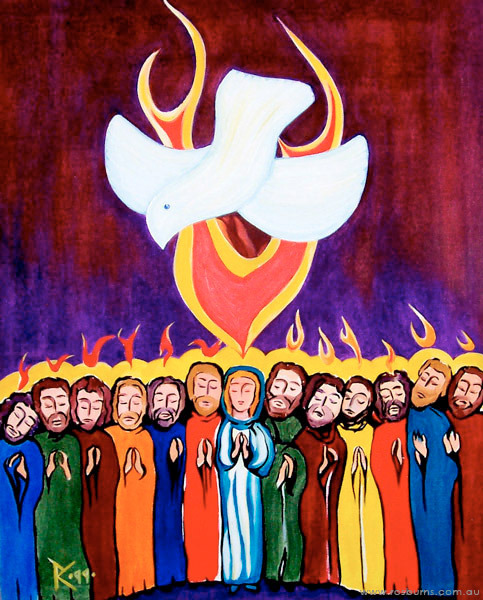
That’s the message of Pentecost. With the Spirit busting loose. With quiet reverence. Today we celebrate the birthday of the church.
We Episcopalians have always been chary of too much exuberance in worship. It is not our way.
I remember back in high school my girlfriend Barbara had been asked by her close friend, to attend Glenda’s church one Sunday afternoon. As boyfriend and protector, I was conscripted to accompany her. I didn’t know much about the Foursquare Church, only that their worship was more enthusiastic than that of the staid Presbyterian church Barbara and I attended.
To say “more enthusiastic” was an understatement. People were standing and murmuring, “Yes Jesus, Yes, Jesus.” Some were in the aisles loudly testifying or speaking in tongues.
Was I ever out of my comfort zone! If this was the rush of the Spirit – I’m sorry, but I’ll take the alternating Sunday. “When’s this over?” I whispered in Barbara’s ear.
Mercifully, there was some sort of intermission and it was announced that the main service was over. We quietly slid out the side door.
It has been said that it is through our imagination that the Spirit has the best chance of getting ahold of us. Through a moment of inspiration.
Lately, I’ve had a couple of hymns that have accompanied me through my days as they weave in and out of various moments.
I’m fond of saying that if you don’t have a song in your heart on waking, your day’s already in trouble. I believe it.
Brian Doyle in A Book of Uncommon Prayer, writes:
“Because you know and I know that a song can save your life. We know that and we don’t say it much, but it’s true. When you are dark and despairing a song comes and makes you weep as you think yes yes yes.”[1]
The “Battle Hymn of the Republic” by Julia Ward Howe bore up the spirits of those in that great struggle to preserve our union and end slavery.
Work songs kept gandy dancers in sync as they hammered in time to straighten the rails of this nation. Lifted their spirits and helped pass the toil of the day.
Union songs forged bonds of solidarity among those struggling for labor justice.
And when President Obama broke into “Amazing Grace” in his rich baritone at the close of his eulogy for The Rev. Clementa Pinckney, killed in yet another mass shooting at a Charleston church – that hymn alone redeemed the day.
To paraphrase Brian’s closing: If today, if haunted by a song that slid out of the radio, or out of memory, and lit up your heart, we pray in thanks that there are such fraught wild holy moments as this. And so: amen.
These songs bind us together. That is the message of Pentecost. It reunites where the Tower of Babel separated – each speaking a language the other didn’t understand.
Keri L. Day, Princeton professor of Constructive Theology and Ethics, reflects on why, as a young girl, she so loved the telling of the story in the Book of Acts. “’And they were gathered together in one accord.’ That line communicated what was held as sacred within our community: our togetherness, our unbreakable bond of living with and loving each other. We were in one accord. The joy of community was the gift of the Spirit.”[2]
“Are not all these who are speaking Galileans? And how is it that we hear, each of us, in our own native language? Parthians, Medes, Elamites, and residents of Mesopotamia, Judea and Cappadocia, Pontus and Asia. Phrygia and Pamphylia, Egypt and the parts of Libya belonging to Cyrene and visitors from Rome, both Jews and Proselytes, Cretans and Arabs—in our own languages we hear them speaking about God’s deeds of power.”[3]
This is the miracle of unity, of understanding.
Now, if your wont is to stand in the aisle and shout, to each their own. But the authentic miracle of Pentecost will lead you from that aisle into the city to include the poor and the dissolute. Into the cancer ward and onto the union picket line. Otherwise, what you thought to be a long-distance call was only a local. As close as your own ego.
My dearly departed friend George Regas frequently told the story of a man in an Episcopal Church who, in the middle of the sermon shouted out, “Amen. Amen.” Folks looked around to see who was causing the commotion, but soon didn’t pay him any further mind. A little while later he stood up and loudly encouraged the priest, shouting, “Preach it, brother. Preach it.” At which point an usher stepped beside him, and whispered, urging him to be quiet. After the third outburst, the usher admonished him more sternly that he’d have to restrain himself, to which the man responded that he couldn’t help it. He had the Spirit. “Well, you certainly didn’t get it here,” scolded the usher.
In our own, quiet way, we Episcopalians pray, “Come, Holy Ghost, our souls inspire, and lighten with celestial fire.”
And within the fertile recesses of imagination and of the heart — yes, even the “Frozen Chosen” are moved to deeds of service and sacrifice.
It was, in fact the Rector of All Saints Church, Pasadena, who went to the assembly point at the Santa Anita Race Track, where Japanese citizens were rounded up to be sent off to far-away concentration camps. This was in 1942, that their priest, Frank Scott, stood in front of trains to protest the removal of Japanese-Americans, American citizens, for God’s sake, hauled off to internment camps during World War II.
Not different in kind from what the Nazis were doing in Germany. And all quite legal, to be sure. There was a government order.
This, in a day when proper Episcopal priests from a well-to-do, prominent Pasadena parish did not do such unseemly things. Moved by the Holy Spirit, that’s exactly what Fr. Frank did! Moved by the Spirit, he was.
These were all Americans – we are all Americans. No barriers, No separation. We are one in the Spirit. That’s what Fr. Frank stood for.
The Spirit in service of unity brings courageous acts of aid on behalf of others. This about the one and true Spirit, not pious bliz-blaz. Or religious hype. Some might call it heroism.
Greater love hath no one than to lay down her life for another. That’s what Amerie Jo Garza did in her last moments, calling 911 in an attempt to save her classmates who were still alive as a shooter sprayed her classroom with automatic fire from a high-powered weapon of war. On May 24th just days away from when Amarie anticipated beginning her summer vacation.
“On Tuesday, the Girl Scouts announced that they posthumously awarded her one of its highest honors for risking, and ultimately giving, her life to save others.”[4]
“The organization gave 10-year-old Garza the Bronze Cross, which is awarded ‘for saving or attempting to save life at the risk of the Girl Scout’s own life.’” [5]
This “spunky” little girl, so full of life taken from us too soon. And how shall we honor her memory? What is asked of us, the living?
As consciousness slipped and darkness enfolded her, I wonder what song, if any, might have slipped into her fading awareness, what song might have escorted her home to God.
I’m willing to bet that the song which greeted her arrival had to have been “For All the Saints, Who from Their Labors Rest.”
No Barriers, Amerie Jo Garza. No Barriers. Amen.
[1] Brian Doyle, A Book of Uncommon Prayer (Notre Dame, IN: Sorin Books, 2014, 58.
[2] Keri L. Day, “We Need a Pentecost,” Christian Century, May 3, 2018.
[3] Acts 2:7-11, NRSV.
[4] Li Cohen, “Girl Scouts Posthumously Award Amarie Jo Garza for Doing ‘All She Could’ to Save Classmates, Teachers During Uvalde Shooting,’ CBS News, June 1, 2022.
[5] Ibid.
June 5, 2022, Day of Pentecost
“No Barriers”
The Rev. Dr. John C. Forney, St. Francis Episcopal Mission
Genesis 11:1-9; Psalm 104:25-35, 37; Acts 2:1-21;
John 14:8-17
I Have Heard of Your Faith

This tumultuous week-that-was began inauspiciously. I opened the computer e-mail on Sunday evening to check it there were any pressing demands on my time, my money or my brain power. What I found was not some scam from a Nigerian prince with millions of looted wealth wanting to stash it in my bank account. No not that tired, old ruse – but the person or persons generating this scam were ensconced in Ireland. This was a ruse by Irish leprechauns.
Details could be had by clicking on a tab labeled: “Remittance Advice.” Regards. Yeah, regards, sucker if you click on that. The great sucking sound you hear won’t be the American jobs being siphoned off to Mexico that Ross Perot feared. No, it will be your hard-earned cash being vacuumed out of your bank account, along with your data and passwords being slurped out of your computer.
As the week progressed, it turned disastrous. We all discovered to our horror, the tragic events of another mass school shooting — a far more deadly scam, that of the NRA and the gun lobby. Abetted by their willing political accomplices who prostitute themselves for the almighty campaign dollar.
This was pronounced the work of a “loner.” FALSE! This young man had plenty of accomplices – the self-serving idiots who mouth the idiocy: “It’s not guns that kill people. It’s people who kill people.” It’s politicians who put guns as a higher priority than our children. And those who vote for them. No, this murderer was NOT a loner. There were others.
These are the fifty Republicans who, in lock-step with Mitch McConnell, have blocked even the most tepid sensible gun safety laws. Throw in a batch of corrupt Democrats on the payroll of this death machinery, and nothing gets done.
Today, to a person, these esteemed representatives even blocked a bill to address domestic terrorism. Have another shot and pass the ammunition (oops, poor choice of words). Gotta support your local, neighborhood terrorist. He’s one of us.
Columbine, Las Vegas, Tree of Life Synagogue, Sandy Hook, El Paso, Buffalo — The list goes on over the decades until we have become inured to the carnage. We’re numbed out. I never again want to hear some inane, insipid words about “thoughts and prayers.” That’s just a bunch of pious bull – simpering NRA apologetics.
After each mass shooting, especially in schools, the cry goes up, “Surely they will do something now.” Authorities couldn’t even manage to send in police on the scene, gathered in the school hallway outside the besieged classrooms – within earshot of those desperate 911 pleas from students in those classrooms.
“There are still eight of us alive. Please send in the police now!” Nothing. Nothing, as their classmates were gunned down and the classroom floor was awash in blood. As the survivors bled out. Over an hour and…Nothing.
We are scolded for raising this as a policy issue. For heaven’s sake we shouldn’t politicize this tragedy. Folks, it’s politics that brought us this tragedy. The NRA and their accomplices have already politicized this issue. To deadly effect.
If you consider other nations demographically similar to ours – we don’t see Canadians massacring one another wholesale on a weekly basis. We don’t see this level of violence in virtually any advanced European nation. NOT ALL OF THEM ADDED UP TOGETHER!
This doesn’t have to be.
Folks, WE ARE NOT WITHOUT RESOURCES TO ACT. We celebrate one of the signal events in the Christian Story. No not Memorial Day, though we know that’s upon us by all the mattress sales – 40 percent off, lay away financing. Free delivery, and we’ll take away your old one. FREE! All major credit cards accepted. Open till 9:00 tonight. Almost the same ad copy gun stores are using this weekend.
No, not that holiday. This Sunday we celebrate Ascension Day. It is as if LOVE exploded and has been let loose throughout the world. Jesus, as a physical presence, is taken from us that the Risen Christ might seep into every nook and cranny. Into every heart and mind. Empowering compassion, giving courage – yes, political courage, to do the right thing by our kids. By ourselves.
In groups of the Christ-infected followers, spontaneous works of mercy and daring acts of sacrifice and resistance erupt. It is in such a group at Ephesus that St. Paul finds hope and joyful fellowship. Not just potlucks, but actual, daring works of mercy and solidarity.
That is the work of the spirit of the living Christ, the reality that transcends the historical Jesus. He’s gone, but Spirit-empowered, the church is launched.
As Luke tells the story, “Then he led them out as far as Bethany, and, lifting up his hands he blessed them. While he was blessing them, he withdrew from them and was carried up into heaven. And they worshiped him, and returned to Jerusalem with great joy…”
Now, don’t get caught up in the strange particulars of this story. It’s how folks remembered the events fifty or so years later. It’s how folks told of such marvelous and incomprehensible events. The bottom line is: He’s gone. But he’s not.
Why are you still staring up into the clouds? THERE’S WORK TO DO.
He’s no longer with us, but let loose in the cosmos – blessing, empowering, comforting, encouraging those who gather in his name. He’s present in your hands and heart. In your minds and in your billfolds. Wherever you gather around his altar to remember him.
Paul finds such a group of the Christ-infected in Ephesus. He, himself, will travel throughout much of the Roman empire forming other such fellowships.
“I have heard of your faith in the Lord Jesus and your love toward all the saints and for this reason I do not cease to give thanks for you as I remember you in my prayers.”
“I have heard of your faith.” Not only heard, but seen.
As I witnessed clumps and knots of grieving families comforting one another this evening, all that remains is the faith that, in love, somehow, we will get through this together. That is Christ let loose in the valley of the deep shadow of death. Faith giving strength to hold one another up, to grieve, to pray together.
After the 2020 election, with Dr. Fauci no longer muzzled and under wraps, no longer under the censorious scowl of the Former Guy, we talked about “free-range Fauci.” Fauci let loose. Well, what we now celebrate on Ascension Sunday is “free-range Jesus.” The reality of Love unleashed upon creation, down through the ages, present most especially in hearts and imaginations of those who love him.
We had barely finished burying the victims of Buffalo when the catastrophe of Uvalde was upon us. One of stories from the Buffalo funerals captured my heart – that of “Mayor Kat,” Katherine Massey who was laid to rest only a Tuesday ago.
Mayor Kat was not prone to sit by idly and bemoan the state of affairs. Sick and tired of the overgrown lot on her street – state property, she had had it with excuses and inaction.
So, she sent a letter to the governor on letterhead of the “Cherry Street Block Club,” which did result in action. The lot was quickly cleaned up. Now, Massey was the only one who knew who wrote that letter. It was her own invention. And that invented club consisted of one sole member – her.
It was that sort of fearless activism which was her hallmark. Her congressman noted at her funeral, “She was the mayor in every neighborhood that she lived in.” Katherine Massey was one of ten shoppers taken from the Buffalo community by another teenage boy with an assault rifle.
She was an outrageously creative activist. To raise health awareness among students in her local neighborhood school, she showed up in a broccoli costume which she accessorized with leopard gloves and sunglasses to perform a rap song she wrote. She was the hit at the school’s assembly.[1] It was probably enough to have even gotten “W” to eat his broccoli.
“She considered herself a single parent with 35,000 adopted children attending Buffalo’s public schools.”[2]
She fulminated, through letters to the editor, against an escalating culture of gun violence in her city. That is the sense of mission and strength Mayor Kat drew from her family of faith at Pilgrim Missionary Baptist Church.
Now, the whole world has heard of her faith and the faith of her community in Christ.
Mayor Kat was a splinter of that glory, a manifestation of the flesh and blood risen Jesus. Free Range, indeed. She is an incarnation of that Ascended Love, a Holy Busybody, God bless her.
As we mourn our losses, hold one another up, might we continue to take strength in the living Christ in our midst. The Christ in the faces of one another as we gather around this table in his precious memory. Not for solace only, but for strength. The strength that nurtured and empowered Mayor Kat. The strength that will get us all through this horrible week. Yes, we have heard of your faith.
“In our Eucharistic meal we are pulled into immense love and joy for such constant and unearned grace…that explains the joyous character with which we celebrate this meal.”[3]
That is what sustains me — to see the love in the faces of those who weekly gather here at the altar of Christ. Your faithfulness continues to give me hope. Yes, I have seen and heard of the faith of the saints gathered here in this northern outpost of Christ in San Bernardino. For us all at St. Francis, I say, “Thanks be to God.” Amen.
[1] “Buffalo says Goodbye to ‘Mayor Kat,’” Los Angeles Times, Tuesday, May 24, 2022.
[2] Ibid.
[3] Richard Rohr, Yes and No: Daily Meditations (Cincinnati, Ohio: Franciscan Media, 2013), 228.
May 29, 2022, Ascension Sunday
“I Have Heard of Your Faith”
The Rev. Dr. John C. Forney, St. Francis Episcopal Mission
Acts 1:1-11; Psalm 47; Ephesians 1:15-23;
Luke 24:44-53
What A Difference a Day Makes

On any given day one’s prospects can change radically. Any day can be the one that makes all the difference for the rest of one’s life.
Dinah Washington sang it so well:
“What a difference a day makes
Twenty-four little hours
Brought the sun and the flowers
Where there used to be rain”[1]
“What a difference a day makes” rose to the top of the pop charts in 1959 and won Dinah Washington, with her rich, silky rendition, a Grammy. Its popularity testifies to that truism, a day, any day, can make a difference – possibly, a huge difference.
A monster asteroid can ruin your entire day. Ask the dinosaurs. A recent discovery seems to have revealed the exact day they began their extinction.[2] Paleontologists in North Dakota have found the remains of a dinosaur leg that has been preserved almost perfectly intact, even with mummified skin attached. This along with a jumble of other life buried in the wall of water and mud that swept across the shore of their habitat, burying all in an instant.
Scientists believe that it was killed by a massive tsunami on the day the asteroid struck Chicxulub in the Yucatan Peninsula of Mexico. In an instant a mile-high tsunami rushed outwards roiling planetary oceans. This wave swept up the inland sea that once divided the American continent, , sweeping away all in its path. All within minutes of the impact.
Much of the impact crater along with the asteroid itself was vaporized and began to fall back to the earth as small glass spherules. “Those fish with the spherules in their gills, they’re an absolute calling card for the asteroid.”[3]
Chemical analyses of several of the spherules intombed in amber bear the same signature of the rock native to Chicxulub and the asteroid itself. All this in a twenty-four-hour day. A terrible, horrible, no good very bad day for planet earth.
Winds as if from a blast furnace charred forest land and thick clouds covered much of the planet for a decade or two, killing off most plant life. Sulphureous gasses and rain absorbed by the oceans killed much of the sea life. The few remaining dinosaurs had nothing to eat and their demise was assured within days. At that point the dinner bell for T. Rex and other carnivores was un-rung. They, too, starved. What a difference a day makes, indeed.
But in the aftermath, little burrowing and hibernating mammals and other small creatures survived the cataclysm. Seeds and spores of previous plant life soon germinated and within a century life found a way back.
We saw that scenario playout after Mount St. Helens erupted. Another horrific day. But a day in which all that had looked like the landscape of the moon was within years renewed in a carpet of green. In the twinkling of an eye as far as geological time goes. God works wonders to preform.
In the twinkling of the mind’s eye comes the revelation of a new creation. No, nothing to do with dead fish and dinosaurs or asteroids. The writer has a very different reality in mind – a day that will make an entirely new difference.
“I saw a new heaven and a new earth, for the first heaven and the first earth had passed away, and the sea was no more. And I saw the holy city, the new Jerusalem coming down out of heaven from God, prepared as a bride adorned for her husband.”
For John the Revelator, what, indeed, a difference a day made as he was translated to a seventh heaven to behold the mind of God.
Meanwhile, for us lowly mortals, we plod along, subject to time and chance. While we have no control over what extraterrestrial bodies may be careening towards earth, in some matters we have a choice. However, all is being made new even when we’re not in control. Asteroids are beyond my pay grade.
Don’t discount chance and opportunity. One day our youngest son got on the internet machine and arranged a date with a wonderful, young woman. And soon we will be headed off to meet our future in-laws. She is that beautiful object of our son’s heart of which Dinah Washington croons:
My yesterday was blue, dear
Today I’m a part of you, dear
My lonely nights are through, dear
Since you said you were mine
Yeah, they are smitten and we delight in the joy they have in one another. What a difference a day makes! A new heaven and a new earth. Gift of God.
Lately, events in Ukraine have caused my mind to dwell on things Russian. One of the books I read as a young fellow after having discovered the pleasures of good literature was Solzhenitsyn’s One Day in the Life of Ivan Denisovich.
Written in 1962, it was an extraordinary publishing event in the Soviet Union, revealing the massive injustices of Josef Stalin. Aleksandr Solzhenitsyn had spent time in the Soviet chain of Gulags in Siberia at hard labor himself. In this novel, he writes of one innocent prisoner, Ivan Denisovich Shukhov, sentenced to hard labor as a spy for having been captured by the Germans in WW II.
This short novel unfolds in the span of one single day of this prisoner, one day of a ten-year sentence. Though set in a labor camp, the work ends on a hopeful note. In that given day, he has secured sufficient food to sustain life. He has kept his integrity in his labor. He has acted as a decent human being to his fellow prisoners, and he has said his prayers to God. The narrator ends the story, noting that Shukhov has lived one of the 3,653 days of his sentence.
What a difference a day makes – in the life of this fictional character, who could be a stand-in for “Everyman.” And while we would not readily equate the terrors of one of Stalin’s gulags with “a new heaven and a new earth,” yet even in those dire circumstances was the possibility of a life lived with integrity.
Such a life is the unfolding of Solzhenitsyn’s spirituality, which grew out of the heart, not out of church dogma. Though the spirituality of the Old Believer’s Russian Orthodox tradition permeates his writings, his is a deeper version. One said to being born out of the “belly of the whale” during those years of imprisonment in Siberia. As is any true spirituality born, out of our own life experiences. And any twenty-four-hour day can make all the difference.
Here is the encapsulation of Solzhenitsyn’s belief “…the only church remaining was that church which, in accordance with the Scriptures, lay within the heart.”[4]
“Your soul, which formerly was dry now ripens from suffering. And even if you haven’t come to love your neighbors in the Christian sense, you are at least learning to love those close to you. Those close to you in spirit surround you in slavery. And how many of us come to realize: It is particularly in slavery that for the first time we have learned to recognize genuine friendship…”[5]
What a difference a day can make in the belly of the whale, in a Soviet gulag prison camp. Even the unfolding of a “New Heaven and a New Earth.” Maybe Ivan’s Twenty-four little hours didn’t bring the sun and the flowers but it brought the choice to be a decent human being. As they do to us all. Gift of God.
“It is our choices that show what we truly are, far more than our abilities,” the wise, old Dumbledore, headmaster of Hogwarts School of Witchcraft and Wizardry counsels the young Harry Potter at a moment of self-doubt. A difference that any single moment of a day can make.
Community is a blessing we can choose, and what a difference that day made in the lives of those who gathered daily to prepare meals for those on the street.
Peter, in Acts chose to sup with the uncircumcised and it made all the difference for the church.
One day, for Amy Frykholm, Bill didn’t show up at the church, so “we went to find him.”[6] His absence made all the difference for a small church fellowship.
“’How are you related to this man?’ the EMT asked me as he put Bill in the back of the ambulance. I climbed in after them. There was no good answer. Friend? Not really. Colleague? Coworker? He was more than an acquaintance. ‘He . . . we work together I finally said.’
“Bill was the front-walk shoveler, meat-loaf maker, coffee brewer, Saturday night grumpster-in-chief at my church. Every time I arrived at the church, he was busy doing something. He filled the steam-table pans for our community meal. He made sure the stairs were clear of snow. He helped install the handicap ramp. He cleaned the bathroom.
“When I first met him, he showed me how to light the stove for the community meal, smelling like stale beer and unwashed clothes. He knew where everything was stored. He complained about everyone and everything—about the people who stood too long next to the coffee machine, who left their cigarette butts on the front porch, who loitered in the hallway, who talked too much, or who were so quiet they must be crazy.
“One spring, one of our regular guests at the meal died of liver failure. Kenny’s belly was swollen, and he lost his mind, screaming with terrible tremors, as if accumulated ghosts were tormenting him. He vomited and had diarrhea until he was unable to eat at all. His ordeal went on for weeks, and at last he died.
“After that, Bill seemed more withdrawn as he went about his tasks. Then one day, he disappeared. He did not come to the meal. We arrived at church to find the snow had not been shoveled. We didn’t know where he had gone
“After a few days, George could stand it no longer, so he went to look for Bill. He searched every apartment, knocked on every door, until he found Bill, barely conscious in the back of a trailer where he had gone to drink himself to death. As far as I could tell, his reasoning was something like, ‘I don’t want to die like Kenny. If it is too hard to stop drinking, and liver poisoning is too slow, I am just going to kill myself quickly.’
Bill was taken to the hospital and proved to be a most uncompliant and difficult patient. One night, delirious, he pulled out all his IV lines, monitors and catheter. The next morning Amy and some friends gathered at Bill’s bed, taking turns holding a hand, shedding a tear or two. Amy continues:
“We sat around Bill as we waited for the urologist to come to fix Bill’s catheter. We talked to him through the sedation. “I want to go home,” he said.
“Bill, these machines are keeping you alive. Staying here is keeping you alive.”
“There was a pause. Finally, I said, ‘Bill, do you want to go home to die?’
“’No,’ he said. ’I want a Pepsi.’
“As we waited for a doctor to speak with us, there was plenty of time to contemplate
“Bill and I shared labor and days. We shared space and coffee mugs. Who is this man to you? He makes coffee for me. Pretty good coffee, too. Somehow, over the space of years, our relation had become a given. The days had been like stitches—some well made, some poorly made—but they had created a mantle that we would now have to assume. I belonged to Bill. Bill belonged to me. And now, I—we—were going to make a decision that only family members typically make. We were going to do this without labels or prescribed roles.
“We spent the day contemplating the Bill we had known, who he was, what he loved, and what he wanted from life. As we talked about “our” Bill, we also gradually saw that he belonged to something bigger, something greater than us. We wordlessly came to act as if we knew that he was going into that something, and it was our job to walk him to the door. We did not claim to know what was on the other side. We had no shared language, took no comfort, told ourselves no stories.
“One word kept coming up for Bill: home. At first, we thought he meant his apartment. We talked about perhaps transporting him there, caring for him there. But gradually, the word took another meaning, one that claimed a place we both knew and did not know. The only way that we could move forward was to believe and to act as if this other place, this home, was love.
“We stood around his bed. ‘The Broncos are going to be in the Super Bowl,’ someone in our group said.
“’Good,’ Bill grunted.
“’Bill,’ I said. ‘We are working on bringing you home.’
“’Good,’ he said again.
We each held his hand. The staff told us later that he was peaceful that night. We started making arrangements with hospice the next morning, but the nurse on duty called early in the afternoon.
“’He is leaving fast,’ she said. By the time George arrived, [Bill] was gone.
Bill and his church family, in one brief, precious day, entered a New Heaven and a New Earth. What a difference a day makes when marinated in Gospel Goodness. A New Heaven and A New Earth, without fanfare and with little note. Except to those blessed to live it. Amen.
[1] Originally written in Spanish by Maria Grever, a Mexican songwriter in 1939, Stanley Adams adapted it in English, 1934.
[2] Dave Kindy, “Discoveries Shed New Light on the Day the Dinosaurs Died,” Washington Post, May 9, 2022. The PBS program is available on NOVA, “Dinosaur Apocalypse.”
[3] Ibid.
[4] A. Solzhenitsyn, Letter to the Soviet Leaders, p. 77. From Donald Roy, “Solzhenitsyn’s Religious Teaching,” Christendom Media, Vol. 4, No. 7.
[5] Roy, op. cit.
[6] Amy Frykholm, “A Stitched-Together Community, Christian Century, February 28, 2018.
May 15, 2022, Easter 5
“What A Difference a Day Makes”
The Rev. Dr. John C. Forney, St. Francis Episcopal Mission
Acts 11:1-18; Psalm 148; Revelation 21:1-6;
John 13:31-35
My Mama Done Tol’ Me

At some point my brother and I learned what most young fellows inevitably learn. You can’t fool Mom. The lady has eyes in the back of her head. She had her ways of finding out just about any mischief we had gotten into. She knew when we were just thinking about it.
As Homer tells Bart in an episode of “The Simpsons,” “You Can’t Fool Your Mother on the foolingest day of your life if you had an electrified fooling machine.” She’s on to you. Don’t even think about it!
At my first church in downtown Los Angeles, the Pico-Union community, it was a pretty tough neighborhood. We were at the intersection of the territories of three gangs. The student turnover in Tenth Street Elementary School was over fifty percent each year. Not just the students – teachers wanted out of there as soon as possible. The place was a shambles of years of deferred, piled up maintenance. The student’s restrooms should have been red-tagged by the health department. Unfit for human habitation.
Our youth were continually in danger of gang recruitment. Especially vulnerable girls. One of our programs for girls in the early evenings was a cooking class taught by a grandma. This wise, old Latina had two missions. Ostensibly, it was to teach our neighborhood girls some of the skills they were not learning at home. The second, and more important, was to provide some guidance, to mentor these girls as they grew up: stay away from gangs and the fast girls; don’t let some boy get his hands in your pants and get you pregnant. Have some self-regard; study hard – YOU actually could go to college or learn a skill to support yourself when you grow up. The college girls who staffed our programs were great role models for what a young girl could become. So, stay in school! There is scholarship money just waiting for you if you are willing to put in the effort. Follow your dream: a teacher, a lawyer, a doctor, a nurse, a writer? Follow the dream. That’s what this abuela said.
Women have been learning this lesson through many years of heartbreak. Ella Fitzgerald in her “Blues in the Night” – has that haunting refrain, “My Mama Done Tol’ Me.”
Her adaptation of this Johnny Mercer hit went down as a warning about shiftless men:
“My mama done told me when I was in pig tails
My mama done told me,
A man’s gonna sweet-talk ya, and give you the big eyes
But when that sweet talkin’ is done
A man is a two-face, a worrisome thing
Who’ll leave ya to sing the blues in the night”
If you hitch your future to some no-account man, you’ll be singing the blues for many a night. And you’ll be going nowhere. That’s the priceless wisdom from mothers that too many young girls are not heeding. Listen to that wise, old Latina! Listen to your mom. Listen to your teacher.
Unfortunately, too many of our mothers are so besieged by their own problems and family baggage that they’re unable to exercise maternal instincts and wisdom. In one of my congregations, one fellow was bringing up his two daughters as a single dad. Their mother had been in and out of rehab for alcoholism and that finally ended the marriage. To boot, the court had taken away all her parental rights. This is not an isolated story. I was always amazed that the girls had come out of this so well.
But if the desire is there, it’s never too late to achieve sobriety, to heal.
In the Gospel of John, Jesus is portrayed as the Good Shepherd.
“My sheep hear my voice. I know them, and they follow me. I give them eternal life, and they will never perish. No one will snatch them out of my hand. The Father and I are one.”[1]
If ever we have Good Shepherds in our day, they are our mothers. They give you life in many ways. Their wisdom is life abundant. Good shepherds of meaning and purpose. Life does not begin at conception and end at birth as many in the Party of Sedition and Greed would have it.
As much as I have learned kindness, generosity, manners and decorum – it was the result of Mom’s teaching and example. To the degree that I have failed in these graces, that can’t be laid at her doorstep. Women down through the ages have been responsible for what little civilization we have. That’s my belief. They urge us to heed our “better angels.”
We are blessed to have a stalwart supporter for women’s dignity and achievement in our family on my maternal grandmother’s side – Julia Ward Howe. Grandma comes for a long line of Howes, including the British general William Howe, who benefited the American Revolution by allowing George Washington to slip through his fingers three times. Wasn’t he sacked or something?
Here’s where I’m going with Julia Ward Howe. She wrote the first Mother’s Day proclamation in 1870, long before it was made a national holiday. You know her for her famous hymn of the Civil War, “The Battle Hymn of the Republic.” Long before the Hallmark folks turned the day into a monster money-making opportunity to sell sappy poems on outrageously overpriced cards. Though, there was a beneficial spinoff for the Post Office. Got stamps?
Today’s commercialized celebration of candy, flowers, gift certificates, and lavish meals at restaurants bears little resemblance to Julia’s original idea. There is nothing wrong with all that hoo-ha. Whatever makes Mom feel appreciated. But here, for the record’s sake, is the proclamation she wrote in 1870, which explains, in her own impassioned words, the goals of the original holiday.
Ward’s proclamation was a call to mothers to not raise up sons to be slaughtered in war. Her proclamation has bite to it. Nothing sappy here
Arise, all women who have hearts, whether your baptism be that of water or of tears! Say firmly: “We will not have great questions decided by irrelevant agencies, our husbands shall not come to us, reeking with carnage, for caresses and applause.
“Our sons shall not be taken from us to unlearn all that we have been able to teach them of charity, mercy and patience. We women of one country will be too tender of those of another country to allow our sons to be trained to injure theirs.”
From the bosom of the devastated earth a voice goes up with our own. It says, “Disarm, disarm! The sword is not the balance of justice.” Blood does not wipe out dishonor nor violence indicate possession.
As men have often forsaken the plow and the anvil at the summons of war, let women now leave all that may be left of home for a great and earnest day of counsel. Let them meet first, as women, to bewail and commemorate the dead. Let them then solemnly take counsel with each other as to the means whereby the great human family can live in peace, each learning after his own time, the sacred impress, not of Caesar, but of God.
In the name of womanhood and of humanity, I earnestly ask that a general congress of women without limit of nationality may be appointed and held at some place deemed most convenient and at the earliest period consistent with its objects, to promote the alliance of the different nationalities, the amicable settlement of international questions, the great and general interests of peace.
Julia today would urge all women and the men who support them to get up off the couch, turn off the sit-com, and get out in the streets. She was one of the early Women’s Suffragists. She constantly pushed women to seize their full economic and political potential.
In 1907, Anna Jarvis, of Philadelphia, began the campaign to have Mother’s Day officially recognized, and in 1914, President Woodrow Wilson did this, proclaiming it a national holiday and a “public expression of our love and reverence for all mothers.”
And while we’re talking about women’s empowerment, my wife came in with this gem for Mother’s Day. Fitting, given the recent leak from the Supremes.
“He who has no uterus should shut up.” Fallopians 5:2.
So, mothers, women, and all who admire and support them, here’s some Mother’s Day suggestions worthy of that original 1870 proclamation.
Arise, all women who have hearts. Let us work together to reinstate the Expanded Child Tax Credit, passed early on in the Biden administration.[2]
This program cut child poverty by 25%. At $3000 per child, this was a lifesaver for many families.
Critics said the money would be wasted on booze, drugs, fast cars and wild women. NOT THE CASE! Over 90% of those families living below poverty spent the money on such necessities as utility bills, rent, food, clothing. The number of children who didn’t have enough to eat fell by 3 million.
Critics were expressing mostly their resentment, not reasoned policy differences. I didn’t hear this crowd bellyaching over the outrageous amount spent for Bezos’s few hours in space, or Elon Musk’s $44 billion to gobble up free speech in his purchase of Twitter. Nothing at all mentioned about these extravagances from the Fixed News crowd. AND, NO – this wasn’t solely their money. They grifted it off of tax loopholes not available to the likes of you and me. What might these billions have done for early childhood education programs? For addiction treatment centers? For the remediation of student debt?
Of course, Julia Ward Howe and her sisters would today be casting an eagle eye on our bloated Department of Defense budget. Yeah, what’s a little waste, fraud and abuse among friends? Besides, these are very good friends. And, I’m sure, eminently worthy of their ill-gotten largess. Let’s consider, just as an opening bid, a 10% cut as a Mother’s Day gift from this year’s upcoming military budget.
That’s why our charity has always supported women’s education and economic advancement in Africa. Give the opportunity, the money to mothers who bear most of the burden for the care of their families, and they’ll use it wisely. The men would be down at the bar or the juke-joint. And who knows what they would have spent it on!? Meanwhile, mothers would be using it to enroll their children in school and feed them. The truism is: raise up the women and a nation prospers.
Here’s another Mother’s Day gift opportunity. Write your representatives, send a letter to the editor pushing our government NOT to freeze Russian’s reserves that are being held in American banks. DON’T FREEZE THEM – LIQUIDATE THEM to support the refugees streaming out of Ukraine, most of whom are women and children.[3]
Use these funds to rebuild their houses, their schools, their hospitals, their factories.
Of course, Putin would complain bitterly. O well. We have to get the money from somewhere to rebuild this nation. We’re talking about hundreds and hundreds of billions, especially if our NATO partners join in concert. A good down payment on the damages he’s caused. War reparations can cover the rest. And if Russia ever becomes a democracy again, we can at that point consider another Marshall Plan.
A donation to Citizens’ Climate Lobby would be a superb gift of a livable planet for a mom. Or another organization like 350.org (Bill McKibben’s group) or The Climate Reality Project (Al Gore’s group). A livable planet would indeed be a nice gift to remember or honor Mom.
Or make a donation to Ukrainian Relief through the UNHCR or your church’s international aid organization.
All these opportunities are openings for God to work healing and restoration, much better than some sappy card. I have to now go out in the yard to see if I can find some dandelions to cover the flower thing. Maybe, I can make up for them by cooking dinner.
Do whatever you have to do to let her know she is honored, appreciated and loved. She’s your Very Good Shepherd. So, do bring your political action and contributions to those supporting women along with your thoughts and prayers. And in any case, Happy Mothers’ Day. Amen
[1] John 10:27-30, New Revised Standard Version.
[2] Ezra Klein, “America Has Turned Its Back on It’s Poorest Families, New York Times, April 20, 2022.
[3] Laurence E.H. Tribe, Jeremy Lewin, “Don’t Freeze Russia’s Reserves. Liquidate Them,” New York Times, April 17, 2022.
May 8, 2022, Mother’s Day, Easter 4
“My Mama Done Tol’ Me”
The Rev. Dr. John C. Forney, St. Francis Episcopal Mission
Acts 9:36-43; Psalm 23; Revelation 7:9-17;
John 10:22-30
Holy Mackerel
“Get that thing out of here. It smells to high heaven!” Or something to that effect, my mom was yelling. There I proudly stood at the kitchen door with a gunny sack of fish I had caught that day.
Growing up in Long Beach, I learned to love to fish. You could fish off the dock at the harbor. You could fish on the shore, casting as far as you could beyond the breaking waves. Or you could save your lawn-mowing money and go out on a charter with some twenty other people. That’s what my buddy Bill, his father and I had done. And we all caught some fish that day.
I had no idea what sort I had caught but my parents knew when the smell of them arrived five minutes before I did. When told they were mackerel and not suitable for eating, I protested, “But I caught them.” I assured my mom that a fishy smell wouldn’t bother me. “They’re mine!”
No matter how much she pressed her point that NOBODY BUT NOBODY eats mackerel, I refused to listen. The compromise we arrived at was that If I cleaned the fish and cooked it myself – after they ate dinner – I could fry it up.
I found out two things that day. One I already sort of knew. First, sometimes moms are right. Second, this fish really wasn’t good for eating unless you’re stuck on a desert island and hadn’t eaten in a week. I don’t remember if I tried to give some of it to Skippy. You’ve heard of Skippy. The dog that would eat almost anything except Dad’s smelly cheese.
The upshot was, after a few sample bites, the remains went down the garbage disposal and the other two fish went to the garbage. That fish was evil.
Right about now, you’re probably wondering where this fishy story is going. Hang in with me. We’re getting there.
The gospel of John tells of another fishing trip. It ended up being a lot more rewarding.
The disciples, dejected and discouraged after Jesus’ crucifixion, went back to their former lives. Peter and several others set out in the evening in their small boat on the Sea of Tiberias.
They’ve been at it all night but had caught nary a minnow. The entire night and nada.
An inquisitive stranger on the shore asks them how’s it going. When they report back their skimpy results, he suggests they lower the nets on the other side of the boat. As they struggle to pull in the bounty, they recognize that it is Jesus who is giving such wise counsel.
What we catch all depends on which side of the boat we’re fishing on – the side of fear and greed, or the side of hope and God’s abundance. Which side are you fishing on?
If you’re fishing on the side with the power-hungry folks attempting to hoard up as much as possible, you just might find yourselves in the company of Marjorie Taylor Greene and her ilk. Or Elon Musk with his $44 billion offer for Twitter. All you will catch there is sedition, greed, fake news and subpoenas. Yes, Marjorie Taylor Greene — even within days of Biden’s upcoming inaugural, she was urging that martial law be declared (or was it Marshall’s Department Store Law?) and Trump retain the presidency. Treason, insurrection and sedition for sure! These folks are QAnon Looney Tunes Crazy. Forget Musk. This is our republic at stake!
You don’t want to be fishing in those waters.
Cast your nets on the other side of the boat with those fishing for the preservation of our democratic society – a compact founded on Common Sense[1] and the rule of law. It was heartening this week to note that Rep. Liz Cheney received a “Profiles in Courage” award at the Lincoln Center ceremonies. It was heartening to witness Mitt Romney, the lone Republican who remained to join the other senators applauding the confirmation of Ketanji Brown Jackson to a seat on the Supreme Court. And don’t forget Adam Kinzinger, the other Republican on the January 6th Committee who has stood firm against this attempted coup. Yeah, I want to go fishing with them. And the good folks at the Lincoln Project and the Bulwark.
While, on probably most policy issues, I would have little in common with this group, yet when it comes to protecting our democratic heritage, we’re exactly on the same page. We’re fishing on the same side of the boat in godly waters.
It will take a while to settle back down to John McCain’s call for “Regular Order,” but if we fish on the side of expanding the vote, if we fish on the side of honest inquiry into what went wrong on January 6th and the events leading up to it, we’lll get to “Regular Order” again. That’s where we allow the processes of deliberation and compromise to work their way to good policy decisions.
Look at that boat trip in the Gospel of John. Peter is the instigator of this fishing excursion. Impetuous, impatient Peter. It is instructive to follow along with this hot-headed disciple through his career in the Jesus Movement.
Time and again, Peter gets it all wrong. He wants the easy way, the fun way, the spectacular way. He would like nothing better than for the whole band to march into Jerusalem and magically depose the religious and political oppressors. To bring, right then and there, the Age of Aquarius – harmony and understanding.
But this is not Jesus’ way. He warns them that this is not how it’s going to go down. He will not avoid the valley of the shadow of death, but must pass through it. What makes us think we’re any better? It is in THAT journey, that we will encounter eternity. In the struggles and the heartbreak we will be sustained by the wounded Christ and his company.
Mr. “Smooth-the-Way” calls us to an easy religion that would avoid all unpleasantness, all hard work, all of life’s difficulties – a religion that reinforces our prejudices and imperial nationalism. But Jesus lets his followers know, that’s not how it’s going to go down.
That’s why the communion prayer says, “Deliver us from the presumption of coming to this Table for solace only, and not for strength; for pardon only, and not for renewal.” We are called to be counter-cultural. How often is the church entertainment, not challenge? How often could believers piously sit in a pew on Sunday morning and then join a mob of KKK nightriders, torches in hand, on Monday evening!? Or cheat their customers?
Peter doesn’t get the new ethic of the Jesus movement, yet Jesus calls him Rock-man.[2] Through this imperfect flesh, God will lay the foundation for a new heaven and a new earth. Though Peter is to be the foundation of the church, he fails abysmally time and again to understand this movement. When Jesus tells him that it will not be an ascension to fame and glory but that first “the Son of Man must suffer,” Peter rebukes him.
“He [Peter] will honor and follow his Lord; but that Lord must so behave as to deserve his honor! Deep in Peter’s loyalty is a vein of self-will…”[3] How often our loyalty arises from sentimentality and egotism. Not thy way, but mine be done.
You notice, that the resurrected Jesus still bears his wounds – so will we, even as we’re raised up in our present moment as the Body of Christ, the Church.
Someone is reputed to have asked Karl Barth, why this Christian journey is so arduous if we are now a new creation in Christ. Barth replied, “that’s because we are still chained to the old man, [the old women]. We’re still dragging them around behind us.” This is going to take some effort on our part.
That’s why I want good strong hymns that are up to the challenge. No “Happy Jesus Music” for me. They are a prescription for seasickness. Give me any day another chorus of “A Mighty Fortress” or “How Firm a Foundation” over some wretched little ditty whose sappy tune has quickly faded before we’re out the church door. Just sayin.’
Our young people who have a good nose for religion that smells fishy, are leaving the church in droves. Especially so-called evangelical congregations that are indistinguishable from the Party of The Former Guy. Especially after January 6th.
Unfortunately, this boat we’re all fishing from is looking more and more like the Leakin’ Lena of the early TV show, “Time for Beany,” later the “Beany and Cecil Show.” How many of you remember Cecil the Seasick Sea Serpent? Yeah, you’re my age. Did you see it on a small, round, black-and-white TV, beginning in 1949 when only three channels were available in the L.A. market?
Well, our Ship of State with all its dysfunction, pay-to-play politics and profiteering, more each day reminds me of the Leakin’ Lena. With tax breaks for the rich and ultra-rich, tax havens for the asking, what can possibly go wrong? Just alone the 734 U.S. billionaires are at last count worth $4.18 trillion. Just think of all the books you could by with that. Or maybe Twitter. How about a space trip? You could probably buy Greenland if it was for sale.
I’ll tell what can go wrong if this is the side of the boat you’re fishing from. Right now, our nation is in the midst of a mental health crisis for our youth. The New York Times on the front page had a section on this silent health crisis.
When I was a teenager, the worst trouble my peers would probably end up in was drinking under age, pregnancy, smoking and shoplifting.
One mother, Linda, tells of catching a glimpse of her daughter “M’s” cell phone. She was horrified by what she saw: some of the pictures “showed her M’s ankles with blood on them from self-cutting. Another showed a cartoon character Genocide Jack – a brunette girl with a long red tongue who, in a video series, kills high school classmates with scissors.”[4]
In 2019 some 13 percent of adolescents reported having a major depressive episode, up 60 percent since 2007. Emergency room visits related to mental health issues for children and teens have risen for anxiety and mood disorders, suicide attempts and self-harm. COVID-19 has only intensified the distress our kids are under. And yet, clinics and services are horribly underfunded. All to give the U.S. more billionaires. On that side of the boat the catch smells to high heaven. On that side of the boat is only death, the result of beggaring our social safety net. Death for the most vulnerable. The weight of this dereliction threatens to capsize the basic decency and norms and that hold us together.
On the other side is life. On the other side is flourishing and hope. That’s the side from which Jesus instructs us to cast our nets. Sometimes it’s a lonely struggle with few rewards as society figures them.
Consider the prison chaplain Chris Hoke.[5] This is his story.
Chris, a wet-behind-the-ears white college graduate, volunteered as a chaplain in the Skagit County Jail some seven years ago. There, among others, he met an inmate who went by the moniker Neaners. He was born José Israel Garcia, who at age ten, like most boys in the village, joined a Mexican gang. With a shaved head and tattooed arms and face, he’s not your picture of a Rotary Club member. Or, for that matter, a member in most any church.
Yet, heart reached out to heart, eventually leading Neaners to proclaim this young White guy the “pastor” of his entire network of homies.
“In a way, we adopted each other. He welcomed me, a white college graduate, into the hidden world of criminal street gangs – not into gang membership, but into the hidden pain and need of his community members. He invited both my prayers and my friendship, and over the years I ended up welcoming him, a tattooed and violent felon, into the family of God.”
“That means that he now has a long e-mail list of Christian friends from various denominations and traditions who write to him, pray for him like a nephew, post his photo on their fridge and sometimes put money on his books so the gang doesn’t have to.”
Chris concludes: “When he gets out, he’ll have work waiting for him at Tierra Nueva, a ministry in Washington’s Skagit Valley. There is a bed reserved for him, and there are church folks and former gang members who are ready to help Neaners become a father to his two young daughters. And we are ready to act on his vision for a gang ministry.”
“He calls his vision Hope for Homies. He wants to work with churches, ministries, families, farms and businesses to create an environment where tattooed gangbangers and the young women who live in the gangs’ shadows do not have to live in dangerous circumstances but can instead plant vegetables and learn job skills.”
Doesn’t this remind you of the risk that Ananias took when he invited the fire-breathing Saul with murder in his eye into the fellowship of the Jesus Movement? Where would the church have been? Without this catch, I pause to think what the church would have lost had Saul not become Paul.
Ananias and Pastor Chris Hoke were fishing on the Jesus side of the boat. And magnificent, glorious was the catch. Definitely not without risk. But, as I say, we are the Church of second and third chances. And how many more? My proof reader suggests possibly 70 X 7. Well, however many it takes. Lower your nets on this side of the boat.
Dr. Albert Schweitzer, at the end of his massive theological tome on the historical Jesus, characterizes our summons to the Jesus Movement in a section my friend Jim Strathdee has set to music: “He Comes to Us.”
“He comes to us as one unknown without a name, Without a name, without a name as of old by the lakeside he came to those men who knew him not. He speaks to us, he speaks to us the same word: Follow me, Follow me! And sets us to the task which he has to fulfill for our time. He commands and to those who obey Him, whether they be wise or simple, He will reveal himself in the toils, the conflicts and the sufferings. They shall pass through in his fellowship, As an ineffable mystery they shall learn in their own experience who He is.”[6]
If I might have the audacity to take issue with the good doctor, as often as not he does come with a name. It might be Chris Hoke, Ananias, and, now, Neaners.
Amen.
[1] See Thomas Paine. “Common Sense,” his most influential tract written in 1776. Or James Madison, The Federalist No. 10 on the danger of factions.
[2] William Temple, Readings in John’s Gospel, First and Second Series, (Toronto: Macmillan, 1939),403. This a dated commentary but the pastoral insights are cogent and relevant still today.
[3] Ibid.
[4] Matt Richtel, “’It’s Life or Death’: U.S. Teenagers Face a Mental Health Crisis, New York Times, April 24, 2022.
[5] Chris Hoke, “Jesus’ Barrio: Inmates as Apostles,” Sojourners, November 13, 2012.
[6] Jim Strathdee, Albert Schweitzer, “He Comes to Us,” There’s Still Time, Desert Flower Music, 1977.
April 17, 2022, Easter Day
“Holy Mackerel”
The Rev. Dr. John C. Forney, St. Francis Episcopal Mission
Acts 9:1-6, 7-20; Psalm 30; Revelation 5:11-14;
John 21:1-19
We Can Do This

I used to have a little Bishop’s Miter cactus in a small blue pot. Actually, it was our son Christopher’s plant. It’s now in a new home in our relandscaped side yard of drought-tolerant plants. And every time this year, as Easter approaches, what looks to be a boring, dead thing, bursts forth with two or three yellow flowers. Luke says, “On the first day of the week.”
It looks again this year to be right on schedule, reminding me that no matter how drear the headlines or how bad the news Ali Velshi is serving up, RESURRECTION HOPE is at hand. And I’m reminded of the words of determination of Ketanji Brown Jackson toher Sisterhood when discouraged, “WE CAN DO THIS!”That’s RESURRECTION HOPE!
It has been said by Frederick Dennison Maurice, an Anglican divine, that It is of little consequence to believe that one dead body was reanimated on Easter morn if the believer cannot believe that RESURRECTION is a real and present event for the faithful. Otherwise, the Easter miracle is just an obscure, one-off event of little practical consequence for how we go through our days. RESSURECTION is empowerment in the Spirit available to all. It is behind the belief that, as Ketanji would urge her sisters, “WE CAN DO THIS.” For Easter People, it is always the “first day of the week.”
No matter the darkness of Good Friday, no matterhow badly this republic may falter,no matter the mediocrity of some of our political class, we have the possibility of correction. Our nation is daily being resurrected as a compact of the rule of law. Yes, this week a problematic personality popped up again in the news: Marjorie Taylor Green. She’s somewhat dismayed that the framers of the 14th Amendment frowned on seditionists and insurrectionists being eligible for election to public office. Imagine that!
In my eighth-grade history class unit on the Constitution, had she been paying attention, she might have come across the words:
“No person shall be a Senator or Representative in Congress, or elector of President and Vice-President, or hold any office, civil or military, under the United States, or under any State, who…shall have engaged in insurrection or rebellion against the same, or given aid or comfort to the enemies thereof…”[1]
A group, of her constituents, “Our Revolution,” has filed suit in her 14th Georgia congressional district, litigating this issue in an attempt to have this provision of the Constitution fully enforced. And of course, MTG is apoplectic. How dare the Constitution be ruled determinative – that the law be followed! Isn’t that just for the “little people?”
This turn of events gives me RESURRECTION HOPE that we yet remain a nation of laws, that someone would bring this case forward. It’s as hopeful as my little bishop’s miter cactus blooming its heart out every sunny day.
It is the Resurrection People who do not give up, do not give into cynicism. Who engage the battle for a civil society each and every day. They run for office, donate to support voter rights, write postcards urging infrequent voters to, for God’s sake, VOTE. No matter how long they make you stand in line.
Even after a former president who, himself, ought to be barred from reelection by the same legal stricture–even after her antics at the Senate Judiciary Committee hearing for Ketanji Brown Jackson to be confirmed to the Supreme Court — should Marjory Taylor Green and Trump both be barred, I shall certainly shed no tear. Disgraceful, rude and obnoxious come to mind in considering her contribution to the hearing. And did I mention ignorant?Why not? She’s an entitled White woman.
Judge Totenberg may possibly have her ruling this coming week as to whether the case can go forward. That would certainly be an affirmation that nobody but nobody is above the law.” RESURRECTION HOPE, indeed! Maybe this republic will yet stand.
Speaking of Hope, this week I just received an e-mail from one of our team that a very prominent CA state senator, James Ramos, who’s on the Appropriations Committee, has put a $26 million earmark in the California state budget for addiction treatment in San Bernardino County. Targeted for House of Hope. We have been working closely with his office and are assured that he is highly supportive of the House of Hope – San Bernardino program. As Ketanji urged her sisters, “WE CAN DOTHIS!”
I’ve just finished reading a book on teen addiction written by a mother and her fifteen-year-old daughter. It is a heart-wrenching portrayal of what addiction does to a family — a real eye opener on the difficulty of achieving sobriety, especially for a young person.
Off the Rails: One Family’s Journey Through Teen Addiction[2]begins with the parent’s last-gasp attempt for help and sanity. Their daughter Hannah’s destructive behavior has literally terrorized her family – dragged them through hell and gone.
As one reviewer writes: “… a desperate story of teen addiction, punctuated by misdiagnosis, overdose, and rehabilitation…A brave if harrowing, work…”[3]
Yes, this book is about addiction, but more than that – from her mother: “…it is first and foremost about my relationship with my daughter and how we saved each other, with help from our family, and lots of people who supported us along the way.”[4]
Some of the harrowing problems from Mom’s perspective:
“Hannah threatened to rip her sister’s homework in half. When I told her to stop, she called me an ugly hag and told me to shut the hole in my face. Then she smiled.”
“When Camilla refused to give Hannah money, Hannah cut the heads off Camilla’s favorite stuffed animals. This scares me. Is she a psycho?”[5]
Hanna would phone her mom at all hours of the night very drunk and very high, calling for help from some party or some street corner, cold, hungry and shivering. Literally, this girl was “off the rails” and shredding her family in the process. Any family dealing with drug abuse or mental illness has lived this nightmare story.
In the end, Hannah is placed in a wilderness camp in Utah, Second Nature, which is for teenaged girls with substance abuse problems. For three months, in the most primitive circumstances, these girls and their counselors would face the behavior which not only landed them in this camp, but landed them in jail, hospitals and on the streets. Stealing, begging, trading sex for drugs, lying, overdosing, suicide attempts — all a very dead-end journey.
As Hannah concludes at the end of her story: this camp is a sort of last resort for only the most screwed-upness (she uses another word here) situation in which she and these girls found themselves.
Hannah is resistant from the get-go. Writing to her mom: “I’m in a wasteland with a bunch of messed-up street urchins who are so bored that they want to fix me. I look at this bunch of hobos and whores and know they have nothing to teach me. They are dirty, they stink and they are meaner than hell. At least to me.”[6]
The trials and melt-downs are many. The other girls, she derisively calls the bitches, will not let her slide during community meeting time – read group therapy here. They call her on her evasions, lies, seeking sympathy, and self-aggrandizing B.S.
Every morning and evening each girl has to get her own fire going using a bow drill, a stick and stone. No matches. If she can’t get her fire going, it’s a cold meal. The best she can do is a whisp of smoke. No flame.
Most of the girls come in with some very serious behavioral and psychological problems. One new girl rejects the first and most basic requirement to join the circle. She is consigned to the outer edge of meetings because she refuses to write her life story. That’s where everyone starts until that assignment is completed.
She is also consigned to the edge of the circle because she won’t dig a latrine. She poops in her pants. As the smell becomes overwhelming after days, she is referred to as Poopster or Poopzilla by the others. Talk about passive-aggressive behavior! Finally, she just decides to hold it in. After several days, this behavior lands her in the hospital.
When she returns to camp, she is still on the edge of the circle, but has begun to write her life story. It looks like she may get with the program after all.
A turning point comes as the end of the three months as Hannah’s stay at Second Nature draws to a close. Hannah is doing much better, but has a long way to go. Returning to Santa Cruz and its drug scene with the same old druggie friends is not an option. Recipe for failure.
When Hannah is told by her parents that she will be going to Vista, a rehabilitation high school, she goes into meltdown. Yelling, cursing, crying, for which she’s busted back down to newbie status. But after several months working back her privileges, she graduates wilderness camp and is ready for Vista.
The story ends with Hannah learning the necessary life skills at Vista and developing pride in helping the other girls with their recovery – the bitches, she now calls them with true affection. She leaves that high school with a sense of accomplishment. She is accepted into a first-class art college, and in the epilogue reports she is able to support herself with her art, now having a B.A. degree.
This is RESURRECTION. It has taken an entire village, literally, to give Hannah the tools, the love, the belief in herself to pull through. This book is a collective, “WE CAN DO THIS.” One day at a time. It’s the really real Easter story. Not just of one, but it’s truly — WE ALL RISE TOGETHER.
A heck of a lot better than dyed eggs, bunnies and all the other junk our society hawks this time of year. It’s the glorious Gospel come alive in living 3-D color.
That is what we aim to be about at House of Hope – RESURRECTION.
I close with a poem a Black woman writes of her journey against all odds. Graduate of Harvard in English literature, and now Poet, Writer, Professor at Vanderbilt University.
won’t you celebrate with me
lUCILLE cLIFTON
won’t you celebrate with me
what i have shaped into
a kind of life? i had no model.
born in babylon
both nonwhite and woman
what did i see to be except myself?
i made it up
here on this bridge between
starshine and clay,
my one hand holding tight
my other hand; come celebrate
with me that everyday
something has tried to kill me
and has failed.[7]
Yes, indeed! Won’t you celebrate with me this first day of the week? This Easter morn? Happy Easter. Amen
[1] The Fourteenth Amendment to the Constitution of the United States, Section 3,
[2] Susan Burrowes, Off the Rails: One Family’s Journey Through Teen Addiction (Berkeley, CA: She Writes Press, 2018).
[3] Op, cit., back cover.
[4] Op, cit., 7.
[5] Op.cit., 98.
[6] Op. cit., 73.
[7] Lucille Clifton, “Won’t You Celebrate With Me” from Book of Light (Port Townsend, Washington: Copper Canyon Press, 1993).
April 17, 2022, Easter Day
“We Can Do This”
The Rev. Dr. John C. Forney, St. Francis Episcopal Mission
Isaiah 65:17-25; Psalm 118:1-2, 14-24; Acts 10:34-43;
Luke 24:1-12
 Forney Charities