
Forney Charities
Improving communities by helping residents, one person at a time.
From Royal Screw-ups to Royalty

It doesn’t take much reflection for those moments of bad judgement to surface in the silence of our thoughts. Times when we could have, should have done better. That little “white lie” that wasn’t so little. That excuse not based on reality. Evil thoughts against one’s political foes. Only takes a second.
My friend Dick related the delightful story of a pastor who decided to skip church and head for the golf links.
That Sunday morning he loaded up his bag of clubs and prepared to head out to the course. He told his wife that he had to visit a parishioner who was in the hospital, and then told his assistant from the car that he wasn’t feeling well. He drove to a golf course in another city, so nobody would know him. He teed off on the first hole. A huge gust of wind caught his ball, carried it an extra hundred yards and dropped it right in the hole, for a 450-yard hole-in- one. An angel looked at God and said, “What’d you do that for?” God smiled and replied, “Who’s he going to tell?”
The Bozo No-No move of a royal screw-up pastor. And who’s he gonna tell.
My friend Susan at All Saints told this story of a screw-up as a young mother.
Her son’s kindergarten was having a tea for the parents. All about the classroom were brightly decorated bulletin boards. One of which was labeled “Easter.”
On it were the children’s paintings of their ideas of Easter. There were bunny rabbits, eggs, flowers and such. In the lower right corner was a painting with a grey blob and a black blob. And her son’s name, Jamie.
The first words out of her mouth to her son in dismay were, “I thought you were supposed to make a painting about Easter.” “But it is, Mom!” (This was before Susan was much wiser as a grandmother, when she might have said, “Tell me about your painting.”)
Jamie persisted, “the grey is the stone that was rolled away. The black is the empty tomb. See!”
A minor screw-up, hopefully not inflicting lasting psychological damage. All of us parents have walked into the same sort of blunder.
But some screw-ups can be deadly. Truly royal screw-ups.
As global warming moves towards an increase of 3.75 degrees Celsius at the end of the century – as we’re getting close to making our “island home” uninhabitable, this is what I read.
The headline in the L.A. Times pronounced, “U.S. pays wind developers to quit.” I read that we were paying a wind farm company, Golden State Wind, $885 million to pack up and go home. That after similar payment of $1 billion to Total Energies to pack up and go back to France.[1]
My latest reading details the folly of such thinking. In her book, Field Notes from a Catastrophe[2], the author of The Sixth Extinction[3], Elizabeth Kolbert, warns us that Global Warming is not something awaiting us in the far-off future. It is happening now. With a vengeance.
While we blithely go about burning more fossil fuels, she narrates incident after incident of the effects of our profligacy NOW.
She tells the story of a rather cold destination where tourists can watch the iceberg gently flow down the fjord in Greenland. At Hotel Arctic in the town of Ilulissat, four degrees north of the Arctic Circle, tourists gather to watch huge, awe-inspiring icebergs slowly drift past their windows.[4]
Only now, the glacier off which they calve, Jakobshaven Isbrae, has retreated several miles and thinned out considerably. The icebergs still flow past that hotel, but they are considerably reduced in size.
Just one sign of how we have royally screwed up our home.
When Jai and I lived in Anchorage, Alaska, old timers used to tell us of how about the first weeks of January we’d get two or three weeks of minus 10 degrees weather. That doesn’t happen anymore. In fact, there’s usually not enough snow in Anchorage to begin the Iditarod, the snow-sled race to Nome. Not enough snow unless it’s trucked in.
Another royal screw-up. Unless we repent and change course, a major royal screw-up.
Remember that an increase in temperature of almost 4 degrees Centigrade, due to arrive by the end of this century, much of the U.S. will be an uninhabitable wasteland, a permanent dust bowl. The Amazon will be dried out and burnt out. The same of much of Southern California.[5]
Did I mention glyphosate, the key ingredient in cancer-causing Roundup weed spray? We now spray it in huge amounts in our national forests to kill off the deciduous trees which might choke out the valuable conifers the timber industry favors – but much more highly flammable than those deciduous species.[6]
The author, Nate Halverson, describes walking through a burn zone in Lassan National Forest that’s completely bare. Then he sees something moving. It’s a dust devil, carrying some of the 266,000 tons of pure glyphosate sprayed in our national forests into the air to who-knows-where.[7] Carrying those toxic carcinogens to your city and mine. But we don’t pay attention to the World Health Organization anymore. What’s a little non-Hodgkin’s lymphoma among friends anyway?
And the studies purporting to declare Roundup safe? They were written by so-called scientists paid by Monsanto, whose work was in numerous places edited and changed by Monsanto – yes, there is a trail of emails to this effect.[8] The main author? A pseudo scientist whose work had previously been discredited.
Super, super royal screw-up.
The other day, one of our table-mates at Pilgrim Place lunch, a gentle Quaker lady, on hearing what I had been reading, turned to Jai and asked, “How do you live with him?”
Here’s my take. Following Christ is the willingness to bear my cross. It is to look into the darkness of human sin and folly and acknowledge it for what it is: evil. Destructive to all and to the planet itself.
In our reading from 1 Peter, we are presented with an alternative.
“Come to him, a living stone, though rejected by mortals yet chosen and precious in God’s sight, and like living stones, let yourselves be built into a spiritual house.”
It is the Spirit that tugs on our hearts and minds, urging and enabling us to accept that invitation to Life. To be as living stones built into the whole stature of Christ.
The author of 1 Peter sums up the invitation:
“But you are a chosen race, a royal priesthood, a holy nation, God’s own people in order that you may proclaim the mighty acts of him who called you out of darkness into his marvelous light.”
We royal screw-ups are indeed meant for royalty. A royal priesthood, bringing to life that which was formerly dead and hopeless. Bringing to life new possibilities, yes, mighty acts, that all might thrive. This is what it means to play our part in the Jesus Movement. It’s action flowing out of faith.
One of those places of hope and new possibilities in Appalachia is a small college, Berea College. It is committed to two key goals: Enabling its students to graduate with little or no student debt and walking with them throughout their college career to ensure that they do graduate. The record for these two objectives is spectacular.
Their work is Spirit-inspired, Spirit-activated. A Christian college that actually lives the gospel mandate.
Many of their students are from impoverished homes, often riven by violence and substance abuse. Students with potential yet who never dreamed of going to college – that is until a recruiter from Berea College showed up on their campus and lit the fire of hope.
Here’s one story:
Jake Miller, in an inspiring piece, “From the Shadows to the Statehouse,” tells the gospel promise.[9]
It’s the story of Linsey Hogg. She knows injustice, she was raised into it, and yet now she is Kentucky’s assistant attorney general.
Raised in an unstable situation in Rock Spring, Georgia, she bounced around from women’s shelters to friends’ couches to her grandmother’s house where her teen aunt attempted to raise her. “It was a kid raising a kid,” she remembered.
In her home of domestic violence the message, spoken and unspoken, was that she would never amount to anything. Though she had been placed in remedial math, a perseptive teacher saw that she should have been placed in advanced math.
She was good at math. It was a calculus teacher and guidance counselor who paid out of their own pockets for Linsey to visit Berea College.
Linsey knew nothing about college and what it might have offered. She did know that she revered teachers. In her small village, they were people of promise. A royal priesthood if you will.
But, having taken an ethics course, she became a philosophy major, though she had originally thought of healthcare because she and her family never had any healthcare.
She worked in the medical field, saving funds for her new vision — law school. In a few years she was admitted to law school at the University of Kentucky. What had distressed her was people who gamed the system. She called the state director of the Medicaid Fraud Control Unit and asked how to get there. It was surprisingly easy. The director told her that no one seeks out the Medicaid Fraud Unit.
When asked what she had taken from Berea College, it wasn’t grit or determination. It was humility. “It is,” she recounted, “a kind of humility with tinges of pride.”
“Sometimes I tell people, ‘You know that poor Appalachian hillbilly, you’re talking about? That’s me.’”
Like Linsey, in ways great and insignificant, we are called to royalty. Despite the royal screw-ups that we have caused or endured. After majoring in poolhall with a GPA of 1.3, it was a campus minister who called me to royalty. Despite my dysfunctional family violence, despite being an academic royal screw-up, I was destined in God’s story for something greater than just being a royal ne’er-do-well. Besides, I was never that great at the pool table. Always behind the eight-ball.
Speaking of royal screw-ups, have you any idea how many A’s one needs to earn in order to pull such a grade point average up to something close to a 3.0? I burned a lot of midnight oil. Norm Self’s call to me was God’s invitation to be part of that royal priesthood. To realize that I was a person of worth and had much to offer if I simply worked for it.
In humility each is called to the royal priesthood in Christ Jesus. Each with a precious gift to offer: maybe in the statehouse, or maybe simply at a neighbor’s bedside, or working with Miguel to bring in Tuesday’s harvest from the Garden of Hope.
The Gospel Promise and Hope of 1 Peter is summed up in a poem by the Jesuit brother Peter Byrne that my friend Jim Strathdee put to music. It’s called, “We are Simply Asked:”
We are simply asked to make gentle our bruised world,
To be compassionate of all, including oneself.
Then in the time left over to repeat the ancient tale,
And go the way of God’s foolish ones.[10]
And in the time left over, put that ancient tale to good purpose – as a royal priesthood. For the good of neighbor and our butterfly friends. All to the Glory of God. Oh, yes, and in that time enjoy the butterflies. Amen.
[1] Hayley Smith, “U.S. pays wind developers to quit,” Los Angeles Times, April 29, 2025.
[2] Elizabeth Kolbert, Field Notes from a Catastrophe: Man, Nature, and Climate Change (New York: Bloomsbury, 2006).
[3] Elizabeth Kolbert, The Sixth Extinction: An Unnatural History (New York: Henry Holt, 2014).
[4] Elizabeth Kolbert, Field Notes, 1.
[5] Mark Lynas, Six Degrees: Our Future on a Hotter Planet (Washington, D.C.: National Geographic, 2008).
[6] Nate Halverson, “The Toxic Forest,” Mother Jones, April, 2026.
[7] Op cit., 41.
[8] Ibid.
[9] Jake Miller, “From the Shadows to the Statehouse, Berea College Magazine, Winter, 2026, 6-7.
[10] Peter Byrne, “We are Simply Asked” as set to music by Jim Strathdee, “Light of the World,” Caliche Records, Ridgecrest, CA, 1982. Words copyright 1976 by Peter Byrne, S.J. Music by Jim Strathdee, copyright 1981.

Build it and they will come. A monarch butterfly visiting our milkweed — Hope for the butterflies and for the some-500 folks we nourish each and every week with healthy vegetables and fruit. We’re now providing for three food banks and a preschool out of our garden.
May 3, 2026
5 Easter
“From Royal Screw-ups to Royalty”
The Rev. Dr. John C. Forney
Acts 7:55-60; Psalm 31:1-5, 15-16
1 Peter 2:2-10; John 14:1-14
On the Road Again

As a child I delighted in those Bob Hope road-trip movies. I especially liked the ones featuring both Bob Hope and Bing Crosby. They usually featured great women, like “The Road to Hong Kong” with both Dorothy Lamour and Jean Collins. An extra plus was Peter Sellers.
More recently, the “Blues Brothers” road-trip is a madcap adventure to raise money for their former orphanage. It stars some of the best musical acts ever – Aretha Franklin belting out R-E-S-P-E-C-T. The band’s version of “Ghost Riders in the Sky” was fantastic.
Then there were the dystopian, post-apocalyptic films like “Mad Max: Fury Road,” “The Road,” “Zombieland,” and “Damnation Alley.” This genre was never my cup of tea. However, “The Road,” taken from a book by Cormac McCarthy, is a powerful meditation on hope in a crumbling society. The unshakeable bond between a father and a son carries the story, as they traverse a desolate, ash-gray landscape. It is a powerful testimony to the human spirit. The book, though somewhat depressing, offers brief glimmers of hope. Towards the end, the father succumbs to failing health and dies. The boy remains with him for three days before he gathers his strength to continue the journey south. He’s found by a family with two children that takes him in. With them, the boy continues to carry the fire of humanity forward in a world at its worst. This is a most powerful metaphor of our present circumstances – a deep meditation on what is ultimately important in our politically ash-gray landscape. Not for the fainthearted. Hint: I thought the book was better than the film, which wasn’t at all bad.
That’s the thing about roadtrips – they’re an uncharted adventure into the unpredictable. Almost anything can happen.
In Luke’s post-Easter story of some men on a roadtrip to Emmaus, likewise, the astounding and unpredictable unfold. Two disciples, Cleopas and another, unnamed follower of Jesus, are on a journey from Jerusalem to Emmaus. About a seven-mile trek.
Luke gives us no idea as to the purpose of their trip. It might have been simply a forlorn wandering through their despondent confusion following the execution of their teacher Jesus.
As they walked, they pondered the tragic events that had taken place over the last several days. How their hopes for a restored Israel had been dashed, had come to nothing.
In the midst of their discussion a third person appears on the road with them. Jesus, though they do not recognize him. Feigning ignorance, he asks them what they had been discussing. They are incredulous. How could this man be the only one in Jerusalem who did not know of the events that transpired over these last days?
When this mysterious stranger asks, “What events?” they spill out the entire story of their teacher, Jesus of Nazareth. How they thought he would be the one who would redeem their people. How Jesus had been a prophet “mighty in deed and in word.” And how the Roman empire, colluding with the local religious authorities, had tortured and executed him, dashing all their hopes. They went on about the stories that some of the women followers had told of an empty tomb and angels announcing that he was in fact yet alive.
“Oh, you foolish men,” the stranger scolded. Slow of heart to believe what the prophets had promised.
My New Testament professor, Dr. Hans Dieter Betz, always marveled that Jesus was known as a great teacher, for what good teacher begins the class by telling his students that they are a bunch of foolish dolts?
He then explained the story of their ancestors to them, beginning with Moses and the prophets.
At this point, admonishing them as “foolish men,” this stranger grounds them in the scriptures and traditions of their faith. Explaining it all in relationship to himself.
Yet they still do not recognize him as Jesus. That is because they lack one basic experience in recognizing him – one essential additional thing that Luke wants us to know.
When they arrive at Emmaus, the stranger makes as if to go on further, now walking ahead of them. But they urge him to remain with them for evening was drawing nigh.
When they set down at table for supper, the man took the bread and broke it and, in that instant, they knew who he was. Their eyes were opened to the reality of Jesus presence; and he vanished from their sight.
Luke, in relating this story freighted with multiple meanings, wants his readers to understand two things. They will know the Risen Lord through understanding their story as passed down through scripture. A story of being in a covenant relationship as a people with a loving God. Struggling through the good times and the bad, ever sustained as a people in the hands of a tender and faithful God.
But this history lesson is not sufficient in and of itself. More than an intellectual understanding is required. Not only of those early disciples, but of us present day followers.
The second lesson: It is in the communal act of breaking bread that the full spiritual reality of the Risen Christ is revealed. In the gathering and the prayers, in the breaking of bread and in the cup of salvation we grow into the Christ’s likeness.
The teaching here is that the faith of the Jesus Movement is not a Lone Ranger operation. It is a faith carried down through the ages by a community of the faithful. Not always understanding the enormity of this spiritual heritage they held in “earthen jars.” Often getting it wrong, sometimes disastrously wrong. Just as many Americans have through the blasphemous Christian Nationalist idolatry of our present day. For such is our contemporary golden calf – the same idol as Moses encountered when he had descended from Mount Sinai with the Ten Commandments.
But I digress. Back to our road story. Upon recognizing the Lord in their midst, they immediately got up and ran to tell the others. They told them how the Lord had been present in the breaking of the bread. And in their fellowship gathered around that table.
Their hearts burned within them. Something so infectious that it could not be kept to themselves.
And so it is with us as we make known the love we have experienced ourselves. Our St. Francis Garden of Hope is the sacramental reality, the present-day experience of Christ’s will that all be fed, just as we are fed every Sunday around his table.
In the movie, “Field of Dreams,” the word of promise as a corn farmer erects a baseball field In the midst of his rows of corn, is “Build it and they will come.” And sure enough, the spectral baseball legends from times past, ghosts of a bygone era, show up.
The same holds true for our Garden of Hope. And this last week, show up indeed they did. Not ghosts, but an entire group of students and others from several of the Claremont Colleges with their teacher Nancy from Scripps College. The leadership of Uncommon Good was also present, as they distribute what was harvested – if you don’t know their work, Google it.
After a morning of harvesting, the bounty was weighed. Amounting to over 500 pounds of good, nutritious vegetables. Radishes, carrots, kale, Swiss chard, spinach, cilantro, lettuce. All the good stuff that won’t be found in any corner 7-11. This was to be distributed through the program that Uncommon Good operates.
Later that morning, we were overjoyed to hear that the recipients were delighted and astounded at their good fortune. Much appreciated it was.
In addition, the next day, thanks to Miguel, Peggy and Beth, another some 20 crates were hauled off to the St. John’s Food Bank, feeding over 500 persons that day. Yes, taste and see that the Lord is good.
We, like those two men on a road trip to an out-of-the-way place, continue that same journey. In the breaking of the bread and the sharing of the cup – and in the leafy green work of many hands, Christ is yet present. With the same fullness and blessing as of yesteryear. Jesus continues to meet us at his table, today and tomorrow.
Now, isn’t that a most satisfying road trip? A trip leading to good nutrition, life abundant and a taste of eternity.
As I oft say, that’s our story and we are glorified in and through it. Sticking to it we are. The only trip worth the price of the ticket. Amen.
April 19, 2026
3 Easter
“On the Road Again”
The Rev. Dr. John C. Forney
Acts 2:14a, 36-41; Psalm 116:1-3, 10-17
1 Peter 1:17:23; Luke 24:13-35
Was You There, Charlie?
My grandfather, Charles Gross, was quite a raconteur, noted for his tall tales and elaborate embroidering of things that had actually happened. He was a master storyteller. With a wry grin and a twinkle in his eye he would launch into relating something that had happened at the funeral home where he worked after retirement from the Lodi post office. Or a story about someone at his Odd Fellows meeting the other night, or a rumor that someone had passed along.
My grandmother, Edna Mae, had become accustomed to such far-fetched stories. Sometimes in disbelief she would interrupt his narration with, “Was you there, Charlie? Was you there?”
He had quite a way with words, and his letters to the editor were frequently published in the Lodi Sentinel. I am fortunate that my mother saved many of these pieces. They bring back fond memories of the two of us walking down to a small corner grocery store where he would buy me an ice cream or soda – something absolutely forbidden in our house as my dad was a dentist. On the way there I loved to hear his commentary on the events of the day or the local news. And couldn’t wait to get back to their house where Grandma was bound to say at some point, “Was you there, Charlie?”
Despite her skepticism, she took it all in good stride. Their fondness for one another always impressed me. I didn’t witness much of that emotion in our house.
And I can picture her skeptical questioning of the disciples’ tales of having seen the Risen Lord — Was you there, Peter?” Was you there, Mary? Was you there, John? Was you there?
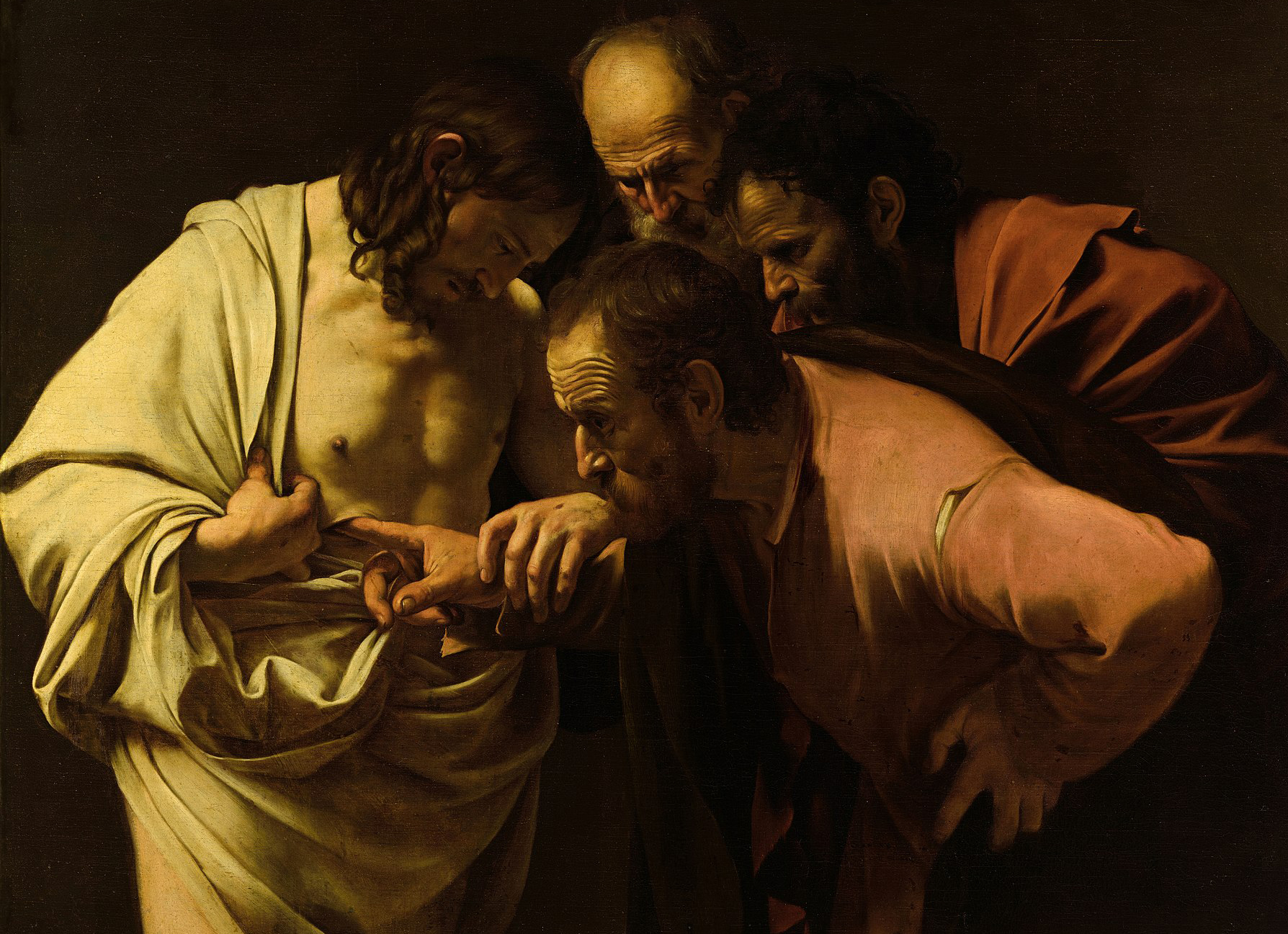
And of course, this is Thomas’s question. He doubts that any of what the other disciples are saying could possibly be true. What have they been smoking? Dead and buried, Jesus was. There’s no use in talking about it anymore.
When he appears in that upper room where Jesus followers were huddled in fear of the authorities, Thomas cannot comprehend the story they tell. He demands proof. “Unless I see the mark of the nails in his hands and put my finger in their mark and my hand in his side, I will not believe.”
A week later, Thomas receives his proof as Jesus again appears although the doors of the house are shut tight. Jesus’ parting words to Thomas – “Have you believed because you have seen me? Blessed are those who have not seen and yet have come to believe.”
Doubt is the proper order of the day. As Frederick Buechner said about religious doubt, “Doubt is the ants in the pants of faith; they keep it alive and moving.”
Unfortunately, the great growth of the church, beginning in the 50s after WWII was, by and large, the church of the “comfortable pew.” Sunday was the most segregated hour in America and what parishioners expected of the church was assurance. Velvety complacency was the order of the day.
Such a complacent and inoffensive Christianity was mocked by that song out of the 60s, “Plastic Jesus.” “I don’t care if it rains or freezes / Long as I got my plastic Jesus / Sittin’ on the dashboard of my car.”
Yet there lurked in the background of our mainline congregations a small group of radical folks whose souls had been infected by the gospels. A group yearning for more than pious platitudes and sappy hymns. They wanted a church that entered into the messiness of a wounded world. A church that would bear the burdens of Christ Crucified in the struggles for civil rights, racial reconciliation.
These folks would see Christ, would know him by his wounded body – the Church that bears the wounds of us all. This Sunday, in many churches is what is known as Thomas Sunday. Thomas wants to see Jesus before he will believe. And how will he know that the one he gazes upon is the real McCoy? By the wounds in his hands and feet. By the gash in his side where he was pierced by a Roman spear. He wants the real thing. By his wounds – that is exactly how he will know.
We will know the authentic representation of Christ – for the Church is the Body of Christ incarnate – when we see the wounds. Authentic Christianity enters into the struggle, the heartache of “the least of these.” It bears the wounds, the worry, of the homeless, the incarcerated, the addicted and the defeated.
Christ is the face of thousands.
The authentic, wounded Christ is yet among us still today. Christ is that despairing man in the pew beside you whose wife has just received a terminal diagnosis of cancer.
Do you now see, Thomas?
Christ is that immigrant who has been detained by ICE. Separated from his wife and one-year-old daughter. Picked up as he arrived at his required check-in under the DACA program.[1]
Do you now see, Thomas?
In the recent COVID-19 pandemic Christ was that nurse working 12-hour shifts, sometimes seven days a week to the point of exhaustion.
Do you now see, Thomas?
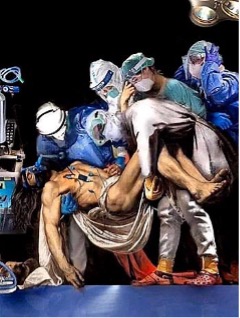
I recall a Facebook post I put up of a contemporary rendition of the Pietà. You remember the artist’s portrait of Mary receiving the tortured body of Christ from the Cross. The Wounded Christ of the Coronavirus Ward.
In this rendition the Christ of the Coronavirus Ward is portrayed as bearing the disfiguration of that disease. His virus-ravaged body is being lowered from a gurney by doctors, nurses and paramedics. Attached to his chest are still the leads of a heart monitor. He wears a face mask and little else to hide his nakedness.
Do you now see, Thomas?
This modern Pieta is not a pleasant picture. Not what you’d probably want hanging on your living room wall. Not the décor of a sanitized, inoffensive spirituality.
I remember also one woman writing back, not so much as in disgust or indignation – but what seemed an honest question, “Why did you post this?”
I explained that as followers of Jesus we need to enter into the hurt and pain of this world, just as Christ did. As Christ still does today.
For Christ takes on the wounded humanity yet today. In Lebanon where over 250 were killed in less than ten minutes by Israeli indiscriminate bombing of downtown Beirut. This Wounded Christ cries out from the ruins of destroyed homes, from the grief-stricken mother pawing through the remains for her dead children and husband.
Do you now see, Thomas?
Unless I see those wounds in the Church, the Body of Christ, I refuse to believe. Without those verifying wounds, it’s all Plastic Jesus.
When I hear Grandma’s question, “Was you there?” I strive to answer, yes, I was there. Yes, I am still there.
Thomas, here is your answer. In the nursing homes and in ICU wards. In ICE concentration camps. In the suffocating silence of a home ravaged by addiction. In the rubble of Gaza, Lebanon, and Iran.
Do you now see, Thomas?
Christ is in the face of that desperate family that has lost their medical insurance for a child with muscular dystrophy who needs around-the-clock care. Lost their insurance to pay for this senseless war of choice in Iran and Lebanon – a war of untold suffering now engulfing the entire Middle East.
Christ is that man languishing in an overcrowded jail simply because he could not afford competent legal advice or bail.
And Christ is the face of that Legal Aid worker toiling hours for little recompense to free him.
Christ is the face of those who blow their anti-ICE whistles, warning all that government thugs are about. At the risk of brutality, arrest or even death.
Christ is the face of that person who writes postcard after postcard urging infrequent voters to get to the polls. The face of millions in the No Kings Day demonstrations across our nation, from shore to shore. And up in Alaska, Hawaii and Puerto Rico. All advocating for a government that respects the dignity and rights of all its citizens.
This Sunday I ask the skeptic in all of us – that Doubting Thomas – might you, in a blind leap of faith, join those folks on the food distribution line, help in a homeless shelter or even greet an unhoused person on the sidewalk with a smile, and maybe a few greenbacks?
Might you now be the face of Christ, putting aside your niggling hesitations and lend a hand to receive his broken body?
Might you be the hands and feet, dare I say the wallet and sweat in our Garden of Hope and Food Bank?
In such generosity of Spirit there is the blessing to be found. Found beyond measure. A smidgen of life eternal.
Oh, Thomas, was I there? Yesterday, today and tomorrow, all of us — we of St. Francis’ and St John’s will be present – bearing the imprint of the wounds of Christ. Touch. Feel.
Do you now see, Thomas?
Amen.
April 12, 2026
2 Easter
“Was You There, Charlie?”
The Rev. Dr. John C. Forney
Acts 2:14a, 22-32; Psalm 16;
1 Peter 1:3-9; John 20:19-31
[1] Deferred Action for Childhood Arrivals. The program that protected undocumented persons brought to America when they were children and who have known no other country than the United States.
Christ the Gardener

We are sometimes blindsided by moments of complete and utter terror. I remember such a night over at our neighbor Jorie’s house where several of us junior high school kids had gathered to watch a new TV program, “The Sea Around Us” in living color. Her family had the only color TV in the neighborhood.
At one point, during an intermission, we broke for snacks that her mother had made. As we passed through the dining room some of the kids were looking out the sliding class door. “Look at that,” one exclaimed. They were all staring at a very large bullfrog out on the patio.
When I looked out the window all I saw was the pitch-black night. I was overcome by a terrifying sensation of being sucked into an empty void. I don’t ever think I have felt such fear since. The experience was one of overwhelming existential terror.
I wonder if that was the experience of those first arriving in the wee hours of dawn to anoint Jesus’ body with spices. When they peered into the gaping black hole of that tomb carved out of rock, what moments of terror seized their souls?
The gospels record no details about what had actually happened at that moment – the seconds when his body was there and when it wasn’t. There were no witnesses. The guards were all asleep.
The entire event, the most seminal happening for Jesus’ followers – and nobody was there. No reporter from NBC Nightly News. No Lester Holt at the anchor’s chair. No bright lights and cameras. No one there.
The first gospel narratives were written a generation or two after those events. Tales passed down from one to another, Mark’s version being the first iteration. John’s version most likely being narrated by his community of faith maybe five generations removed from that first Easter.
Christian writers, attempting to explain the inexplicable down through the centuries. The entirety of that Easter Event still alludes our capacity to understand.
John Cobb, the eminent process theologian in his work, Christ in a Pluralistic Age,[1] explains the astounding experience of that first Easter. That morning, the spiritual reality of who Jesus was, is now let loose into the created order.
Remember, Dr. Cobb would remind us, “Christ” was not Jesus’ last name. It denotes the spiritual reality of his life and message now transcending his death. The core of his being. A new, transforming power let loose in the world. Passed from one follower to another down through the hallowed halls of time by the faithful – a long procession of members of the Jesus Movement.
Christianity so understood, is not a set of dogmas, not a rule book, but a way of life. In the first years after his death, Jesus’ followers were known as “Followers of the Way.” Look out the door of our parish hall to that garden that feeds some 470 people a week — that’s what we believe. That’s how we roll here at St. Francis.
As such, it is a mature Spiritual understanding capacious enough to encompass
the gifts of all religious traditions rooted in the way of compassion and servanthood.
Here is one way in which an ecumenical “generous orthodoxy” works itself out. Let me tell you a story told of an interfaith gathering. Unfortunately, the host pastor preceding the featured speaker of the evening – this pastor who was to give opening remarks and welcome, was from a very conservative church. His agenda was not interfaith understanding. He used his brief moments of introduction to score religious points for Jesus.
He was there to prove the supremacy of his Christian faith. He was solely bent on demeaning the speaker’s faith, proving the superiority of his own, rather than entering into any interfaith dialogue. He cared not a whit about the sensitivities of those in the room who were not Christians.
He addressed the crowd reading from one of the most exclusivistic passages of the John’s gospel. “I am the way, the truth and the life, no one comes to the Father but by me.”
What a jerk, many thought. Way to make our guest feel welcome!
Most in the audience were embarrassed by this lack of charity, by this lack of basic manners. Folks sat in their seats in stony silence, glued to their places as interfaith relations were possibly set back hundreds of years. As the guest speaker approached the podium, all wondered how he would respond.
The speaker stepped up and benevolently smiled at his audience. After a pause, he proclaimed, “The pastor is absolutely correct.”
“For, what is the way of Jesus, but the way of peace, humility, truth, gentleness and respect. That is the only way one can approach God, enter into the Holy.” No matter what his or her faith might be.
This Hindu man had seen in Jesus that which this pastor failed to register: the Inner Light of God. The speaker had seen the same spiritual luminosity that those Wise Sages saw in that baby’s eyes, lying in the poverty of a manger.
The same vibrancy those early witnesses experienced on that Easter Morning. John Cobb asserts that this is the spiritual reality let loose in creation that yet lives through the humanistic values and ethic of the Renaissance. Christ has infused the spirit of that age. In the work of Michelangelo, DaVinci and Fra Angelica. Artists who through their work testified to that God-spark they perceived in all human flesh and endeavor. Through the milieu of the Renaissance and later the Age of Science, that human capacity for invention and exploration of those men and women who understood the grandeur of the created order – through their lives that same Spirit yet lives. Just as it did among the first astounded followers that Easter Morning.
We will soon baptize Luther James Forney, calling upon the very same Spirit let loose that first Easter — the Holy Spirit, if you will – to give him the same discerning mind and generous spirit as we’ve known in the Risen Christ.
We call upon God to give him the same passion for justice and freedom as those intrepid souls who followed Harriet Tubman through the swamps of the South to new lives of dignity and promise in the North. Following the Drinking Gourd to freedom. Terrifying journeys often steps ahead of the trackers and baying dogs.
We call upon the Holy Spirit to give him the courage to stand for what is right – just as did those German farmers who hid Jews in their fields and barns. Never knowing when Gestapo agents might show up and kill everyone involved. Just as did that family in Amsterdam who for two years hid Anne Frank in their attic. Never knowing when some nosy neighbor might betray them and summon Hitler’s SS agents.
We ask for a discerning mind to speak truth to power as did Bishop Mariann Budde after witnessing our president desecrate one of her churches. Leading an entourage of cabinet officers across Lafayette Park to hold a Bible upside down in front of St. John’s Episcopal Church for a photo op.
For it is in these inspired and intrepid souls that Christ is known today. These are true and trusted people of the Way, the ones of whom that Hindu teacher spoke. For the authentic Way of Jesus, the Risen Christ, is the face of all who daily live out that humble care for their fellows. Yes, even to the point of death, as did two ICE protesters in Minneapolis.
We pray that Luther James might have that same generosity of Spirit as did that Hindu speaker, a capacious understanding of divine purpose that transcends our limited sectarian boundaries. An openness to the magnificent depths of our common humanity and the marvels of this created world, honoring God’s presence in all persons.
Frederick Buechner, in his book The Faces of Jesus,[2] makes the point that we have no idea of what Jesus looked like. Despite all the glorious attempts of our noted artists down through the years. We have absolutely no idea.
Mary Magdalene thought he might have been the gardener. And why not? He is the face of even those who presently tend our St. Francis Garden of Hope. When it comes down to it, in the last reality, the face of the Risen Christ is your face. And mine. And the sweet face of this tiny child Luther James whom we will baptize into the family of the Jesus Movement. Luther James, you are the Easter face of the Risen Christ.
As we gather in thanksgiving and gratitude for his life, as we pour out our prayers, hopes and dreams for him – that he finds his own way as a blessing to our common life as a part of the Beloved Community – we raise the Easter Greeting. Christ is Risen. He is Risen indeed.
Amen.
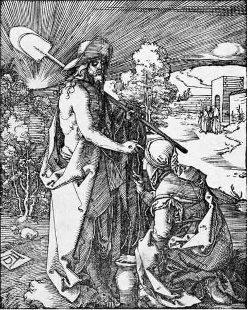
Christ the Gardener, Albrecht Dürer, c. 1511
April 5, 2026
Easter Sunday, 2026 – the Baptism of Luther James Forney
“Christ the Gardener”
The Rev. Dr. John C. Forney
Acts 10:34-43; Psalm 118:1-2, 14-24;
Philippians 2:5-11; John 20:1-18
[1] John B. Cobb, Jr., Christ in a Pluralistic Age (Philadelphia: The Westminster Press, 1975), 33.
[2] Frederick Buechner, The Faces of Jesus: a Life Story (Brester, MA: Paraclete Press, 1974).
This Night
In the Passover liturgy, the youngest son at the meal asks the seminal question, “Why is this night different from all others?”
The narrative of the Passover, the haste in being ready at a moment’s notice to leave Egypt, the hurried meal, so rushed that the dough for the bread has no time to rise. The night of death that hovers about the fleeing families as they hear the howls of anguish from those families touched by the Angel of Death. It must have been most terrifying to the young.
Even if they had no understanding of the danger and the dread of their parents as the readied for a journey into a terrifying unknown – they surely sensed the danger and the silent anxiety of their parents and neighbors as families gathered in bunches on the path outside their houses.
A night like none other.
This story has provided assurance for people fleeing oppression throughout the ages. It was a lamp for the feet of Harriett Tubman and those fleeing enslavement in the south. To hear the baying of the tracker dogs was surely no less frightening than the sound of clanking armor and pounding of horses’ hooves of Pharoah’s approaching army that perused the escaping Hebrews. That night of departure, a night like none other.
I’ve been listening to an oral history of the personages and events around the development of the atomic bomb. What struck me was the fraught moment of decision for many Jewish scientists as the Nazi storm clouds began to envelope Germany.
The recollection of those whose options were diminishing by the moment and the alarm forcing a decision. To leave or stay. I’m surprised by the number in denial, saying, chancellors come and chancellors go. Hitler probably won’t be any worse than the others.
And their other colleagues, university professors and doctors squeezed out of their professions and livelihoods, as options shrank – those intrepid souls who decided to get out while it was still possible. Before doom settled in.
Nights like no other, Krystallnacht, the Night of the Long Knives when Hitler’s Brown Shirts assassinatedmany of the intelligentsia, business and professional classes of Jews who remained behind.
Nights of terror. Nights like no other as Germany sank into a living hell.
Today, US Marines have been called up for duty in Iran. Their commanders have told them to prepare their equipment, steel their spine and make loved ones aware that some of them will not be coming back. Get your affairs in order. Final instructions ought to be given for families to carry on in the case they’re killed in battle are now in order.
Nights like no other as they hastily assemble and prepare to head out.
We all have premonitions of that last night or our last fleeting moments. The time when everything hangs in the balance. A time when we will no longer look forward to that aromatic cup of coffee. A time when we will see that last sunset. The time when we will no longer hear the voice of a loved one or feel their gentle caress. In a real sense, we all face a final night like no others.
As Jesus drew his friends around him, he knew that night would be a night like none other. For all of them. He knew that this would be his last meal with those companions over these last three or so years. Night was closing in. The end was in sight.
A night that would turn the world upside down. Caeser’s arms might momentarily hold sway, but a new, subversive order was in the borning. Not based on might, prestige or outward appearance, but based on humility.
As Jesus took a towel and basin and prepared to wash his disciples’ feet, a gesture so radical, they could not comprehend it. Nothing in their past experience had prepared any of them for this new way of being.
Yes, even at those last hours they still understood nothing. As Luke records the disciples’ bad behavior at that meal and the commandment to serve one another, “They understood none of these things; this saying was hid from them and they did not grasp what was said.”[1] They quarreled amongst themselves at that table. Who would be the greatest? And if they should fall to the Caesar’s sword, who among them might sit at their Lord’s right hand?
They understood nothing; nor do we comprehend this new thing God is doing before our very eyes. Time and again we mess it up. Yet here we are, assembled at this night out of sheer Grace at the Welcome Table..
As we come forward in obedience to Christ’s command to wash one another’s feet, to share in the Bread broken and the Cup of Sorrows poured out — in all humility let us remember and give thanks to that Man for Others who by his example has ushered in a new way of being. A night like no others as we prepare to venture out – not knowing where the Spirit leads, but on the road in faith.
As it has been through the eons of time, for generation after generation – it has ben that the choice is ours. Will we with humble and contrite hearts set our prerogatives aside and join our Lord in the creation of a New Creation – will we join Christ’s vision of a Beloved Community – united as brothers and sisters in venturing into a new way of being? Or will we drift along wherever the Kingdom of Caesar takes us? Lives of lesser purpose. Just a part of the food chain until our eyes are finally shut in sweet oblivion?
O Lord, in this moment, teach us to number our days that we might get a heart of wisdom. Lead us into that Life Abundant that we might truly live. Usher us toward a foretaste of Eternity. On This Night. Amen.
[1] Luke 18:34, RSV.
April 2, 2026, Maundy Thursday
“This Night”
The Rev. Dr. John C. Forney, St. Francis Episcopal Mission
Exodus 12:1-4, 11-14; Psalm 116:1, 10-17;
1 Corinthians 11:23-26; Gospel: John 13:1-17, 31b-35
The Summons of the Via Dolorosa

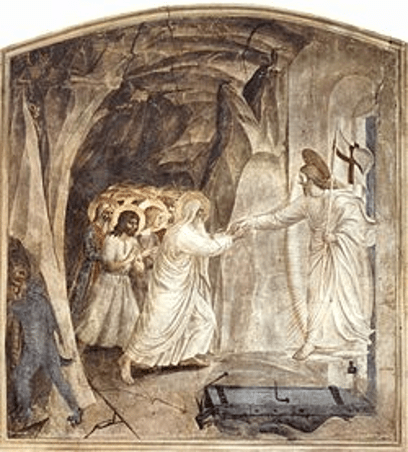
Today, my issue of the Living Church arrived and on the front cover was a picture of the “Harrowing of Hell.” This image is from the Icon Museum in Recklinghausen, Germany, artist unknown.
In the Apostles Creed, one line reads, “he descended to the Underworld” – which we interpret to mean “to the dead” – or to “Hell.” This is taken from the verse in 1 Peter, 4:6. The Harrowing of Hell is commemorated on Holy Saturday.
I take this observance to mean that, ultimately, no one is beyond the saving grace of the Good News. Yes, even Judas.
When Jai and I were in Jerusalem, that city was so commercialized that It was difficult to get into the mind of the auspicious and seminal events of Holy Week. Among all the stalls offering everything from tourist trinkets to lentils, dates and melons, nothing seemed to have remained from the time of Jesus’ last days.
It wasn’t until we got to the Wailing Wall – the only remains of the second temple wall begun by Herod the Great — and the Church of the Holy Sepulchre that I began to feel some of the ambiance of that ancient City of David. Yet I had no idea where the path of sorrow was which Jesus took from his trial to the Cross on Golgotha — the Via Dolorosa –I had no idea of how it might have wended its way through the city to that fateful end.
It is during this time of Holy Week, beginning with Palm Sunday, that even the non-believing world becomes aware of the Christian story. With the reenactment of the pageantry of the processions of the palms around the world, the world becomes acutely aware of that Man for Others. The one who “humbled himself and became obedient to the point of death—even death on a cross.”[1]
In our milieu of hyper-partisan Christianity, many – especially our younger generations — are repulsed by the vulgar sensationalizing of the message by right-wing Christian Nationalists. Whatever their mental picture of Jesus, THIS IS NOT IT.
In his book, Evangelism in the Age of Despair,[2] Andrew Root makes the point that the substance of the Good News can mostly be conveyed by those who come to others as a servant, in humility, entering the suffering of this age.
The only Christ that neighbor might ever encounter is in that neighbor, friend, who becomes vulnerable to their pain, their great despair. Just as Christ descended to the dead with Good News – for in his or her despair, overwhelming grief, that friend was indeed dead to themselves and those around.
Dr. Root tells a prototypical story, drawn from a number of experiences of such a contemporary encounter.[3]
The story begins with Mary Ann, who had landed a job with a trucking company outside of San Diego, California. Her new boss, Bud, the owner, of this small operation, was most supportive, though a somewhat gruff personality.
As the company grew, Bud realized that he needed someone to manage personnel, a Human Resources manager. He offered the new position to Mary Ann, though she’d had no experience in such work. But Mary Ann was a quick learner even though she had no college background. By attending conferences, seminars and through reading, she was soon up to speed. The company was still small and the demands for the new HR position were not overwhelming.
It finally looked like everything in her life was clicking. She had two wonderful children, a home in a nice neighborhood and a great job she loved.
Until, out of the blue, her husband announced he wanted a divorce.
She might have seen this coming. She and her husband more and more frequently bickered over money and pretty much everything else. Mary Ann figured that more money from her increased salary would resolve the tension. Not so.
There she was, now on her own with two children under ten without a father. Grief, self-doubt and depression became the order of her days. The emotional pain shook her to her core. She could barely be there for her children or her job.
She poured herself into her job and that helped somewhat. But busyness could not take away the shame, the anxiety and the sorrow. The sorrow, more than anything else, settled about her as a dense fog. No sunshine to her days.
Mary Ann’s father, like many from the 60s counter culture had drifted to the West Coast. Some in Los Angeles, others to the Bay Area around San Francisco and Berkeley. Unlike her father, she didn’t hate the church, she just never gave it much thought.
Her father was a “tough-it-through” kind of guy. Never admit your hurt.
One day, a coworker, Valentina, who had been noticing Mary Ann’s slow decline into despair, approached her and asked her if she was okay. “I’ve noticing that you seem to be carrying a lot of weight on your shoulders – a pretty heavy load.”
Those words caused an emotional dam to burst in Mary Ann. She, for the first time, unloaded her burden. For two hours they talked. Mary Ann felt that she had been held in a way she never had before. Yes, she needed a friend.
Valentina, also, had known loss. Her son had been arrested and sentenced to jail for theft, which led to addiction. She told Mary Ann how the people of her church had come to the courtroom and sat with her during the trial. They fed her for three weeks afterward.
Because of that experience Valentina was walking a nearby horse-trail with Mary Ann three times a week.
Valentina’s pastor was constantly telling the congregation that the followers of Jesus know sorrow. She saw that example through the depths of her own depression. Because of that, she was now out on this horse-trail with Mary Ann three times a week.
Valentina may be the only image of Christ that Mary Ann would ever know. And that is sufficient. In that friendship was born the entire message of the Gospel. Now vibrantly alive in Mary Ann’s heart as well as she walked her own Via Dolorosa.
I never found out where that ancient trail of tears led through Jerusalem, but I am well acquainted with that Via Dolorosa in my own heart. And it has been a saving grace at needed times to have had trusted companions along that way.
Yes, together we navigate that path as it has wound its way through our lives, through the lives of friends and family for in faith we know it leads to an Easter Sunrise.
That’s my story and I’m sticking to it, for Christ in our friends will join us along the way to lift and to sustain. Just as Christ does three times a week on that horse-trail in the guise of Mary Ann’s dear friend. Amen.
[1] Philippians 2:8, NRSV.
[2] Andrew Root, Evangelism in an Age of Despair: Hope Beyond the Failed Promise of Happiness (Grand Rapids, MI: Baker Academic).
[3] Ibid, the story which follows is from pages 4-7.
March 29, 2026
Palm Sunday, 2026
“The Summons of the Via Dolorosa”
The Rev. Dr. John C. Forney
Liturgy of the Psalms: Matthew 21:1-11
Isaiah 50:4-9a; Psalm 31:9-16;
Philippians 2:5-11; Matthew 26:14-54
I Only Know That…

There’s an old song from the 80s by Boxcar Willie. Born as Lecil Travis Martin, one day sitting at a railroad crossing he saw a boxcar go by and in the door was a fellow who looked like his loading master in the Air Force. Willie Wilson became the inspiration for a second career as Boxcar Willie. And for many years during the Korean War, he had a full-time gig with the Air force, retiring as a Master Sargant.
One of his signature hits was “Hey Mister Can You Spare a Dime.” Like many of his songs, this one showed great empathy for the down-and-out – the hobos cast adrift.
During times of adversity and social dislocation, many families were splintered, often as the men went looking for work in far-away places, or sometimes out of guilt they felt their families would be better off without them. They didn’t want to be a burden, or were too ashamed to stick around. Or they became stuck in the bottle.
These days, it is often addiction that shreds families. Or mental illness. Sometimes, it’s losing or being priced out of housing. Or the loss of a job. Right now, so many Americans are living on the margin. One little unexpected expense throws many families into financial chaos.
In John’s gospel we encounter a barrage of dysfunction occasioned by the completely unexpected.
Jesus encounters a blind man on the side of the road. The disciples first instinct is to cast blame. “Who sinned, this man or his parents?” Who’s to blame? Often, it’s blame the victim. That’s how racism works.
When Jesus dismisses such scapegoating, he then proceeds to heal the man with spit and mud. Then tells him to wash in the pool of Siloam.
The man, to his astonishment, sees. The unexpected, the unexplained.
The man’s neighbors who had only known the fellow as a beggar, now begin to argue among themselves. The blind do NOT see. Their fellow villager could not possibly be now seeing. They refuse to accept what their own eyes see – this guy now seeing must have just looked like the beggar they had know at the side of the road.
When the man explained how it was that Jesus had healed him, he can’t rightly explain where that man presently was.
And since this was done on the Sabbath, the religious authorities are now involved in this community-wide imbroglio. This Jesus must be a sinner since he had done the deed on the Day of Rest, the Sabbath.
But no one who is a sinner, one group argued, could have done such a deed. Yet most of the pious folks cannot believe this man. They ask him to explain again and again what had actually happened.
They now call the man’s parents. Out of fear they mumble, ask our son. He is of age. Yes, even the man’s parents deny him.
When the formerly blind man is again hauled before the righteous religious leaders, they now tell the man to give Glory to God, not Jesus – for he is a sinner.
All the seeing man can say is, “I only know that … I only know that I once was blind but now I see.”
In the Gospel of John, this event was considered much more than a healing miracle. It is a sign – a sign that in Jesus and his work, God is in this place. It as a sign of the Divine Will for redemption and salvation. Indeed, God is working God’s purpose out step by step as our Lord trods the sacrificial path to Jerusalem. Step by step with wonders along the way.
And we, when the most astonishing things transpire, can only say… in open-mouthed amazement — can only say, “Thanks be to God.”
What exactly happened, and how it happened we cannot rightly say. As my Methodist friends would say, “My heart was strangely warmed.”
In response, we with warm hearts respond as best we can and thank God we have breath and life, and capacity to make some meaningful response.
My friend Dick came upon a fellow just by chance, or maybe not by chance. Who knows, he can only say that… he can only say that this man was a gift of God as he lay on his cot.
Over the months Dick got to know Tom and his little dog. Dick helped Tom find a living situation that would accept his little dog. When the shelter demanded that the dog be licensed and given his shots, Dick hit me up to help foot the bill. In that way I got to know Tom and his dog.
No, the dog was not blind but now sees. But he was licensed and vaccinated. And for Tom, that was miracle enough. Tom had been on his own, no known family but that little dog. And the people who rallied around the two to keep them safe, housed and fed. Miracle enough for Tom.
Did God direct Dick to Tom in that first shelter? I only know that… a mystery. And a blessing to all involved.
Ohers would have blamed him for his shabby circumstances. Or have run Tom out of their communities. Many of our communities would not have behaved any better towards Tom and the other homeless on our city streets than had that beggar’s village regarded him. Sweep them off the streets. They’re a big inconvenience. Bad for business.
But as debilitated as he was, Tom was doing the best he able to do with his mental health issues. In and through friends of the Jesus Movement healing happened in some small way for Tom and his dog.
Such healing, call them miracles if you will, is wrought through human agency and the real stuff of creation – even spit, mud and water. Through the solid voice of compassion and encouragement.
How often have you felt that gentle nudge, that silent voice propelling you as an agent of mystery, of compassion?
During the Great Depression on many nights my grandma who lived in Lodi, CA, would set some of the supper she had made for the family out on the back porch with a ladle and paper bowls. This was for the vagrants who came through her’s and grandpa’s back alley at night hunting for any sustenance, anything useful that might have been thrown away.
She was well aware, since her husband was the postmaster of Lodi, that they were going to be okay. Unlike the many who trod that back alley.
Her hands and bowls of supper on her back porch were signs that in some small way God was in this place. You may be down-and-out, but a kind, gentle woman has remembered you. Sacrament of God’s Remembrance. A sign that in some small way God was in this place.
Under the tyranny of the ruling religious leaders and the pressure of the Roman empire, we have the story of an entire community fractured – a family, a village, a faith community.
And the only fully functioning person in this melodrama is the beggar, the one considered of no account. He speaks the truth, “All I know is that…that I once was blind but now I see.” A sign of God’s will for the healing and restoration of all creation – into a community of love.
Amid all the chaos and incompetence, the horror of masked goons dragging Americans and others off the streets. Killing with impunity on our nation’s city streets, I cannot blame those who are totally bummed out and would rather withdraw in a warm cocoon. Thankfully, we have those amongst us who are opening the eyes of an electorate gone blind.
One of these healing persons is the United Methodist Bishop, Grant Hagiya. Bishop Hagiya, now retired, is presently the president of Claremont School of Theology – my alma mater. The bishop, in his episcopal letter, gives us sound instruction on how to survive the next three years. With our souls intact.
- Focus only on that which we have control over in our lives. We can’t personally stop this insane war. We can’t stop the predations of the grifters around this president. But we can support candidates we believe in. We can make sure our friends and family vote in November. Save the date – November 3rd.
- We can take our baptismal vows seriously. Resist evil, and when you fall into the sin of complacency and accommodation, repent. Rely on the One who empowers you to resist evil and oppression.
- Speak the truth to the erasure of our history by Trump. Have the moral courage to embrace the total American journey, its glorious people of all races and nationalities that have made their contributions. Have the courage to accept open-eyed the worst we have done and been. Speak that truth to those who would whitewash our errors.
- Take time to enjoy the ordinary activities of the day, whether washing dishes, playing cards with you kids or reading them a book. Take time to enjoy a lunch with a cherished friend or making dinner. Delight in these pieces of our lives.
The bishop’s letter draws on the wisdom of a Zen monk who counsels us to look at the day’s activities as a string of beads. Some large, some small. Some eye-catching, others dull. From the broad perspective of time, all beads are equally important. They’re all pieces of our lives. Rejoice and be glad that they are given to your hands and heart. The appropriate response here is, “Thanks be to God.”
This is clear-eyed wisdom for getting through the next three years with equanimity and graciousness. And your sanity.
The Serenity Prayer is a fitting close here.
God grant me the serenity to accept the things I cannot change, the courage to change the things I can, and the wisdom to know the difference.”
With this calming of mind, like that ancient beggar, we can rightly say, I only know that…that God is in this place. A sign indeed! Amen
March 15, 2026
Lent 4 – Mothering Sunday
“I Only Know That…”
The Rev. Dr. John C. Forney
1Samuel 16:1-13; Psalm 23;
Ephesians 5:8-14; John 9:1-41
The Invitation of Living Water

One of the most foreboding places on this earth is a scorching, dry desert.
I remember my first church off the 395 Highway in Randsburg, California. Randsburg in the 1890s had been a thriving gold mining community of over 6000. More gold was taken out of the Yellow Aster Mine on the outskirts of that town than from any other mine in California.
A number of citizens of that town had banded together to build a Methodist church and from stories of the old timers — those pews for some 80 persons were mostly filled on any given Sunday.
By the time I arrived as pastor, some 80 years later the town had dwindled down to some 200 souls and the remnant congregation was comprised of 4 persons. That’s right, just 4.
My assignment was to follow up on a major bequest that had been given the church, collect the money for the denomination and then close the church.
What I soon discovered was that my predecessor had been a rather cranky personality who alienated many in that community and the other adjacent communities of Red Mountain and Johannesburg. He also hated visiting folks. He was uniquely ill-at-ease with people.
I also discovered that if I spent a couple of days a week visiting around the three towns, all about a mile apart, there were a number of folks interested in having a vital alternative to the bars and TV.
Within weeks we had a little congregation of 10, then 20-some.
When I had first arrived, besides the minute congregation – the most depressing thing was that there was no water. The water had been shut off a couple of years ago to save money.
Out in that scorching desert without water – I desperately wanted it to flow for our little group. Another new member of the church and I did the repairs to the plumbing, paid the fees and got the water flowing. The next Sunday was a real celebration. Water was the sacramental sign that the Spirit was alive in this place.
We did a lot of other things in the six years I served there: Started a senior citizen’s lunch program in the community hall in Johannesburg, started a youth group, had a church breakfast before the Sunday services began. Even built the first indoor flush toilets. Previously it had been taking your chances with the black widow spiders in the outhouse.
But I always felt that getting the water running was the sign of the real beginning. The proof that there was life in that place. That small community of faith was Living Water for those three towns.
In our lectionary readings appointed for this Sunday we have two passages where water is front and center.
In Exodus we read of the grumbling of the parched Israelites as they travel the desert wilderness under the leadership of Moses. In fact, they are at the point of mutiny, about to stone Moses. Their complaint was about the lack of water to drink.
“But the people thirsted there for water; and the people complained against Moses and said, ‘Why did you bring us out of Egypt, to kill us and our children and livestock with thirst?’”
The upshot was that God instructed Moses to take some elders and go to the rock at Horeb. Strike it with the staff used to strike the Nile. Moses did as told and water flowed from that rock.
Water, the precious substance of life, was the sure sign, the answer to the people’s quarrel with the Lord, “Is the Lord among us or not?”
In our passage from John, this gift of water is also life itself. What Jesus provided at the well for that Samaritan woman was Living Water, the very substance of Eternity itself. In those few moments at that well Jesus reveals her to herself at the deepest level.
With amazement she leaves her water jug and runs back to her village, summoning one and all. “Come and see.” This Living Water is Jesus himself. “Come and see.” And all in that town made their way to him. She had come upon the very substance of Life Everlasting – and her life overflowed with it as well.
“Living Water” is a metaphor – a word-symbol that connotates multiple meanings. That is its richness.
When those words become sacramental – a physical substance revealing a spiritual reality – they are just that, real.
That woman at the well experienced a profound reality in the truth Jesus revealed about her life. And in his lack of judgement, he freed her. She became a living witness to his reality. In her being that soulful exuberance was Living Water.
In this passage from John’s gospel, he is not only speaking to that woman long ago, but he’s speaking to us. As we drink deeply of what Jesus is offering, we become “Living Water.”
We live in a parched land. Hate and division are the weeds of this desert landscape. Greed and racism the tumbleweeds that are blown by an ill wind. We have a politics that feeds on it all. And billionaire grifters that profit from it.
So, where in our deepest souls do we encounter that saving “Living Water.”
One theologian, Stanley Hauerwas, identified that essential life-giving substance as Truth.
When I immerse myself in my Book of Hours, prayerbook readings for traditional times of daily prayer for each day of the week, I find myself before a Centering Reality. There I find the redeeming truth that God loves me and all of creation – that you and I are persons of worth, persons who matter, bound up together in a life-affirming mutuality.
These prayers are a needed reminder that no matter my pitiful state of mind, that’s not the final story. Yes, God is love and those who abide in love abide in God and God in them. End of story.
These passages from scripture are Living Water.
Yesterday, in my dialysis chair I had the opportunity to watch the funeral service for the Rev. Jesse Jackson. The eulogies and singing – a huge gospel choir – they were a gusher of Living Water.
Remember his signature mantra. “Keep Hope Alive. Keep Hope Alive.”
As former president Obama cautioned, in our day, given the outrages of this current administration, that’s a difficult task.
Every day we are assaulted by new disasters, new incompetencies. Lies upon lies that give the “Father of all Lies” a run for his money.
We were not going to have anymore “Forever Wars” was the pledge, yet with no congressional approval we’ve committed American forces to a debacle that is now consuming the entire Middle East. Americans are being slaughtered in our city streets by ICE thugs right out of a Gestapo play book. The planet continues to heat up and the response of White House incompetents who seem to have never read a science book is, “Drill, baby, drill. Drill, baby, drill.” And fire all the people at EPA who had previously monitored the increasing amounts of greenhouse gasses. Yeah, what’s that burning smell?
All this to avoid the fallout and consequences of the Jeffrey Epstein files? All to distract us from the testimony of an underage thirteen-year-old girl who had allegedly been sexually assaulted by Trump at an Epstein party? Any FBI investigation into her story? Nothing! All swept under the rug. Nothing to see here, folks. Just move on. Just move on.
Every day a new outrage. Yes, it’s difficult under such a barrage of sewage to Keep Hope Alive.
Yet, Jackson’s memorial service was a tonic for the soul. An overflowing fountain of Living Water. A river of Gospel Goodness straight from our Lord, running down through the centuries to that church auditorium yesterday.
President Obama laid out the challenge facing the community of faith these coming days. The temptation is just to keep our heads down and hope this would all go away or pass us by.
Rev. Al Sharpton, in the midst of this debilitating chaos, gave us our assignment. Much as Jesse Jackson would hand out assignments at his rallies. Our assignment is to be that Living Water, nourishing all we lift up, all we sustain by Holy Resistance, uniting not dividing. Rev. Al gave us our commission to Keep Hope Alive in whatever small ways we can. He buoyed up our faith that Hope might flow through us.
That service was a healing balm to the souls of all who witnessed it. You can catch the entire event on MSNOW YouTube.
And so the community is gathered in around this life-enhancing Word, a bountiful spring of Living Water. We share stories of family and of hardship. Stories of grandchildren. We share stories of adventure and joy. And the stories of such legends as Jesse Jackson.
And the garden just outside our parish hall that feeds 470 persons each week with nutritious vegetables and fruit – that also is Living Water for those who come to St. John’s Food Bank every Wednesday.
We are a community of Living Water that nourishes not only the soul but our real-life neighbors in need. Those veggies are Spirit made flesh.
Here is the Living Water we thirst for in this barren desert now called America. Our assignment is to pass along those stories, to be those stories of Living Water in word and deed.
I close with a favorite story from my dear friend Dick Bunce. A story flowing with pure Grace. Living Water.
Early in the last century, a minister boarded a train and went looking for a seat. The train was crowded and he felt fortunate to land a seat. He found himself sitting next to a young man who seemed disinterested in conversation. As the train got underway, the minister saw that the young man seemed burdened and preoccupied. The minister found a way to get a light conversation started, and this led to a question to the young man about the purpose of his trip.
Somehow, the youthful man sensed that this older fellow was trustworthy and genuinely interested. So he shared his story.
A couple of years prior, while in his late teens, he had become rebellious. He wanted more freedom and pursued it in a lot of the wrong ways. One evening, when confronted by his parents, he exploded with anger and shouted over his shoulder as he strutted out that he was leaving and would not be coming back.
He held to that for two years. He hitchhiked, took odd jobs, and made no attempt to reach out to his parents.
During his self-imposed exile, he matured. One day, at long last, he sat down to write a letter – perhaps the hardest letter he’d ever attempted to write. He stated that he been wrong and that he would like to see them again. He said he’d be on the 4:30 afternoon special and gave the date.
This was the train he was on as he talked to the minister. It happened to pass the backyard of his parent’s home. By simply looking out he’d be able to get a good view of the yard.
After writing the date and time, he said to his parents that if they wanted to see him, simply hang something white on the Sycamore tree. He was quick to add that he would understand if they preferred not to see him considering how rudely and irresponsibly he had behaved.
Eventually, the train neared his old neighborhood. The minister and young man fell silent as the train rounded a wide curve that would bring the yard into view. The yard appeared. And there was something white hanging from the tree.
Oh yes! White towels, sheets, blankets, pillow cases, you name it – a blizzard of white hanging from the tree, eaves of the house, even the telephone wires.
The minister watched as this young fellow stepped off the train at the station just a mile or so from the house. As soon as he was off the train, he ran.
He ran toward the open arms of his mother and dad.
Just as, at our end, when our journey’s over, we run into the open arms of our Lord Jesus Christ – Living Water for all who thirst for something of eternity.
Amen
March 8, 2026
Lent 3
“The Invitation of Living Water”
The Rev. Dr. John C. Forney
Exodus 17:1-7; Psalm 95;
Romans 5:1-11; John 4:5-42
Journey into the Unknown

The beginnings of ambitious journeys are often beset by missteps and bad luck. Or sometimes splendid serendipity. Nothing certain here – that’s definitely the case with any Lenten journey taken in deep prayerful seriousness.
It was certainly the case for one man’s most ambitious journey to capture the presidency of the United States – a journey into the unknown.
It should have been a slam dunk. George H. W. Bush, a former pitcher in college, would be throwing out the first ball at Game One of the National Leage Championship Series. All he would have had to have done was to take a taxi to the game, buy his hot dog, walk out onto the pitcher’s mound and throw out the first ball at Game One on the National League Championship Series.
It would have been a friendly crowd of some 40,000 fans, many of whom would have been his fans as well. Seated with beers and hot dogs in hand at the Houston Astrodome – a solid GOP crowd of Bush’s hometown. Many more looking on through the magic of TV.[1]
BUT, NO!
Plans and arrangements are meticulous, byzantine even. Every moment scripted. A huge motorcade. A black, handsome book with the seal of the Vice President noted every event down to the minute with diagrams – from the seating on the plane, the order of cars in the motorcade, staffing, every division of the staffing party, their phone numbers, every word that Bush would speak. Everything. The whole enchilada – planned down to a T. Down to the minute. A cast of hundreds.
Everything accounted for. Except one thing.
It had been a loooong time since Bush had last thrown a ball. A long while – back when he had played for Yale.
In his windup he couldn’t get his arms over his head so they ended up in front of his face. “…he sort of swivels to his left, and his arm flies back—but it won’t go back, so he gets it back even with his shoulder, and starts forward while his right lace-up feels for the dirt on the downslope, and he can tell it’s short while the throw is still in his hand, and he’s trying to get that little extra with his hand, which ends up, fingers splayed, almost waving, as he lands on his right foot, and lists to the left, towards first-base line.”
The upshot? The ball bobbles, then lands in the dirt many feet from the catcher and slowly rolls into his mitt. All on nationwide TV.
One just never knows how it will turn out with such a shaky beginning. Definitely, nothing certain. Not in this case. Yet we all know how that race turned out.
This was the inauspicious beginning of the most improbable journey any man or woman might undertake – the journey to be elected president of the United States of America. For a man or woman to leap from the belief that he or she should be president to actually saying in the back of their mind, “I am going to be president,” is a most improbable journey, fraught with many chance moments of disaster, moments of glory, and moments of missed opportunity. A journey into a great unknown.
Abram and Sarai likewise embarked on a great, fraught adventure, a most improbable journey into an unknown future. No guarantee as to the outcome. Nothing certain, but by faith alone.
“Now the Lord said to Abram, ‘Go from your country and your kindred and your father’s house to the land that I will show you. I will make of you a great nation, and I will bless you, and make your name great, so that you will be a blessing…’ So, Abram went, as the Lord had told him.”
Went. Went to where? Literally, only God knows. Sarai must have been ready to institutionalize her husband. He and his little band could have easily perished following this phantom of his own mind. The wackadoodle voices of mental illness. Delusional promptings of an unwell mind. No one would have ever heard from him again – as tragic as the Donner Party that perished in 1846 in the Sierra Nevada Mountains of California.
And yet, most unlikely, three of the world’s great religions – Jewish, Muslim, Christian — look to Abraham as a forefather of their faiths. And don’t forget Sarah, though the men left her out. Biblical note: Abram’s and Sarai’s names were changed in Genesis 17 to signify their acceptance of a new covenant with God.
Lent is also a time of journey, embracing an unknown and uncertain future. It’s in our face, right there as ICE pulls terrified immigrants from their houses, workplaces and cars. People whose perilous journeys to the US in search of safety or fleeing hunger or opportunity have led them to travel on foot thousands of miles.
This time of Lent invites us also to embark on such a incredible journey with all its perils and promise. A journey without maps as Graham Greene called it in 1936 – a travelogue based on his journey into the heart of Africa.
Instead of passively listening to the lessons of this Lenten season – what my boys would label as blizz-blaz, floating over distracted minds at 10,000 feet as it is read on any given Sunday morning. In our book of Lenten readings, focus on one or two passages that grab your mind. Or a hymn. Ask yourself in prayer, how does my life and my spiritual journey relate to the inner truth of this reading, this song?
What might it be saying to me personally? What might it be saying to my faith community? Finally, what might it be saying to the world? Trust that if this really is the Word of God, it has hidden power to restore, to change your life. Yes, read, mark, learn and inwardly digest. It will feed your soul.
In open, unguarded prayer with that passage, you might discover some wonderful surprises. You might discover some needed correction. You might find opportunities to be part of something greater than yourself. All, an open door to eternity.
The unexamined, closed up and guarded life goes nowhere. I’ve been reading a new book on the life of Robert McNamara, McNamara at War.[2]
McNamara had been a whiz kid. He had a superior intellect that he believed could solve virtually anything he put his mind to, whether it was running the Ford Motor Company or the World Bank. And mostly, he had succeeded.
But when he served as Secretary of Defense under Presidents Kennedy and Johnson, he came upon a problem that utterly confounded him.
At first, he thought that if he could just produce a high enough enemy body count, the numbers would vindicate his efforts. In his hubris he vastly underestimated his foe and their willingness to sacrifice for their own country. He also underestimated their inventiveness and the assistance they were getting from the Soviet Union and China.
We all know how that ill-fated journey ended. The authors of McNamara at War dramatically portray how the folly of Vietnam consumed Robert McNamara in guilt and self-reproach. It ate him alive.
Though at his life’s end he could confess his role in the many mistakes that led to the final debacle, with fleeing citizens scrambling to board helicopters taking off from the US embassy roof — many falling to their deaths, losing their finger-holds on the sides of those crafts as they became airborne – He could accept responsibility for all this, in the end he could not answer the primary question – why were we there in the first place?
The tragic end of McNamara’s life is portrayed as that of a doddering, disheveled old man, wandering the well-worn trek from donated office space to his Watergate apartment in Washington, D.C. Though some folks recognized that old man, when they greeted him, he kept his head down and plodded on. He no longer had that youthful powerwalk. “Some thought he looked more like “’Ichabod Crane,’ hunched over, old and shaky, wearing a shabby trench coat with is belt hanging down” [3]
McNamara’s ill-fated journey into that war was one unexamined by any deeper spiritual values. A journey emotionally kept bottled up inside his depressed, tormented psyche.
In the end, his second wife would recall, “Throughout his life he had surmounted almost every challenge he and encountered. But not this one ‘It was the big heavy albatross around his neck…and he couldn’t get rid of it. It was suffocating him. It was killing him.’”[4]
Such are the dangers of any life’s journey when wrapped up in oneself.
Any journey into the unknown is chockablock full of dangers and opportunities. Discernment is critical. As well as trusted companions who will speak the truth to you as well as encouragement. Unexamined through a lens of any lasting values, disaster often waits.
We begin our Lenten journey with the eternal guidance of the Word of God, the traditions of our church, and the companionship of a gathered community. Fed and nurtured by the Body of Christ and the Cup of Salvation, we do not stumble into the darkness of unexamined imaginings and folly.
While we do not know what the future holds, we do know who holds the future. With the Lord as our guide, as we step into a Lenten journey we step smack dab into the need of the world. And into our own deep inner spiritual needs.
As Fleetwood Mac sang, “Don’t stop thinking about tomorrow. Don’t stop thinking about tomorrow. Yesterday’s gone. Yesterday’s gone. Don’t stop thinking about tomorrow. Don’t stop thinking about tomorrow.”
We boldly step out into that tomorrow in faith, not knowing the twists and turns, but confident in the Promise. Amen.
[1] Richard Ben Cramer, What it Takes: The Way to the White House (New York: Random House, 1992), 3-29.
[2] Philip Taubman and William Taubman, McNamara at War: A New History (New York: Norton, 1925).
[3] Op. cit., 1.
[4] Op. cit., 2.
March 1, 2026
Lent 2
“Journey into the Unknown” The Rev. Dr. John C. Forney
Genesis 12:1-4a; Psalm 121;
Romans 4:1-5, 13-17; John 3:1-17
How is it With Your Soul?
Philip Roth wrote a novel set in the 1990s, The Human Stain, being the last of a trilogy on American life. It looks at the messiness of human existence, and how, in finality, there are no complete remakes, no ultimate do-overs. The American myth of self-reinvention is just that – a myth. In many ways, we’re stuck with who we are. And this year we feel so stuck.
I’m reminded of a high school friend telling me the story of his first and last motorcycle ride. Several of us were standing around at my good friend Jerry Weisner’s house talking big bikes when he told us why he didn’t ride one anymore.
He had come to a friend’s house to admire his new Harley-Davison and the friend asked if he wanted to try it out. Of course, he knew how to ride it. What kind of sissy did his friend think he was, anyway? Of course, he knew! Though he did have some considerable trouble in getting it fired up.
As he listened to the deep bass of the muffler, revving the engine, he popped the clutch accidentally. The bike shot across the street at very high speed. Jumped the curb and roared across a neighbor’s front lawn on the opposite corner. When he came to, he was lying sprawled out on the remnants of a coffee table in the front room. Cut to ribbons. Shards of broken glass and lamps all around. Did I mention blood? Lots of it.
When a hysterical woman ran in screaming, my friend said that all he could mumble was, “Lady, I’ve really screwed myself up.” Although “screwed” was not the word he used.
My friend’s plight vividly describes our situation, personally and nationally.
As Ricky Ricardo, upon coming home to the latest domestic disaster, would, in exasperation upbraid Lucy, “Lucy, you’ve got a lot of ‘splaining to do”. We all do. And life is short. Eventually, ashes to ashes we all end up.
O Lord, teach us to number our days that we might get a heart of wisdom.
We’re cooking the planet. We in America are awash in a sea of guns. Poverty stalks the streets of our cities and rural countryside. You know the litany. Got a lot of ‘splaining to do. And then there are our personal failings: lethargy, our half-truths, pretended helplessness, frivolity, cowardice — pretending that the evil all about us is none of our concern.
What’s left? What’s left is an opportune time for some deep soul searching. Taking a moral inventory.
As we receive these ashes, let us remember that we are but a moment of sunlight fading on the grass. In the passages we read in these forty days, we are again presented with the opportunity to allow them to sink deeply into our being.
During these forty days we are presented with the opportunity to allow the Spirit to move us beyond ourselves, to move us to something greater, something of eternity.
Time to take stock.
What’s left is “in the meantime.” Only to come before our Maker with the words of that old gospel song: “It’s me, It’s me, It’s me, O lord. Standing in the need of prayer.”
Answered with another hymn: “There’s a Wideness in God’s Mercy like the wideness of the sea.”
In and through faith we find restoration. We are lifted beyond the muck and distracting voices that we might hear that “Still, Small Voice.” This is what a Holy Lent is all about.
As we pray every Sunday, “It’s in giving that we receive, and in dying that we’re born to eternal life.” In the Christ let loose in creation, we also shall rise. Amen.”
February 18, 2026
Ash Wednesday
“How is it With Your Soul?”
The Rev. Dr. John C. Forney
Isaiah 58:1-12; Psalm 103;
2 Corinthians 5:20b-6:10; Matthew 6:1-6, 16-21
 Forney Charities