
Forney Charities
Improving communities by helping residents, one person at a time.
Plenitude
There are just some folks you can count on. Their word is as good as gold. And others? In the building business we have a saying: “Money talks and cow manure (or something like that) walks.
Some subcontractors will be Johnny-on-the-spot on the agreed date and time. Others, you might as well take off your speed-dial.
As we conclude the celebrations of our 250th birthday this Fourth, too many are left holding a bad check, marked “insufficient funds” when they attempted to redeem the promises of our Declaration of Independence.
God’s Word does not return marked “insufficient funds.” Hear the promise from Isaiah:
“As the rain and the snow come down from heaven and do not return there until they have watered the earth, making it bring forth and sprout, giving seed to the sower and bread to the eater, so shall my word be that goes out from my mouth, it shall not return to me empty, but it shall accomplish that which I propose, and succeed in the thing for which I sent it.”
And to the best of the ability of the good people of this nation, the promises grounded in that ethic shall not be null and void, but over the generations accomplish the purposes our founders intended.
Yes, they did not comprehend the full ramifications of that promise – for those without property, for the enslaved, for women, for our LGBTQ community. They had absolutely no idea what they were setting forth. What they opened to future generations was a nation of expansive opportunity.
Now, we haven’t gotten there. We’re still on the journey. But as the clouds break and brilliant sun shines through, the dreams of unlimited possibility become reality. Plenitude.
Ignatius reminds us that the Glory of God is a man fully alive, a woman fully alive. We’re talking here about a theology of abundance – plenitude. Too many, even in our churches, have a theology of scarcity.
In my church budgets I would always insist on an income category labeled “faith.” Faith because I believed we were always capable of stretching beyond what we thought possible. In Anchorage I had a hard-nosed, green-eyeshade treasurer who worked to keep us within the budget. Chuck would always insist on knowing the specifics of each and every budget item.
So, he was quite skeptical when I showed up and stuck this new category into the income side of the church budget. “Just how much is this going to bring in to pay the bills, Pastor Forney?” I’d ballpark it with a figure that while not completely beyond reality, would cause us to stretch. Faith, if you will.
And every year I was there we exceeded the budget total. Yes, with “faith” thrown into the match. That is because God’s Word does not return empty.
Like the story of the seeds cast in faith, I always believed that enough seeds would fall on good soil. There might be rocks, gophers, brambles and roly-poly bugs. But enough seeds would fall on good soil without pests.
I’m learning that this seed business is very tricky. When my family took me to the California Botanic Garden, I saw a plant that was about six feet high covered with white blossoms that the bees absolutely loved. Looking around, I saw a sign that said California White Sage.
When I went to their store, they had many seeds of California natives for sale, including California White Sage. So, I bought one packet of them. It said it contained over 100 seeds and told me how to plant them. It also warned that the seeds of this plant had a low germination rate. I figured that with 100 or so seeds, I couldn’t miss. Wrong.
I planted several in each little planter space of this large group of spaces all connected together. It said to wait 4 or 5 weeks. I did. Nothing.
Then I got serious and ordered a heat mat for starting plants from seed. Replanted all the sections again. Our garage is perfect for what the seed packet said was required – warmth, my grow-lights and heat-mat. So far in only one tiny section two small seedlings have sprouted. Out of some 40 or 50 seeds sown, only two tiny sprouts? And I discovered Saturday morning that they had died. Not over an eighth of an inch tall. That’s why Miguel runs the Garden of Hope and not I.
Yes, this seed business is very tricky.
Jesus knew that when he told the Parable of the Sower. But in hope, he had faith that enough of the seeds would land on good soil with the right amount on sun and rain.
My favorite science fiction writer Octavia Butler, in her wildly popular work, Parable of the Sower, nails it.[1] In this dystopian tale we are the seeds.
A recent book I am reading in dialysis, Mattering. It speaks to one of our deepest needs, to feel that we matter.[2] We matter to ourselves. We matter to others. That the contribution we offer to the public good matters. We sow mattering in how we treat people.
To sow the seeds of Grace, is to nurture this need in others. And as we do, we also nurture it in ourselves. Where others feel they matter, God’s Word has found fertile ground. Good soil.
Let me tell you a couple stories of how this transpires.
The author, Jennifer Breheny Wallace, opens her book, “It all began with a clementine.” I didn’t know what that was so Googled it. A clementine is a hybrid of mandarin and sweet oranges.
Jennifer arrived at the Harlem train station early one morning. The hustle of the crowds filled the senses as did the odors drifting from the various shops selling bread, breakfast items, coffee. The screech of arriving trains on the platform above and the fumes were almost overpowering.
She noticed a small bodega, brightly lit, on a corner of the station. She stopped in to browse and overheard the following conversation.
“A man with gray hair called to me from behind the counter. ‘Ah, welcome,’ he said. “It’s wonderful to see you.’ He spoke with the warmth of someone greeting a regular, though I wasn’t. As I browsed, I overheard his conversation with another customer, someone who clearly was a regular, about the clementines he had picked up at the market that morning. ‘I remembered how much you liked them last time,’ the shopkeeper said. ‘When I saw them, I knew I had to bring them in again for you.’ The customer thanked him for always being so kind and thoughtful.”[3]
The author also noticed those clementines, how the bright orange contrasted with the drab gray of the station. But what stayed with her as her train pulled out of the station was the care in the exchange. The way the shopkeeper’s thoughtfulness did more than provide fruit, but paid attention and remembered – a small matter but it contained a large portion of Grace – you matter.
This shopkeeper was a seed of Grace bringing forth connection. Enhancing worth. God’s Word had deeply taken root in the soil of that man’s soul. And there was flourishing.
In looking through the current issue of Newsweek magazine, one first notices the section, “250 Great American Heroes.” Spread in those opening pages are an array of many who might be accounted heroes. Unfortunately, it is limited to people connected to our military struggles. I’m thinking, what about teachers, what about doctors and inventors? What about those who resisted many of the fruitless, tragic conflicts of our history? My friends who served as conscientious objectors in hospitals and in forestry work? What about those whose witness against senseless wars was their flight to Canada and beyond?
As I was arguing in my mind with this narrowness of this piece, I came across a woman whom I would in fact regard as a true hero, Mary Edwards Walker, April 10, 1854. Yes, the Civil War.
The piece was entitled, “She Crossed to Heal.” It recounted how she had crossed enemy lines numerous times because the Confederate soldiers on the other side were not her enemy – suffering was.
Dr. Walker had a contract with the Union Army of the Cumberland and frequent traversed the front line to treat wounded civilians in northern Georgia who had no access to healthcare. The military refused to grant her a commission. Of course not – she was a woman. She served anyway.
With a cobbled together outfit of trousers and a modified coat, she went about her mission, no matter the politics or allegiances. She was eventually captured deep in enemy territory after assisting a Confederate surgeon in preforming an amputation. She was finally exchanged for a captured Confederate surgeon. Though never given the respect of rank, she was the only woman of that war to receive the Medal of Honor, which she wore every day until she died in 1919. In Dr. Walker, God’s Word did not return empty. Good soil she was.
Her message to those she healed and attended to was, you matter. Dr. Walker was God’s good seed planted in one of our most excruciating conflicts.
To instill mattering was one of the most important items in Dr. Walker’s little black doctor’s bag. Mattering is “so deeply ingrained in us that after basic survival needs like food and shelter are met, it is the need to matter that drives human behavior.”[4]
That was the divine touch of Jesus. “You matter” — to the leper, to the dunderhead disciples to whom he showed infinite patience. To the woman of ill repute at a well in Samaria.
To you and me when down and out of sorts.
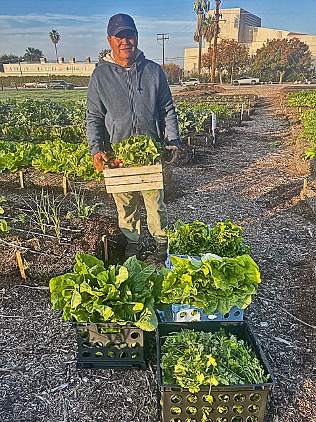
It is the message to those who receive our fresh produce every week at the food banks that St. Francis Garden of Hope serves. It may even be the small act of kindness to the driver in front of us attempting to change lanes. You matter. Go on ahead of me, and have a nice day. In all such acts, large and small, there is the plenitude of Mercy. An overflowing fountain. God’s “faith” budget item.
Such a life of generosity is the indwelling of eternity. God’s sign that we matter. As my fictional hero Detective Harry Bosch notes, “Unless everyone counts, no one counts.” That’s our mission in the Jesus Movement, to instill and foster mattering. In God’s big picture I count. You count. We all count. And can I get an Amen for that?
[1] Octavia Butler, Parable of the Sower (New York: Seven Stories Press, 2016). This edition includes a marvelous introduction by Gloria Steinem.
[2] Jennifer Breheny Wallace, Mattering (New York: Portfolio/Penguin, 2026), 1 ff.
[3] Op. Cit., 1-2.
[4] Op. cit., 5.
July 12, 2026 – Pentecost 7, Proper 10
“Plenitude”
The Rev. Dr. John C. Forney
Isaiah 55:10-13; Psalm 65:1-14;
Romans 8:1-11; Gospel: Matthew 13:1-9, 18-23

