
Forney Charities
Improving communities by helping residents, one person at a time.
To Forgive and Reconcile
My next-door neighbor Tom – the one who taught me how to drive a big rig — told me one afternoon that his brother had gone to collect the rent at one of the houses he owned. His brother knocked on the door, it opened and the occupant shot him point blank in the head.
The family was distraught for months on end. The murderer got off with a relatively light sentence. The youthful shooter was “just a kid,” they said. “Just a kid.” The family wanted blood. How does forgiveness carry any weight in such circumstances? How is it possible?
Yet in faith, by the Grace of God, it is possible. Let me tell you the story of Azim Khamisa. Azim Khamisa is a father awakened to the news that his only son Tariq had been shot by a 14-year-old gang member, Tony Hicks, over a slice of pizza. In the bitter days that followed it would have been natural for Azim to have been consumed by anger. That would have been the end of Khamisa’s life. Bitterness ending only at the grave.
But something happened to intervene. After a number of weeks when bitterness subsided, Azim began to think, in reality, there were two sets of victims. There was also the family of the gang member who had shot his son. After a while Azim was prompted by all that is Holy and all that is Reconciliation –prompted to reach out to the killer’s family. It was a grandfather. This man had raised the other boy.
That two families not be devastated, the two men, Azim and Ples Felix, Tony’s grandfather and guardian, began meeting. Azim finally went to visit Tony in jail, where he was serving a 25-to-life sentence.[1]
When Azim looked deeply into Tony’s eyes, he didn’t see a killer. He saw a very wounded human being, pretty much like himself. Wounded.
“Since the beginning of this tragedy, Tony confessed to his crime and has continuously sought to better his life. He has apologized to the Khamisa family, shares his remorse, and plans to join Mr. Khamisa and his grandfather, Mr. Felix, in their efforts to teach children accountability, compassion, forgiveness, and peacemaking.”[2]
“From prison, Tony has written numerous blogs responding to questions from youth participating in the TKF (Tariq Khamisa Foundation) programs. He has also earned his GED and is working towards his AA degree in Social Work. Tony participates in Gang members Anonymous, Alcoholics Anonymous, Toastmasters, and has done rigorous self-inventories to identify his character defects.”[3]
Through the efforts of Azim, Tony is now out of prison and has a job at the Tariq Khamisa Foundation.
On the foundation’s web site are many stories of forgiveness. From perusing them, it became clear to me that there’s no automatic formula. Nothing’s more unrealistic than the teacher demanding of two boys who had been in a knockdown-dragout fight than to say, “All right, you boys shake hands now and be friends.” The muttered response of one would surely be, “See you after school.”
Forgiveness is a spiritual gift as much as anything, born of calmness and a softening of the heart. It is nothing to be demanded. It is at best an endeavor by both parties. It can’t be compelled in the heat of the matter. Perhaps, later, much later, those harmed and traumatized by the tragedy of September 11th will be able to let it go, or at least get beyond disabling grief. To “let go and let God.” But probably not today.
One more story from the Azim’s foundation from the “Forgiveness Project.” This is the story of two fathers, one Israeli and the other Palestinian. The conflict that has endured for generations. I share the story of the Israeli father.
“I was on my way to the airport when my wife called and told me Smadar was missing. When something like this happens, a cold hand grabs your heart. You rush between friends’ houses and hospitals, then eventually you find yourself in the morgue and you see a sight you’ll never forget for the rest of your life. From that moment you are a new person. Everything is different.
“At first, I was tormented with anger and grief; I wanted revenge, to get even. But we are people – not animals! I asked myself, “Will killing someone else release my pain?” Of course not. It was clear to my wife and me that the blame rests with the occupation. The suicide bomber was a victim just like my daughter, grown crazy out of anger and shame.
“I don’t forgive and I don’t forget, but when this happened to my daughter, I had to ask myself whether I’d contributed in any way.
“The answer was that I had – my people had, for ruling, dominating and oppressing three-and-a-half million Palestinians for 35 years. It is a sin and you pay for sins.[4]
Getting back to my Facebook political posts, the other day two of us had sharp disagreement and some harsh words over how our president has handled his responsibilities. Commenting on my rant about his calling our fallen, “losers” and “suckers,” he responded that I didn’t know who I was talking to.
In his next post, seconds later, he announced that he was a vet and had twenty years of service. At that moment my heart softened a bit and I thanked him for his service, letting him know that I also had served. Two years as an Army medic.
Surprise, he also had been an Army medic in Afghanistan. And thanked me as well for my service.
Then he let me know that the main reason he had voted for Trump was that he was fed up with elite politicians who just talked and had done nothing for people like him. I said I understood. Understood completely. That’s why I had supported Bernie.
We ended in agreement that the politics of this nation are pretty screwed up and agreed to a virtual toast, that no matter how things turned out on November 3rd, we would hoist a virtual beer “To the Constitution and to the Declaration of Independence.’ We bid each other, “Good night.”
When we consider the pain and suffering brought on by the 9/11 attacks twenty-five years ago, what does forgiveness mean? We are now in the territory that time and God alone can enable us to cope.
Is there forgiveness for so much pain, so much loss? There’s no alternative. Eventually. The early church knew our failings and the damage we do to one another.
The Gospels tie God’s Grace in with forgiveness. Forgiveness is front and center in the Parable of the Lost Son and Forgiving Father. An essential part of the Lord’s Prayer. Hear this admonishment from today’s gospel.
Upon hearing Jesus’ teaching on forgiveness, Peter approached him with a question. This was an inquiry based upon the teachings of the Torah – “Lord, if another member of the church sins against me, how often should I forgive? As many as seven times?” This was the standard proscribed. Jesus said to him, “Not seven times, but I tell you seventy-seven times.”
Forgive seven times seventy? The natural man, the natural woman, says, “I don’t think so.” Yet here is this implacable demand: “Seventy times seven times.”
To back it up, Jesus tells the parable of a man forgiven a great debt by a generous king who receives most distressing news. The slave recently forgiven an enormous debt is shaking down his fellows for what they owed him. Seizing one debtor by the throat, the slave demanded, “Pay what you owe.” This is a debtor who was owed only a fraction of what had been forgiven him by the king. Hearing this news, the king was enraged. He had that slave tortured until he should pay his entire debt — hundreds of thousands of dollars owed the king. As the slave was led away, the king raged, “Should you not have had mercy on your fellow slave, as I had mercy on you?”
I’m wondering how many Americans this past week hearing or watching those tapes on TV replay, listening to still grieving family members, replaying in our own memories like an endless loop – asked what can forgiveness mean? What can reconciliation mean in the face of such horrendous evil?
The wrong done is beyond the pale. So much pain. So much pain.
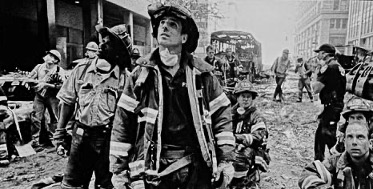
As I wandered a few weeks ago through the 9/11 Museum at Ground Zero, heavy of heart, the enormity of the sacrifice of so many was overwhelming. The firefighters rushing up those stairs of doom as fleeing office workers stampeded down. Those workers who risked their lives on those stairs in aiding handicapped colleagues get down. Sometimes physically carrying them. It was overwhelming as I realized those stairs preserved in that exhibit were Holy Ground. Tears clouded my vision.
Looking at the crushed fire engine on display — seeing again the videos of those jumpers who would rather die in that manner than be burned to death. Often holding hands with a colleague as they plummeted to their deaths. The story of a women standing on the ledge attempting to preserve her modesty by straightening her skirt before jumping.
I began to understand that it will only be through the awesome Grace of God that I am able to move on. That we as a nation will regain our humanity. We must absolutely refuse to blame all Muslims for this act of perfidy. I must claim all the more strongly this people of Abraham as my brothers and sisters, all of us sharing a common humanity.
As the day closes, I can only fall back on the spiritual wisdom of Reinhold Niebuhr’s Serenity Prayer:
“God grant me the serenity to accept the things I cannot change,
The courage to change the things I can,
And wisdom to know the difference.”
And St. Francis:
Lord, make me an instrument of your peace.
Where there is hatred, let me sow love;
where there is injury, pardon… Amen.
[1] https://www.virtuesforlife.com/father-forgives-sons-killer/
[2] https://tkf.org/tony-hicks/
[3] Ibid.
[4] Rami Elhanan, “The Forgiveness Project,” Stories of the Tariq Khamisa Foundation
September 13, 2026
Pentecost 16, Proper 19
“To Forgive and Reconcile”
The Rev. Dr. John C. Forney
Genesis 50:15-21; Psalm 103:8-13
Romans 14:1-12; Matthew 18:21-35
 Forney Charities