
Forney Charities
Improving communities by helping residents, one person at a time.
Lord, Have Mercy
The crowd which welcomed Jesus and his merry band into the streets of Jerusalem is the very same crowd that, at the end of the week, would scream, “Crucify. Crucify. Crucify. Giddy and bursting with excitement over a possible comeuppance for their Roman occupiers, they ran and pranced along with Jesus, waving palm branches, shouting, “Hosanna.” The air was electric with the possibility of miracle.
Cruel irony, how the crowd can turn so fast. Cruel irony, how we can turn so fast on our highest ideals. Through our lofty proclamations, runs a bitter streak of violence. Lord, have mercy. We crucify him time and again.
In her book, Caste: The Origins of our Discontents, Isabel Wilkerson narrates a litany of betrayals of our American ideals. All in defense of the caste status of those on the top rung. This is a history of our nation you didn’t, and our kids still don’t, learn in their eighth grade or high school history classes. You probably didn’t learn it in a college course. Yet, it’s an indispensable part, for we are again on the verge of its repetition. This book is required Lenten reading for Americans.
In 1951, Youngstown, Ohio, the city championship was won by a team that had one black kid on it. The coach, unthinkingly, took the team to celebrate at the city swimming pool. When the lifeguard saw Al Bright, the only black player, he forbade the boy to enter the enclosure with the other boys. Al was forced to sit outside the fence and watch the others eat their picnic lunches and frolic in the water. From time to time someone would join him out there and bring him something to eat.
Even though several parents and coaches attempted to persuade the pool staff to change their minds, there Al sat on a blanket outside the fence enclosing the pool that one of the lifeguards had laid out for him.
Finally, the supervisor of the pool was persuaded that Al could get in the pool. Only if everyone else, who was white, got out. Al was led to a little rubber raft. As he got in it, the lifeguard repeated over and over, “don’t touch the water.” The lifeguard entered the pool and towed the raft with Al around the pool for a single turn as parents and coaches watched from the edge. All the time the lifeguard kept repeating, “Don’t touch the water. Don’t touch the water.”
Al was then escorted to his assigned spot on the other side of the fence.
“The lifeguard managed to keep the water pure that day, but a part of that little boy died that afternoon. When one of the coaches offered him a ride home, he declined. ‘With championship trophy in hand,’” Watkins, a boyhood friend, would later write, ‘Al walked the mile or so back home by himself. He was never the same after that.’”[1]
Imagine the pain of that crown of thorns pressed down upon the brow of that little boy. Christ crucified again. In our own day.
This week we call Holy, for it contains both the bitter pain and sublime hope of the Gospel. We behold the sorrow of the world, sorrow like none other. In the poignant moment of fellowship Jesus and his companions gather for a last meal. This Holy Week is every week, as will Easter arrive every week. The bitter mixed with the sweet. But this week we face betrayal, torture and abject forsakenness. Can you not keep awake?
As the old hymn puts it, “If you can’t bear the cross, then you can’t wear the crown.”
Communists, in rejecting religion, called Christianity the opiate of the masses. As if faith was some sort of blinders that might enable us to ignore and skirt the ugliness of hate and tragedy — the ugliness of what we do to our fellow human beings.
Not so.
Faith is what allows us to look death and tragedy straight in the eye and carry on, find a way, make a way when there is no way.. And when we’re called to our Maker, it is faith that enables us to hear that clarion sound, “Well done, my beloved. Well done.”
Through our community in Christ we are surrounded and upheld by that glorious company of the faithful. It is only through their strength, through their encouragement and support, that we complete the race we’ve been assigned. Even Jesus needed a few others. And we’re just not in his class.
Yes, many were willing to watch a little black boy slowly diminish, to shrink and to spiritually die on the edge of a municipal plunge one warm day. But not all. Some knew this wasn’t right. Some knew this was diametrically opposed to everything they had been taught in their churches. They may not have had the tools resistance champions of justice now have. They may not have understood the power of civil disobedience, but some, that afternoon had their hearts ripped from their breasts.
That is the first step – a willingness to let the pain of rejection and tragedy enter one’s soul. To feel at one’s root core Al’s rejection. But that is only the first step. Imagine if the entire team and bystanders had, instead of yielding to passivity, marched outside the pool enclosure and joined Al. Imagine the power of that NO.
Today, as Christ is dismissed and scorned through Jim Crow voter suppression laws, we are being confronted with the same choice as those onlookers at a Youngstown municipal pool in 1951.
The question always is, which side are you on? The side of complicity through silence? Will you, too, avert your gaze and refuse to see? Not act? Or, will you be on the side of “necessary trouble?” Will you be on Al’s side?
Mother Teresa puts our Palm Sunday choices this way in a simple poem, “Forgive Them Anyway.”
People are often unreasonable, irrational, and self-centered. Forgive them anyway.
If you are kind, people may accuse you of selfish, ulterior motives. Be kind anyway.
If you are successful, you will win some unfaithful friends and some genuine enemies. Succeed anyway.
If you are honest and sincere people may deceive you. Be honest and sincere anyway.
What you spend years creating, others could destroy overnight. Create anyway.
If you find serenity and happiness, some may be jealous. Be happy anyway.
The good you do today, will often be forgotten. Do good anyway.
Give the best you have, and it will never be enough. Give your best anyway.
In the final analysis, it is between you and God. It was never between you and them anyway.
Do not forget — It is God who brings Resurrection Joy even through the most bitter tears. Amen
[1] Isabel Wilkerson, Caste: The Origins of Our Discontents (New York: Random House, 2020), 120-121.
“Lord, Have Mercy”
Rev. Dr. John C. Forney
March 28, Palm/Passion Sunday
Mark 11:1-11; Isaiah 50:4-9a; 31:9-16;
Philippians 2:5-11; Mark 14:1—15:47
We all Rise, Together

As a young woman, Diana Harvey Johnson, now seventy-four, marched up the steps of the courthouse to register to vote. There she was confronted by a white woman who pointed to a Mason jar on the counter. “How many butterbeans are in that jar.” The inference was that if she was able to correctly guess the number, she would be allowed to register.[1]
“’I had a better chance of winning the Georgia lottery than guess how many butterbeans,’ Ms. Harvey Johnson continued. ‘But the fact that those kinds of disrespects and demoralizing and dehumanizing practices – poll taxes, lynchings, burning crosses and burning down houses and firing people and putting people in jail, just to keep them from voting – that is not far away in history. But it looks like some people want to revisit that. And that is absolutely unacceptable.’”[2]
“You were dead through the trespasses and sins in which you once lived, following the course of this world, following the ruler of the power of the air, the spirit that is now at work among those who are disobedient.”[3] Through our nation’s original sin, the notion that some count more than others, America’s ideals have often been a dead letter.
The spirt of “this world” is the evil that overtook much of this nation after the Civil War, after Reconstruction, and now, after the Civil Rights struggles of the 60s. It is presently “Jim Crow in a suit and a tie, drafting new voter suppression laws in states across the land.
The sin, the evil, is exclusion. It’s, “You don’t count in this country.”
“But God, who is rich in mercy, out of the great love with which he loved us even when were dead through our trespasses, made us alive together with Christ.”[4]
In the midst of the hypocrisy, the land theft, the lynchings, God has been silently at work perfecting. In every age, reaching some righteous hearts and minds.
As Christ rises, we all rise together. That’s the bottom line of “For God so loved the world…”
The bottom line of Paul’s proclamation is – brothers, sisters you count. We all count as God’s own. No one is left out, left behind. In the gospel of Jesus Christ, we are all raised up. Just as Moses lifted up the serpent in the desert. We all rise together.
“But God, who is rich in mercy, out of the great love with which he loved us even when we were dead…” Loved us even when we’ve given up on ourselves.
Those who take this promise to heart, they are God’s own. We all rise together. In our rising is proof positive that God “so loved the world…”
You count at the voting registration table! You count at the school house door! You count at the college admissions selection committee and on the high school track team. You count!
We now have a whole bunch of folks who must have gotten a defective Bible. The part about God’s inclusive love for all must have been left out. Wasn’t in Sheriff Jim Clark’s Bible. Must have not been included in Governor Faubus’s Bible. Sure wasn’t in Bull Connor’s Bible. Nope. No evidence of any love on Bloody Sunday at the Edmund Pettis Bridge that day.
Must not be in the Voting Suppression Bible — definitely wasn’t in the spirit of those brand-new laws stifling the right to vote – like the elimination of Sunday voting, the restriction of same-day registration, the elimination of convenient drop-off boxes. Except that one lone box, out in the middle of the Arctic tundra.
“For God so loved the world…” That may well be. But not you if you’re the wrong kind of voter.
But St. Paul continues, “For by grace you have been saved through faith, and this is not your own doing; it is the gift of God…” The Easter story we so desperately await in this Age of Pandemic is that in Christ we all rise. Together.
You are okay, just right. The way you were created – simply by virtue of your being here. “God does not make junk.” So, stay in that voter line. Make your voice count. Stay in school and don’t let anyone turn you around. Finish that novel.
Opportunity for all is the foundation of our country. The idea “of the people, by the people, for the people,” – that’s a straight line from Paul’s proclamation that all are precious in God’s estimation. Derivative from the Honest-to-God Gospel of Jesus Christ. No watering down.
The God of Jesus is not about perishing. This God is about raising us all up to the full stature of who we are meant to be. We all rise together.
The people who remind us of this truth are our “balcony people,” as George Regas called them. They cheer us on. Though they be saints long gone on before, or they be current mentors and champions, they cheer us on as we approach that bright finish line.
This last week, March 8th, we celebrated International Women’s Day. It is a day to celebrate one half of humanity that too often is ignored, patronized, dismissed. These are the ones we’ve been waiting for if we but see them. Strong, competent, talented, assertive women.
And they’re bustin’ out all over the place. Not just at the voting booth, though I believe Stacy Abrams is a role model for all of us, men and women alike.
In celebration of Women, I picked up a book of the noted science fiction writer, Octavia Butler. Very few successful writers in this genre are women, especially Black women. In the Library of America, one can obtain the first collection of her stories and two of her novels.
Octavia grew up as a introspective girl, later subject to bouts of loneliness and depression. But her mother was a fierce advocate for her daughter. When a sixth-grade teacher told Octavia that she could not learn very well because she was “colored,” her mother, angry at this teacher, urged Octavia, you “be somebody.” And gave her a typewriter for Christmas – that she would later write her first five novels on.[5]
Even her well-meaning aunt urged her to take up something practical: nursing, teaching, something what would return a decent salary. “Black people can not grow up to work as writers.” Butler worried that this might be the case. “In all my thirteen years, I had never read a printed word that I knew to have been written by a Black person.” Yet, at this age she had already submitted a number of stories to science fiction magazines, encouraged by her science teacher.[6]
One night, as a seventh grader, watching a B-movie, Devil Girl from Mars, on late night TV, she came to four revelations. “The first was that ‘Geez, I can write a better story than that.’ And then I thought, ‘Geez, anybody can write a better story than that.’ And my third thought was the clincher: ‘Somebody got paid for writing that awful story.’ So, I was off and writing.”[7] This in the seventh grade!
Octavia, grew up in our own backyard, Pasadena and Altadena, attended Pasadena City College and my alma mater, Cal. State Los Angeles. She would rise, and rise indeed, publishing scores of novels and short stories. In 1984 her short story, “Speech Sounds,” is published in Isaac Asimov’s magazine and it wins her first Hugo Award for Best Short Story. Hugo Awards are among the most prestigious in the SciFi trade. In 1995 Octavia would be awarded a John D. and Catherine T. MacArthur Foundation Fellowship – the “genius award,” so called. Her novel, Parable of the Talents, wins a Nebula Award for Best Novel in 1999. The top award for science fiction writers.
As Octavia rises, we all rise together. All, in the full humanity that God intends for each one. Her work has enchanted and challenged her many readers.
Another story, another incredible woman, from a recent episode of “60 Minutes.” As a young college graduate, Charlie Blackwell-Thompson remembers standing in the NASA control center for many space launches. Having, upon graduation, applied for a job at NASA, she stood in that fabled room and thought to herself, “I want a seat in that room.” As a woman, this was not likely. Virtually everyone in that room was a man.[8]
Charlie now has THE SEAT in that room as NASA’s first female launch director.
A year from now she will give the launch command for a journey that will return humans to the moon. The same room that witnessed the Apollo Missions leave earth. The same room she had visited thirty years ago as a young college graduate.
If you look at those old black-and-white NASA photos, all you see is men. White men. Now, over thirty percent of the launch crew is women. This room is presently diverse enough to almost look like America.
This achievement in inclusion is the realization of Paul’s proclamation — We all count. The ethic of Jesus, running down the century and across cultures, through America’s foundational documents, has brought us to the richness of his promise for all. We all count.
Title 9 has done this for women sports. Title 9 was the seminal change in the U.S. education code that mandated equity in sports for both male and female. Both funding and opportunity had to be on a parr for both.
Now, a little home-town bragging. Title 9 in high school, basketball opened the door for women like Diana Taurasi, a home-grown star from Chino’s Don Lugo High School. She went on to headline University of Connecticut (UConn) Women’s Basketball.
On July 8, 2018, Taurasi became the league’s all-time leader in field goals. Taurasi would also earn her ninth career all-star appearance after being voted into the 2018 WNBA All-Star Game. This opportunity came all because of Title 9.
When I was in high school, during gym time I would see the girls in their area playing just half-court. When I asked a friend why this was so, she told me that girls were too delicate to run up and down a full court. Tell that to Diana Taurasi.
After college, she was a top draft pick by the Phoenix Mercury and that year was selected WNBA Rookie of the Year. In 2017 she became the all-time top woman scorer, and is now considered one of the best female basketball players ever.
As Diana rises, we all rise together. The Glory of God is a woman fully alive. A wonder to behold, on or off court.
We have our own Hayden, an up-an-coming pitcher in girls’ softball, burning them in at over 60 miles an hour. I can’t wait for COVID to be over so I can see her show her stuff.
A couple of all-stars have combined to coach Hayden develop her talent. Crystl Bustos is an all-time home run hitter in the late ‘90’s. She was on the Olympic team in 2000, ’04 and ’08. A two-time gold medal winner, known as “The Big Bruiser.”
Another, Rhonda Wheatley, from Cal Poly, Pomona was the number one pitcher on Team USA for1980 through ’88. She was the fifth most winning pitcher ever in NCAA, Division 1. With a record 198 wins and only 60 loses, she was one of the starting pitchers in the 1987 Pan American Games. That is the sort of help Hayden is attracting.
Thank you, Title 9, that Hayden’s magnificent talent can blossom. If she keeps at it with her studies and pitching practice, I hope to see Hayden in the record books. This talent we also acknowledge on International Women’s Day.
This is what St. Paul celebrated in his glorious epiphany, “There is neither Jew nor Gentile, neither slave nor free, nor is there male and female, for you are all one in Christ Jesus”.[9]
Hayden, you and your teammates totally count, and are precious in God’s sight. Your talents will be honored as far as they will take you. You go, girl!
This week wherein we lift up the gifts and accomplishments of our sisters, it’s good to wear a pink stole.
Why a pink stole? I’m told by our most English of Episcopalians at St. Francis that this Sunday is “Mothering Sunday” — No, nothing to do with the American holiday, Mother’s Day. Think, “Rule Britannia.” Yes, do remember the woman who gave you birth, but ALSO remember your Mother Church. Especially the one in which you were baptized. Leave a special offering. So, we put on the pink – for a number of reasons.
Title 9 and other opportunities opened across the board access for our sisters to excel. As they do, they lift us all. In the Spirit of Christ, we all rise together. This is not your grandfather’s church or country anymore. All really does mean all.
Octavia is interred in Altadena at Mountain View Cemetery, near her mother. Inscribed on her marker are words from Parable of the Sower: “All that you touch, you change. All that you change, Changes you. The only lasting truth is Change. God is Change.”[10]
Amen.
[1] Nick CoraaNIRI ns Jim Rutenberg, “Georgia Bills Target Black Church Voting Drives, New York Times, March 7, 2021
[2] Ibid.
[3] Ephesians 2:1-2, New Revised Standard Version.
[4] Ephesians 2:4-5, NRSV.
[5] Octavia: E. Butler: Kindred, Fledgling, Collected Stories, Gerry Canavan & Nisi Shawl, editors (New York: The Library of America, 2020), 744.
[6] Op. cit., 745.
[7] Op. Cit., 744.
[8] Bill Whitaker, correspondent, “60 Minutes,” March 7, 2021.
[9] Galatians 3:28, New International Version.
[10] Octavia, 755.
“We all Rise, Together”
Rev. Dr. John C. Forney
March 14, Lent 4
Numbers 21:4-9; Psalm 107:1-3, 17-22; Ephesians 2:1-10; John 3:14-21
“The Ten Suggestions?”
Helen and Henry Howard, an elderly couple, ran the little Union 76 station and café attached to it. It was just a wide spot in on the highway through Johannesburg, one of the three former mining towns served by the Randsburg United Methodist Church, my first appointment. Inyokern was the second of this two-point charge. I still remember my friend Alan announcing to the congregation we were attending on a Sunday before we were about to depart that I had received my appointment: “The bishop is sending John to Unicorn and Rancid.”
Anyway, I digress – on to the point of this story. Helen was a faithful member of the Foursquare Church in Johannesburg – the other towns being Randsburg and Red Mountain. If you’ve been up Hwy. 385 you know the place.
For several weeks Helen had been after me to teach the “Released Time” Bible study that churches in California were allowed to make provision for during the regular school day. It would he held at her church because that was just a short walk from the elementary school which served students in the three towns, all about a mile apart. Jai was the teacher for this one-room school house.
The curriculum provided by the Council of Churches for the program was mostly non-doctrinal. The purpose was mainly to teach kids their Bible stories.
I hemmed and hawed. Helen was Foursquare, right? I once want to one of their churches with a high school girlfriend because her friend Glenna had pestered her into going. To say that their worship was exuberant would be an understatement. Certainly nothing for the “Frozen Chosen” from the Presbyterian tribe, which is where my girlfriend attended. I was the drag-along.
So Helen was a nice person, but I wasn’t sure about this. Well, soon Helen had an ally. The Spirit spoke. She said, “C’mon. You don’t need to be so stuck up. They’re Christians, too.” So, I acquiesced and said, “Yes.”
Other than there being no A/C and the room being dimly lit – sleep inducing – I got through the first few weeks or so until…
There we were in Exodus with the Ten Commandments. The first few were no sweat. We could all understand that you should go to church and thank God for everything. We knew that murder is bad. Helps nobody. Nor does stealing all
their stuff. God certainly wouldn’t like that any better than we if it was our stuff that got boosted.
Then we came to adultery. I really hadn’t thought much about how I would approach this with the kids. There was the giggle factor, and I didn’t want to get into a Peyton Place scenario. So, I punted. I asked the group if they knew what “adultery” meant.
At once a very angry boy jumped up and pointed to another kid. Rage in his voice, “That’s like when your grandfather ran away with my mom.”
Silence. After what seemed like an hour I stammered, “Well, I guess we all know that adultery is.” This was the most recent scandal of those three little towns. The story, with embellishments, was everywhere. The town jaws were flapping big time.
The final retort of the young boy of the accused grandfather, “Well, when my grandpa runs off with someone, he doesn’t just take her to California City!” A planned community out in the middle of nowhere that never really got built. Except for a scattering of houses, a couple of dives, a gas station and a motel. The No-
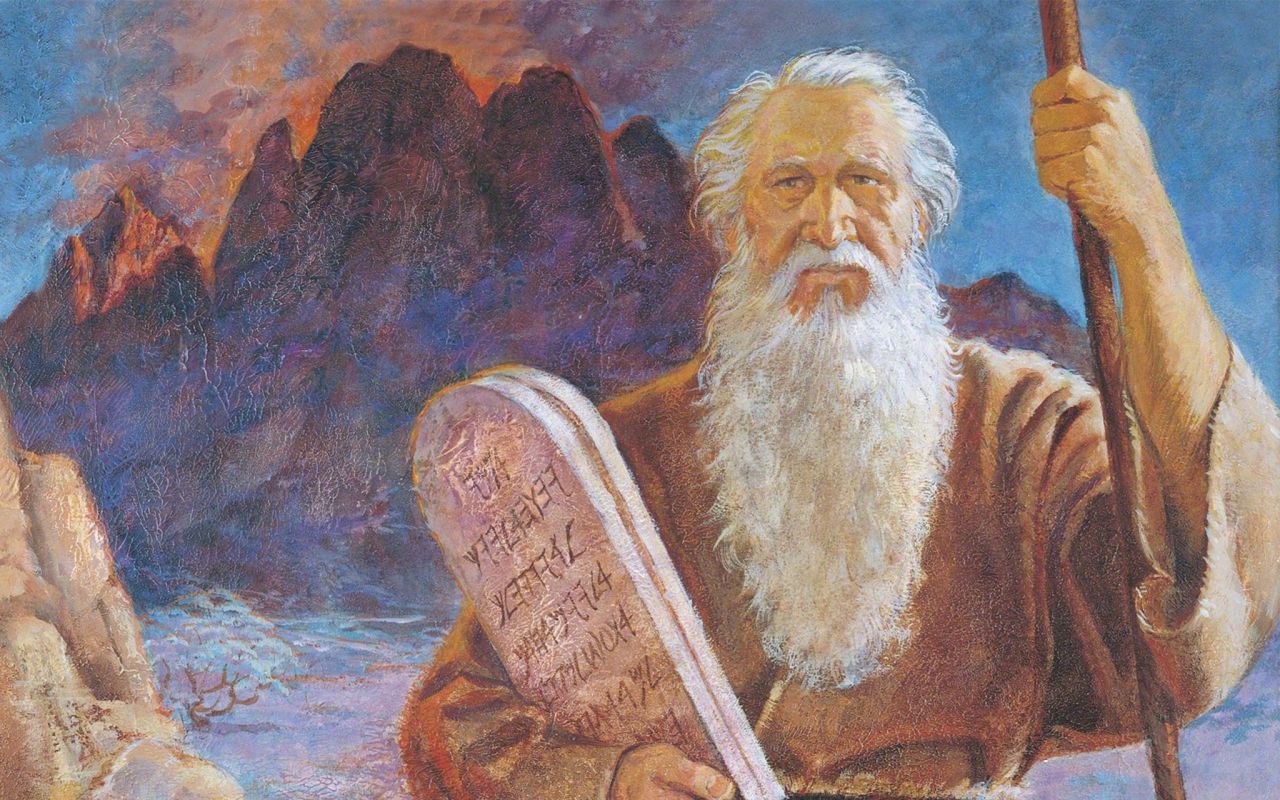
We have from the Mount of Revelation Ten Commandments, not Ten Suggestions as my Unitarian friend calls them.
The purpose of the Law, those Ten Suggestions, are to keep us focused and attentive to what gives life, not what sucks it up. They’re about what is necessary for freedom in community. And our frail community was in shambles for quite a while as everyone chose up sides.
The Law exists not for itself, but enable us to keep the freedom God won for us when we were brought out of bondage in Egypt. “I am the Lord your God, who brought you out of the land of Egypt, out of the house of bondage. You shall have no other gods before me.” It’s Gospel THEN Law. Friends, there’s as much Gospel in the Old Testament as in the New.
There is no freedom if all is up for grabs. If one has to be on continually on guard to protect life and limb. And the part about idols – they may seem to work for a while. Like a great set of wheels that would turn the girls’ heads. Because we sure thought that we were so dorky that we, all by ourselves, wouldn’t attract any notice. Talk about lusting after something like a ’57 Chevy. The fins, the chrome, they were to die for. What was that about covet? And idolatry?
They may seem to work for a while, but what then. What about when you’re forty- five and the chick who you lured into the seat next to you, now has nothing in common with you. And he with the fancy car? Now an ignorant blowhard. Maybe, you’re no catch either. A couch potato every night watching WrestleMania or old reruns of Kojak or the Wheel of Fortune? And who knows where the kids got off
to? They never call.
The ethic of “do your own thing – nobody will get hurt” doesn’t really work. The problem is, somebody always gets hurt.
This is the struggle within Paul. “I do not understand my own actions. For I do not do what I want, but I do the vey thing I hate.” We, just being human, are “born for trouble as the sparks fly upward.” The Law is to preserve Gospel Freedom. It is the adult guardrail that counsels against such as, “It seemed like a good idea at
That is why a key question in the baptismal pledge asks, “Will you persevere in resisting evil, and, when you fall into sin, repent and return to the Lord?” It doesn’t ask, “if you fall into sin,” but “WHEN you fall into sin.”
I know my weaknesses. As a political pugilist, I’m not so charitable to those on the other side of the aisle. My Lenten discipline this year is to regard those of other persuasion not as enemies but, at best good Americans with other ways of seeing things. Though I admit I still have difficulty with those who have gone over the QAnon edge. I’m not too hot about the Antifa folks either. But I’m making a good attempt to understand what took some of my opponents to such extreme. To regard them as opponents, not enemies. Pray for me.
This discipline is good for my soul. And also good for House of Hope. Addiction knows no party. It’s neither Red nor Blue. All sorts, from bankers to brick layers, from professors to students.
I really have to believe in the possibility of redemption, but that’s no quick fix. You may have taken half of your life to get hooked, and it’s going to take the other half to amend your ways, to find a life of sobriety, of community.
I think it begins with empathy, understanding. That is surely one of the gifts of the Spirit, for most of the time we have compassion not within us. Too often, it’s not my first thought – to think about walking in someone else’s shoes.
“Thou shall not, Thou shall not.” This is the law. It is a guardrail for safety of the soul. The purpose is to preserve the freedom and bountiful life won for us already.
“God spoke all these words to Moses on Mount Sinai: “I am the Lord your God, who brought you out of the land of Egypt, out of the house of slavery…” That’s it in a nutshell. Do not fritter this gift away. Do not forget who opened the door to the wonder of this life.
A passion for this priceless inheritance is at the root of Jesus’ anger at the folks outside the temple with their money changing tables and animals.
“‘Take these things out of here! Stop making my Father’s house a marketplace.’ His disciples remembered that it was written, ‘Zeal for your house will consume me.’”
The entire purpose of Moses, Jesus and the prophets – all of it down to the present day – is to bring humanity into community with each other and the animating Spirit behind it all. It’s not about yard sales.
Yes, there is behavior that destroys the fragile bonds of community. Behavior that is completely off limits. We should abstain from such. There are also sideshow distractions from the core teachings of our Judeo/Christian heritage. Mercy, Justice and forgiveness go much farther than raffles and rummage sales, bingo night and beautiful liturgy.
Instead of just the “do-nots,” lets also consider the “dos” this Lent — while we’re considering an amendment of our ways.
I came across a piece by a writer, Simone Ellin, who in school had been unmercifully bullied by some of the “mean girls.” You know who they were in your high school. Dressed tough. Sullen. Smoked and used foul language. These talked back to teachers, and sooner or later often were expelled.
In high school this woman had been bullied and ridiculed by some of these girls. As a result, her self-esteem had been in the dumps for much of her adult life.
She writes: “For decades, I’ve struggled with low-grade depression, anxiety and feelings of inadequacy and underachievement that have persisted despite years of therapy. I won’t argue that my mental health issues stem only from the bullying I encountered in school, but those experiences ― and my lifelong shyness, hypersensitivity and self-consciousness, made me a perfect target for bullying and exclusion”1
Suddenly, she had an idea. She decided to contact her former classmates, not
1 Simone Ellin, “I Tracked Down The Girls Who Bullied Me As A Kid. Here’s What They Had To Say,” Jmore magazine, 2-19-2021.
only those who had bullied her but the other girls as well. What happened after that was astounding and life-giving.
The response of one girl was typical of comments she received from others who had bullied her. “I’m so sorry,” she said repeatedly during our call. “I swear I’m not a bad person. I think about what I did to you all the time. I don’t know why I chose you. I had a miserable home life.” She revealed some of the trauma she’d been through and, though I might have guessed that my classmate came from a troubled background, hearing it from her own lips made all the difference. I was finally able to forgive her, and (I hope) to help her to forgive herself.”2
Not one girl was nasty or bitter. Many calls ended in tears of relief and reconciliation. Being stuck in that high school nightmare was slavery for both women. Not what God
intended. For how many has the bondage of junior high, high school, been another
Egypt? For me, junior high was an utter social disaster.
Against the sort of heartfelt charity of Simone there is no law. Always, such abundant Grace in season. If I can practice just a half an ounce of such kindness and understanding to my Republican colleagues — that would be some reconciliation which God could put to good work.
In this life, the blessings of Beloved Community are rare indeed. More valuable than much fine gold. They must be nurtured to be sustained. And as Simone Ellin has demonstrated, it is never too late to put into practice their nurture.
“Truth and Reconciliation” do in fact work. Ask Archbishop Tutu. Ask the South Africans. Nothing is fixed forever – ask the people of Northern Ireland. Ask whites and blacks of the New South. Forever and forever, hate is not fixed.
Rebirth is a never-ending journey, beginning with one step. One phone call. It requires charitable leadership and the willingness to risk. As Christians, we are the people of “The Second Chance.” Remember who brought you out of the land of Egypt, out of the house of slavery. Remember the One who still is your Liberation.
Here, at hand. Now. Amen.
“The Ten Suggestions?”
The Rev. Dr. John C. Forney
March 7, 2021, Lent 3
Exodus 20:1-17; Psalm 19; 1 Corinthians 1:18-25; John 2:13-22
Stuff Happens

Isabel Wilkerson, author of Caste, opens her book with the recollection of a old black and white photo of Germany in the 1930s, a rather famous photo taken at a Hamburg shipyard in 1936.
The photo is of some hundred shipyard workers lined up facing the sun, and offering the heil Hitler salute with rigid right arms held outstretched in honor to Der Fuhrer.
However, if one looks carefully at this picture, in the upper right, one sees a man who does not salute. His arms are folded. It is one lone man standing against the tide, the onslaught about to engulf all of Europe in abject terror. He had a premonition of a horror the others missed or refused to acknowledge.
Though he had joined the Nazi party early on, he had come to know that they would bring disaster and heartache. He, an Aryan, was in love with a Jewish woman. He had come to see the Nazi propaganda machine as a fount of lies and slander against the Jewish people. She and her friends were nothing like what Hitler and their ilk portrayed. So, there he stood, alone, grim-faced, refusing to bow to the lie.[1]
A flood was about to engulf his nation, and among the many, only he saw the disaster. He was among the few in that boatyard who saw the Nazi tsunami approach the shore before it struck with the full force of the Nuremberg Laws – laws modeled on the US Jim Crow laws, stripping away the last vestiges of a proud and vibrant civil society. One lone shipwright knew that his nation would come to no good end under Hitler, when this Nazi stuff happened.
One lone man, not unlike those patriotic Republicans, who voted for conviction of the former president. Yes, insurrection and sedition – treason is definitely bad “stuff” happening.
It is said that Hell hath no fury like a woman scorned. Try a Trump scorned. He has declared war on every single member of Congress who had not supported him in his second impeachment trial. If you backed McConnell, you’d better be looking over your shoulder. That is the message.
Our nation is now awash in a flood of hate and vengeance unlike any since the Civil War. QAnon lies drench great masses of Americans submerging us in a conspiracy of lies and fantasies beyond all bounds of logic.
Republicans are presently drowning in the frightening political flood waters of Trumpism. Old values and verities are swept away in the chaos engulfing that tribe. What about deficits? What about “law and order?” What about truth? What about decency and humility? What about small but effective government? All sacrificed on the altar of expediency and in base subservience to one man.
The Grand Old Party of my parents has become a shark feeding frenzy. My mother, who was the founding president of the Women’s Republican Club of Signal Hill, would have been aghast to see her party be submerged under an obsequious tidal wave of a cult owing fealty to one broken man.
Mom, stuff happens, even in your Grand Old Party of Lincoln.
“We did not send him there to vote his conscience, we did not send him there to do the right thing, whatever he said he was doing,” Dave Ball, the chairman of the Washington County Republican Party in Pennsylvania, said of Toomey’s vote to convict Trump”[2]
No room for dissent, any more than in the old Soviet Politburo under Stalin. Censure and expulsion are now threatened against any Republican siding with Mitch McConnell following his speech in the well of the Senate following the vote on the possible conviction of Trump. To stand up, it will take a woman, a man, of the same courage as that of a lone worker in a Hamburg shipyard in 1936. Ask yourself: would you have had the courage of that solitary man?
Any standing against this idolatrous cult, this base worship of one man will be swept away. My parents and their friends would not have, did not, survive such a political onslaught washing over their conservative values and loyalties, their years of working in precinct politics. My mom would have been heartsick had she lived to see this unsightly end.
In our lesson from Genesis, the reader comes out the other side of this biblical Flood. Noah and his family and all the critters scamper down the gangplank and the sun is shining. And bright in the sky is that rainbow. Sign of God’s covenant, God’s promise never to do that again – no matter how badly we behave. Yes, it’s all bright flowers, butterflies and rainbows.
Not so fast, I protest. As one young girl asked her mother about Noah and the ark, “What about all the animals? They didn’t do anything.” As Jesus asks, concerning those piously excusing God for a terrible tragedy, “Or those eighteen who were killed when the tower of Siloam fell on them – do you think they were worse offenders than all the others living in Jerusalem? No, I tell you…”[3] Sin and repentance are a different discussion.
Personally, I find this narrative highly problematic. Like Job arguing against God about unfairness, I protest. I want an accounting. “What about all the animals? They didn’t do anything.” Jesus refuses to blame all disaster, natural or otherwise, on human sin. Sorry, Pat Robertson – gays and lesbians did not cause 9/11. (Now, the Sixth Great Extinction is entirely another matter – we have culpability, and that’s a different sermon.)
Scholars now know that this Flood story was a Hebrew adaption of a much older Babylonian story of another flood, centuries earlier. In fact, those looking for a historical antecedent think this narrative might have had its origins in the immense catastrophe when ocean rise caused the Mediterranean Sea to surge past the Bosporus straights to flood into the area we now know as the Black Sea. This, some ten thousand years prior to the telling of our story.
Within a just a few, brief, horrendous days raging waters swept away hundreds of thousands. Livestock and all. This is the sort of catastrophe that would have been sealed in memory passed down for generations upon generations by the descendants of those who survived. Yes, and what about the animals? They didn’t do anything bad to God.
Whatever the origin, however we attempt to tidy up this calamity, sometimes bad stuff happens. Stuff happens. It’s that simple. Stuff happens. Actually, some order it.
Paired in our readings with Noah’s disembarkion from the ark is Mark’s narrative of Jesus’ baptism. Jesus is drawn from the waters to receive God’s blessing, ‘You are my Son, the Beloved, with you I am well pleased.’ And the Spirit immediately drove him out into the wilderness. He was in the wilderness forty days…’The time is fulfilled, and the kingdom of God has come near; repent, and believe in the good news.’”
You are my son. You are my daughter. Those words that every Christian should hear as they emerge from the baptismal waters, sprinkled or submerged therein. You are my beloved. With you, I am well pleased.
Repent – put on a new mind. Time to wrap your mind around a new fact – in the deepest sense, the real alternative fact – God is doing a new thing. Time to think outside the box and recalculate where your life’s going. Lent is a time of recalculation. Stuff happens, and the choices you make, make all the difference. They tell us, they tell you, who you are and whom you serve.
One writer surmised that, in fact, we ought to think of Lent as being without end. Repentance and renewal are always in order. We are consigned to walk in a wilderness lasting not forty days, but for the duration. Surviving this journey has nothing to do with giving up chocolate or coffee or T-bone steaks or whatever. Actually, God can’t do much with the little bit of chocolate you might abstain from this Lent.
But God can do A WHOLE LOT with a renewed and refocused heart, an amendment of foolish ways. That is material God can definitely work with. If you traverse this wilderness with lasting values and purpose, you are not a wanderer but a pilgrim. You know the destination – the Beloved Community.
In Texas this week, we had two hearts which God might have put to good use. A heart of compassion and a me-first heart, a heart of après moi le dèluge – after me the flood – attributed to King Luis the XV of France. This, the ultimate nihilistic expression of indifference to “stuff’ happening.
‑We saw the heart of heartless indifference in full display in Texas this week as Ted Cruz and his family hightailed it out of the frozen clines of that state for the warmth of tropical Mexico, at a first-class resort. With heat and electricity.
Meanwhile, another former politician of a different heart chose an alternate path. He remained in that baren wasteland of death, frozen waterlines and no heat. Beto O’Rourke stayed behind to host a virtual event for seniors, helping them locate aid and assisting others suffering in their deep-freeze state.
‘Yes, the “Eyes of Texas are Upon You,” Ted. And, also those of the Houston police authorities who, in the worst emergency in a century, were summoned to make sure your departure went smoothly at the airport. Not that they might have other things to do, Well, at least almost smoothly, except for those pesky photographers who caught you skedaddling out of Dodge after the frigid “stuff” had hit the fan. No forty days in the wilderness, frozen or otherwise, for our boy.
“On Wednesday, many first responders, civic leaders and concerned citizens from all over the country struggled to aid the people of Texas during their ongoing crisis, caused in part by an imperfect and isolationist electrical grid and in part by a storm that many scientists have identified as yet another example of fatal extreme weather caused by climate change. Meanwhile the Lone Star State’s most famous senator – that climate-change denying, isolationism-preaching, self-proclaimed true patriot —tweeted his concerns” [4]
“You know the guy, that guy of many disaster films…”that guy. The weaselly, duplicitous tough-talking middle management type villain who sets bad things (stuff) in motion, or completely denies they are happening until it is far too late. The guy who likes to be front and center when all is going well, but as soon as the going gets tough does everything he can to take care of himself.”[5] As one billboard put it, “Texas froze. Ted fled.” Leadership, for sure.
Our baptism is to initiate us into a community where the ethic is a heart renewed, a heart attuned to the needs of “the least of these.” A heart immersed in the notion of solidarity. A heart so prepared, that when the flood does come, as surely as it will, she is ready with a raft and life preserver, food and clean drinking water. For others. She will not be the first hot-footing it out of town. And if flight becomes necessary, she will take as many as possible with her.
Yes, two things the writer of the Flood story did get right. First, the flood will come — or in this case, ice – a frozen flood. Second, it requires of us our duty. Is that duty only to ourselves? Or is it, in solidarity – God’s solidarity – to be with our companions amidst the raging waters?
Ted made one answer. Beto, another. Beto’s answer is the sort that will get us through forty days in a winter wilderness, in any wilderness.
“What about the animals?” Enlightened hearts will realize a duty to the entire natural world. As St. Francis has taught us, everything is connected.
I remember bringing to Jonathan’s room late one night some supplies needed for a project due the next day. I still can’t figure how it was that his teachers always seemed to wait until the very last minute to assign these projects – late at night when almost all the stores were closed – but that’s an educational problem to be solved at another time. Anyway, as he sat on the floor with poster board and pictures, glue and scissors scattered about, a very large wolf spider scurried away from it all, towards the door.
Jonathan immediately went into freak-out mode, hopping around, all the while shouting, “SPIDER. SPIDER.”
When I told him that this spider was just one of God’s little, beloved creatures, he responded, “Yeah, the kind that will kill you.”
Actually, fact is, these might be deadly to a cricket, but not to a young boy late with his homework.
What about the animals? They didn’t do anything. Even to the tardy and the procrastinators.
In our church, before baptism, the congregation, joins together in remembering their baptismal covenant, which in part affirms:
“Will you proclaim by word and example the Good News of God in Christ?…Will you seek and serve Christ in all persons, loving your neighbor as yourself?…Will you strive for justice and peace among all people, and respect the dignity of every human being?…” The hoped-for pledge being, “Yes.”
An informed and repentant heart would also include a healthy respect and gratitude for the natural order, even wolf spiders. (Yes, I confess, I do squash the spiders in the shower for my wife when she freaks out about them. Lord, have mercy). I know, they didn’t do anything.
Yes, the story does end with butterflies, blue skies and rainbows. That’s God’s doing in the “time that shall surely be, when the earth shall be filled with the glory of God as the waters cover the sea.”[6] In the meantime. In the meantime, it’s up to us to pilot the life rafts, throw out the preservers. Warm and nourish the survivors. Feed the animals in a stinking ark, and pray for bluer skies and some rainbows for all of God’s children – in “the time that shall surely be.” What did you think you were baptized for, anyway? Amen.
[1] Isabel Wilkerson, Caste (New York: Random House, 2021), p. xv.
[2] Travis Wilkerson, “Republicans Have Emerged From The Capitol Insurrection United Against Democracy,” HuffPost, February 17, 2021.
[3] Luke 13:4,5. New RSV.
[4] Mary McNamara, “Cruz flies right into villain mode,” Los Angeles Times, February 19, 2020, p. E-1, 4.
[5] Op. cit.
[6] The Hymnal 1982, No. 534, The Church Pension Fund (Episcopal Church), 1982.
“Stuff Happens”
The Rev. Dr. John C. Forney
February 21, 2021, Lent 1
Genesis 9:8-17; Psalm 25; 1 Peter 3:18-22;
Mark 1:9-13
Into the Valley of Despair

Bishop Michael Curry, the Presiding Bishop of the Episcopal Church, in his new book, Love is the Way[1], tells the story in the opening pages of a woman with a mission who became an integral part of their family.
Michael’s mother died when he was eight years old. Into the midst of the sadness of this event stepped a woman who fleetingly knew the family.
Josie Robbins would stop by his father’s church on Sundays to drop off a neighbor kid for Sunday school, and then proceed to her own church, a Baptist Church up the street. When Josie heard of the death, she asked that Sunday, “How can I help?” She did not shy back from the despair of this family tragedy. She entered it.
At first Michael’s father was somewhat hesitant. Letting in a stranger in the midst of such emotional transition? He wasn’t sure. But he obviously needed help. A church to pastor and two children to care for – it was overwhelming.
That day Josie entered the house, Michael’s father brought her into the spare bedroom to a pile of clothes heaped up on one of the twin beds. He had managed to wash them, but that was it. They lay there in a rumpled heap. Josie set to work with an iron and ironing board, lovingly preparing those clothes, mostly for two children she had not yet met.
From that day on, Josie would take on more household responsibilities: making lunches, shopping trips, dinner.
“Moved by love, Josie jumped in with both arms and never let go. She would take me and my sister to the W.T. Grant store in downtown Buffalo so that we could head straight for the parakeets and hamsters, like we had done with Mommy. She made the hurt go away.”[2]
Over the ensuing years, Josie was an essential part of family celebrations, from high school and seminary graduations to weddings and baptisms.
Michael concludes by asserting that Josie is what love looks like. A woman with a purpose, grounded thoroughly in a gospel notion of sacrificial love. She was not hesitant about stepping into tragedy and loss. She was willing to enter the valley of loss and desperation.
At the time Bishop Curry wrote his book, Josie was still in his life at 85 years old. Still a part of the family. That’s what love looks like.
When our boys were both young, and we were living in Southeast Alaska, we had the visit of our bishop George. George was an affable man with many years’ experience in parish ministry. That Sunday, he not only preached and celebrated at the Eucharist, but also did the children’s sermon. Later at lunch one of the boys announced that he wanted to be a bishop. I was somewhat surprised and asked why. “Dad, did you see how big his ring was?” This was the bright shiny object that caught Jonathan’s attention. And true, Bishop George had a large purple amethyst stone in a rather prominent ring, given to him by the Diocese of Alaska.
Of course, we know that a bishop is much more than a handsome ring. He or she deals with many knotty problems: parishes in financial trouble, those in decline who have lost their sense of purpose, depressed or struggling clergy. A godly bishop does not shy away from difficulty and pain. She enters it. He enters it.
And beyond the hurt and difficulty of the moment, bishops are expected to pursue a hopeful vision for the mission of the church. Much of their ministry is down in the depths of some pretty lonely valleys. It’s not just the mountain top experience of consecration and a splendid ring.
The same with the rest of us, whether ordained or lay.
That, I take as the point of the gospel story of the Transfiguration in Mark’s gospel for this morning.
In Mark’s gospel Jesus takes his followers James and John up on the high mountain of God’s revelation.
His appearance is suddenly dazzling. He shimmers and shines like that first star which led the Wise Men. It is indeed “Christ of the shining mountains, True and transfigured king.” The voice speaks almost the same words which began his ministry at baptism. “This is my beloved Son, listen to him.”
And in the midst of it all are Elijah and Moses, talking to Jesus. Elijah and Moses, harbingers of the inbreaking Messianic Age.
And poor Peter has no idea what to make of it all. He is consumed by the experience. He might as well be in paradise. He doesn’t know what to say. He’s like a little boy hauled in before principal, afraid and stammering.” So finally, he blurts out, “Wow, this is great. Let’s make three tents, one for you, one for Moses, and one for Elijah.” But, of course, he has absolutely no idea what he is saying.
Peter is so painfully all of us. He just doesn’t get it. Clueless.
These are strictly Old Testament rumblings: the mountain, the cloud, the voice, the luminescence, and Moses and Elijah. The glory of God is fully manifest in Jesus as the culmination of revelation.
By locating this passage where it is, Mark lets the reader know that this Transfiguration narrative is not to be taken as the substance of Jesus ministry. It is only a pre-Easter glimpse of its consummation, a “foretaste of glory divine” as the old hymn puts it. It is also an essential step onto the road of Calvary.
But of course, they will not stay basking in the glory of Transfiguration. Jesus will not hear of it. Splendor is not his purpose. His mission is firmly grounded in lived reality of those who hunger and thirst for righteousness. He’s a man with a mission and that mission is to drag all of creation through the knothole of human suffering and depravity into a New Creation. Jesus is not into purple amethyst for its own sake.
I remember my college days working in Central Juvenal Hall in Los Angeles. I had the night shift, which was mostly quiet as all our little charges were asleep. We had kids as young as fourth and fifth grade in my wing up through junior high. I had a dim desk light by which to work on my homework, and usually nothing memorable happened. One night, however, firmly took root in my memory. One of the young boys woke up and alerted me that he needed to go to the bathroom. I walked down the hall with him as he shuffled along in his PJs to the boy’s room. After he had finished his business, we headed back to the dorm. As he climbed back onto his mattress on the floor, he said to me, “I wish I had been like you and stayed in school. Then I wouldn’t be here now.” It about broke my heart.
So many boys here, many certainly not for the first time – in fact they’d made a career of juvey hall even at their tender young ages, are lost not only to themselves but to society as well. These were throw-away kids with no hope for much of any future than crime. I remember asking what one boy might want to do when he got out. “I don’t think much about it. I’ll probably get shot.”
In our school-to-prison pipeline, those who plan prison construction can get a very accurate count on how many cells will be needed by just asking third grade teachers how many of their students can’t read. That’s one of the best predictors of how many of our kids will become lifers.
My good friend Hal served some twenty years as a prison chaplain. He could have had a great ministry in a large suburban church but he instead chose a great ministry behind bars bringing whatever gospel hope and aid he could to the incarcerated men and their families he ministered to. Hal came down off the glorious mountain of seminary studies and chose the Valley of Broken Dreams and Dashed Hope. And it has made all the difference in the world according to Hal. I say God bless him. He has had a life richer and fuller than most clergy in quiet suburban churches with great pay and green lawns. And a nice pension to boot. Down off the mountain is where life is actually to be had.
We recently celebrated Dr. Martin Luther King’s holiday. Listen to his summons to a congregation of organizers and activists on that evening before he was shot. He didn’t have to get caught up in a labor dispute involving sanitation workers in Memphis, Tennessee. Some of his followers argued against it. Garbage workers, for Christ’s sake. Yes! Indeed. For Christ’s sake. But on hearing the story of two black sanitation workers taking shelter during a heavy rainstorm being crushed to death on February 1, 1968, when the compactor mechanism of the trash truck was accidentally triggered, Dr. King knew he would very soon be in that city.
There he saw clearly his vocation, and it was there with a bunch of garbage workers – nobodies in the eyes of society, that he gave one of his greatest speeches on the eve of his assassination. It is indeed a speech clearly directed to us at St. Francis, and Christians sitting in pews all across America this morning. King’s theology was not escapist, prosperity gospel nonsense. This is what he told the assembled folks that sweltering night:
It’s all right to talk about ‘long white robes over yonder,’ in all of its symbolism. But ultimately people want some suits and dresses and shoes to wear down here. It’s all right to talk about ‘streets flowing with milk and honey,’ but God has commanded us to be concerned about the slums down here, and his children who can’t eat three square meals a day. It’s all right to talk about the new Jerusalem, but one day, God’s preacher must talk about the new New York and the new Atlanta, the new Philadelphia, the new Los Angeles, the new Memphis, Tennessee. This is what we have to do.[3]
Looking back on my life as an older adult – much older now, I have now come to realize that my unique journey had to run through my particular dysfunctional family with all its rage and heartache. It had to run through academic failure and two years in the Army. It had to run through my trucking and construction companies. But only by traveling through the valley of my teenage insecurities, screwups and failure, would I come into the personhood that Christ intended for me.
But it’s tough. Yes, the mountain top is easier but it is not the journey. No, I’d much rather be on the front lines in the struggle against global warming and white supremacy. I’d much rather be with this wonderful church family here in San Bernardino. This is where Christ seeks to make all things new in our particular part of creation. It’s because I see that we have not given up. And I pledge not to give up. We understand that there are more steps to be taken on our journey together, and our journey with those with whom we will come to minister. More steps to a House of Hope. Ours is a journey of hope that sees beyond the grubbiness of addiction. Ours is a journey of hope that sees beyond the poverty of many of our neighborhoods. Ours is a journey of hope that sees beyond the school to prison pipeline. Ours is a journey that sees beyond fine rings and the vestments of splendor. Our journey is what love looks like.
The mountain top is long past. Yet, with Moses and King, and all who have gone on before, we’ve seen the promised land. We’ve caught a glimpse of divine purpose working itself out. Now we set our eyes firmly on the dusty Lenten highway. Our hearts are not heavy. It is with joy that we come down off the mountain to be among those whom Christ loved, and for whom he prayed and toiled and died. We will find in faith that there is bread sufficient for this journey.
As St. Paul writes of the Christian calling: “Ever dying, here we are alive. Called nobodies, yet we are ever in the public eye. Though we have nothing with which to bless ourselves, yet we bless many others with true riches. Called poor, yet we possess everything worth having.”[4]
I am one in spirit, with George Bernard Shaw when he said, “I want to be thoroughly used upwhen I die, for the harder I work the more I live.” That’s the down-the-mountain ethic.
O Lord, we pray, give us strength for our journey down from the mountain to begin our Lenten journey here at Saint Francis Episcopal Mission. Give us strength and courage that we run the good race set before us and claim the blessing and the joy of Christ’s Beloved Community where all have a seat at the table. Amen
[1] Michael Curry, Love is the Way (New York: Penguin Random House, 2020), pp. 12-15.
[2] Op cit., p. 13.
[3] “I’ve Been to the Mountain,” 1968. Delivered at Bishop Charles Mason Temple, Memphis, Tennessee.
[4] The New Testament in Modern English, J.B Phillips 1960, 1972 J. B. Phillips. Administered by The Archbishops’ Council of the Church of England. II Cor. 6:9-10.
“Into the Valley of Despair”
The Rev. Dr. John C. Forney
February 14, 2021, Transfiguration Sunday
2 Kings 2:1-12; Psalm 50:1-6; 2 Corinthians 4:3-6;
Mark 9:2-9
Touch me, Heal me

Anyone familiar with the 12-step recovery movement would recognize this introduction: “Hi, my name is Joe, and I’m a recovering QAnoner.”
I case you’re wondering about QAnon; it is a loose collection of conspiracy beliefs centered around Donald Trump and the Republican Party and the BIG LIE that he had in fact won the election – an election that has been stolen by a secret cabal of bad actors. The core assertion is that a secret, “deep state,” coterie of Satan-worshiping pedophiles is festering among our elites. They are conspiring to take over the government, Hollywood, and big business. They could certainly have the mess on my desk if they want to take something over. If this conspiracy theory weren’t so dangerous, it would be laughable.
The QAnon conspiracy theory grew up on the fringes of the internet. The origin hinges on one person, “Q,” with supposed inside government information, who began posting pieces about this plot, His assertion is that Trump is waging a secret war against it. Trump is the new messiah who will lead us all out of the darkness of this conspiracy. QAnon has grown from a handful of deluded souls to a mass movement within the Republican Party, with almost sixty percent of Trump supporters claiming allegiance.
Beyond lending credence to the belief that it was necessary to storm the Capitol last January 6th – beyond the death and destruction that the bizarro myth legitimated – is the damage it is doing to its adherents.
Those who have gone down the QAnon rabbit hole are discovering that this cult is as dangerous and as life-destroying as any other. Those lies spawned by Jim Jones, Ruby Ridge, Scientology, David Koresh, Birtherism…you name it…they’ll kill your soul. They consume every waking moment. The Bible calls it idolatry. And getting out is nigh on impossible.
Those ensnared are often loners looking for answers to the insurmountable problems assaulting them over the airwaves and on the internet. For some, life has simply become too difficult. These convoluted ideas provide easy answers to complexities that at the same time, assure them that whatever they are experiencing, it is not their fault.
Deep, mysterious, dark forces are at work beyond our feeble powers to influence. Do your “research.” “The TRUTH is out there.” “Q sent me.” The unfortunate adherents of QAnon languish in a fever-dream of half-baked reality. Life is slowly sucked out of them. Just like with any addiction.
After Trump left the White House, shattering the hopes that He Would be the new Messiah to lead America out of the “deep state” wilderness, even more elaborate stories were needed to shore up belief.
Many evangelical Christians bought into this fantasy, believing that Trump indeed wore the mantle of heaven. He was God’s anointed to save America. All that was tawdry, the lies, the women, the cheating – it was all overlooked. Explained away. Of no real consequence.
Trump had secretly won the election, and on the original date for the Inauguration, March 4th, he would reveal himself in all his electoral splendor as our REAL PRESIDENT — to wage war against the satanic imposters – read Democrats (socialists) , Muslims, Jews, scientists, the media, and non-believers.
Friends, this is a fever dream. A sickness of the soul and of the mind. Difficult as it is, there is an exit ramp.
This is every bit as much a fever as we read of in the Gospel story this morning of Simon’s mother-in-law.
“When Jesus and his disciples left the synagogue, they entered the house of Simon and Andrew, with James and John. Now Simon’s mother-in-law was in bed with a fever, and they told him about her at once. He came and took her by the hand and lifted her up. Then the fever left her, and she began to serve them.” [1]
I wonder what Gloria Steinem would have made of this story. I’m sure that I know what my friend Marilyn Reynolds would have made of it. “Only a man could have written it. What is this anyway? Jesus healed the woman just so she could go make lunch? Indeed, only a man could have written this.
The point here is not a discussion about sexism and the marginalization of women. The point is that she was restored to usefulness — as limited as that might have been in a patriarchal society.
That is the point of healing, restoration to agency and purpose. That’s why at House of Hope we insist, “There is no recovery without a job.” A job provides a source of inner satisfaction, a network of relationships, a means of making a way in the world. In short, community and purpose. A reason to get up every morning.
“Touch me. Heal me,” might have been her silent prayer. And at the touch of One who cares, is healing. Every bit as much as in that closing song of the 1960s rock opera, “Tommy,” by The WHO.
Here’s the take-away from this lesson. In and through touch, love is communicated. Touch as vivid as Michelangelo’s painting of God reaching to touch Adam amidst celestial splendor.
Touch as immediate and healing as the hand on a shoulder of another wracked with loss. Touch as powerful as hands anointing the head of another in prayer.
Touch me. Heal me. And there are the beginnings of wholeness.
In our present day of COVID-19, touch has of necessity taken on an electronic form. I know; this is not near as satisfying and comforting. But, trusting in God’s Spirit, it shall suffice.
Back to those stuck in QAnon Wonderland.
One escapee from the QAnon cult, Ceally Smith, had spent a year chasing QAnon phantoms and mysteries. She was recruited into it by a boyfriend, with whom she has since broken up. It was now destroying her life.
Ceally would spend hours at her computer monitor doing “research,” attempting to validate the web of lies and stories she was discovering at these fringe sites. Until her eyes glazed over, until she could barely keep them open — often until three and four in the morning, chasing one shadow after another. Sleep deprivation had turned her to a zombie. She could no longer be a fit mother to her children. Her work and studies took a nosedive.
Her life destroyed, emotional exhaustion her daily fare, Smith now wanted out. Through the healing touch of those who did not condemn, she was slowly restored to the usefulness of her own life – having a reason to smile at the morning. Restored as a mother with children who loved her and missed her terribly when she had disappeared down that dark hole of the QAnon cult. The warm embrace of those who care is the necessary healing touch. Even if it’s only possible over the internet. Touch me. Heal me.
As in any addiction, these followers soon lose family relationships, are fired from their jobs and sometimes end up homeless on the streets. No different than if the drug were alcohol, a gang, the home shopping channel, gambling, a toxic relationship, or opioids.
For those fleeing the QAnon addiction, restoration of connection to trusted friends and family is essential. Touch me. Heal me.
Michael Frink is a Mississippi computer engineer who now moderates a QAnon recovery channel on the social media platform Telegram. He said that while mocking the group has never been more popular online, it will only further alienate people. Derision does not promote healing.
As the old telephone commercial put it, “Reach out and touch someone.” Or in the recovery movement, “Make a friend, be a friend.”
That is what Michael Frink does electronically. His digital touch is healing for many who enter his electronic recovery community.
Frink said he never believed in the QAnon theory but sympathizes with those who did.
“I think after the inauguration a lot of them realized they’ve been taken for a ride,” he said. “These are human beings. If you have a loved one who is in it: make sure they know they are loved.”[2]
Healing becomes reality as it’s given away. One ex-believer, Jitarth Jadeja, of Australia, has formed an internet recovery community to help others like him who had been sucked into this death cult. QAnon Casualties offers advice to recovering QAnoners and to the relatives of those still meshed.
Within weeks of Trump’s loss, the membership of QAnon Casualties exploded to now over one hundred thousand. It has grown so fast in the last few weeks; three new moderators have had to be added. In this compassionate work, I would affirm that a greater reality is involved. The One who is the Source of All Healing is offering a warm embrace. Touch me. Heal me.
The approach is empathy through electronic touch: “They are our friends and family,” said Jadeja,. “It’s not about who is right or who is wrong. I’m here to preach empathy, for the normal people, the good people who got brainwashed by this death cult.”[3] That is the offramp for people like Ceally Smith.
His advice to those fleeing QAnon? Get off social media, take deep breaths, and pour that energy and internet time into local volunteering. Give your recovery away. Touch me. Heal me. Heed the desperate cry.
The tragedy of COVID-19 is that for those hospitalized, the touch of friends and family is not possible. Our dear St. Francis sister, Alicia, died this week without the comfort of family to hold her. So often this last ministration to the dying falls to a nurse, doctor or orderly – a complete stranger — to hold a hand in the final fleeting moments of life. We can only grieve that that reality is what we’re forced to endure. The best we can do. And pray.
To touch, to heal, is the vocation of us in the church. As with Simon’s mother-in-law, as with those caught up in the QAnon death cult, as with those is the last hours of life in an ICU ward – we are called to reach out. Touch. Heal. If only online or by phone.
Our nation will heal as disillusioned souls find their way out of the shadows of lies and conspiracy fevers. Even if, for now, virtual touch is the only possible means of healing. Today, let us simply listen to the cry, “Touch me. Heal me.”
For those living alone, as the saying goes, “Reach out and touch someone.” Offer comfort. Encourage them to be vaccinated ASAP. Make that call. Today. Amen.
[1] Mark 1:29-39, New Revised Standard Version.
[2] David Klepper, “Some QAnon Supporters Checked By Reality Seek A Way Out,” AP, January 28, 2001.
[3] Op cit.
“Touch me, Heal me”
The Rev. Dr. John C. Forney
February 7, 2021, Epiphany 5
Isaiah 40:21-31; Psalm 147:1-12, 21c; 1 Corinthians 9:16-23;
Mark 1:29-39
Not Knowing Left from Right

I remember when we lived in downtown Los Angeles, Jai and I were the dorm parents at what had been a boarding house, Dorcas House, next to the church. College-age women who were interns at the summer program and for our tutorial programs we sponsored during the school year lived there. The guys lived in the apartment on the second floor above the church. It was even worse shambles than Dorcas House.
We really had no experience at this, but we were a “mature, older couple” who would make sure these girls were safe and sober. It was an eye-opening experience. As I say, there are no failures, only learning experiences.
We assigned teams responsible for keeping the common areas downstairs picked up and sharing in preparing evening meals.
There was one woman who didn’t even know how to make Jell-O. As I had been cooking for my college roommate and myself, and then for Jai and I, I could not comprehend the ineptitude of these people when it came to the kitchen.
Some of our housemates did not know a spoon from a spatula, didn’t not know their right hand from their left in the kitchen. Interpersonal dynamics were often as chaotic as egos rubbed up against one another.
And cat poop all about, from several of the girls’ cats. Did I mention that? And the plaster of Paris clogged drain in the kitchen because, that seemed the best place to put the leftover remains of an art project? Must have been a good idea at the time.
We now have an entire nation that is about as clueless as those young people in the Dorcas House kitchen. And as clueless as Jai and I had been at being house parents.
We’re like that great city of Nineveh to which Jonah was sent – a large urban population of some hundred twenty thousand souls, a hapless people that “doesn’t know their left hand from their right.”
Nineveh has nothing on us for shambles. We in America these days would give them a run for their money when it comes to folly. This is the most divided we have been since the Civil War. The legacy of grift at the highest levels staggers the conscience. Incompetence is mind-boggling. We’re a clueless people, not knowing our left hand from our right. Wandering in a great darkness of the BIG LIE.
Incompetence of Alex Azar, former Health and Human Services secretary is criminal. He and those placed in charge of the worst health crisis in over a century are a failure at every level. They have over 400,000 dead Americans on their hands to prove it. This need not have been. Is that staggering death toll enough proof of ineptitude for America? Tell me, Alex, tell me, Donald – how is 400,000 dead a great success? By what measure?
As we begin the inauguration of a new administration, the FBI must now vet national guard and police forces, because their commanders cannot guarantee at whom they will be pointing their guns. How many QAnon crazies have infiltrated the ranks? How many white supremacists? One National Guard sniper commented that it was a sad, sad day when he had to worry whom to be scanning as a potential target – someone inside or someone outside the security perimeter.
How was it that the FBI was able to quickly round up so many insurrectionists who trashed our capitol? Easy! They all took selfies and posted them on Facebook. The cops have the videos. They left a trail of breadcrumbs all over the internet. Guys, was that with your left hand or with your right? Not your best thinking.
We’re a nation that doesn’t know its left hand from its right hand. And we’re dying as a result. Every bit like those clueless and disolute Ninevites.
Seeing the chaos of those insurrectionists surging through the halls of Congress and prowling about the Senate chamber – is it any wonder my mind took a road trip down memory lane to Dorcas House at that little downtown church in Los Angeles some fifty years ago?
We’re presently dying like flies in the midst of the worst pandemic in a lifetime, and half of us refuse to wear masks or social distance. It’s all a Democratic hoax, they proclaim. We attend Superspreader events in large crowds and then wonder how it happened that grandma’s stone-cold dead two weeks later.
Now, I ask you. Is it any wonder that Jonah didn’t want to go to Nineveh? Nineveh? Seriously, Lord???
This would not have been on anybody’s top-ten pulpit list. It’s like what one friend early on asked me soon after I had arrived out in the desert for my first church appointment, “Forney, what did you do to the bishop to get sent out here?” When I told him that I had actually requested the desert, he probably thought I was as hopeless as those Ninevites. Not a good career move.
Little did Simon and Andrew know what they were getting into when they left their nets to join up with this itinerant preacher beckoning from the shore. James and John, never would their days be the same. And you and I?
All we can say that, in some inchoate and mysterious way we answered, “Yes.”, This is what we enlisted for when we affirmed that call to join the Jesus Movement, s call from darkness to light, from falsehood to truth, from bondage to freedom, from death to life. Maybe not the best career move in the eyes of the world. Yet,this is our call each and every morning when we awake — given afresh with the rising sun and a cup of java.
This is a journey that none of us takes alone, but in the company of others who challenge and encourage us. It’s in and through this glorious company of the saints of God.
As we move forward as a nation under the leadership of a new president, the call to each of us is similar.
President Biden has received bipartisan support from our former presidents (well, almost all of them). He will need our support and prayers.
Upon President Biden’s address, Bill Clinton said that “everybody needs to get off their high horse and reach out to their friends and neighbors” to try and make unity possible. “You have spoken for us today,” he continued. “Now, you will lead for us. And we’re ready to march with you.”
Obama told Biden that he’s proud of his former vice president. “You and Kamala need to know that you’ve got all of us here rooting for your success, keeping you in our prayers,” he said, with Bush and Clinton in agreement. “And we will be available in any ways we can as citizens to help you guide our country forward. We wish you Godspeed.”
Martin Luther King framed the challenge somewhat differently in his last book. The choice before us is either CHAOS or COMMUNITY.
Will we choose the chaos of climate catastrophic or will we recognize global warming as a problem on our doorstep confronting all of us? Will we choose LIGHT from the lamp of knowledge or will we retreat into infantilism, crying FAKE NEWS, FAKE NEWS.
Little time is left. When those climate tipping points come, they will be sudden and cataclysmic. A mass methane release from that which is frozen at the bottom of the Arctic Ocean and under the northern tundra, will put us on an irreversible path to melting all the planet’s land ice. Does a sea rise in relatively short order of around 90 feet sound cataclysmic enough? It would be enough to impact eighty percent of the world’s population that lives within 200 miles of the ocean.
Choose the LIGHT from the lamp of science. This is not fake news. Even if you didn’t hear it on Fox or didn’t read it on Facebook or in a tweet. Our call to discipleship is to TRUTH. It is to heed the urgent warning. Rejoin the Paris Accords. Push for tough public policy equal to the threat. Our call is to be the biggest, loudest pests our representatives in Congress have ever encountered. Join Citizens’ Climate Lobby – the most effective group addressing global warming with a tax on carbon. Before you poo-poo this, do your own research. Check them out. Whether you join or not, this is your call to follow. Or choose Bill McKibben’s 350.org. God is calling you to be part of the solution.
Our call to discipleship is to put aside egos and find places where we can cooperate to rebuild our economy. Push for economic policies bold enough to address the pain of those who are now entering their eighth month, their twelfth month without a pay check. It is to fight for them with the same fierce urgency as if we were the ones to discover an eviction notice stapled to OUR front door. That is Jesus’ summons to us today. He’s calling to make common cause even with those with whom we disagree to get something done. To find ways to be bold together. It is the call to make trouble. Good trouble. Necessary trouble. This is our call from darkness to LIGHT, from falsehood to TRUTH, from chaos to COMMUNITY, from death to LIFE. Choose LIFE that you and your grandchildren may enjoy the fruits of this wonderful life.
This call to follow is discerned in the pain of those who have lost dear friends and family in COVID-19. Our call is to remember. Remember and mourn those whom we’ve lost. Then recommit yourself do all you can to stem this tide of this pandemic. If your neighbor’s not taking it seriously, your call to discipleship is to be a complete pain in the behind. Get in their face. It is to insist on competency and equity in rolling out vaccines to the most seriously impacted communities. It’s not about you. It’s about us.
No privatized theology of “me and Jesus in the bushes.” You don’t “Come to the Garden Alone.” You come to a feast ladened table prepared for ALL of us. A table sagging under gospel bounty. A privatized spirituality is a perversion of the Gospel of Jesus Christ. Our call is about developing the spiritual resources to sustain the Beloved Community, and to reflect the face of Christ in our midst. Passing the Peace is more than catching up on the latest gossip, though that too. It’s the sacramental expression that we belong to one another. The same for our call as American citizens. I cannot be who I am meant to be unless you are fully who you are meant to be – the theology of Ubuntu.
Look about. The pain you see may be your only call to follow – the only call you are going to get from Our Lord. The pain of the world is your summons. That call is as clear as that clarion call those fishermen heard over two thousand years ago. As clear as the nose on your face. Those who have ears to hear, LET THEM HEAR.
And in that call to heart and mind, to conscience and date book and checkbook – in that call is ETERNAL LIFE. Whether you are Jew or Gentile, Buddhist or Muslin, Christian or None-of-the-Above – in your answer to that summons is BLESSING and ABUNDANCE — the only life worth living.
The choice is yours – are you part of the problem or part of the solution, part of God’s redeeming work, or part of the world’s distraction? Part of chaos or community?
Set before each of us in these days of peril is an open door to God’s abundance. Choose LIFE over that which numbs and kills the soul. Choose LIGHT over the dark and despicable. Choose TRUTH over the convenient lie. Choose FREEDOM over bondage to that which is of no consequence.
Enter into that Glorious Company of the Faithful — that Glorious Company of Apostles and Martyrs, seen and unseen, who surround us every Sunday with their witness and prayers as we gather in Christ’s name. Those who run with us.
Gracious Lord, may your Church ever sit at the Right Hand of all that is Holy, all that is Beauty, all that is Compassion, of all that is Justice. (with apologies to the lefties out there). Amen.
January 24, 2021, Epiphany 3
“Not Knowing Left from Right”
The Rev. Dr. John C. Forney
Jonah 3:1-5, 10; Psalm 62:6-14; 1 Corinthians 7:29-31;
Mark 1:14-20
Faith and Habitations of the Mind

I remember as a young boy awaking one morning to a disagreement between Grandma and my brother who was then in the first grade. It seems she had been going over some of his science notes with him and he was attempting to tell her that the sun went around the earth.
When she insisted that, absolutely, the earth went around the sun, he argued back, “No, it’s in my notes. The teacher said that the sun goes around the earth. It’s right here in my notes.”
There was nothing she could say that would disabuse him of this notion. Being in the third grade, I knew that Grandma was correct. The earth goes around the sun. Tom insisted that they go show Mom. She would know that he was right.
What I learned that morning was not an astronomy lesson, but a psychology lesson. Once people get a notion in their minds, it’s very difficult to convince them otherwise.
Will Rogers spoke this truth when he said that it’s awfully hard to convince a man of something when his getting a paycheck depends upon him believing exactly the opposite. Logic in many cases only goes so far. Maybe, in most cases, doesn’t count at all.
The mind is a strange habitation of all sorts of stuff. What is really real?
Who would have ever thought that our 2020 election could turn on a conspiracy theory that Hillary, and later, Joe Biden, were part of an international child sex trafficking ring, holding kids in the basement of a pizza parlor? These QAnon fever dreams have infected an entire national political party.
It seems that such bazar conspiracy theories are now a national past time. Like baseball or the NFL. I was astounded as I watched Trump’s former national security advisor General Flynn and his entire family, take the QAnon pledge, “Where we go one, we go all.” Go figure. This lunacy has reached the highest levels of national life.
Now, one could say that such notions are harmless. We can dismiss their adherents as kooks. Pay no attention. Harmless. Until they aren’t.
Americans were horrified to watch thousands of rioters breaking into the halls of Congress, filled with the notion that the past national election had been stolen. “Stop the steal,” was the chant of those surging down the passageway.
All to show that much of life is not rational, but emotional space filled with need, desire, and fear. All highly irrational. And that is the case of this strange call of the disciple Nathanael.
When Philip finds Nathanael, he implores him to come and meet Jesus, the one of which the prophets and Moses wrote — Jesus from Nazareth. With a shrug, Nathanael dismisses the summons, “Can anything good come out of Nazareth?” “Look, man, you’ve gotta to be kidding. Nazareth? Really?”
“No, really. Come and see.”
When Jesus sees Nathanael approaching him, he exclaims, “Here is truly an Israelite in whom there is no deceit.” Nathanael is astonished.
“How is it you know me?”
“I saw you sitting under a fig tree,” Jesus answers.
“Say what?” Nathanael incredulously responds. This is crazy stuff. “You think I’m reliable just because you saw me under a fig tree??”
“Philip, where did you meet this dude? I don’t think he’s all there. He’s off his meds. Let’s get going, I’ve got work to do. No time for this nonsense.”
This is WHAT Nathanael should have said. What you or I would have said. Or at least thought.
But, no. Nathanael exclaims in wonder, “Rabbi, you are the Son of God! You are the King of Israel.”
Now, it’s Jesus’ turn to be astonished. “You believe because I told you that I saw you sitting under a fig tree?”
This has to be the weirdest recruitment call in history. Can you imagine Human Resources bringing on a new employee in such a fashion? Can you imagine this interchange at a Diocesan Commission on Ministry interview?
“Do you believe because I said I saw you sitting under a fig tree?”
The candidate and the members of the commission would all have been referred to an appointment with the shrink. This is totally bonkers.
STOP. STOP RIGHT THERE.
Think about it. Isn’t this the basis on which we make most of our important decisions?
How did our oldest son meet his wife? He was late to a concert in Portland and when he got there the doors had closed. So, what to do? He wonders into a video game parlor down the street. While he’s zapping space aliens or whatever, he looks at the women at the game next to him. They get to talking, and the rest is history.
I met Jai on a bus trip to Lincoln, Nebraska. Our younger son Christopher, probably went about the relationship thing more systematically, more logically. He met Alexis through some online relationship web site.
And how did each of us come to faith? How did each of us come to such matters of the heart? It wasn’t through the logic of some syllogism; I can tell you that.
We were immersed, at least in America, in a culture saturated with Jesus. It may have been what we grew up with. It may have been a friend who said, why don’t you come to church with me. It may have been through despair, the “dark night of the soul,” when everything else we had tried had fallen apart or seemed empty. But, as a mature person, we made a decision that Jesus had something for us. He was important.
To finish the dialogue between Jesus and Nathanael, let’s re-enter that story.
“You believe because I told you that I saw you under the fig tree? You will see greater things than these.”
“Very truly, I tell you, you will see heaven opened and the angels of God ascending and descending upon the Son of Man.”
Whatever this means, I take it to be saying that in Jesus, we will encounter all that brings vitality and meaning to life. Its “On-earth-as-in Heaven” time. A way of living scripture calls “eternal life.” Kairos Time – the fitting season when everything hangs together. It’s about our hearts’ deepest desires – something that causes all the busyness of our days, and the nothingness of our days to hold together. In short, it’s about a heavenly banquet here on earth.
We taste smidgens of those brief moments – your child’s first word. A lover’s embrace, overhearing your boss praise you to another employee. A concert that stirs the soul. The face of a dear one at church. The enthusiastic welcome home by a beloved and faithful dog. Watching the line of faithful receiving communion at the altar rail. We’ve all know those moments.
It’s about stepping outside the bounds of logic into a space where there are no guaranteed answers. “Come and see.”
It really is about the “leap of faith.” That’s the price of the ticket. Absolutely NO GUARANTEES for this ride.
The call of Samuel, the call of Nathanael? The call of any the rest of us? Where’s the guarantee? The proof of the validity that this is about something real? There is none. The only reassurance, if any is to be had, is that of our heart and of those who care for us.
“Come and see.” “Come and see.”
And many do.
These days, the conspiracy theories that swirl around are probably no more bizarre than those of Nathanael’s day.
I read that many are heading to Washington this coming week with all sorts of fantastical nonsense filling their minds. Many are absolutely convinced that the election was stolen by a pedophile, or that the recent insurrection at the Capitol was staged by Antifa just to make Trump look bad.
It’s all a jump shot. A million distractions vie for our attention. And yet there’s Philip: “Come and see.” And he will reveal all the secrets of your heart’s desire.
The summons to day is still the same, “Come and see.” Our hearts and good friends will direct us to what gives life. Scripture, a community of faith are yet good guides.
Those who reside outside this sphere of influence are not exempt from a “Glory Attack,” as my friend Ed Bacon calls it. Could happen on a lonely night of desperation, the sight of a homeless person asking for some spare change outside her sidewalk tent, or on some dusty road to Damascus.
“Come and see.” And it might just be that the heavens are opened with angels ascending and descending. In a moment of splendor everything is made clear. Life is full with an overflowing abundance. Yes, on some days we do experience that goodness. “Come and see.”
This week we remember one such disciple who not only came and saw, but led many others to “taste and see that the Lord is good.” Martin Luther King was a beacon for those hungering and thirsting for justice and inclusion. His way of nonviolence freed oppressed and oppressor.
In the days to come, we have a lot from which to recover in America. The bonds of affection have been sorely tested.
For our fellow citizens, the summons is still the same, “Come and see.” See what gives life and binds us to one another. The proof is that of the Spirit-filled heart. Life brim-full and overflowing. Even on a day in the sun with hundreds of thousands at the Lincoln Memorial. Or on a day filled with snarling dogs and Billy clubs on the Edmund Pettis Bridge, “Bloody Sunday.”
Nathanael came. Martin Luther King came. Ella Baker came. John Lewis came. Rosa Parks came, and so have countless others. They made it to the mountain top. Saw the Promised Land. How good it is when brothers and sisters dwell together in unity. “Come and see.”
The gladness of your heart will be the only proof, the only guarantee you’ll get that this way of life is the way for you. “Come and see.”
Amen.
January 17, 2021, Epiphany 2
“Faith and Habitations of the Mind”
The Rev. Dr. John C. Forney
1 Samuel 3:1-10; Psalm 139:1-5,12-17; 1 Corinthians 6:12-20;
John 1:43-51
Out of Chaos

Water, the stuff of life or dangerous high seas. The staff of life or chaos and death.
I find it fitting, and intriguing, that the story of Jesus baptism is paired in our lectionary readings with the first creation account of Day One in Genesis.
But let me get there with a story from my early childhood.
As a young boy, one of my favorite stories was about a little tug boat, “Little Toot.” Little Toot was the most rambunctious screw-up in New York harbor. Up to mischief of one sort or another. He had no sense of propriety. Just like boys my age. His father’s constant refrain, “Won’t you ever grow up?” Sounds like a parent, doesn’t it?
Well, the little boat finally goes one prank too far and is escorted by police boats out of the harbor and banished. Out there alone at night out on the high seas as a storm gathers itself. Soon waves are crashing all around. Lightening streaks the skies. Thunder deafens the ear.
Amidst mountainous waves, completely dwarfing the small tug, Little Toot spies a S.O.S. flare high in the sky. The story ends most satisfactorily as Little Toot rescues the distressed ocean liner and, as clouds part to sunshine, brings the ship safely into harbor to his father’s praise.
I had been given a record of this story. With all the terrifying sound effects of the raging storm and towering waves, that’s where my mind froze. In my imagination I can still hear the fog horn, the music swelling as Little Toot was lifted on one gigantic wave, only to plummet down the other side.
It may be that I identified our family’s dysfunction with Little Toot’s predicament. My father’s volatile moods and temper were that storm that crashed around helpless Little Toot. At most any evening meal, the tension in our family was like waiting for the first thunder clap of that story.
The raging seas of our family were always seeming to swamp me. Like Little Toot, I was tossed about in a storm of emotions beyond my comprehending.
As we look back on this disastrous past year and the chaos of our nation’s capital, it is no wonder my mind flashed back to this early childhood experience, to Little Toot.
The first act of creation is the construction of order out of the vast ocean of chaos. It is to set the limits of the sea. It is to establish the hours of day and of night.
“In the beginning when God created the heavens and the earth, the earth was a formless void and darkness covered the face of the deep…”
That disordered void, that consuming darkness was often meal times at night.
That disordered void and consuming darkness has been our nation adrift in a sea of disease. Like that small boat in my children’s story, we have been buffeted about by forces beyond our control.
Help has never seemed more elusive or far off. Trump rioters roam the People’s House with flags of insurrection and sedition. Trashing the place. Never had our nation’s capital endured such disaster since the British burned the place to the ground in 1812. This, the doing of the most chaotic presidency in our nation’s history. CHAOS.
As the chaotic scenes flood in from Washington, D.C. equally distressing scenes flood in from our nation’s hospital emergency entrances. As President Tweet fulminates against a “rigged” election, his messages egging on the mob, images flash across the TV screen of utterly exhausted medical staff. The camera lens zooms in on long lines of ambulances in hospital driveways to unload patients for whom there is no room. Nurses scramble to find one more bed. Even gift shops and lunch rooms are repurposed to accommodate the sickest. Outside, beyond exit doors, are morgue trailers stuffed with the bodies of the dead. The hallways are utter disorder. Staff rushing to critical patients with IV lines and bottles as various monitors beep a cacophony of alarms. Doctors flipping frantically through charts of the newly admitted patients. Long lines out the front doors awaiting triage assessment. Who will live? Who must die? CHAOS.
And every Friday night on the PBS Newshour, Judy Woodruff presents a new roll call of those we’ve lost. Chaos, disorder, all around. Nurses and doctors in brief breaks cling to one another, shedding tears of exhaustion. Bereft of hope and comfort.
The politics of the nation well resemble the chaos of that hospital hallway and the ICU rooms.
The Black Lives Matter movement has devolved into communities of despair, the focus shifting from the rage at police killings of the innocent to hopelessness over the disproportionate toll communities of color have borne as a result of a legacy of our racist health systems of neglect. Disproportionate numbers of deaths have wracked minority communities and our reservations. CHAOS.
Our government seems incompetent to manage. Like that little boat in my story, we are buffeted about with no rudder. The great ship of state, America, has lost steam.
One woman, Kathy H., reflecting on the gross mismanagement of this disease, in desperation begs, “How can he have this much power to kill thousands upon thousands of Americans and not be removed or held accountable?” Another, “They have unleashed a Frankenstein monster on us.” The pandemic sea rages. Darkness engulfs patients and survivors alike.
And there is no leadership from Congress. “I object,” are the only words Senate leader Mitch McConnell can utter when considering a mere $2000 economic life saver of a stimulus package. “I object,” with those two words, millions more jobs are lost and hundreds more businesses closed. “I object,” the lines at food banks and soup kitchens lengthen. “I object,” and hope dies.
Yes, we had an election. But forty percent of all Americans refuse to accept the results. The federal prosecutor who filled the president’s mind with fantasy notions of fraud now now resigns in disgrace. The damage incalculable. His conspiracy fiction is the diet the mob storming the halls of Congress has feasted on. Too late for “sorry.”
In last-minute desperation Trump’s toadies concoct one scheme after another to overturn the election. Even at the late date of the counting of electoral votes in the combined House/Senate session. Legal desperation concocted out of thin air to force the vice president presiding over the session to toss the will of the voters. Is nothing sacred? CHAOS.
Chaos on a national scale as the waters of disorder threaten to drag our democracy in to the dark void of partisan rancor and mob rule. Militias descend on Washington, arming themselves to “protect” an election they consider stolen. Many throw up their hands in disgust, and switch the channel to reruns of “MASH” or “I Love Lucy,” as the mob ransacks our capital.
It is into these roiling waters, that, BY THE GRACE OF GOD, we are pulled to the surface, sputtering and coughing through our baptism. BY THE GRACE OF GOD, we are raised up into a community of healing, possibility and solidarity. This is not a private event. It is a joyous celebration of the entire Blessed Community of Life. Over the nurture of a lifetime, we grow into the promise of this sacrament.
Out of the darkness, LIGHT. Out of chaos, order and grace. And we hear the firm, strong voice Jesus heard, “You are my Son, my Daughter, the Beloved, with you I am well pleased.” Yes, you are beloved of all that is holy.
This is the same summons to each of us at our baptism as we are welcomed into the company of the faithful: “You, Jane – You, Louise – You, Jesse – You, Judeo – You, Barbara. You — Hayden…. Yes, all – beloved daughters and sons, with each and every one of you — am I well pleased. Continue to grow into your baptism. No matter your age, the journey’s not over.
As a young boy, I remember being taken from our Sunday school class one morning and solemnly walked up the center aisle of this huge sanctuary with my brother. There the minister in a black robe said something and water was sprinkled on my head. I didn’t understand what it was all about at the time.
But as I grew into the community of faith, I began to know I had sort of a second family. This was a family grounded in peace and constancy, caring and dependability. Baptism is not some act of magic conjuring. It is not a spell cast out of the world of Harry Potter. Baptism is an act of incorporation into a spiritual reality, the outward manifestations are those same verities that build the Beloved Community of Dr. Martin Luther King. Water, Spirit, incorporation in the name of the Holy Trinity, it’s all a mystery beyond logical comprehension – a mystery one grows into over a lifetime. It is a recognition of a spiritual reality working as a peculiar treasure over generations of the faithful, and not-so-faithful.
I have had Spirit-filled mentors along the way who enlarged the promise of my baptism. By word and example, they were “Little Christs” to me. They were seeds of hope. By their steadfast persistence and belief in what I could become, they kept that hope alive, even when I had lost it.
“Weeping may endure the night, but joy comes in the morning.” And the light of that joy cannot be overcome by the darkness.
In the midst of the chaos of these last days and months, we have held on to each other. We have held on to the promise of America, as have faithful communities all across this nation – And we hold on until this land becomes “sweet land of liberty” for ALL our people.
We continue the work to strengthen and uphold one another. The House of Hope in both the Ohio Valley and San Bernardino continue paths forward as funding begins to materialize and a competent and loyal staff is recruited.
This great republic shall endure the chaos of the night. True and authentic patriots of both our parties will perform their duty to the Constitution of this nation. Republicans and Democrats stood fast against conspiracy theories and threats from a seditious president. They did their job to ensure that the will of voters prevailed. They barred the door against the raging mob.
WE HAVE SO MUCH MORE WORK awaiting us in the days ahead. The problems we face are legion: racism, voter suppression, a right-wing disinformation media complex, apathy, starvation and homelessness in our streets. AND not the least, a raging pandemic.
As we reaffirm our baptismal vows today, the bottom line is our pledge to respect the dignity of all persons. In that dignity we behold the Face of the Divine. This pledge is colorblind, non-partisan, transcending all artificially constructed boundaries. It is true for the native born and the immigrant alike – yes, even those without proper papers. It is true for young and old, abled and disabled, stretching across all religious boundaries, to include those who claim no creed as well.
That is the full meaning of our baptism into the Jesus Movement.
When this promise is fulfilled in actuality, when it is true for the “least of these,” we will have come as close as humanly possible to that Blessed Community, we will have seen in the face of Jesus. Amen.
January 10, 2021, The Baptism of our Lord
“Out of Chaos”
The Rev. Dr. John C. Forney
Genesis 1:1-5; Psalm 29; Acts 19:1-7;
Mark 1:4-11
Mary’s Sunday

There’s a story of two small Baptist churches at an isolated Midwest crossroads. Both across the street from one another.
This is the story. Somewhere along the line in the mid-fifties one of the pillars of the one of the churches died – and left, what was for that poor congregation, a significant bequest. Within what was judged to be an appropriate time after they had put him in the ground, the Board of Deacons set about discussing what they should do with this handsome sum.
It was obvious to everyone that needed repairs on the roof had first claim. And right after that came a new furnace. And maybe even A/C.
But there was a great desire to make the place more attractive. Face it, nobody is going to see the roof or even the furnace. Paint was in order. Inside and out. And since they were painting, shouldn’t they also replace that threadbare carpet down the center aisle. Mary Jane going down the aisle on her father’s arm almost tripped. Can you imagine a new bride on her honeymoon in a leg cast?
What color? The interior decorating committee began to realize that this was a most thorny issue. Some wanted a burgundy red and others opted for blue. Red is nice it matches the color of the hymnals. It’s bright and cheerful, especially on a drab, snowy day. The blue faction argued that it should be blue because Mary wore blue. Well, we’re a Baptist church, what does Mary have to do with anything?
Round and round they went. And went. To exhaustion.
And today, there are two very handsome churches, one across the street from the other. One with red carpet. The other with blue.
Amongst my tribe, Mary is also problematic. When the subject arises, the Anglo-Catholic faction clutches their roseries just a bit tighter to their breasts, as they gaze over to the statue of Mary in powder blue pastels behind the altar. The Protestant crowd begins to hum “A Mighty Fortress” and wistfully recalls Luther’s “Ninety-five Theses” nailed to the church door. A polemic against all the Roman accretions to church tradition and dogma. They think that Cromwell got it right when he striped the churches of statues and all the froufrou on the altars. Gone are the candles. Gone is the cross. Gone are fine vestments. This, after he deposed King Charles and chopped off his head. This austere Protestantism was an anti-Roman screed if ever there was one. Mary’s nice but we’re not gong to pray to her. Reformation is the not-so-secret word of the day. And by the way, it’s NOT an altar. It’s a TABLE. The High Church vs. Low Church argument, now, has mostly subsided, eclipsed by far more weighty concerns. Now, maybe it’s either one or the other, depending on one’s theology. Says he who is snake-belly low.
So, what is the truth about Mary? And how do we understand her place in current thinking? The actuality of Mary is lost in the mists of time. At best, we can say she was a young, impoverished, peasant girl.
Several years ago, I heard Mike Kinman place Mary in her rightful place.
“The angel said to her, “Do not be afraid, Mary, for you have found favor with God. And now, you will conceive in your womb and bear a son, and you will name him Jesus, for he will save his people.”
Here is this terrified, impoverished peasant girl, pregnant, with no husband. In that society, her grim situation is virtually a death sentence. She will be shunned and cast out. And, to boot, she had absolutely no choice in the matter. No agency.
Like many young girls today, being pregnant, out on your own with minimal education is almost a death sentence. How many will end up in dead-end jobs, or, worse yet, walking the streets, addicted, homeless and battling bouts of depression?
Not a much brighter future now than two thousand years ago. But our Mary is no shrinking violet.
“God, if this is your plan, then let’s play it out all the way.” Mary takes two steps back and says to the angel, “Hold my beer and watch this!”
With a fierce love bursting from her heart, Mary launches into one of the most radical songs in all human history, the “Magnificat.” Hold my beer and watch this, indeed. This action is going to turn the world upside down. I might be a poor peasant girl in rags. I may not make the cover of Vogue magazine, but through me, God is going to start shaking the pillars. Some serious shaking:
“The high and mighty will be thrown off their thrones. The humble and meek lifted up and the self-satisfied hot shots sent empty away. The hungry will be fed and the rich will exit stage right empty handed.”
With the last notes of Mary’s song dying in the distance, the angel Gabriel slinks away muttering, “Nasty woman.”
Here is the real miracle. Out of those society regards as of no account; Out of Mary’s burning love, God pulls off one of the greatest social justice movements of all time. And today, God still does. God still remembers that mercy and justice are at the heart of anything that matters.
So, just who is this Mary? Through the centuries many images abound.
The picture that wells up in my mind is of a strong woman of agency. Not quite Zena, Warrior, but also no wallflower. My Mary looks more like “Rosie the Riveter.” A face set in determination. Muscular. No nonsense.
I’ve had teachers like that. Teachers who were going to pull us through the knothole of long division, no matter what they had to do. And they weren’t about to take any crap from us wiseguys in the back row dinking around. And learn long division we would, by God. And, by Mrs. Tomkinson.
I’m sure we muttered under our breath, “Nasty Woman.” Or something similar. Nasty Woman — my sixth-grade teacher was. Mrs. Tomkinson had deadly aim with a chalkboard eraser. Those of us who talked during worktime, knew the power and accuracy of her arm. I speak from experience.
Those who follow in the prophetic tradition of Mary’s Fierce Love continue to raise up a mighty ruckus on behalf of the left out, the locked out the discarded. In this same tradition of NASTY WOMEN down through the ages. They raise up a ruckus to fight for their students and pull them through long division. Mrs. Tomkinson loved us enough to not let us make a career out of being screw-ups.
A long line of God’s cherished “Nasty Women” has sprung forth from the instant Mary refuses to be that self-effacing, passive, demure peasant girl of the patriarchy’s conjuring. Here is a strong woman of agency. If Mary was given the power of divine revelation, she, by God, was going to use it. Mary, in the instant of revelation, understood the full potential of what God was doing in that moment. “My soul proclaims the greatness of the Lord, my spirit rejoices in God my Savior; for he has looked with favor on his lowly servant…He has shown the strength of his arm, he has scattered the proud in their conceit.”
The prophetic lineage flowing through Mary has stretched down the ages to women to great effect. Wonderful, strongly compassionate women. Nasty Women.
All those determined, women on a mission who have come to congress in these past few years come to mind. Let me tell you, these women are not dressed in simpering, pastel blue. No! Suffragist White. Just like those who filled the streets demanding the vote over one hundred years ago. Like the women of the Seneca Falls Convention of 1848. Look it up. It’s in your history book.
Men, to their discredit would demean and marginalize them. “Let us explain the facts to you.” “She was warned. It was explained to her. But she persisted.” “They’re just the SQUAD.” If we can put a silly label on them, we can dismiss, demean, ridicule – and ignore their voices. Pay no attention. “Nasty Women.”
WE NEED THESE WOMEN. They are the salvation of this Republic! They are going to tell us things we don’t want to hear. Inconvenient truths. TRUTH.
These women are exposing the rot at the foundations of this republic. They’re forcing us to face facts. And to do justice for “the least of these.” We absolutely CAN NOT have a democracy when forty percent of our citizens live in poverty and near-poverty. Listen to James Madison! Listen to Mother Jones. This is fierce, tough, love.
Powerful men are learning firsthand the strength of moral force behind these women. Like Mrs. Tomkinson, their aim is true and delivered with great power. Ask Jeff Bezos, founder of Amazon. Ask Mitch McConnell. Ask Joe McCarthy after Margaret Chase Smith bit into him with her “Statement of Conscience” speech.
A number, like Rashid Tlaib, represent the poorest districts in our nation. These are the neighborhoods of dilapidated housing stocks, mind-crushing poverty, crap schools and over-policing. These are the breeding grounds of the school to prison pipeline. “You tell us how many kids in the fourth grade are not reading and we’ll know how many prisons to budget for.” Women of Fierce Love get it.
Several of these neglected districts are now represented by Nasty Women who are raising a ruckus over this immoral and shameful neglect. “Hold my beer and watch this.” Indeed!
Congresswoman Tlaib has taken on the obscene profits and rank plundering bby Amazon. One might raise objections to bringing up such “inconvenient truth.” One might say it was going to incite “class warfare.” Ms. Tllaib would reply that we already have class warfare. And her district lost. We’ve all lost.
With a Fierce Love every bit as determined as Mary’s who sung Magnificat, Representative Talib joins the fight.
“World leaders have accused Amazon CEO Jeff Bezos, the world’s richest man, of “acting with impunity” by pocketing profits while “dodging and dismissing [his] debts to workers, societies, and the planet” in a recent scathing open letter.[1]
“Rep. Rashida Tlaib is among the signatories to that letter and one of Bezos’ chief critics.
“This pandemic has exposed just how broken and wrong it was to allow a man with this amount of wealth to get away with not paying his fair share.”
“Amazon paid no U.S. federal income taxes in 2017 and 2018 despite posting income of $3.03 billion and $10.07 billion for each of those years respectively. In 2019, Amazon paid roughly 1.2% or $162 million on eleven and a half billion in income. Tell me, how much did Jeff Bezos walk away with? His secretary at the front desk paid at a higher rate on her paltry income. Way to go, big-time spender!
Bezos and his billionaire class fight tooth and nail to keep it all. The latest one and a half trillion in tax cuts benefited mostly those at the top five percent. Not so much, that distraught mother or father facing an eviction notice. Not so much, that owner of a corner deli, heartsick about laying off his last worker. Not so much, that teacher wondering how to scrape together a few dollars to buy her own supplies because her school ran out months ago. Probably, years ago.
Reporter Sibile Marcellus is the blessed Nasty Woman who spilled the beans on Bezos. Cut from the same cloth as Mary and Mrs. Tomkinson.
These strong, determined women of The Squad fighting for the survival of their people – they are Mary of the Magnificat. They’re coming after these guys in their gated mansions who give the rest of us male chauvinist piggies a bad name.
The mighty will indeed be cast from their seats. Many of these newly elected women, Republican and Democratic alike, wrested seats from dinosaurs who have done nothing for years. Most never actually showed at townhall meetings. They relied on cash, cash and more cash along with name recognition to sail through. Year after year. Well, no more.
There’s a new Nasty Woman in town and she looks a lot like the people of her district: black, brown, working class white, and feisty. Blessed Nasty Woman. And she’s fighting for ALL our own good.
You dink around, and that eraser’s already airborne. You stuff your wallet with unpaid taxes, you cheat your workers and expose them to disease, make wagers on how many will get COVID-19 and die — watch out. Nasty Woman’s hot on your trail, lawsuit in hand.
Today we celebrate Mary, no more a tool of a patriarchal church that would limit and subdue women. No pastels. Powerful voices, right out of the prophetic tradition of Amos, Isaiah, Miriam, Rebecca, Hagar, Jeremiah, Jael – running through the pages of prophetic activist voices directly to Jesus.
Light that fourth Advent Candle for LOVE — Mary and her Fierce Love for the “least of these.” Let us join her song: “My soul proclaims the greatness of the Lord.” Our gracious and revolutionary God would magnify all of us to raise a ruckus, a holy ruckus.
Amen
[1] Sibile Marcellus, “Amazon CEO Jeff Bezos cashing in on pandemic at workers’ expense is ‘immoral,’ says Rep. Tlaib,” Yahoo Finance News, December 17, 2020.
December 20, 2020, Fourth Sunday of Advent
“Mary’s Sunday”
The Rev. Dr. John C. Forney
2 Samuel 7:1-11, 16; Canticle 15, BCP, p. 91; Romans 16:25-27;
Luke 1:26-38
 Forney Charities