
Forney Charities
Improving communities by helping residents, one person at a time.
Mostly Silence

In matters of the heart, when it comes to what deeply counts for the soul, Advent is mostly a season of Silence. Oh, there is much background noise, grey noise.
Like the traffic outside my hotel room in New York City at night – easily tuned out. A minor distraction.
Sometimes the news breaks through, but only a story which leads us into the deep silence of an unspoken prayer, maybe deep longing, perhaps a regret. This is the holy silence of Advent. If we truly are attuned to it.
I came home this last Sunday to a story of homelessness among college students.[1] I wasn’t aware of how many of our impoverished students are living in their cars in order to afford an education. In order to do better than their parents’ generation.
“Living in their cars, for God’s sake?” I thought. Is this the best we all can do for these students working sometimes two jobs and at night typing up their assignments at night in a van.
It was a story of a group of students unable to afford campus housing finding community in a campus parking lot, G11, at Cal Poly Humboldt in Northern California. Finding community until the school ordered them off campus.
The president of the college refused to meet with any of them, closing off any possible discussion of alternative solutions. “Just be gone – we don’t care where,” was the official message.
With this, my Advent silence was filled with deep shame. That we, the richest nation in the world, this is how we treat the “least of us?” Shame and sadness overcame me. The angel of Annunciation must be weeping. Our hearts are nowhere prepared to receive the Prince of Peace. “Love Divine” is far. With the author of Isaiah in today’s reading, our lives are rent with sorrow and longing.
“O that you would tear open the heavens and come down, so that the mountains would quake at your presence—as when[2] fire kindles brushwood and the fire causes water to boil—to make your name know to your adversaries, so that nations might tremble at your presence!”
Silence. Waiting.
And in the meantime, we have much to answer for. We’ve made hash of our priorities and a mess of the planet.
The other day at our common meal at Pilgrim Place, our friend Helen Dwyer read for the noon meditation a poem by another of our Pilgrims, Renny Golden, of her hometown Chicago and its river. It is a tale of the deep stain we humans have left across the land.[3]
We’ve come with shovels, dynamite, and bulldozers. We’ve polluted with run-off oil from our streets, plastic bags and who-knows-what-else. We’ve dammed and drained until the fish are gone, and only a fool would now eat any pulled from the muck.
And from that river, it could be mostly any river in America, silence. And in our hearts, in our soul of souls, a silent yearning for what might have been. What once was. And if we have any humanity left at all – deep silence within.
“I spoke to the Chicago River today the way
I talk to God. Not begging. Grateful
as Potawatomi mothers dipping water gourds
“in dawn light, a nod to thank the river.
Who, what were you, I asked the river,
when you were tribal, pure, a companion?
“Silence, like God’s, not even a whisper.
We came with muskets, then shovels, then dynamite.
I asked forgiveness. The dog we kids let out
“near traffic. Its hind legs crippled.
This mutt river wounded with sewage,
oil, crop poison. Same sorrow.
Advent is of two messages – judgement, the need of repentance and the promise of restoration. The babe in the manger grows up, and, if we’re fortunate, so do we in our spirituality.
The words of Isaiah, the promise of End Time Reckoning – this is far beyond nasal chipmunks singing happy Winterfest songs.
In this life not every participant gets a gold medal just for showing up. To the degree we despoil God’s creation, we are all losers. There may be no do-overs. In the damage we do to one another, we are all losers. With tears of repentance and forgiveness, sometimes a do-over.
The ersatz spirituality of shopping mall speakers blaired across aisles stacked with Christmas specials is no substitute for the biblical Advent message folks will hopefully hear in many of our churches. If they have chosen wisely.
In his book, What is Vital in Religion, Harry Emmerson Fosdick relates the story of one man who has seen it all, one for whom the platitudes of an easy faith are an insult to the conscience and to the integrity of experience. I fear this fellow speaks for much of modernity:
“I don’t know what I believe, but I don’t believe all this God is love stuff. I have been in two world wars. I have been unemployed eighteen months on end. I have seen the Missus die of cancer. Now I am waiting for the atom bombs to fall. All that stuff about Jesus is no help.” [4]
The wanton slaughter of Palestinian civilians – women, children, the elderly — picks up pace again this morning. An eerie silence from piles of rubble until we hear the shrieks of horror and sirens.
Truly, the dark night of the soul. Silence shrouds our fears, the misery we nightly witness. Repentance is the only authentic response possible. The beginning of any authentic Advent journey.
These past weeks a friend, a former pastor of Downey First Christian Church, asked me to write a review for his recently published book, Acres of Oak.[5] The title is taken from a quip by the senior pastor of a church he briefly served as an associate, Pilgrim Congregational Church in Pomona, referring to the rows of empty pews in many of our churches. In his book, Pastor Rich narrates his story of his entering the ordained ministry and the congregations he has served,
Pilgrim Church is a very large edifice with a good number of Sunday school rooms, all built with the expectation that when the kids left the Sunday school door, they would enter the sanctuary door. Instead, they just migrated out the door, and shortly after, their parents followed.[6]
In his pilgrimage he has seen the mainline church become a mere vestige of what it once was in its former glory days. One congregation he served in San Gabriel, Mayflower Congregational, founded by three breakaway splinter groups grew to over 900 in the 1960s. Then with amazing rapidity the bottom fell out.
By the 1980s the membership had dropped some 600 members. In 1984 the church had a remnant of only 52 pledging units. Acres of oak, indeed. And high maintenance demands. The world seems to presently have little need of what we once offered.
Even seemingly healthy mega evangelical churches are being rent asunder by conflicting loyalties – to the Former Guy, or to our Lord Jesus Christ. Their youth leaving in droves over this conflict.
These are tough times. Our world, like that of Herrod, is in great anguish. The birth pangs of what we cannot yet fathom.
Expectancy mixed with dread fills the silence of our souls as we scan the morning papers over coffee. No easy answers. Certainly not from happy Jesus music or holiday extravaganzas.
This Advent, at St. Francis, we will gather once more, read the ancient texts, await fulfillment in the silence of passing days. Or maybe join in plaintive hymn: “O Come, O Come, Emmanuel, and ransom captive Israel that mourns in lonely exile here…” And we will work for a better tomorrow for the “least of these.”
But we sing our hymns together in solidarity; and in that I find hope. Hope as small and as powerful as in a tiny baby laid in a manger. Amen.
[1] Debbie Truong, “Living in their Cars to Afford College,” Los Angeles Times, November 27, 2023
[2] Isaiah 64:1-2, NRSV.
[3] Renny Golden, The Music of Her Rivers (Albuquerque, New Mexico: University of New Mexico Press, 2019), 77.
[4] Harry Emmerson Fosdick, What is Vital in Religion (New York: Harpers Brothers, 1955), 1.
[5] Richard Kurrasch, Acres of Oak: A Pastor Rethinks Church in the 21st Century (Chicago: Windy City Publishers, 2023).
[6] Op. cit., 61-62.
December 3, 2023
Advent 1
The Rev. Dr. John C. Forney
Isaiah 64:1-9; Psalm 80:1-7, 16-18;
“What the River Said;” Mark 13:24-37
“Mostly Silence”
A Vision Glorious

If you’re my age, you know where you were. You know where you were when JFK was shot in that motorcade in Dallas, Texas. You know where you were when Dr. King was gunned down on that balcony outside his second-floor room at the Lorraine Motel in Memphis, Tennessee. You know where you were when those planes flew into the World Trade Tower in New York City on September 11th.
Some tragedies indelibly are etched in memory, living with us throughout the rest of our natural lives. The pictures at times unexpectedly flashing before our eyes, unbeckoned. Blindsiding us in moments of vulnerability.
Sometimes it’s a private, family tragedy, like the day my mom called to tell me my father had had another heart attack and was now in Long Beach Memorial Hospital. He had somehow survived that one; it was his fourth.
“No, don’t fly back here, he’s recovering. The doctors say he’ll make it.”
“Be sure and call us every day, and if he takes a turn for the worse, “I’ll be there.”
Mom had waited a few days to call. Like many families, ours did not do well with bad news.
There are times, public and private, when the bottom just drops out. Hope dies. With bated breath time stands still. When just getting out of bed seems an insurmountable obligation of the day.
It is on those days we desperately long for a way forward. A word of hope. The message of faith that this is not the end.
This past week, at a preaching conference put on by our Episcopal magazine, the “Living Church,” a group of a little over a hundred of us, clergy and lay, wrestled with our most difficult of assignments – preaching the Word of God.
We had three bishops at the conference. One of those, on being introduced from Saskatchewan, gave the following advice: “The best way to accommodate a bishop in ceremonial functions is to assume he’s blind, he can’t hear, he smells, and he doesn’t know what’s going on.”
Now, Jai said that this story doesn’t really fit in here, but it’s too good to pass up – a preacher’s prerogative.
Preaching today — on the face of it, how presumptuous! To speak for God!? Especially in a secular age, when such seems most irrelevant. A task so inconsequential as the world rushes on. Often, from one catastrophe to another.
And THAT’S exactly why our task is so utterly important – to bring a message of hope and redemption. To speak to the heart and the mind. To bring a message that binds up and renews!
Our minds, our hearts, as of late have been transfixed by the calamity unfolding in Gaza and Israel. Every evening on our TV screens, tragic, sorrowful remnants of families are interviewed, asked to go through their loss one more time. “How was it in the midst of that music festival, running for your life as all about you your friends were being slaughtered by Hamas gunmen?” “What do you want to say to those who have kidnapped your three-year old daughter?” One more day of disaster porn.
Images of total and absolute destruction of Gaza flash on the screen over and over. Paramedics rushing hopeless cases through piles of rubble, gray with the settling dust of an overnight bombing. Scenes of distraught survivors picking through mounds of broken concrete, desperately hunting for lost loved ones.
For families on both sides, the End of the World. Waiting for news that never comes.
And we who watch this unfolding tragedy from across an ocean, from miles away – yes, we’re caught up in the sorrow as well. If we have any heart at all. If we haven’t lost our soul.
And we who watch this serial disaster unfold, we wonder, what of our complicity? Will we find our nation before the World Court, forced to answer for our role in this slaughter of innocents?
Honest contemplation forces us to consider the seeds of this disaster. It was years in the making. Since the founding of the State of Israel. The foundation for some and the nakba, the catastrophe, for others. As one writer has put it, “The Too-Much Promised Land.” So many hopes pinned on one small piece of real estate.
How does one preach a word of hope in such a world? Let alone the Word of God?
A young seminarian is said to have asked the great theologian Karl Barth: what could be preached after the news came of Hitler’s appointment as Chancellor of Germany. What saving word was there to be said? Barth responded, “Preach as if nothing happened.”
God’s Word transcends the daily setbacks with a Vision Glorious – the enduring Word of God’s purpose for a restored world, restored relationships. Take this message to Herr Hitler.
Coming out of Babylonian captivity, the Psalmist could proclaim:
“Come, let us sing to the Lord; let us shout for joy to the Rock of our salvation. Let us come before his presence with thanksgiving and raise a loud shout to him with psalms.”
Such vision has pulled us through the muck and mire of daily tragedy. Even decades-long disaster.
Reading of those Conductors on the Underground Railroad, they were guided by such hope. Cold, wet, terrified. Leading small bands on the journey from slavery, with the baying of vicious dogs of the trackers on their heels. Follow the Drinking Gourd. Following that constellation to a dreamt of future. No guarantees, only keep one foot going in front of the other. Breath searing aching lungs.
And what inspired them? it was the faith of a Risen Christ proclaimed and put into action. A gospel literally with feet. It was the belief that human beings are meant for something better than drudgery and degradation. Recited at church Sunday after Sunday, in prayer meetings, and in the hymns your mother sang while at her daily chores about the house or in the field.
And here’s the secret – we all get there together. On that Last Day, on that “Great Getting Up Day in the Morning,” gathered into glory, only one question – did you give your sister, your brother a helping hand? That’s the only question on your Final Exam. Did you give a care for the very least?
Today we celebrate the consummation of what this whole Christianity thing is all about – The Reign of Christ. We celebrate a Vision Glorious where all will be seated at the Table of God’s Plenitude. A seat for all. Yes, ALL MEANS ALL!
Each one of us who follows that crucified carpenter from Nazareth is commissioned to be a Conductor on this Railroad of Freedom, this Railroad of Promise. “Get on board, little chillun.”
It is this vision, this hope, shared with friend, family and stranger that daily sustains. This is what, on our best days, we would preach. And in this Vision is Salvation. Amen.
November 26, 2023
Last Sunday after Pentecost, Proper 29
Christ our Sovereign
The Rev. Dr. John C. Forney
Ezekiel 34:11-16, 20-24; Psalm 95:1-7a;
Ephesians 1:15-23; Matthew 25:31-46
“A Vision Glorious”
One Lord, One People

As I often say, I especially love All Saints Day because with grateful hearts we receive the blessings of God through the lives of so many who have built us up. These are the ones who’ve helped us to thrive. Or like my 11th grade English teacher Mrs. Reiner who did her darnedest on my behalf.
George Regas called these folks his “balcony people” — those living and those who cheer us on from beyond the grave. They urge us to pull out our best stuff. They instill confidence and expect that we will strive always to do the honorable thing. Even when the cost is high. These are the people who have invested in us. Because of them we are far better than we might have been, left to our own devices. These are the Saints of God, a few of whom I want to highlight.
In short, the Saints are those who have brought us along with them that we might thrive. Their victories are our victories. They are testimony to the basic truth: We are all One.
You’ve known them – a parent or other family member who believed in you. A teacher or maybe a scout leader. It might have been a neighbor down the street. Or someone at work.
I want to mention Ruth Jean Simmons. Ruth, born in 1945, grew up in a Black East Texas sharecropping family. The last of twelve, the baby of the family. She not only rose far beyond what life expected of her, but returned that gift to her many students later on.[1]
Her family’s house — actually, “shack,” — in Daly, not much more than a wide spot in the road, had no running water, the only heat being provided by the woodburning stove in the kitchen.
She worked in the cotton fields, beginning at the age of six. The work was backbreaking and consumed most of her waking days and those of her other family members. Restricted to purchasing at the company store on the farm, families would sink further and further into debt.
This is what life had laid out for Ruth Jean Simmons. Her foreseeable future, until she would die. A life of unending toil, dwelling in a land of ignorance and Jim Crow racism.
Her hope for something better came from her church and the hymns they sang. They resonated with the promise of something better than endless toil and hardship.
Recitations were one activity young Ruth delighted in. The passages she memorized for this activity, especially the verses about the Passion and Resurrection embodied hope.
“Come and see the place where he lay,” was an invitation to the imagination to conger up a time of liberation of Blacks from their earthly burdens.
“Even as a child, I understood that these passages gave hope to all of us who sought signs of change from segregation and discrimination. When churches staged programs and gave us the opportunity to recite stories of deliverance, I understood that these performances were giving sustenance and meaning to many of the famers attending the services.”[2]
It was her Sunday school teachers that opened up the meaning of the Bible to her, and the sermons she heard. It was the hymns which gave comfort and promise of a better future.
These comforting hymns her mother often sang through the weekdays of her unremitting toil. “In the Garden,” “Guide me, O Thou great Jehovah,” and “Jesus, keep me near the Cross,” were among her favorites.
Because she lived on a school-bus line on Highway 19 after the family moved to Latexo and truancy laws were more strictly enforced, Ruth, unlike her siblings, regularly attended school.
There she encountered one teacher who would set her on the path to an unimaginable future: Miss Ida Mae Henderson.
“Accustomed to my family calling me ‘you ole big-eyed girl!’ I found it remarkable that this woman greeted me with ‘Hello, precious!’ or ‘good morning, baby!’ By telling me that I was valued and speaking to me in this way, she invited me into a world of mystery and magic.”[3]
Ruth remembers the classroom as something special, from the brilliant lighting that was unaffordable in her home to the order of all the desks in a neat row. More importantly, she had her own desk, her own private space just for her. And laid out on that desk were all the materials to begin her education. The whole setup indicated that something very important was to happen here. This room seemed like magic to a child coming from a house where there was not enough furniture for everyone to have a place to sit.
She recounts, “Everything seemed possible with Miss Ida Mae.” From that teacher Ruth received the first praise she had known as a child. “Her words made me feel like a unique person rather than an appendage to my family.”[4]
Much later in life Ruth Simmons would be invited back to the little community of Grapeland, the home of that first school. The invitation came from one of the prominent white churches, a church that back in the day allowed no Blacks in Sunday worship. This for a program held in her honor.
And up came a very frail Miss Ida Mae. “I was overwhelmed to see this woman who had set me on the path to a career in education. She had introduced me to the simple premise that the life and exercise of the mind bestowed enormous power and promise. She provided me a beacon that guided me toward achievement through education.”
“She was the incarnation of all that it means to be a teacher, a mentor, a guide. Ever hopeful about what human beings can achieve through learning.”[5]
Saints Alive! If you were fortunate, you also remember a teacher like Miss Ida Mae Henderson. Or you had a mother like Ruth’s who sacrificed to make sure you had the basic necessities for school. But more than that, a mother who taught you discernment. Ruth, as a young girl, would aspire to “be able, like Mama, to be as observant or as discerning.”
Years later at a ceremony at Harvard, where she had earned her PhD in Romance Languages and Literature, Ruth sat on the stage listening to the encomiums lauding her accomplishments as president of Smith College and later Brown University — the first Black woman to have ever reached this pinnacle of academic achievement, wondering how on earth she got there. “How did I end up here?”
There she sat, musing about the “improbability of the moment.” It was through a life’s journey graced with saints galore who sped her along the way. Saints who had paved the way through their own accomplishments and perseverance, and then given back.
As I sat in Decker Auditorium on All Saints Day as we at Pilgrim Place celebrated the lives of those saints in our midst who are now no longer with us in body, gratitude welled up in my soul as candles were processed up the aisle for those who had nurtured us along the way. My old ethics professor Joe Hough, an iconoclastic hero who taught me community organizing. Dean Freudenberger, an agricultural missionary in Africa who returned to teach those skills at my seminary. Saints galore flooded my being as tears flooded my eyes.
We celebrate those family and friends who have been part of our common life here at St. Francis. Testifying that we all are One, in the benevolent embrace of one Lord. Amen.
[1] Ruth J. Simmons, Up Home: One Girl’s Journey (New York: Random House, 2023).
[2] Op.cit., 43.
[3] Op.cit, 68
[4] Op. Cit., 69.
[5] Op.cit. 72.
November 5, 2023
All Saints Sunday
The Rev. Dr. John C. Forney
Revelation 7:9-17; Psalm 34:1-10, 22
1 John 3:1-3; Matthew 22:15-22
“One Lord, One People”
Whose Head is on this Coin?

Again, I’m amazed at how uncanny it is that the Holy Spirit seems to continue to be working in overdrive. This past week I just got our taxes in under the wire – with all that was going on we absolutely had to get an extension. So, October 18 was the bewitching hour.
I remember back to when I had taken over much of the financial aspects of my parent’s construction and real estate company. I had opened a letter from the California State Franchise Board. Mail from these people is never good.
It turned out that Dad owed them around three hundred dollars and some odd change. This was for his share of the employees overhead for about two years previous. Dad was absolutely insistent that this was all a mistake. Their mistake!
I would spend hours on interminable hold attempting to contact someone so this issue could be resolved. Dad would not be mollified until every last stone was turned over.
We went down to their regional office in Long Beach and spent, I can’t tell you how many hours, while Dad attempted to convince the woman at the counter that he was right. He really didn’t owe them anything.
It’s no wonder that the Plexiglas window was one inch thick. They probably get a lot of irate taxpayers like my father.
Finally, after we got home, he somewhat settled down. My arguments forecasting impending doom and confiscation made an impression. I had reminded him of the adage of our high school government teacher, Mr. Marchek, “The power to tax is the power to destroy.” And how dictatorships have most effectively used this mechanism to eliminate their opponents. This was one fight he was not going to win.
Grudgingly, though he wasn’t going to pay this “unfair and outrageous” tax bill and penalties, he would acquiesce to my writing the company check to satisfy the “greedy so-and-sos.”
Matthew tells the story of religious authorities coming to Jesus with the question about the obligation to pay taxes off to Rome, the colonizing power of their land. This was a highly provocative question for two reasons. First, given the brutality of Roman occupation, any payment or cooperation with their demands would be seen as collaboration with a hated enemy. Second, the face on the Roman coin to pay the tax was that of an infidel who claimed to be divine, who claimed the titles of divinity proper to a god. To handle this coin was to become ritually unclean. Haram! Definitely not kosher.
So here come these pompous leaders thinking to trap Jesus. Hypocrisy dripping from their lips like honey:
“’Teacher, we know that you are sincere, and teach the way of God in accordance with truth, and show deference to no one; for you do not regard people with partiality. Tell us, then, what do you think. Is it lawful to pay taxes to the emperor, or not?’”
“But Jesus, aware of their malice, said, ‘Why are you putting me to the test, you hypocrites? Show me the coin used for the tax.’ And they brought him a denarius. Then he said to them, ‘Whose head is this, and whose title?’”
And you know the rest. “Give to Caesar the things that are Caeser’s and to God the things that are God’s.”
Just whose face is on that coin?
In a democracy it’s all our faces. All of us!
My friend at lunch the other day said, “If it’s true that it takes a village, then it’s up to all of us to make sure the streets are swept and in good repair, that the sewage and water systems are functioning and that there are decent schools to educate our children.”
Community is a gift of God. It is up to us to exercise good stewardship of our common life together – paying the bills. That, in part, means providing the necessary financial as well as the political support. It means behaving in a civil manner towards one another and accepting our obligations to participate in the process. It means constructive criticism – and causing “Necessary Trouble” as a last resort.
When serving on the Planning Commission of our town of Ridgecrest, CA, for a number of meetings we were dealing with the owner of a lumber yard. He didn’t want to adhere to the zoning regulations or pay the required fees for operating his business.
At the last meeting dealing with this obstreperous fellow and his refusal to pay the required fees, our city councilwoman, Florence Green, in exasperation said, “Listen we’ve got to run the city one way or another; which pocket do you want us to take it out of?”
It’s up to us. It’s our face on that coin.
And I consider it a blessing to pay taxes – it means I’m making money. Look at it that way if you don’t accept theological persuasion.
Through our common civic endeavors, sometimes amazing excellence breaks out.
I attended an inner-city high school in Long Beach, California, Poly High. “The Home of Scholars and Champions.” It was located in one of the poorest, most racially diverse parts of town.
And while our sports teams took home more than their fair share of CIF state victories, a new principal arrived on the scene who academically made all the difference.
She developed within that high school a magnet school for science and math. That endeavor allowed, and still allows, Poly to send more students to UCLA than any other school in California. This, from the poorest section of town!
This degree of academic excellence has been underwritten by our taxes and civic support. Sometimes, we get what we pay for.
Driving through the roads of Connecticut this past week, I noted that they all looked like they had been freshly paved. No potholes and the lane markings were fresh. Even on country roads way out of town. Not anything like our disastrous roads in California which are one big pothole. Yes, their taxes are a bit higher. Again, you get what you pay for.
We are Caesar in a democracy. It’s not only our face on that coin, but it’s our schools and highways, our government services from fire, police to post offices and senior citizen centers. After-school programs and decent jails, prisons and reintegration programs for those being released.
Our faces on that coin. All to be counted a blessing.
Should we pay taxes?
As one businessman has said, “I don’t mind giving fifty percent of what I make back to the American people because they give me one hundred percent of what I earn.”
But of course, we need to monitor as to how our money is spent. And sometimes we get it flat-out wrong. Like investing in a possible candidate for Speaker of the House of Representatives who has no accomplishments to his name except vituperation. A person who authored only four bills in some sixteen years and not a one of them has been enacted into law. Someone who in that brief trip from an assistant wrestling coach is now worth over $30 million. And for all that, what we got was election denial and the support of an insurrection against the U.S. government! This, the would-be leader of the Chaos Caucus. So, for weeks to come, and for weeks into the foreseeable future NOTHING GETS DONE!
A pretty poor result for his hefty congressional salary and whatever funds he can grift off his campaign coffers. We’ve got to watch the purse. It’s our head on that coin, and this man would represent us.
No more million-dollar toilets in Air Force jets, or hammers costing hundreds of dollars. The fact that the Pentagon budget has not been, and apparently cannot, be audited ought to in itself raise red flags about fiscal responsibility. As I said several Sundays ago, quoting Reagan, “Trust BUT verify.” It’s our head on that coin. It’s our money. It’s our future at stake.
Yes, there will be mistakes. I’ve made my share of them. But God’s gift to us is each other and the common endeavor we share. Always to perfect and renew.
I close with James Baldwin’s take on our responsibility to one another. That’s a Torah gift and a Gospel demand. That we can work it out together is both a Gospel gift and a Gospel obligation.
Listen to Baldwin in his essay, “Nothing Personal.” He says:
For nothing is fixed, forever and forever and forever, it is not fixed; The earth is always shifting, the light is always changing, the sea does not cease to grind down rock. Generations do not cease to be born, and we are responsible to them because we are the only witnesses they have. The sea rises, the light fails, lovers cling to each other, and children cling to us. The moment we cease to hold each other, the moment we break faith with one another, the sea engulfs us and the light goes out.[1]
As St. Paul enjoins those of us in the Jesus Movement, “Rejoice with those who rejoice” …and, to paraphrase Tom Bodet’s Motel 6 commercial, “We’ll keep the lights on for you.” Amen.
[1] James Baldwin, The Price of the Ticket (New York: St. Martin’s Press, 1985), 393.
October 22, 2023
21 Pentecost, Proper 24 The Rev. Dr. John C. Forney
Isaiah 45:1-7; Psalm 96:1-9
1 Thessalonians 1:1-10; Matthew 22:15-
Just Who Let You in Here?

It is uncanny how the Holy Spirit sometimes seems to be working in overdrive. This past week Jai and I flew East to Connecticut so that I might officiate at our younger son Christopher and Alexis’s wedding.
Jai and I headed out a few days early so as not to be caught in the same sort of massive airlines schedule kerfuffle as we encountered when we attempted to fly to Vancouver for our Alaskan cruise with these two.
We drove out to the venue, the Waveny House in New Canaan, a huge mansion built by the Lapham family in 1912, sited on three hundred acres.
As we drove up a long drive to this massive edifice, it had its intended effect – we were most impressed. On the day of the wedding, we had arrived as the catering crew was wheeling in huge round tables and setting up chairs. We made our way upstairs to the bride’s room and the groom’s suite.
There was Christopher and some eight or nine groomsmen and one groomswoman, Erin. She and her brother had grown up in Alaska with our two boys beginning in preschool. She is part of the family.
This was shaping up to be a most joyous occasion.
The same as in Jesus’ Parable of the Wedding as told in our gospel lesson for today from Matthew. This was another story to illustrate the mysteries of the Reign of God at the end time.
All sorts were invited but many proved unworthy. They ignored the invitation. They made silly excuses. Some even mistreated and killed the messengers.
So, as all was ready and the fated lamb slaughtered, this king again sent out messengers to invite any and everyone they encountered. As the guests assembled, there was this one fellow not wearing the customary wedding robe. A party crasher perhaps?
“’Friend, how did you get in here without a wedding robe?’ And he was speechless. Then the king said to the attendants, ‘Bind him hand and foot, and throw him into the outer darkness, where there will be weeping and gnashing of teeth.’”
There’s lots of scholarly commentary on this lack of a proper wedding robe. What I take it to be is evidence of a piss-poor attitude. At such joyous celebrations no Debbie Downers or Bobby Bummers are needed, thank you. Definitely not ready to join Kool and the Gang, “Celebrate Good Times, Come On!!!” If not the outer darkness, at least the penalty box with him!
No rain needed on this parade. Though someone forgot to tell this to the weather forecaster. A tropical storm blew into New England and our rehearsal started off with a deluge.
While the outdoor site for the ceremony was a huge, covered porch able to fit the hundred or so guests, it was still cold and a bit windy. The women with their bare arms and shoulders were definitely chilled.
Finally, the moment arrived. I walked up the aisle followed by Christopher. Then Jai on the arm of our oldest, Jonathan. Then all these wonderful young men and women of the wedding party. Splendid in their formal attire. These young kids, previously in jeans and sweats, clean up real nicely!
As Alexis approached on the arm of her father, I noticed a lump already forming in my throat. Their smiles were radiant. Though the sky was overcast and still drizzly, she sparkled like the sun. Christopher’s face was incandescent.
I knew I had to keep remarks short. Days earlier when I had told Bishop John that I was given five to eight minutes, he commented, “John, I’ve never known your sermons to be anywhere that short.”
So, I began, “Friends and family, we are gathered in the Name of All that is Holy to join this man and woman in marriage.”
I was mostly keeping it together. Though I told them of my wife’s admonition about some of my sermon stories, “You can’t tell that.” “Why not?” I asked. “You’ll cry.” “They’re used to that,” I would respond.
I told them, that though they thought they knew each other pretty well – actually they had been together about five years – there would still be some surprises ahead.
I recounted that soon after Jai and I were married, asking her what she knew how to cook. After a pause, she offered, “I can make tuna salad sandwiches.”
“That’s all?” I thought. “That’s all!?”
We’re going to have tuna sandwiches until death do us part?
Meanwhile, Jai, as she gazed upon several piles of dirty clothes strewn about the floor was wondering, “What did his mother tell him?” “John, don’t put your dirty clothes in the clothes hamper! Leave them on the floor, otherwise what will your wife have to do?”
Is that what his mother taught him? No Prince Charming here! Piles of dirty clothes unto death do us part?
Surprises there will be. Count on it.
I reminded the couple that their new relationship will reveal the divine mysteries of human existence. When Martin Luther abolished the monasteries in the 1500s, the monks asked him, that without the regular hours of monastic prayer, how would they now know the will of God?”
“Go get married,” he told them. “Your wives will tell you what God wants you to know.” And likewise, we might add, your husbands. Holy insight will be born of this new relationship as in no other. That is your gift to the other.
By the time each had said their written vows to one another, we were all a bit choked up.
I followed with the traditional vows.
“Forsaking all others, Alexis, do you take this man to be your wedded husband…?” Yes, then Christopher, “Do you take this woman…?” Yes, “To love, honor, and cherish in sickness and health. For richer or poorer?”
After pronouncing them husband and wife, before I had a chance to say you may kiss the bride, they were locked in a tight embrace. John Ford Coley got it right, “Love is the Answer.”
I closed with words from 1 Corinthians on love. I told all assembled that this was for them as well, these words on love. It is patient, kind. Does not insist on its own way. Bears all. Forgives all. It is the glue to our humanity. Among all that passes away, it alone endures. I think this is what I said. By this time all three of us were quite emotional. And there was not a dry eye in the house.
I introduced to the assemblage, Christopher and Alexis Forney, and we then we all smartly proceeded back down the aisle.
For my toast after dinner, I mentioned that in Greek Orthodox weddings crowns are sometimes placed over the heads of the couple to signify that they are now king and queen of a new creation.
They are joined to create a new family rooted in the love and values they bring to their marriage. They are creating a whole new reality to be a blessing to each other and to their families.
I mentioned that I had seen a coffee cup that said, “I don’t have any favorites among my children…but if I did, it would be my daughter-in-law.”
Not only are we creating a totally new reality, but the gifts and talents they bring to this relationship they bring to their community. To America. They are creating a family that looks like America.
To that agonized question, “People can’t we all get along?” I told all that the faces in this room were the answer to that plea. A resounding YES. Here is now a new family that looks like America. And I am blessed and proud to be a part of what is being created today. Right here in this room.
So off they go, “side by side, singing their song.” God bless ‘em.
Indeed, this is a foretaste of that divine “Kin-dom.” No Debbie Downers, no Bobbie Bummers, PLEASE! You come with attitude…to the penalty box with you!
Marriage is understood as a sacrament because it is through such union that we have the opportunity to grow into our fullest selves. To grow up. These days our understanding of this union is much more capacious than back in my day. With marriage equality, this blessing is extended to all.
They’re now off in the Catskill Mountains of New York enjoying a brief honeymoon. You do know what the honeymoon sandwich is, don’t you? Lettuce Alone!
I still remember the hate and vituperation at All Saints, Pasadena, when one of Jai’s best friends, Mark, was joined with his male partner, Phil, in a ceremony of commitment (same sex marriage was not yet permitted in California). Yet, despite all the outrage, their union, and later, marriage, lasted far longer than many straight marriages. Sadly, years later, it ended in “unto death do us part.”
The joy of deep human companionship, especially through marriage, is a picture of eternal life. Our congregations should reflect the same blessings. If your church does not, you’re in the wrong church.
Find a church that challenges, informs, celebrates good times, lifts your heart. I believe that’s a good part of what we do here at St. Francis Episcopal Mission Outreach. Sunday after Sunday. And often midweek.
I have been richly blessed to have shared in this transcendent moment, this taste of “Love Divine, All Loves Excelling,” with my wife Jai, Christopher and Alexis and a whole new family. With scattered friends across this nation. And with you here at St. Francis. Proof positive that God is Good…All the time! Amen.

The Newlyweds Toasted
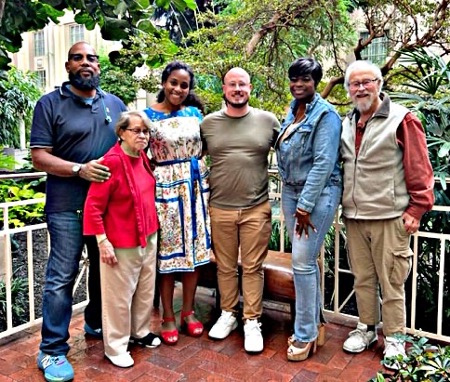
The families with the newlyweds – the next day
October 15, 2023
20 Pentecost, Proper 23
The Rev. Dr. John C. Forney
Isaiah 25:1-9; Psalm 23
Philippians 4:1-9; Matthew 22:15-22
“Just Who Let You in Here?”
There is no Try

A favorite character of one of the “Star Wars” films was the diminutive gnome, Yoda. Wise beyond words as he attempted to teach Luke Skywalker how to harness the power of The Force.
At one point as Luke fails again and again, Yoda exclaims in exasperation, “There is no ‘try.’ There is only do or not do.”
This might be the message of two sons in Matthew’s gospel assigned for this Sunday. Do or not do. There is no “try.”
“A man had two sons; he went to the first and said, ‘Son, go and work in the vineyard today.’ He answered, ‘I will not; but later he changed his mind and went. The father went to the second and said the same, and he answered, ‘I go, sir;’ but he did not go. Which of the two did the will of the father?”
And for this reason, the “kin-dom” is opened to all who respond to the call. That is why prostitutes and tax collectors will be received ahead of stiff-necked religious authorities who quibble over theological fine points while the world goes to rot.
A while back, actually, several years ago as chapter head of our Pomona Valley Chapter of Progressive Christians Uniting, I had championed a small group of Muslims being harassed and tormented by their white, supposedly Christian neighbors.
Their fine Christian neighbors had at points thrown pig parts onto their property to desecrate it (or so they thought). These people were besieged with one legal action after another by their neighbors. “Islam” is from the root word for “peace” – salaam — but many in the surrounding community would not have it so.
Our chapter, over several months, raised some ten thousand dollars for the legal defense fund of that Muslim congregation.
Hate, vituperation, porcine entrails? Definitely NOT what Jesus would do. But that’s another sermon.
At the annual dinner of An-Noor Mosque (the name of which translates as “the Light”), my family and I were invited to receive a token of their appreciation and friendship. In accepting the honor on behalf of our Pomona Valley Chapter, I mentioned that if one had asked me several years ago if I would have any Muslim friends, I would have been at a loss for words. No, of course not. I didn’t even know any Muslims. And now, here I was surrounded by an entire group of new friends that I had come to know and admire over the past two years of this saga. What a blessing to be found through all this struggle!
One of the things I learned about Islam is that while they don’t put quite the same emphasis on theological explication of their faith that we Christians do, there is a much deeper concern for right and righteous behavior. Doing the right thing – thus the extensive code of ethical writing and rulings. Say AND do. There is no “try.”
As I oft quote Mark Twain, “It would be a lot easier to believe in the possibility of redemption if the redeemed looked a little more redeemed.”
When I headed up Project Understanding – Temple City, our ecumenical fair housing program, we had a number of participating congregations. The three or four I could always count on were the Quakers, the Unitarians, liberal Catholics who believed in the social teachings of their church and the small band of Disciples of Christ folks who gave us office space at their church. These folks put their faith into action.
They would accompany home seekers who had been refused an apartment. They would confront apartment managers and landlords with the demands of California’s fair housing laws.
Our volunteers were the incarnation of Dr. King’s aphorism, “It is always the right time to do the right thing.”
They would help put on community education events to help these gatekeepers know the law and educate managers and owners to assuage the fear that if a person of color moved in all that the other tenants would move out. Actually, no one would leave because people hate to move – and we found that no one did. And this new tenant, if they could afford the rent, would take the same care of their unit as that older, white tenant. And that was invariably the case.
Now here’s the real irony – our very first client was an Italian man. For some reason, the owner hated Italians. Go figure!
The people in our fair housing organization walked the talk. And their work often took them far outside their comfort zone. It’s not easy listening to some racist screaming at you about ruining the neighborhood. Quick – Where’s the Pepto-Bismol?
The slogan of our movement was and is: “Good Neighbors Come in All Colors.” And that’s what we worked at day in and day out. Every passing month, the blessings of God’s Kin-dom grew by the number of new people who walked through the doors of opportunity.
I’m reminded of the fictional persona, a buxom nurse with attitude, Geraldine, played by Flip Wilson – always a memorable segment and crowd pleaser of his comedy show. Her opening lines as she strutted her stuff were, “What you see is what you get.”
When our clients looked at these church folks, what they saw was what they got – God’s open arms of welcome.
The church is indeed a door into a smidgeon of eternity when the operative ethic is, “What you see is what you get.”
These were the Christians in the past who sheltered Jews from Hitler’s extermination camps. These were the Christians who stood with Catholic priests and nuns martyred by death squads in Central American countries for siding with the poor. These were the Christians who marched with Martin Luther King in both North and South.
When it came to “Do or Not Do.” They did!
It’s sometimes difficult to put into context the work we do, which often seems more humdrum than heroic. Running the copy machine, stapling, attending a community meeting doesn’t seem so exhilarating as joining a demonstration to protect LGBTQ rights or stop the banning of books at one’s local school library. Yet, little by little it all works to make manifest God’s gracious welcome to all.
As our planet is besieged by what my friend, Katherine Hayhoe calls, “Global Weirding,” it is time to move to a more responsible stewardship of this earth. I’m told that this past Friday, New York City, where our younger son and future daughter-in-law live, received as much rain in three hours as would be normal for an entire month. Christopher reports water in their basement and flooded streets. Again, the subway was awash. I’ve been wondering if Alexis made it home from work okay.
Bill Nye, the “Science Guy,” said it’s now time for “big picture” thinking. Definitely, do not vote for any climate denier. Do not vote for any who aid, abet and fund them.
The first step may be to educate oneself on where your dollar goes in the marketplace. And while there is no salvation in purity of action, at least it’s possible to avoid giving our consumer dollar to some of the worst of these culprits. Time to educate yourself. How we spend our income is a Christian responsibility. You have the “power of the purse.”
Join an environmental group like Citizens’ Climate Lobby that has been working for a sustainable energy future. Or 350.org, Bill McKibben’s group. There is no “try,” only “do or not do.”
What future do we wish for ourselves and our children and grandchildren? What they see may not be much of a future.
Letters to the editor, a phone call to a missed friend, a welcome to a new person at Sunday Service. It is all part of the essential work of the Jesus Movement. All part of the “do” of the journey.
I know, when folks look at St. Francis what they see is indeed what they get. And while some of us might be “trying” at times, here faith is manifest in action. And Love is the ethic.
In less than a week, Jai and I head off to Connecticut to marry off our youngest son Christopher and his beloved, Alexis. We have a stake in what sort of planet we leave them. What sort of politics we leave them. What sort of commonwealth we leave them. And you, likewise, for your family.
“In the beginning God created…” Light was the first gift of this wondrous event. Let’s pray that this same Light set our imaginations and will on fire that we keep it all going. Do or Not Do is the question before us. The gift of Holy Spirit is to fortify our imaginations and steel our will: To the Glory of God. Amen.
October 1, 2023
18 Pentecost, Proper 21
The Rev. Dr. John C. Forney
Ezekiel 18:1-4, 25-32; Psalm 25:1-8;
Philippians 2:1-13; Matthew 21:23-32
“There is no Try”
It’s Not Fair
Back some time ago when I was running our family’s construction company, “Forney Development Co.,” we had three projects in various stages of refurbishment in Lake Arrowhead.
I would often be up there to monitor progress. One day I got up there, obviously none of the crew was expecting me as they were all standing around. When I asked as to why I heard no hammers pounding or saws cutting I was told that they were waiting a delivery of lumber.
I looked about the job site which was a mess. It hadn’t been cleaned up in some while. I told the crew that there’s not a single job site around that doesn’t need picked up and swept up. AND, I didn’t have any pay category for just standing around.
They got the message. And the lumber delivery arrived shortly after we had the place tidied up.
Employees are often a trying and tricky proposition. To get the right person in the right job is a knack developed over time. And sometimes it just doesn’t work.
Alfredo always wanted a raise but his foreman would tell him that if he couldn’t add two fractions together, he wouldn’t be able to figure the layout for roof trusses and rafters. “If you can’t do this basic math, how can I recommend to John that he give you a raise?” Alfredo never seemed interested in learning the math but also felt that Manny was unfair in not recommending him for a raise.
I now have one fellow that can be off chasing rabbits in a flash. I’ve learned that I cannot give him more than one task at a time. Otherwise, the most important task never gets accomplished.
Instead of getting a unit ready for a new tenant, this fellow’s under the box truck fiddling with the shocks and the liftgate. We don’t need the truck now. Meanwhile our tenant has paid his deposit and is ready to move in. We have tile to set, new carpet to lay, plumbing to repair, mold to eliminate and a new window to be installed. Just for starters.
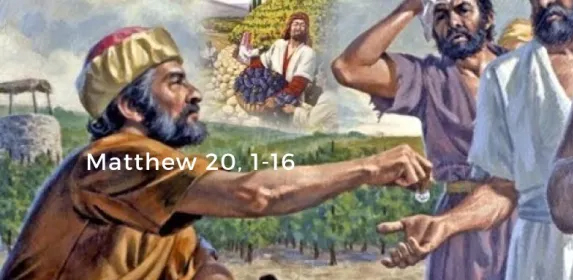
I can only imagine the distressing plight of the harried landowner in Matthew’s story of harvest time at his vineyard. Everyone grousing about who got paid what! And a labor shortage to boot!
What is fair?
Matthew’s little vignette got at this issue for the legalists in his congregation. And of course, any business owner is going to bridle at the proposition that those showing up at the job site at the last hour would be paid the same as those showing up at 6:00 o’clock that morning. Owners would shout to the rooftops, “Unfair.” We can’t run any business that way. We’d be out of business!
Well, this parable is not about fair wages. It’s about God’s generous heart.
An early controversy in the growing church was whether and how the gentiles should be welcomed. Why should these new converts be exempt from the difficulty of laboring under the demands of the Law when the children of Israel have been under that burden for generations. It’s not fair!
They waltz right in at the last hour and are yet receiving the same benefits of God’s love as the ones who have had to prove themselves under the Law for generations. Not fair!
We face the same issue here in America. Our borders are besieged with immigrants seeking shelter, seeking refuge from oppressive governments, from murderous gangs, from the effects of climate change, from lack of economic opportunity. Residents in cities besieged by this influx cry, “It’s not fair. This is not sustainable.”
In New York, Mayor Adams lamented that this issue “will destroy this city.”
As the price of everything continues to climb, wage earners and their families are squeezed. Since the Age of Reagan, income disparity between the bottom eighty percent and the very top has skyrocketed.
We now have less social mobility than we had in the Gilded Age of the late 1890s through the end of that century. Labor actions and strikes are now at an all-time high as workers struggle for a fair wage, a living wage. And artificial intelligence threatens to eliminate many of the now existing jobs.
We all are hearing a collective, “It’s not fair” resonating throughout the land. A general disgruntlement.
Statistics say the economy is doing just fine. But people are not feeling it in their pocketbooks.
It’s time to take a new look at the covenant that binds us together as a people. We need to look at the economic arrangement that binds our various nations together in a common economic rule of law.
What’s fair?
The job category of just standing around and doing nothing won’t cut it anymore.
What is fair?
Last evening on PBS “News Hour” was a segment on the obstacles to people released from incarceration who are prevented from obtaining occupational licenses for many vocations – teacher, public safety officer, electrician, cosmetologist, elder care, real estate agent, nurse, doctor or attorney.
Even though they might now have acquired the education and have demonstrated the aptitude, they are denied access to appropriate employment, in many cases due to a bad decision as a teenager. Now, THAT’S not fair!
What is fair? This for starters:
These people have done their time, paid their debt. It is high time to welcome them back into civil society with all the benefits and privileges. That’s a mirror in a small way of God’s magnanimous embrace of all. It’s the reality of the Parable of the Prodigal Son come to life.
Many of these folks will be among our clients at House of Hope. A part of our two-year program will be to provide the education and employment readiness skills for such new beginnings.
Let’s not forget, many will relapse once or twice before attaining long-term sobriety. We believe in second and third…and more chances.
Yeah, you’ve still got to do some basic math to get by in life. You need to pay your bills. You need to be able to fill out a job application. Maybe, write a cogent sentence. You’ve got to be able to get your life organized.
But I’m especially most grateful for an eternal welcome for the disorganized, the ADD folks. As is our welcome at the Lord’s Table: “Whoever you are and wherever you are on your spiritual journey, you’re invited to this Table to receive the Bread and Wine made holy.” For you, my friend, even at the eleventh hour, are holy and precious in the sight of God. Amen.
September 24, 2023
17 Pentecost, Proper 20
The Rev. Dr. John C. Forney
Jonah 3:10-4:11; Psalm 145:1-8;
Philippians 1:21-39; Matthew 20:1-16 “It’s Not Fair”
Trust But Verify

My friend Susan, a priest at All Saints, says that she is never disillusioned by the church. That’s because she has no illusions about the church. Whatever else the church is, it’s a fallible human community like all others. How often have I arrived at a new parish but to be accosted by all and sundry wanting to make sure I understood their side of the various conflicts that had been roiling that congregation. Sometimes for years.
Archbishop William Temple used to say that the Church is the only institution that does not exist primarily for its own members. The poor archbishop, I fear, had far too lofty a view of our frail humanity. Church folks can be as self-centered as those of any other grouping.
When I was in college, I was a promoter of California’s new fair housing law, which so-called conservatives were wanting to repeal.
My then girlfriend’s parents owned several apartment buildings and definitely felt that they should not be forced to rent to “undesirables” – read Blacks or Mexican-Americans.
When I would attempt to make the case that we should all be able to get along and live together – isn’t this what the gospel teaches? I was told in no uncertain terms that that was religion, but apartments were about business. Two different issues. Needless to say, under that disagreement my then girlfriend and I soon parted company. And these folks were good Methodists, regular church attenders.
Unlike my friend Susan, I did have illusions about Christian community.
As Mark Twain would quip, “It would be easier to believe in the possibility of redemption if the redeemed looked a little more redeemed. He, in his day, discovered the same spiritual blindness of the Church when it came to the issue of slavery.
The prophet Ezekiel proclaims that he has been made a sentinel for the house of Israel, to warn the wicked from their ways.
“If I [the Lord] say to the wicked, ‘O wicked ones, you shall surely die,’ and you do not speak to warn the wicked to turn from their ways, the wicked shall die in their iniquity, but their blood I will require at your hand. But if you warn the wicked to turn from their ways and they do not turn from their ways, the wicked shall die in their iniquity, but you will have saved your life…I have no pleasure in the death of the wicked, but that the wicked turn from their ways and live; turn back, turn back from your evil ways; for why will you die, O house of Israel?’”
The message is always, “Choose Life. Choose Life.”
That, AND that we are our sister’s, our brother’s keeper. We have a mutual stake in one another’s well-being.
This is a difficult proposition in our American hyper-individualistic culture. The Gospel ethic cuts straight across that stance. Hear Paul this morning: “Owe no one anything, EXCEPT to love one another.”
It’s the same ethic as that of my favorite fictional L.A. detective character in Michael Connelly’s Harry Bosch novels when it comes to effort put forth to solve murders, “Everyone counts or no one counts.”
Matthew enjoins his readers to do all possible to retain a member, even in the heat of disagreement and bad behavior.
I know that I sometimes get taken advantage of because of being too trusting. I assume that most are honest, upright actors. But even in the church, especially in the church, so much is at stake, we do get crossways with one another on occasion.
In the days at the height of the Cold War, when nuclear Armageddon was a real possibility, our state department went apoplectic when it looked like Reagan and Gorbachev were on the threshold of banning all nukes.
They did not trust Reagan’s over-optimistic assessment of Gorbachev as an honest broker. How could we possibly believe those “dirty, rotten Commie so-and-sos?”
Reagan’s answer? “Trust but verify.”
That’s the one thing he said that I believe carried weight. And hope. I confess, I was not a fan, considering how he eviscerated our mental health establishment in California. But as I said, this response resonates as true.
About eighty percent of folks will behave in ethical upright ways. Another fifteen percent might be ethically squishy. And maybe five percent or fewer are of a larcenous heart and will rob you blind.
A welcome respite and antidote to our hyper-partisan culture comes in Elizabeth Currid-Halkett’s book on the middle of our nation, The Overlooked Americans.[1] To get an assessment of the country, the author interviewed hundreds of people – all sorts, from all parts of the nation and of all political stripes.
What she discovered is that we have much more in common than the pundits and radio shock-jocks would lead us to believe. A key question the author asked of all interviewees was what democracy meant to them.
What she found was an affirmative answer to Rodney King’s tormented question, “Can we all get along?” A definite “yes” was the overwhelming answer of almost all respondents.
As a whole, we citizens had a capacious and generous understanding of the national covenant that binds us together as a people. Some of our answers:
“…everybody has a choice, everybody has a vote, everyone mattering” – this from a single mom in Appalachia.
“Where everyone gets a fair say with decision-making, to some extent…People should help make decisions for the country and to have the freedom to have free speech and practice any religion, without being persecuted” – a neurologist from Memphis.
Despite differences in age and section of the country, most answers seemed similar. Maybe we can all get along. And where we have differences, “trust but verify.” Cut each other a bit of slack.
It all takes a bit of tending. In a discussion between Marilynne Robinson and President Obama, quoted by the author, Robinson remarked on our national experiment with self-rule: “[Democracy] was something that people collectively made and that they understood they held it together by valuing it.” “We cannot take it for granted…It is a main thing that we remake continuously.”[2] It is based on our valuing one another.
When going through some of my brother’s things, in his workshop – a very large space – I came across one huge safe. Then another. And yet another. These things weighed hundreds of pounds and were almost six feet tall by four feet wide and two feet deep. One after another until I counted at least six of them. Two of which were still in their shipping containers. He had a forklift to move them.
My friend wondered what was going on with his thinking. The answer? Paranoia. Tom didn’t trust much of anybody. The world was obviously out to rob him blind. I offered to loan my friend my psych textbook on paranoia. It explains everything we were seeing.
The Gospel answer? Life’s too short to live in continual distrust of one’s fellows. Bad for the heart also.
The ethic of the Jesus movement is that of a generous spirit. Most of us, even in the church, will do the right thing. Our differences? “We can work it out,” to quote the Beatles. “We can work it out.”
The church is like a big family. We are not just a random assortment of individuals who happened to stumble in off the street. We belong to one another. And that’s the reality I witness every Sunday here at St. Francis.
Yes, like any family we have our differences, but there’s no evil intent implied or expressed – like any family.
I can still remember our late controversy here at St. Francis over the Thanksgiving gravy. On one hand we had the giblet’s faction and opposed was the giblets-free opinion. In my mind’s eye I could envision schism over gravy of all things. Giblets were essential. Giblets were an atrocity. Which would it be? As my grandmother would often exclaim in disgust, “Oh, good gravy!”
The problem was solved by having two gravy selections. You choose. Would that all church controversies could be worked out so amicably. Maybe this solution comes under the category of WWJD. Or at least, it’s as close as we could get.
As one of my favorite hymns puts it: “Blest be the tie that binds/Our hearts in Christian love:/The fellowship of kindred minds/Is like to that above. We share each other’s woes,/Our mutual burdens bear,/And often for each other flows/The sympathizing tear…When we asunder part,/It gives us inward pain.”
This is indeed a journey where everyone counts, where everyone is precious in the Lord’s sight. Let us continually pray for the grace to live out this vision. Amen.
[1] Elizabeth Currid-Hacket, The Overlooked Americans: The Resilience of Our Rural Towns and What that Means for Our Country (New York: Basic Books, 2023).
[2] Op cit, 29-30.
September 10, 2023
15 Pentecost, Proper 18
The Rev. Dr. John C. Forney
Ezekiel 33:7-11; Psalm 119:33-40;
Romans 13:8-14; Matthew 18:15-20 “Trust But Verify
The Sins You Forgive; the Sins You Retain

At my first assignment as a United Methodist pastor out in California’s Upper Mojave Desert, I served two congregations. One of them, the one in Randsburg, I was supposed to close after the church had received a bequest left it by the matriarch of the parish, Mrs. Jewell.
Since we had only 4 members there upon my arrival that July 1, closure made complete sense. However, since our attorney handling the matter was less than diligent, this matter was dragging on and on. Pretty soon we were up to ten members, then twenty. This was becoming a thriving operation.
One of the couples who lived up the hill above town, Muriel and Harold Beck, attended regularly, but Harold’s brother who lived next door wouldn’t darken the door of the church for Sunday services. But if we needed any repair to the furnace or the plumbing, he was most willing to come down and get us operational again.
One weekday, when I’d usually make my visits to folks there, Harold asked me if I might make a pastoral call on his brother Jim. He’d love to meet me.
Was I in for quite a story! First of all, Jim had worked with the Wright Brothers – yeah, the first airplane Wright Brothers. He had some wonderful reminiscences to share of Wilbur and Orville and their bicycle shop. He had left before they had started building their biplane, the Wright Flyer in 1899.
But here’s the thing which stuck with me: The tragic story Jim shared. Upon leaving high school, he was signed up as a baseball player in one of the minor leagues, then for a short while went up to the majors. I don’t remember the team, not even positive now that Jim was his first name.
When Jim told his pastor that he would have to be missing Sunday services, the pastor told him in no uncertain terms that he would be going straight to hell.
That was the last Jim’s church ever saw of him. Or any church. Though he and I developed a good friendship and we had numerous visits, he could absolutely not get over the hurt that pastor had inflicted on his soul.
In our reading from Matthew, we are told that the Church has been given great authority.
“And I tell you, you are Peter, and on this rock I will build my church, and the gates of Hades will not prevail against it. I will give you the keys of the kingdom of heaven, and whatever you bind on earth will be bound in heaven, and whatever you loose on earth will be loosed in heaven.”
That foundational passage has been the source of much hurt and pain when interpreted in support of an imperial version of the Christian faith. And it has been the source of much Gospel Joy, when interpreted as a prompting for servant leadership.
Too often those in authority have, since the rise of the Constantinian church, used this passage to exclude, to flout their authority, to oppress. The abuse of authority, cloaked in those few verses, has itself been the source of great sin.
When confronted with such clerical pomposity, my wife responds, “And who put you in charge?” Of course, they themselves did.
And the evil which flows from such misuse and distortion of authority is legion.
I believe that Paul Tillich best described the parameters of sin when he looked at it as a three-fold separation: Separation from others, separation from self and ultimately, separation from God.
Sin is not those nasty, spiteful or criminal things we do. They are all symptoms of that initial separation.
We can remain locked in to this separation. Out of judgmental disposition we can attempt to lock others into the tragic separation which is often the human condition. To remain bound, we tie ourselves to something that will eat our souls alive. Much as flesh-eating bacteria consumes the living body.
Or we can choose release. “Let go and let God” – an insight from the Holy Spirit. Grace abounding.
Yes, we can retain sin. But our calling in Christ Jesus is to pronounce release. Sometimes called forgiveness.
Some of you are aware that recently my brother Tom passed away. He had been a resident of Twin Falls, Idaho. He had never married and had no children. I was his only sibling. So, guess to whom the chore has come in wrapping up his affairs.
Tom, had an extra copy of the family packrat gene. Little by little, I’m discovering what all he left behind. One of his former employees, now my employee, discovered in going through is check register, four huge storage units here in California.
These are really huge – 14 feet by 50 feet – completely packed with stuff: Pieces of scrap metal, furniture, assorted piles of lumber, machinery, and at least two vehicles. There was an old Chevy panel truck in one and a Ford Ranchero in another. The Ford’s worth restoring, but I have to first find the hood somewhere.
When we got the first storage door opened and I looked inside, I could only mutter, “Lord, take me now!”
He owned a triplex in Loma Linda and one of the garages there is also full of his stuff, including an 80s-something Lexus.
Besides leaving all this stuff behind, Tom had a personality disorder, leaving behind a lot of hurt. He could say all manner of hateful and resentful things.
Looking back at our troubled relationship, I’m faced with a spiritual choice: Do I retain all this hurt and emotional mess, or am I willing to release it?
This choice was given greater focus when I was confronted with the responsibility of writing his obituary.
Also, most helpful was meeting one of his tenants at the Loma Linda triplex, an African named Rose. Rose, a former citizen of South Africa, was most kind and generous in her hospitality. This was the open and welcoming African hospitality I had experienced in Ghana. I was invited in to her apartment, given a warm hug and offered coffee or tea.
Rose, was completely devastated to hear of Tom’s death. She reminisced on what a generous landlord he had been. She needed a new dishwasher? He had one installed. She needed a new refrigerator? He purchased one for her. Over the years, he had kept rents well within reason.
When I met with two of the women who ran the storage facilities, I heard similar stories.
From his former employee, I heard of his concern for the environment. He would not use plastic anything if he could avoid it.
The final analysis? Tom was a mixed bag, even though he had been estranged from the rest of the family for years. In writing his obituary, I was given the Spirit-nurtured opportunity to both acknowledge the damage he had done over the years, and to acknowledge the grace-filled aspects of who he was: in short, to “let go and let God.”
Over the weeks and months to come, as I empty out the mounds of stuff from his storage units, I will pray for the spiritual strength to keep this perspective. One day at a time.
We can, in our own hurt and despair, choose to retain the sin of separation, but our life-giving opportunity, our calling, in the Jesus Movement is to release it. And the promise is that even greater life will flow back into us.
As we pray every Sunday after communion:
Lord, make me an instrument of your peace.
Where there is hatred, let me sow love;
where there is injury, pardon;
where there is discord, union;
where there is doubt, faith;
where there is despair, hope;
where there is darkness, light;
where there is sadness, joy.
Grant that we may not so much seek
to be consoled as to console,
to be understood as to understand;
to be loved as to love.
For it is giving that we receive;
it is in pardoning that we are pardoned;
and it is in dying that we are born to eternal life.
A tough assignment for sure; yet in such living, we are led the door of eternal life. Amen
August 20, 2023
13 Pentecost, Proper 16
The Rev. Dr. John C. Forney
Isaiah 51:1-6; Psalm 138;
Romans 12:1-8; Matthew 16:13-20
All Means All – Take 2
When we lived on Green Street, I had a five-mile walking course laid out that took me up to Foothill then back down Towne to home. I would often do this route after dark.
One evening as I was heading back down on Towne, I didn’t notice that one section of the sidewalk had been lifted up by tree roots. The next thing I knew I was sprawled out in some juniper bushes in the park strip. Down for the count.
As I slowly gained my wits and realized that I was probably going to live, I noticed a sharp, stabbing pain wracking my shoulder. Then I began to feel like maybe, in fact, I wasn’t going to make it. The pain was excruciating. “They’re going to just find my cold, dead body lying here in the morning when they bring in the trash containers,” I thought. After laying there for a number of minutes, I realized nothing was broken, and gingerly got back on my feet.
Obviously, I didn’t expire, but made it back home. The next day I did report this trip hazard to the city. I wasn’t going to sue them, but the next victim might.
In our reading from Matthew, we discern the importance of the Law and the tradition. We see the importance of Jesus’ mission to the people of Israel. But, in today’s reading, the gospel writer is moving us beyond this narrow vision. The dietary restrictions are not the sole point of it all – the be-all, end-all in themselves.
“’Listen and understand: It is not what goes into the mouth that defiles a person, but it is what comes out of the mouth that defies.’ Then the disciples approached and said to him, ‘Do you know that the Pharisees took offense when they heard what you said?’…’Let them alone; they are blind guides of the blind…what comes out of the mouth proceeds from the heart, and this is what defiles.’”
Mathew goes on then to introduce the foreign woman, breaking all boundaries of protocol.
“Just then a Canaanite woman from that region came out and starting shouting, ‘Have mercy on me, Lord, Son of David; my daughter is tormented by a demon.’”
Jesus ignores her, as well he should according to custom and propriety. But she persists. “’Send her away, for she keeps shouting after us.’” But this is my kind of woman. She will insist that Grace trumps all. She will not be denied. When Jesus tells her that his mission is solely to the house of Israel, and that one does not take the children’s food and throw it to the dogs, she nails him and his stodgy, limited understanding of God’s Welcome.
“She said, ‘Yes, Lord, yet even the dogs eat the crumbs that fall from their master’s table.’”
At this point Jesus grants her the healing she seeks for her daughter. “’Woman, great is your faith! Let it be done for you as you wish.’ And her daughter was healed instantly.”
And like the Grinch who Stole Christmas, Jesus’ heart grew three sizes larger.
The divine, enfleshed in human yearning, grew beyond the narrow bounds of nationality and custom. Grace upon Grace. That’s what God is all about as revealed in the maturing vision of the Matthew’s community of faith as evidenced by their preserving of this story.
We come to the consummation of this vision when the Risen Christ in Matthew commands us to take this understanding out to all. “Go and make disciples of all nations.” All means All!
The Johannine community captures this sentiment exactly. “God is Love, and those who abide in Love abide in God and God in them.” Not a sloppy, sentimental, Hallmark pastel-cheap sentiment – but a Love that costs. A Love that commits to doing the necessary thing. A Love that speaks the Truth and lets the chips fall where they may. What Bonhoeffer called “costly grace.”
Somewhere the spiritual writer Anne Lamott nailed it when she posted, “You can safely assume you’ve created God in your own image when it turns out that God hates all the same people you do.”
So, folks, here’s the takeaway: When we act as the “Frozen Chosen,” when rules become more important than the essential of Grace, are we Christians not a stumbling hazard every bit as much as that broken sidewalk that sent me sprawling into the bushes?
Such impediments were called a skandalon, a stumbling stone – just as such attitudes are a scandal to the proclamation of the Gospel in our day.
When we ignore the damage done to the “least of us” and just go about our comfortable lives, aren’t we as dangerous to the faith as that cracked concrete?
In the Episcopal Diocese of West Virginia, Bishop Mike mandated that every parish and mission would have Narcan, the antidote to opioid poisoning, available on site with people trained to administer it.
One stodgy priest was heard to comment, “Why would we do this? They’ll just overdose again.” Yeah. Right – probably up there with what Jesus might have said. And just what part of the Gospel did this uncaring clergy creep miss??? A stumbling stone to the proclamation of Gospel Grace, that soul is.
Out of the abundance of the heart the mouth speaks, indeed!
I find that there is much joy to be had in being part of the welcome, in being part of the solution. That’s what the Jesus Movement is all about.
Saturday morning, I went out to Amy’s Farm, a non-profit organization and met with Randy Berkendam, Amy’s husband who runs the business end of things. He showed me around and we talked about the prospect of them moving to St. Francis as they are being evicted due to the land being sold to a developer.
I witnessed all sorts of healthful, productive activity – now that’s Gospel Grace. That farm is a welcome to all – Gospel Welcome.
This is an opportunity for Love-in-action that God may now be giving to us. Just as a woman with a hemorrhaging daughter was an opportunity for Jesus to grow spiritually – dare I say, for God to grow? — the community of faith to grow?
Randy, at another location, showed me a huge, monster pile of composting soil which would need to be stashed elsewhere than at St. Francis. It is the essential soil composting. With this, Randy believes he can get moved and have the farm up and running in as little as 6 weeks.
Right now, Amy’s Farm is economically self-sustaining. Unfortunately, selling healthy food does not pay all the bills. Two potential sources of income would be reimbursement from the House of Hope – San Bernardino for making this form of therapy available for our clients; the second being from a local college or university which would want to make a sustainable farming course available to their students. Amy’s Farm presently has one such arrangement. Our son Jonathan took such a course at Kenyon College and loved it — one of the best classes he took there, he says.
Are we interested in hearing what Randy has to say? Are we sufficiently daring to step out in faith for the sake of Love? — Jesus did.
Everybody, stay safe, keep batteries and flashlights handy just in case. But in any case, the lights will NOT go out on the Spirit of St. Francis! Amen.
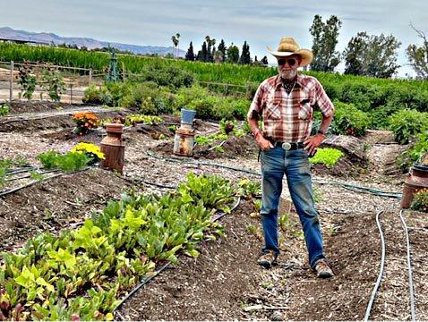
Randy shows off the farm. It was built over a bed of wood ships then layered with rich, composted soil. Notice the efficient drip irrigation.

Rich, black, living soil, makes the kale grow!
August 20, 2023
12 Pentecost, Proper 15
The Rev. Dr. John C. Forney
Isaiah 56:1, 6-8; Psalm 67;
Romans 11:1-2a, 29-32; Matthew 15:10-28
“All Means All – Take 2”
 Forney Charities