
Forney Charities
Improving communities by helping residents, one person at a time.
The Power of Love

Like many other people, my days are filled with things to do and places to go. Right from the get-go, I’ve got a “to do” list and the internal dialogue between my two ears is the ordering of it.
If there’s a problem, I’ll quickly jump to possible solutions before carefully assessing the nature of it in all its complexity. This is especially true, if the matter brought to my attention involves another person.
How many times have we all been that busy, hostage to the chores of the day?
In our lesson from Mark, Jesus is confronted with a personal problem on his busy journey. He also has places to go and things to do. In the midst of the busyness, he seeks some respite in a private home. He just needs a few moments of peace and quiet for himself. So, an interruption comes as a big annoyance. A thing to be dispatched with quickly. It is the story of the Syrophoenician woman who seeks healing for her demon-possessed daughter.
When the woman makes her request, Jesus abruptly dismisses her with, “’Let the children [of Israel] be fed first, for it is not fair to take the children’s food and throw it to the dogs.’ But she answered him, ‘Sir, even the dogs under the table eat the children’s crumbs.’”
Her clever response cuts him short. To listen, really hear what the other is saying and be affected by it. That’s the “Power of Love.”
A favorite from the film, “Back to the Future” by Huey Lewis and the News, “The Power of Love,” soared right to the top of the charts.
The Power of Love is deep, down really listening to what’s said and what’s not said.
The chorus nailed it:
You don’t need money, don’t take fame
Don’t need no credit card to ride this train
It’s strong and it’s sudden, and it’s cruel sometimes
But it might just save your life
That’s the power of love
That’s the power of love
The power of Jesus Love was intense, active listening. He let that women get to him. And she WAS RIGHT!
The God spark in him was changed by her plea.
In the midst of his annoyance, Jesus listened. Actively listened.
That was the first lesson of my married life. I had to learn to really listen to Jai, to let her inside and take account of her concerns. To be emotionally available. It’s taken fifty-seven years and I’m still working on it.
Jai gets the first crack at each and every sermon. My first question to her after she’s read it, “Was it interesting?” Second, “Did it give you a better understanding of the scripture lesson?” My writing has profited immensely from simply listening to my wife. Her gift back to me is the Power of Love.
The Church also listened, realizing that its mission is far more comprehensive than to a small, select group of the “chosen”. The Gospel mandate transcended culture, race and gender. We’re still working on that lesson. Indeed, “In Christ there is no east or west, no north or south.”
The broader mission all began with truly hearing the anguished plea of this outsider, this foreigner. In hearing those on the margins, we also may learn to listen to our own lives.
Frederick Buechner points the way, “Listen to your life. See it for the fathomless mystery it is. In the boredom and pain of it, no less than in the excitement and gladness: touch, taste, smell your way to the holy and hidden heart of it, because in the last analysis all moments are key moments, and life itself is grace.” Listen to the lives of those around you and see their lives as sheer grace.
And in listening to those whom we would too quickly dismiss, we stumble upon the amazing grace of who we are – renewal for ourselves and for the world. That’s the Power of Love.
When I was teaching, and had to referee a dispute between two young fellows on the playground, one of the first things I learned was to listen deeply to both sides. The matter was never so simple as it seemed to either of the disputants. My duty was to give both boys voice, let each be heard.
Recently, Nicholas Kristof had some very important advice on listening in his latest op-ed column, “Why We Shouldn’t Demean Trump Voters.” And, yes, I have to plead guilty.
Quoting Bill Clinton, he writes “’I urge you to meet people where they are,’ said Clinton, who knows something about winning votes outside of solid blue states. ‘I urge you not to demean them, but not to pretend you don’t disagree with them if you do. Treat them with respect — just the way you’d like them to treat you.’”[1]
Kristof continues, “It’s more than politically stupid – it’s difficult to win votes from people you’re disparaging.” But it’s more than that.
Kristof adds, “It has also seemed to me morally offensive, particularly when well-educated and successful elites are scorning disadvantaged, working-class Americans who have been left behind economically and socially and in many cases are dying young. They deserve empathy, not insults.”
Good politics begins with deep listening and really hearing the other.
When Kristof shared with some of his colleagues the nature of his forthcoming piece, many were aghast. “Plenty of readers replied hotly: ‘But they deserve to be demeaned!’”
Kristof counsels that we step back and all take a deep breath. He recalls FDR’s radio address, a “Fireside Chat” of April 7, 1932. His talk, “The Forgotten Man,” addressing a nation at the height of the Great Depression, roused a nation to believe in one another.
FDR did not scold, did not cast blame. He heard and empathized. I like to think that this demeanor came deep from what he had learned over the years in his Episcopal congregation. And listening to his Eleanor.
“These unhappy times call for the building of plans that rest upon the forgotten, the unorganized but the indispensable units of economic power, for plans like those of 1917 that build from the bottom up and not from the top down, that put their faith once more in the forgotten man at the bottom of the economic pyramid.”[2]
As his funeral train made its way across the nation, a man was found weeping along the route, and was asked if President Roosevelt had been a close friend. “I didn’t know him,” the man replied. “But he knew me.” This was a feeling shared by millions of Americans.
Roosevelt listened. He listened to his former colleagues in congress. He listened to the reports Eleanor brought back from her trips throughout the land. In the grace of his listening our nation was healed. That’s the Power of Love. Gospel Love.
The Power of Love is the willingness to listen, especially when the news is not good of favorable to oneself. And let that message into your soul. To be affected by it at the depths of one’s being. To risk being changed by it.
This past week, on the front cover of The Economist was the headline on Sudan.[3] This is a tragedy that has received far less coverage than the war in Ukraine and Gaza, yet it is deadlier than both combined.
“Africa’s third-largest country is ablaze. Its capital city has been razed, perhaps 150,000 people have been slaughtered and bodies are piling up in makeshift cemeteries visible from space. More than 10 million people, a fifth of the population have been forced to flee from their homes…6 to 10 million people could die from starvation.” Folks, this is not “Morning in America.” And the world stands by as a collection of bad actors – Russia, Iran, Egypt, Saudi Arabia, Turkey have played both sides to their own benefit.
We, in the West, need to impose biting sanctions on those fueling the conflict with money, weapons and soldiers. We need to hear the cries of the ignored. We must heed their call. I wonder how long we would turn our heads if these victims were white. And don’t think that this disaster will not find it’s way to our door.
Lord have mercy, Christ have mercy, Lord have mercy upon us.
We have abandoned this part of the world just as we have abandoned the women of Afghanistan. As far as they are concerned Biden has been no different than Trump. They both conspired to sell these women and girls into a future of misery and abject servitude.
No education beyond the sixth grade is permitted for girls. For women, no employment in virtually any job. Women are not to be allowed in public spaces – parks, gyms, shopping areas. They are virtually restricted to the home, being housewives and having children.
We sold them out. They were not consulted in the negotiations and abandonment that extinguished their hopes. All decided by a bunch of men who cared not a whit about their future or aspirations. Colin Powell once said, “It’s Pottery Barn rules. You break it, you own it.” Apparently, not us.
Lord have mercy. Christ have mercy. Lord have mercy on us all.
A widow, Ms. Rahmani, who had worked for nonprofit groups for nearly 20 years before the Taliban seized power, cannot now provide for her four children since women were barred from employment.
“’I miss the days when I used to be somebody, when I could work and earn a living and serve my country,’ Ms. Rahmani explained. ‘They have erased our presence from society.’”[4]
This is our doing. We invaded their nation then walked away leaving a complete disaster. The men in charge took no thought for what they left behind for one half of the population, the women and girls.
Can you hear them now? Let us deeply listen to their pain. Listen as Jesus deeply listened to that Syrophoenician woman. As he listened to so many along the fraught road to Jerusalem. This is the first act of love.
Lord have mercy. Christ have mercy. Lord have mercy upon us.
Listen we must. And become aware. Support aid through whatever channel. “Your thoughts and prayers” are insufficient here if not acted upon.
The Power of Love may seem insignificant, but when infinitely multiplied by the Spirit that stimulates creative solutions, empowers our gumption and fortifies courage, who knows what the Almighty can do through those of us willing to listen and to act? For the present, perhaps the best we can do is to immerse ourselves in the spirituality of the Serenity Prayer. Ask and accept forgiveness.
God grant me the serenity
to accept the things I cannot change;
courage to change the things I can;
and wisdom to know the difference.
Then we’ll see the amazing Power of Love.
May it be so. Amen.
[1] Nicholas Kristof, “Why We Shouldn’t Demean Trump Voters,” New York Times, August 1, 2024.
[2] Franklin D. Roosevelt, “The Forgotten Man,” Fireside Chat, April 7, 1932.
[3] “Why Sudan’s War is the World’s Problem,” The Economist, 9.
[4] Christina Goldbaum and Najim Rahim, “With New Taliban Manifesto, Afghan Women Fear the Worst,” New York Times, September 4, 2024.
September 8, 2024
16 Pentecost, Proper 18
Isaiah 35:4-7a; Psalm 146;James 2:1-10, 14-17; Mark 7:24-37
“The Power of Love”
What Defiles and What Builds Up

More about food this Sunday. Some religious authorities insisted that the dietary law be followed scrumptiously – washing hands. Now, even my mother insisted on that before dinner. Not that we scrupulously followed her directions about hands.
But these ultra-religious leaders insisted that dirty hands, or not sufficiently-washed hands would lead one into the outer darkness and gnashing of teeth, utter doom. You might be defiled for all eternity. Even Mom did not go that far.
In addition, there were certain foods that might defile one. Now that I could believe. At least liver and onions, rutabagas, parsnips and tomato aspic could come close to leading to eternal damnation. At least that’s what I told Mom (or something like that). She didn’t buy that either.
Now, before we shift all the blame to religious leaders long gone, maybe we should point this passage to our hearts.
Sometimes, we Episcopalians can be just as pompous and self-righteous about our traditions. Our hoity-toity attitudes can get in the way of Gospel love. We can be standoffish and aloft when it comes to working with others in the Christian family.
I remember one of our more Anglo-Catholic priests upbraiding me for having children’s sermons during worship. She asserted, “The Episcopal Church is an adult church.” To which I responded, “Jan, if we really believe that, we soon will be a cadaver church.” Do children’s sermons really defile our traditions? Really???
Some religious big shots confronted Jesus concerning all the nit-picking traditions and superstitions in the practice of their faith. “Why do your disciples not live according to the traditions of the elders, but eat with defiled hands?” To which Jesus responded, “Isaiah prophesied rightly about you hypocrites, as it is written, ‘This people honors me with their lips, but their hearts are far from me…’”[1]
When it comes to “defile,” there are far more serious failings to consider than dietary laws. As in what defiles a nation. As in what defiles the whole community.
A while back, we passed two significant anniversaries – the conviction of Lt. William Calley in the massacre at My Lai and that of Charles Manson and his cult followers’ – “The Manson Family” — murderous rampage in Los Angeles. March 29, 1971 was the day of both convictions.
Lt. Calley gave the orders that resulted in the wanton slaughter of some 450 innocent villagers, men, women and children – many raped and brutally tortured by U.S. troops before being shot and bayonetted.
That day was a moment of complete desecration of this nation, the military and all that we as Americans hold sacred.
That very same day Charles Manson and his followers were convicted of the brutal murders of the La Biancas and those at the home of Sharon Tate. Utter Desecration.
But there’s an alternative. In the midst of our worst, many more are bending their efforts to lift us up.
Most of us will attempt to live lives of decency and compassion for both neighbor and stranger. And as Machele Obama proclaimed last week on the “contagious power of hope,” “America, hope is making a comeback. Big time!
Most of us will be good neighbors. As Oprah Winfrey said that last week’s Democratic Convention, when a house is on fire, we wouldn’t ask who the owner voted for, we don’t ask what party they are a member of, or whether they are black or white. And even if they are a “childless cat lady, we’ll try to get the cat out.”
These efforts range from the minor to the sublime, from those of seemingly no consequence to those of political import.
It’s about standing up for truth and rebutting misinformation and lies. The other day at Vons in the checkout line, I was practicing what Sister Semone Campbell of “Nuns on the Bus” dubbed “checkout line evangelism.”
I had asked the clerk totaling up my bill if he had seen any of Vice President Kamala Harris’ speech. The clerk responded, “She’s anIndian.” “No,” I asserted, “she’s biracial. Her father is a Jamaican black man.” “No, she’s Indian,” he persisted. I challenged him to look it up on the Google machine. “She’s biracial.” Meanwhile, Jai was attempting to shrink into the groceries as others nearby listen in on this exchange.
This little episode might not have convinced him, but it did in some small way rebut the misinformation and ignorance that’s out and about in our political landscape.
In the aftermath of the defilement by the bombing of the 16th Street Baptist Church in Birmingham on September 15,1963, one man stood tall for justice, Doug Jones.[2]
Due to the rampant violence, that city had earned the moniker of “Bombingham.” At the trial of a KKK member, the only person to have been charged with that crime, a young law student, Doug Jones, had skipped classes to sit in on all the proceedings. When a guilty verdict was announced, Doug swore in his heart that he would somehow work to bring the others to justice.
His perseverance and efforts paid off. Amost four decades after that trial, Doug had risen to become a U.S. Attorney based in Birmingham, and that bombing still haunting his days and nights.
Despite the advice of well-meaning friends, he began to dig into that case. “Let it lay. Nothing to be gained by digging all that old stuff up again.”
Doug would not allow our nation to wallow in justice denied. It would not be denied for Addie May Collins, Cynthia Morris Wesley, Carole Robertson, Denise McNair and their families. He would dig and dig.
There was a lot to cover up. The FBI was well aware of the threat the KKK posed to anyone, even their own agents and informants. There were KKK sympathizers within their own ranks.[3]
Bending Toward Justice is Senator Doug Jones’ story of how, in the midst of abject defilement, justice finally triumphed for these girls and their families. He lifted up, he restored faith in our system of laws.
On the other end of the spectrum, I came across a story of a family working to restore what is broken.
In the Los Angeles Times I read this article on the little Mojave Desert town of Amboy. I suspect many of you have never heard of the place.[4]
I knew it as a geology major. There’s an extinct volcano right outside the town. We would take trips out there to climb it and collect “bombs.” These were rocks ejected from the volcano. As they fell back to earth, the mouton lava solidified in a round form with a tail on both ends, thus a “bomb.”
The town of Amboy dried up and was abandoned when bypassed by the interstate highway. Finally, an immigrant named Albert Okura enamored by the cultural heritage and mystique of the place, purchased the entire town. Albert’s son, Kyle, upon inheriting it, has labored to restore the small café, Roy’s Motel and gas station in hopes of having a portion of Route 66 named in honor of his father, Albert Okura.
Albert, the “Chicken Man,” founder of the Juan Pollo restaurant chain, had originally purchased Amboy some twenty years ago. As a former geology major and a bit of a “desert rat,” I am overjoyed to see the restoration of Amboy and some of its iconic buildings.
Yes, “Get your kicks on Route 66,” and explore wonderful places like Amboy. Just a minor tribute to one man building up America. As Kyle, now the owner of Amboy, proclaims, “It’s unlike any other place you can visit. There’s nothing like it and no way you can replicate something like Amboy.”[5]
It is folks like Doug Jones and the Okura Family; it’s teachers and attorneys, farmers and students, all working to lift up and perfect this nation. We don’t have to deny the worst of the desecration that has been perpetrated on the body politic and our citizens, especially those on the margins – but we can accept these truths and move beyond the worst in our history. We don’t banish that part of our history but allow the better angels of our nature to lead us into greater light.
That is what most of us believe and work for – restoration, perfecting, aligning our efforts with our best vision and values. That is what will be on the ballot this November.
Again, I close with my favorite James Baldwin passage from his book of essays, The Price of the Ticket.
“For nothing is fixed, forever and forever and forever, it is not fixed; The earth is always shifting, the light is always changing, the sea does not cease to grind down rock. Generations do not cease to be born, and we are responsible to them because we are the only witnesses they have. The sea rises, the light fails, lovers cling to each other, and children cling to us. The moment we cease to hold each other, the moment we break faith with one another, the sea engulfs us and the light goes out.”[6]
Amen.
[1] Mark 7:5-6, NRSV.
[2] Doug Jones, Bending Toward Justice (New York: All Points Books, 2019).
[3] Op. cit., 49.
[4] Alex Wigglesworth, “Saving a Patch of Americana,” Los Angeles Times, June 16, 2024.
[5] Wigglesworth, op cit.
[6] James Baldwin, The Price of the Ticket (New York: St. Martin’s Press, 1985), 393.
September 1, 2024
15 Pentecost, Proper 17
Deuteronomy 4:1-2, 6-9; Psalm 15James 1:17-27; Mark 7:1-8, 14-15, 21-23
“What Defiles and What Builds Up”
The Sacramental Dinner Bell

Food is basic – necessary for survival. Call me whatever you want but don’t call me late for dinner.
It is unconscionable that the civilized world stands by as famine stalks Gaza and Sudan – where just in Sudan three fourths of a million are on the verge of starvation. And the world sits idly by. Especially, when virtually all food shortage is the result of wars, mismanagement and government indifference.
Food is one of those areas in life where we can be most critical. At Pilgrim Place, our retirement community, if the string beans are undercooked there will be a flood of comments from the residents – at least one from me!
Some foods do not please and there’s no getting around it. My brother Tom could not abide Brussels sprouts. With me it was liver and onions. If I was quiet, when my parents’ attention was directed elsewhere, I could slip most of that in small pieces to our dog Skippy who waited expectantly at my seat.
One night as dinner was concluded, Tom still had five or six Brussels sprouts on his plate. He placed a napkin over them and proceeded to take his plate off the table, something he never did. As Dad looked up from the evening paper, he reached over a hand and whisked that napkin off Tom’s plate.
“Sit down,” he commanded. “You’re going to finish those.”
As Dad went back to his paper Tom mulled his options. Then a flash of inspiration. Maybe these horrible things might taste better if he put them in his glass of lemonade. Nah, that didn’t improve them. Well, what about some ketchup. That always made food taste better. By this time, Dad had lost his patience. “Tom, you’re going to eat those…NOW!”
Tom tried to choak one down, gagging and sputtering lemonade all over. He was soon in tears when Mom, the peacemaker, came over. She got Dad to agree to let him dump the concoction if he would eat just one. And promise to never do that again. I was sure glad that I didn’t mind eating my Brussels sprouts.
In scripture, food is symbolic of the goodness that God intends for all. It is what the end-time feast is all about, a metaphor for God’s bounty that all are invited to share in on the Last Day. “On this mountain the Lord of hosts will make for all peoples a feast of rich food, well-aged wines, of rich food filled with marrow, of well-aged wines strained clear.”[1] All the stuff I now can’t eat due to my renal diet I’ll be able to indulge in. And…I’ve already notified St. Peter that if there’s no beer, I’m not going.
Again, this week’s passage from John’s gospel brings to mind the Eucharistic feast. I consider this sacrament as Christ’s invitation to all the sit at the Table of God’s Free Bounty when the dinner bell is rung. That wafer is the sacramental token of God’s desire that all are welcome to partake in the riches of creation. “Taste and see that the Lord is good.”
Food is a metaphor of God’s graciousness, the whole shebang – God’s will that all are satiated with the entire goodness of creation. As we, the Church, — Christ’s Body — cooperate with the Spirit to bring this vision to reality, we are Christ present to our neighbors. It might not be much – a few tomatoes, some peaches and apricots – but it shall suffice when offered up with all the other food that’s donated and distributed every Wednesday at St. John’s.
Unfortunately, this is not how the real world works within our economic system. If one examines that word, “economy,” it comes from two Greek words – “oikos,” meaning house and “nemean,” meaning to manage.
In the teachings of Jesus, there is about those left to manage affairs for an owner who is away — just as we are given responsibility to manage our affairs in the physical absence of the Lord. And how are such managers to be judged? – not on the Last Day but now, in the daily grind of our economic system? I like to think the standard to which they are held is how the wealth of the household is distributed equitably to all. Especially the “least of these.”
Now, if we had a manager who was responsible for say, one hundred souls, and say only two of them ended up with 90 percent of all the goodies. And forty of them had virtually nothing, or near nothing — how would we rate that manager? If half of them had untended illnesses and never saw a doctor or health care professional, how long should that manager remain in charge? If sixty percent went to underfunded schools or mostly missed classes, would you keep paying that manager? If ten members of that household actually had to live on the streets, or were sold into servitude because the manager refused to provide for their essential care, would you keep that manager? Does this regime the look like the Beloved Community of the Jesus Movement?
“You’re FIRED!!!” would the end of that operation.
Indeed, you would say that manager ought to be relieved of his or her position and, if not cast into the outer darkness with the mournful whaling and the gnashing of teeth — he or she at least ought to be compelled to live in a tent city on Wilshire Blvd. or some Skid Row among those suffering is the result of the neglect this manager has wrought. And maybe after a bit of eternity, we might hope that this derelict manager would have developed a little compassion for the cast aside.
Is it any wonder that a good number of the younger generation have given up on the capitalist system? Their beef? All it’s done is saddled them with massive amounts of student debt, mainly because the uber rich have refused to support public colleges the way they were previously compelled to under a tax code when they paid their fair share.
When I went to a community college, I think my tuition didn’t amount to much more than $25 a unit – no longer the case. Even at public colleges, our students end up graduating with $30,000 to $40,000 in student loan debt. Hundreds of thousands if they go on to graduate school.
Jorge Reiger, in his book, Christ and Empire,[2] takes the analysis of the disparity further than H. Richard Niebuhr’s Christ and Culture by noting that most theology is done in the context of a comfortable middle-class culture. If we are going to look at the context from a comfortable, highly educated standpoint, that’s not the group Jesus was interested in. The “Least of These” was his focus. We must ask, what does it mean to do theology from the bottom? Yes, Jesus was interested in the well to do, but only in that they might develop a heart for those at the bottom, the dregs of the empire’s economic and political system. How often are we are that rich, young man, woman, sent empty away?
The emphasis on the importance of food enough to satisfy all is a stand-in for God’s will that all have enough of life’s goodies to flourish. Not only are we talking about freedom from hunger, but the freedom for each woman and man to be fully alive, to reach their full potential. It’s about being fed with the freedom to have decent work at a living wage. The freedom to have political agency. The freedom to love whom you love. It’s about the freedom to have decent housing in a safe community. The freedom to learn and go as far as your talent and effort will take you. In short, to thrive. St. Ignatius proclaimed, “The Glory of God is a man [a woman] fully alive.” That means, not only us middle class folks but especially those at the bottom the heap. The heavenly dinner bell is rung for those who hunger, not for the well satiated.
At my favorite bookstore in Charleston, West Virginia, this past week, I came across a new biography of Harriet Tubman by Tiya Miles. In her new work, Night Flyer, Dr. Miles centers her story in the context of Harriet’s spirituality and African traditions. Harriet Tubman rang that heavenly dinner bell loud and clear for those would escape the brutality of their enslavement. Her’s is a theology from the bottom. Freedom was the nourishment she served up.
Though Harriet never learned to read, she was deeply immersed in the fabric of the Christian story. In her work, God was a reality providing comfort, assurance and guidance. Immersed in a patriarchal society wed to the institution of slavery and domination, she developed a countercultural belief centered on freedom and liberation.
“God set the North Star in the heavens; He gave me the strength to my limbs; He meant that I should be free.”[3] She followed that North Star, the apogee of the Drinking Gourd,[4] to lead her to her own freedom, and would by it, lead hundreds of others out of the yoke of bondage to their own freedom. This notion of freedom “stemmed from her lived experience, moral intuition, critical inquiry, cultural learning, religious feeling and environmental surroundings.”[5] That call to liberation was Harriet’s dinner bell ringing.
Would that the Church learn from Harriet Tubman and realize that if we are to be faithful to the vision of the Jesus Movement, we too must stand against the norms of a society that leaves far too many in the dust. Ours must be a countercultural stance. As Christ’s option is for the poor, so must ours be as well. As managers in the Jesus Movement our task is clear. The poet spells it out: “We are simply asked to make gentle this bruised world. To be compassionate of all, including one’s self. Then in the time left over to repeat the ancient tale and go the way of God’s foolish ones.”[6] May it be so. Amen.
[1] Isaiah 25: 6, NRSV.
[2] Joerg Rieger, Christ & Empire: From Paul to Postcolonial Times (Minneapolis, MN, Fortress Press, 2007). H. Richard Niebuhr, Christ and Culture (New York: Harper & Row, 1975).
[3] Tiya Miles, Night Flyer: Harriet Tubman and the Faith Dreams of a Free People (New York: Penguin Press, 2024), xviii.
[4] the constellation we now call the Big Dipper.
[5] Ibid.
[6] Peter Byrne, “We are Simply Asked” as set to music by Jim Strathdee, “Light of the World,” Caliche Records, Ridgecrest, CA, 1982. Words copyright 1976 by Peter Byrne, S.J. Music by Jim Strathdee, copyright 1981.
August 18, 2024
13 Pentecost, Proper 15
Proverbs 9:1-6; Psalm 34: 9-14
Ephesians 5:15-20; John 6:51-58
What’s This Stuff?
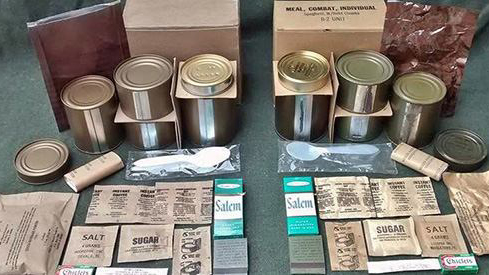
When I was in the Army, our cook was often a favorite target for scorn and derision – and bad jokes. We knew they believed in hiring the handicapped because we joked that Cookie must have had his taste buds shot off in the Korean War.
But mess hall food was far superior to C-rations. Various items in tin cans we called “mystery food.” I still remember the end of a long day out on bivouac after having marched for miles when we finally sat down to dinner with our various cans of C-rations. I searched through the pile of them and was overjoyed to find a can marked “lima beans and ham.”
We had these small devices to open the cans we carried around in our pockets. I got mine out and could soon smell the odors of my anticipated meal wafting out into the still, late afternoon air. When I finally got the can opened, it was a major disappointment. What’s this stuff? There, I beheld one lima bean floating in a sea of grease. Having nothing else, I managed to choke it down. Enjoy. “Bread of angels…food enough,” our Psalm asserts.
There’s a Passover song that’s traditionally sung, “Dayenu.” It translates as “it would have been enough.” If God had only brought us out of Egypt, and left us at the Red Sea, “It would have been enough.” If God had led Moses’ band to the Red Sea and left them there, “It would have been enough.”
If God had split the sea for us, and had not taken us through it on dry land, it would have been enough. Dayenu.
If God had led them through the desert wilderness and had not given them the Torah, “It would have been enough.” Dayenu.
If God had only provided manna and nothing else, “It would have been enough.” Dayenu.
It’s an exclamation of gratitude for that which is actually provided. Dayenu!
If God had only provided one lima bean floating in a sea of grease that evening, “Dayenu.”
When confronted with this white stuff that arrived in the morning – supposedly food – that’s what the children Moses had asked for – What’s this? Which is the literal translation of manna – “What’s this stuff?” – a variation on the question we soldiers asked of Cookie’s offerings.
It’s the answer to Moses’ band’s complaint about the food.
“In the morning there was a layer of dew around the camp. When the layer of dew lifted, there on the surface of the wilderness was a fine flaky substance, as fine as the frost on the ground. When the Israelites saw it, they said to one another, ‘What is it?’…Moses said to them, “it is the bread that the Lord has given you to eat.” Dayenu!
What’s this stuff? Sometimes you don’t want to know.
When we had our diocesan convention in the interior of Alaska, an area mostly populated by the original inhabitants, Athabascan peoples, we would have delicacies of the cooking of that region. Minto was spectacular in their hosting of us all from around the state for an entire week.
Among the offerings were fish head soup and moose head soup. Don’t ask what’s in those dishes. Just enjoy and be a polite guest. In the face of such gracious hospitality, no one dared ask, “What’s this stuff?” It was all the largess of God’s free bounty. Enjoy. “Bread of angels…food enough.” Dayenu!
If all we can provide from St. Francis Garden this year is a few tomatoes and some fresh fruit – Dayenu.
As we wander through a wilderness, much of it our own making, we often feel helpless and depressed at the choices. In the darkness of the journey, we are so polarized that many have dropped out, given up hope.
That’s the burden of a democracy where we all have a voice. Sometimes those voices are shrill and racist. They speak revenge and retribution. And do so with millions of dollars.
So, I would say, if only we had two, out-of-touch guys competing for our votes for president, Dayenu.
If we now have a completely different race with a clear choice, and folks still stay home. Dayenu.
If we are still at gridlock but at least can’t pass any harmful legislation, Dayenu.
If Simone Biles had only won the silver and not the gold. Dayenu.
If she had won the gold but not been given a shout-out on the Wheaties cereal box, Dayenu.
This summer fire season started earlier than ever. By July just one fire, the Park Fire, had burned an area comparable to the size of Rhode Island. If we just can’t summon the political will to address global warming, but more folks are engaged in the conversation, Dayenu.
But, every now and then, the odds do break in favor of those who are oppressed, those unjustly imprisoned.
Like, many who witnessed the release of captives unjustly held by Putin in Russia, I was overjoyed to see their arrival back In the good old US of A – and even though we didn’t get them all out, Dayenu.
For the families of those journalists and activists held in Putin’s autocratic regime, we got quite a few released. It was through months and, sometimes years of hard work we freed the ones we got. Dayenu.
In the wilderness of our longing there are no secret cures, no magic, but we have by God’s grace the manna of hope and perseverance. Dayenu.
If sickness assaults us, and there seems no cure, we have the power yet of accompaniment with those who travel that wilderness. Dayenu.
Steady acts of faithfulness, often don’t seem like much but they are enough. Dayenu. An “attitude of gratitude” shall be sufficient by the Grace of God to not only find a path forward and survive, but maybe, just maybe, to thrive.
And yes, we grumbled about mess hall food but Cookie did the best he could, which on occasion was stellar. And if nothing else, quantity made up for quality after a long day’s marching. Dayenu.
On this Sunday, my eighty-second birthday: for what has been, my teachers and family who have brought me thus far; for what is today, friends and family, my business associates and partners who support me now in the opportunities and challenges that lie ahead; and for what the future holds – it’s been one heck of a ride, and I say, DAYENU! Amen.
August 4, 2024
Pentecost 11, Proper 13
The Rev. Dr. John C. Forney
Exodus 16:2-4, 9-15; Psalm 78:23-29;
Ephesians 4:1-16; John 6:24-35 “What’s This Stuff?”
A Generous Extravagance

Nothing signifies abundance like a church potluck. In the downtown United Methodist Congregation I served as a young deacon, we had a wonderfully diverse congregation: black, white, Salvadoran, Asian, Mexican – all of which enriched our culinary experience at our potlucks.
It was Sr. Aguilar who taught me to make authentic Mexican rice. We would have everything from Southern fried chicken, tamales and spring rolls to refritos and Mexican stew. And there was so much, there were always lots of leftovers.
Just as in the story from 2nd Kings we read today – an extravagance of God’s unbounded generosity – as found in this morning’s psalm.
“The eyes of all wait upon you, O Lord, and you give them their food in due season. You open wide your hand and satisfy the needs of every living thing.”[1]
In our gospel reading from the book of John we have a retelling of the miracle of the feeding of the multitudes found in the three synoptic gospels which preceded John’s gospel by well over thirty to forty years (Matthew, Mark, Luke).[2]
John even mentions a seemingly small detail of abundance, “Now there was a great deal of grass in the place…” – another sign of the lushness of God and what was to transpire.
The point here is that God’s abundance was so great, even when beginning with not much of anything – five barley loaves and two fish – like our church potlucks, there was enough from the banquet Jesus served up that the leftovers from the fish and bread were enough to fill twelve baskets!
When I was a little boy, I remember asking Grandma why aren’t there miracles anymore. One commentator’s answer: to see a miracle, just look at what you now have, little or much – that right there is enough to make a miracle.
The gift of creation is the everlasting Kingdom of God. And its abundance is meant for all. Its beauty is all about, even in the tiniest of creatures.
After our Friday gathering, “Suds on the Deck,” at our house, I caught out of my peripheral vision some small movement. There on my pant leg was a small jumping spider. Now, you may not know that jumping spiders are among the most intelligent of the arachnid family, with very good eyesight. I carefully brushed it off and returned it to the deck.
I was enthralled to watch her tentatively explore her new surroundings. I say “her” because by this time of year most males would have fulfilled their biological purpose and would have passed on. She, then jumped well over twenty times her quarter of an inch length to the leg of one of the chairs. I must have sat there some twenty minutes mesmerized by this wondrous creature – more evidence of the expansiveness of the unmerited gift of creation. God’s bounty is all about.
When two lovers are drawn together, by chance or fate, the miracle is that they find a way to love each other in this often-tragic world. Christopher and Alexis met on line. Of all the possibilities, one combination in millions, maybe billions. And they are so suited for each other! We absolutely delight in seeing then together. Jai and I met on a bus heading to Lincoln, Nebraska. She was sitting on the seat behind me. What are the odds? The love and long-distance phone calls, letters and all – signs of God’s gracious bounty.
Wonder at it all is certainly in order. So is gratitude and our loving response. We are called to have a theology of abundance, not scarcity.
As we head into November’s election, the American people are presented with two stark visions: one of the expansiveness of the Founder’s vision and one of retribution, vengeance and scarcity. Will we live into the vision of a republic of equality and opportunity, or will we reserve all the goodies for only the “right” people, the “deserving” people. Does America mean “all,” or just some?
To those who have trouble with DEI – diversity, equity and inclusion — you’re cutting out a huge swath of the voting public. You’re cutting out my daughter-in-law and all other women of color. To demean our vice president as simply a DEI hire is beyond the pale. Such racist misogyny is not the “politics of addition” that my favorite commentator Mark Shields always talked about. Not the theology of abundance.
I trust that those who are so cavalierly dismissed will return the favor in November.
Will we cherish the created order and address global warming? Or how hot has it got to get before we wake from our slumber, from our ignorance? Of course, we could call it something else. The wit Andy Borowitz suggested an alternative, “The world’s going to burn to a crisp and then we’re all gonna die.”
God’s faithfulness is seen in the majestic wingspan of a golden eagle. Still fresh in my memory is a float trip I took with friends through the interior of Alaska. To be out there in that wilderness is totally renewing. The bounty is beyond our imagining. One day, as we drifted around a bend in the river, we startled a golden eagle at its lunch. It launched from a branch overhanging the river then silently soared just feet over our heads. I think we let out a collective gasp in amazement at the beauty of it’s majestic eight-foot wing span. Such is the “glory” of God’s wonders – beauty that is fitting praise to the Lord.
On that trip, of course we had packed adequate food, but most of those freeze-dried packages went unopened. We caught so many Dolly Varden, an ocean-going trout, that for every meal we had fresh fish. These were so large, I had to cut them in half to get them to fit in my ten-inch frying pan. They can be huge, with some getting up to twenty-seven pounds. God’s free bounty, indeed!
At night the northern lights would dance over our heads, filling the sky with a splendor beyond belief. Yes, “All your works praise you, O Lord,” and we your servants are transfixed in wide-eyed and open-mouthed amazement.
Certainly, gratitude and respect are in order – as well as care.
Some biblical scholars explain the feeding of the five thousand as a miracle of sharing. Once the loaves and fishes were divided up and passed around, others opened their hearts and shared what they had brought, resulting in enough to go all around with sumptuous leftovers. In our greedy, materialistic, self-centered culture, such sharing alone would be considered a miracle. However it happened, the Gospel of John refers to it as a sign of God’s gracious extravagance. This is how God rolls — enough for all. Sharing can be our only response.
All this is God’s gracious gift of something out of nothing – creation ex nihilo. We didn’t make it. Any heart pumping warm blood can only respond in gratitude.
This November will we vote to revere this gift, or just pave it over? Will it be about our common life together or about whoever-dies-with-the-most-toys wins? As our president said in his Wednesday address to the nation, the idea of America rests with its people, you and me.
What’s your money, time and enthusiasm on?
When it comes to a choice between the politics of greed, vengeance and retribution, or the politics of “God’s free bounty,” my money’s on that soaring golden eagle. Amen.
[1] Psalm 145:16-17.
[2] Matt. 14:13-21; Mk. 6:32-44; Lk. 9:10-17,
July 28, 2024
Pentecost 10, Proper 12
The Rev. Dr. John C. Forney
2 Kings 4:42-44; Psalm 145: 10-19;
Ephesians 3:14-21; John 6:1-21 “A Generous Extravagance
Poor Choices and Costly Alternatives

When I was stationed at Letterman Hospital, San Francisco, I served in the Neurology Department. There I was trained as an encephalograph tech, the brain wave test. Initially we had an NCO in the EEG lab, an E-5 Specialist Monroe, who was senor to both of us two trainees.
Shortly after my arrival, specialist Monroe was court martialed and busted down to corporal. This wasn’t the first time he had been demoted. When we asked him what happened, from the bruises on his face it should have been evident.
Over the weekend he had been in another bar fight. The word that came back through the scuttlebutt was not good. Apparently, he and his combatants had pretty well torn the place up – furniture broken, shattered windows, broken beer bottles everywhere – the place was trashed. Hundreds of dollars in damages. What a weekend. Finally, the MPs arrived to break it up and Monroe ended up in the stockade for a spell.
Monroe had little recollection of what had happened, but word came back that the more he drank, the more belligerent, the mouthier he got. And from there, it was off to the races as chaos ensued while fists flew, along with chairs, ash trays and glasses.
This was the second or third time he had been busted in rank. The colonel, chief of our neurology service, had had enough. Monroe was out of there. Assigned to the worst job possible, laundry duty.
I was promoted to E-5 and became senior enlisted staff.
I had seen Monroe at our barracks after work and asked him, why did he frequent these bars which were just trouble for him. He really had no answer, except that he had been barred from the enlisted officer’s club. I didn’t have to ask the reason.
Poor choices, but there were alternatives – like maybe dealing with his drinking problem, like staying in the barracks and watching TV – oodles of alternatives come to mind. But no – poor choices was all he seemed capable of.
Amos tells the story of poor choices. His prophecy is a warning, much like my mother’s, “Johnny, look both ways before running out into the street.”
“This is what the Lord God showed me: the Lord was standing beside a wall built with a plumb line, with a plumb line in his hand. And the Lord said to me. ‘Amos what do you see?’ And I said, ‘A plumb line.’ Then the Lord said, ‘See, I am setting a plumb line in the midst of my people Israel; I will never again pass them by; the high places of Isaac shall be made desolate, and the sanctuaries of Israel shall be laid waste, and I will rise against the house of Jeroboam with the sword.’”
A plumb line is used to determine if a wall is 90 degrees vertical to the ground or a people morally straight by Amos’ reckoning. The plumb line never lies.
Apparently, Jeroboam’s sin was the revolt he led against Solomon’s son Rehoboam which split the Davidic kingdom in two – Judah in the south and Israel in the north with Jeroboam as it’s king. Further, he designed a religion to cater to his whims, building two temples with golden calves. Idolatry, in other words. He chose poorly. There was an alternative — the God of the Torah, the plumb line of righteousness and equity.
Today, out of nowhere, in Mark we get the story of Herod having had John the Baptist beheaded at the whim of his wife. John had railed against Herodias, for she had been his brother Philip’s wife, and it was not lawful to have one’s brother’s wife. It was score-settling time.
One commentator avers that there is not a word of grace to be found in this story, which seems like an incidental one-off.
Herod, like too many guys basking in their power, thought he had to play the big man, testosterone-fueled. Yet, there was an alternative tugging at his soul. He knew John was a righteous and holy man. While greatly perplexed by John’s utterances, he liked to listen to him.
This request by his step-daughter he could have refused, but it would have cost him dearly in the esteem of his guests. So, John’s head was served up on a platter as the trophy for her dancing. Poor choice, even though he knew in his heart that this was wrong. As Dieterich Bonhoeffer would call the alternative, “Costly Grace.” Requiring a huge helping of humble pie.
That is the grace I see in Amos’ prophecy and Herod’s dilemma. There is a choice, an alternative – as difficult as that may have been — Costly Grace in the form of repentance.
Of course, Amos’ desire is to warn the people of Israel of the destructive path they are on, his purpose is exactly to get repentance. The path they were following as a society would implode upon itself. Out of their weakness, they would have no resources or wisdom to deal with outside threats such as the Babylonian army, soon to be at their gates.
The forced exile to follow, the prophet attributed as their just deserts for their debauchery and crushing the poor in their midst. My Buddhist friends would chalk it up to Bad Karma. What goes around comes around. The logical results for violating the moral structure of the universe and Torah ethics. As my junior high coach would warn, “You’re cruisin’ for a bruisin’.”
Amos’ purpose? To get his hearers to amend their ways. To turn from self-destruction – to turn around, a complete change of mind — the meaning of metanoia, repentance. It’s all about changing behavior, not about feeling sorry or remorseful. As the hymn puts it, “Turn back, O mortal, quit thy foolish ways.”
And as one verse of “How Firm a Foundation” puts it, “When through fiery trials thy pathway shall lie, my grace all sufficient, shall be thy supply; the flame shall not hurt thee; I only design thy dross to consume, and thy gold to refine.”
Unfortunately, how often we grasp for the easy solution, not the costly alternative. American foreign policy is littered with such poor choices.
I’ve been recently reading of one the worst episodes of our venture into the Philippines after we seized them as a result of the Spanish American War, 1898, Massacre in the Clouds by Kim A. Wagner.
The story opens with a photograph of a gristly massacre received by W. E. Du Bois. It depicts an open pit filled with the bodies of defenseless men, women and children – some one thousand in all. On the rim of the killing grounds, American soldiers are shown standing nonchalantly by. No evidence at all of shame.
This tragedy was the result of an expedition up a dormant volcano by Major General Leonard Wood and his men on March 1906, who for hours would fire indiscriminately upon those who had taken refuge in the crater of that volcano, the so-called Moros, American slang for the Muslims of the southern islands of that nation.
The incident became know as the “Battle of Bud Dajo.” Not a battle at all but the wanton killing of trapped unarmed men, women and children. This atrocity was bigger than either Wounded Knee or My Lai and would have slipped into the mists of history except for that one photograph.[1]
U.S. military authorities tried to bury the story. When that became impossible, it was claimed as “a brilliant feat of arms,” according to President Theodore Roosevelt.
We have little or no recollection of that horrific day. But they do! They remember as if it were yesterday.
The only three of note who spoke against the atrocity were W. E. B. Du Bois, Mark Twain and Moorfield Story, president of the Anti-Imperialist League. Virtually every American paper heralded it as a courageous action. Medals were to be passed out to those participating in the tragedy, many participants promoted for what now would be called a “war crime.”
Fortunately, through the diligent efforts of Kim Wagner over years, the story has come to light.
There was never any expression of remorse from the killers because the victims had been completely dehumanized – just vermin, savages. General Wood summed up the operating ethic in a report from Manila, “They will probably have to be exterminated.”[2]
Why must we remember such sordid and ghastly events of the past? Because there is no healing possible without telling the truth of these events. That is the only path to healing. In our remembrance is the grace of costly alternatives.
Incidentally, I wondered as I made my way through this book, did any of these soldiers ever learn a counter narrative from their Sunday school teachers or the sermons they might have heard? They certainly would not have found such in their history books, which to this day glorify American expansionism and whitewash its crimes. I wonder, did ever an inkling of a costly alternative cross those soldier’s minds as they fired upon those hapless victims?
That we have this story is sheer unbounded grace, for its truth may someday set us free – get us to reconsider our role as a nation. As my friend Ed Bacon was wont to say, “The truth will set you free, but first it will hurt like hell.”
As Amos concludes his short book of dire prophecy on a note of hope, “On that day I will raise up a booth for David that is fallen and repair its branches, and raise up its ruins, and rebuild it as in the days of old; in order that they may possess the remnant of Edom and all the nations who are called by my name, says the Lord who does this.”
With repentance, this is “that day.” With repentance, costly and saving alternatives spring to mind and heart.
“The flame shall not hurt thee; I only design thy dross to consume and thy gold to refine.” Amen
[1] Kim A. Wagne, Massacre in the Clouds: An American Atrocity and the Erasure of History (New York: Public Affairs Press, 2024)/
[2] Op. cit., 86.
July 14, 2024
Proper 10
The Rev. Dr. John C. Forney
Amos 7:7-15; Psalm 85:8-13;
Ephesians 1:3-14; Mark 6:14:29
“Poor Choices and Costly Alternatives”
Just Us Chickens

Early on in my ministry I encountered a woman with an excruciating tale of abuse. No, not her. Her daughter was being sexually abused by her father. She told of having fled in the middle of the night while he was off carousing. She and her daughter had holed up in a cheap motel. As the long shadows of that night darkened her soul, she grew more and more desperate.
She, finally, in the wee hours of the morning decided to turn to God. Her situation was so pitiful and desperate she reasoned that only God could help her. She had no inner resources left. She was running on empty.
She found the Gideon Bible in one of the drawers of the dresser and thought that if she just opened it, just opened it anywhere, God would provide an answer. She laid it on the bed, opened it with a finger and put it to a passage on the facing page. “They conspired to kill Paul,” it read.
Was this the message God meant for her, that maybe she should kill herself? Fortunately, good sense prevailed and she did not heed that message.
We had a notice on our church at the door leading into the worship service, “We know you often talk with God – but probably not on your cell phone. Please silence it before worship.”
So, how would you know if you had received a message from God? In what manner might it have come?
Have you ever known with absolute certainty that the message was directed to the core of your being from the creative force at the center of all existence?
This is the experience of Ezekiel. He relates his commission from God in our lectionary reading:
“’O mortal, stand up on your feet, and I will speak with you.’ And when he spoke to me, a spirit entered into me and set me on my feet; and I heard him speaking to me. He said to me, ‘Mortal, I am sending you to the people of Israel, to a nation of rebels who have rebelled against me; they and their ancestors have transgressed against me to this very day. The descendants are impudent and stubborn. I am sending you to them, and you shall say to them, ‘Thus says the Lord God.’”
Two things here. First the commission is absolute. You SHALL say to them. Second, it’s not going to be a walk in the park. Ezekiel’s being sent to a tough crowd, dead set in their ways. Obdurate and recalcitrant.
This is exactly the same crowd Jesus encounters, folks who could not believe that any saving message could come from their own midst. Just us chickens here. No one else.
This Jesus fellow? How’s he so special? Where did he get all this? Don’t we know his family? He’s just the carpenter’s son. As Nathaniel asks in John’s gospel, “Can any good come out of Nazareth?” His hometown folks could not accept that a redeeming message could come from their midst. The result of his visit was bupkis. Nothing!
“And he could do no deed of power there, except that he laid his hands on a few sick people and cured them. And he was amazed at their unbelief.”
“So, he then left and went among the villages teaching. He sent the twelve out, two by two, giving them authority over unclean spirits.” Travel lightly, he instructed them.
The twelve, who were they? Just ordinary fishermen he encountered along his walk. No impressive credentials, just plain folks. As my mom would say, “Just us chickens.” No one special.
Yesterday I delighted in watching the PBS special, “A Capital Fourth.” Sure, it was an over-the-top celebration of America. But it wasn’t all the pomp and circumstance, or the military hoo-ha that was the source of my pride. It was the crowd.
This was a good, diverse cross section of America, “just us chickens” –average folks out having a good time together. Yes, there were a few exceptional “chickens” present. Present was one of the original “Rosie the Riveters” who put together bombers to defeat the forces of tyranny during WWII. These Rosies were just ordinary people who answered the call to duty when it came.
These were the people who returned from work to tend “victory gardens” and save metal and rubber. They watched over one another’s kids and supported good schools. “Just us chickens.”
And that’s who Jesus sends out to spread the good news. Yes, there are a few folks who need to amend their ways, as we all do from time to time. But the overwhelming message is that God is good and so is the life we are given to live.
Take a look at what some of us ordinary folks are called to do. Most of us will raise up the next generation to be self-sufficient, caring adults. No mean feat in these troubled times with rampant drugs and cell phone addiction while immersed in a culture where “greed is good.” Most will be of a generous heart and hold to the norms of respect and honest dealings.
Most of us, like those twelve Jesus set out on “Mission Impossible” come from rather ordinary backgrounds.
This past week we lost one of baseball’s greats, Willie Mays. His background was rather ordinary. He grew up in a mostly Black industrial town in Alabama, Westfield. His parents, never married, separated when he was three. He was subsequently raised by his father and two aunts, with a good foundation from his AME church.
When he was only five, he and his father would play catch out in the yard. By high school, he was showing evidence of his mother’s athletic ability. He signed his first professional contract with a Negro League team before he was out of high school at seventeen. And you know the rest of the story – one of baseball’s greats.
His nickname, the “Say Hey Kid,” stuck early on from how he would greet his team mates. After a few home runs for the New York Giants, one sports writer Jimmy Cannon, would write, “There goes the Say Hey Kid.”
His over-the-shoulder catch in Game 1 of the 1954 World Series is one of the most famous baseball plays of all time. Known as “The Catch,” hundreds of young aspiring baseball players would grow up practicing “The Catch.” Famous as he was, he was not above playing stick ball with kids of his old neighborhood on visits back home.
Just one of us chickens, who with a bit of talent and lot of hard work became a very notable chicken. Just like Peter and John and some of the others Jesus sent out. Just like you and me, sent out to do the best we can, making our witness where opportunity opens up. In our families, in our jobs and in our free time.
Let me tell you another story of some very ordinary chickens doing an extraordinary thing. Have you ever heard of the “Wide Awake” movement? Neither had I. It was a forgotten force for ending slavery and getting Lincoln elected president.[1] Jon Grinspan, curator of political history at the Smithsonian Museum has dug deeply into the forgotten past to bring us an amazing story. Read his book, Wide Awake.
The story begins with an episode of mob violence following the presentation of an abolitionist speaker in Wheeling, West Virginia. The mob howled, “The speakers! The speakers! The northern dogs! Let us have them!” James Brisbin, one of the speakers, could hear the shouting and hissing.
His only hope was to get out of town unnoticed, to get across the Wheeling Bridge across the Ohio River back into Ohio. During his presentation an angry crowd had grown outside the lecture hall.
As rain poured down and the carriage rocked on the uneven road, passing the plaza before the bridge leading to the Wheeling Island, a large crowd blocked the path. Brisbin, clearly identified as a northerner by his clothing, his white hat and long brown hair, was clearly identifiable as an outsider.
He’d have to run for it. No choice.
“Then Brisbin was out of the carriage, trying to move briskly but inconspicuously through the crowds. But his outfit gave him away. Just as he neared the great bridge’s iron toll gate, a hand yanked him by his long hair. Another grasped his shawl. Brisbin sprang forward, losing a fistful of hair and breaking his shawl’s fastener. He wheeled halfway around and struck one of his pursuers in the face. Then, certain he was going to die, dashed for the bridge.”[2]
As he pounded down the wooden planks, a strange sight emerged in his field of vision. He slowly made out a squadron of men, dressed in black, eighty strong. At their head, a veteran officer kept them in a tight martial column. “Some held banners with their stark symbol: an open and unblinking eye.” Many held torches and some, revolvers. These were the Wide Awakes.
This was a sight never before seen in American politics.
Later Brisbin would tell his Virginia hosts that he had marched into Wheeling with these “Wide Awakes and I would return with them dead or alive.”[3]
Who were these men? And why do we know so little about their movement. Most likely, they have escaped the pages of history because we write about the giants of our national story. None of those assembled that night were notable. The Wide Awakes were a grass roots phenomenon founded by a group of tailors on the spur of the moment. Their original purpose was to protect abolitionist speakers. It would soon mushroom into hundreds of chapters with millions of adherents in most cities across the nation. Just ordinary folks, livery stable boys, store clerks, handymen, farm laborers and assorted others. Just us chickens, no one special. Yet, they became one of the major forces propelling Lincoln to the presidency. They were bound and determined that a group of some 600,000 slave holders in the South would not seal the fate of the American promise. Read the book, Wide Awake, it’s a most amazing story.
Just average folks, much like those gathered out on the National Mall this past Fourth of July, doing their best to be good citizens and watch out for their neighbors, raise decent kids. Much like those simple fishermen sent out to proclaim a new day of hope. “Now is the moment of salvation.” Stand on your feet and announce it to the hills and hollers, countryside and city: “God is doing a new thing.” Join in. This is our moment. Yes, just us chickens. We will save this democracy. “We are the ones we’ve been waiting for.” Amen.
[1] Jon Grinspan, Wide Awake: The Forgotten Force that Elected Lincoln and spurred the Civil War (New York: Bloomsbury Publishing, 2024).
[2] Op. cit., x.
[3] Ibid.
July 7, 2024
Propers 9
The Rev. Dr. John C. Forney
Ezekiel 2:1-5; Psalm 123;
2 Corinthians 12:2-10; Mark 6:1-13
“Just Us Chickens”
E Pluribus Unum

One of my favorite films is “Blues Brothers,” released in 1980. It featured a star-studded cast of cameo performances.
The film’s plot centers around the tale of redemption of two paroled convicts Jake, played by John Belushi, and his brother Elwood, played by Dan Aykroyd.
The Mother Superior of the orphanage in which they were raised sets the two out on a “Mission from God” to raise funds to save it from foreclosure. It is a madcap adventure involving neo-Nazis and a frantic and relentless police chase throughout. It featured cameo performances by Aretha Franklin, Ray Charles, John Lee Hooker and Cab Calloway, among others.
One of my favorite performances is by Aretha Franklin, “Queen of Soul,” as she belts out the crowd-pleaser “R E S P E C T.”
Our two appointed lessons for the occasion of our Independence Day give substance to Franklin’s song. They’re about an ethic of respect, which is meant to be the hallmark of our covenant with one another as Americans. It is also meant to guide our nation in its affairs with the global community.
Recently, we lost a Giant of Justice, The Rev. James Lawson. He was a good friend and colleague of mine when he served at Holman United Methodist Church in Los Angeles and I was serving that denomination.
More than that, he was one of the chief strategists and leading nonviolence theorist, working with Dr. M. L. King in the sixties.
Jim began his activism while still in high school in the 1940s. He organized his first sit-in at a Massillon, Ohio, restaurant, a diner that refused to serve Black people. The owner finally served him but told him never to return.[1]
Jim did not start out with pacifist leanings. One day at school a white boy was taunting him with racial slurs and obscenities. Jim hauled off and smacked him good. While there were no repercussions at school, it was different when he arrived home and told his mother what had happened.
His father had always told him to defend himself, not so his mother. “Jimmy,” his mother scolded, “what good did that do? There must be a better way.” Her words stung like needles. She refused to even look at him as she admonished his behavior.
Jim remembered thinking that his world “just sort of stopped.” He heard himself saying in the depths of his being, “I will find that better way.”
While in college he joined the Fellowship of Reconciliation, a pacifist group committed to change through nonviolence. He later refused to serve in the military during the Korean Conflict, serving 14 months in prison.
He was recruited by Dr. King to organize weekly workshops on nonviolent action while serving as a pastor in Nashville, Tennessee. He trained many who would become leaders of the Student Nonviolent Coordinating Committee (SNCC).
In 1953 he joined a Methodist mission to India where he became aware of Ghandi’s nonviolence resistance methods. While in India he came upon a newspaper article covering the Montgomery bus boycott. He reports “shouting for joy.” He returned from studying Gandhian methods of civil disobedience and enrolled in Oberlin College, later transferring to Vanderbilt’s divinity program in Nashville.
There he began holding workshops in nonviolence, soon organizing sit-ins at lunch counters. He relied on role playing, teaching others how to ignore taunts and slurs; showing them how to use their bodies to absorb the blows of hate and use self-restraint.
He knew these students must be disciplined and highly organized. Fellows must wear suit coats and ties, the women in dresses and heels. They would occupy stools at the lunch counters in shifts and maintain eye contact with their assailants.
Sit-ins spread. A “’non-violent army’ of about 500 strong, drawn from Fisk University and other local colleges – leaped into action occupying three downtown Nashville lunch counters. Over the next three months more establishments were targeted, to include bus terminals and major department stores.”[2]
After a group of 81 students were attacked by a white mob, Lawson was expelled from Vanderbilt, causing many faculty to resign.
Lawson remembers, “We had a very disciplined movement…with students as our primary energy.”
Three weeks later, an attorney who had been representing the demonstrators had his house bombed. This triggered a yet larger march. The boycott of white businesses spread. Finally, the mayor issued an appeal to the white citizens of Nashville to end their discrimination.
Soon afterward, lunch counters began serving Black customers, reinforcing Lawson’s belief that nonviolent direct action was far more effective in ending Jim Crow than lawsuits which were seen as “’middle-class conventional, halfway efforts to deal with grave social injustice.”
SNCC continued to organize voter registration drives, becoming the militant arm of the movement. After the first “Freedom Ride” was stopped by a white mob attacking the bus, a small group trained by Lawson, completed the trip.
Finally, TV coverage of white brutality and law enforcement violence did what all the lawsuits could not accomplish. The revulsion they engendered throughout the nation caused President Johnson to move off dead center, ending his temporizing and silence. Soon he would deliver a speech to Congress, closing with the famous line, “We shall overcome.” Legislation was passed enshrining the right to vote and be free of discrimination in accommodations serving interstate travel – bus and rail lines, hotels and restaurants. This legislation was the beginning of real democracy in America.
This is a heritage worth celebrating. Yes, much remains to be done. The forces of racism continue to weaken and roll back this landmark civil rights legislation. It’s like weeding in St. Francis Garden – our work to preserve these rights and others is never done. The force for Evil is relentless, and so must we be as well.
Lawson was relentless to the end of his days, being arrested several times protesting the police killing of Eula Love in 1979 and for participating in demonstrations protesting US military involvement in El Salvador. Later he risked a church trial for blessing the relationship of a lesbian couple in 2000.
He served as the head of the Los Angeles chapter of the Southern Leadership Conference. He was an important voice in the founding of ICUJP, Interfaith Communities United for Justice and Peace. Along with three former presidents of the United States, Jim delivered a most eloquent eulogy at the service for Representative John Lewis, exhorting Americans to “practice the politics of the preamble to the Constitution” as a way to honor Lewis’ life.
Respect was the loadstone of Jim’s journey, the center of his public and private ministry.
R E S P E C T – the only glue that will hold our nation together in these perilous times. Our democracy hangs in the balance. As the revolutionary slogan of 1776 cautioned, we must “hang together or we will hang separately.”
We serve a God who “executes justice for the orphan and the widow, and loves the strangers, providing them food and clothing.” Remember, “you were strangers in the land of Egypt.” R E S P E C T is our praise, our way of “paying it forward.”
“Love your enemies and pray for those who persecute you, so that you may be children of your Father, [your Mother], in heaven; for God makes the sun to rise on the evil and on the good, and sends rain on the righteous and the unrighteous.”[3] Try as we may, we poor, fallible humans will most often fall short. But among us there are some exemplars who come close. The Rev. Jim Lawson was one who did. For his life and for his witness to a Living Gospel with feet, we say, “Thanks be to God.” Amen.
[1] Elaine Woo, “Civil Rights Era’s ‘Leading Nonviolence Theorist: 1928 – 2924,” Los Angeles Times, June 16, 2024. (This and the following are from that article.)
[2] Ibid.
[3] Matthew 5:45b, NRSV.
June 30, 2024
6th Sunday after Pentecost
Propers for Independence Day
The Rev. Dr. John C. Forney
Deuteronomy 10:17-21; Psalm 145;
“Letter from a Birmingham Jail”; Matthew 5:43-48 “E Pluribus Unum”
We Plow the Fields and Scatter the Good Seed on the Land

One activity still possible while in a hospital bed is reading. I’ve consumed quite a few newspapers and periodicals. In the science section on one weekly, I came across the limitations of our technology – the Google machine, to be specific.
If you had ever wondered how to keep the cheese on your pizza while eating it — use glue. That was Google’s handy household hint. Use glue. I, suppose it might have been a little more helpful if it had suggested a brand. Now, left to my own devices, I might have used duct tape in error. Big mistake.
That story just goes to show that there are some things, like “common sense,” for instance, that humans will always be better at than AI or any other whiz-bang invention.
The coming wave of modern technology will astound but none of it will ever be a stand-in for a real father’s wisdom and love.
In Ezekiel we find the promise and wisdom of nourishment. “Thus says the Lord God: I myself will take a sprig from the lofty top of a cedar; I will set it out. I will break off a tender one from the topmost of its young twig; I myself will plant it on a high and lofty mountain. On the mountain height of Israel I will plant it, in order that it may produce boughs and bear fruit, and become a noble cedar. Under it every kind of bird will live…”
This is what a good father, what a good husband does, he nourishes productivity and coaxes from the land a good life for his family. In short, brings home the bacon.
Before our children were born, given my family of origin’s poor dynamics, I had serious doubts about my ability to be a good father. It wasn’t until I came across the title of a book on parenting that I began to loosen up a bit. The book’s title? “Good Enough.” I realized that I didn’t have to get everything right, that I would make mistakes. I just had to be good enough.
Mark’s gospel puts the teaching in another light. “Jesus said, ‘The kingdom of God is as if someone would scatter seed on the ground, and would sleep and rise night and day, and the seed would sprout and grow, he does not know how. The earth produces of itself, first the stalk, then the head, then he full grain in the head…’”
These past weeks, with the 80th anniversary of the Landing at Normandy, we honored those men who were asked to rise to the defense of our civilized society. They were asked to do something they had never been trained or wished to do, to kill another human being.
Many were fathers with established lives. Growing up, most envisioned a future as having a good job, marrying their sweetheart, raising a family and contributing to their communities. In the end, awaiting the golden years of retirement. Unfortunately, such a dreamt of future was denied to many of our citizens of color at the time.
My father’s generation has been labeled the “Greatest Generation” by newscaster Tom Brokaw in his book by the same name. After war was declared by Congress, hundreds of thousands flooded the recruiting stations to fight against the Axis Powers – Germany, Italy and Japan.
My father served in the dental corps in Okinawa. Jai’s father served in Germany, running the motor pool. He went in as a private and was discharged as a lieutenant with a battlefield commission.
Contrary, to the Former Guy who dodged the draft, these men were not “suckers.” They were patriots, many of whom paid the ultimate price. This from an unfit felon who had the audacity to ask his then-chief of staff John Kelly: “Why should I go to that cemetery? It’s filled with losers. What was in it for them?”
Have you no respect? As a veteran myself, I highly resent the disparagement that felonious draft dodger casts on those who did serve. But enough of him! (Had to get that off my chest).
The story of WWII is a story of thousands of individual stories of men like our fathers, like your fathers, who had left shop and farm, left the comforts of home and family, to report for duty when called. As I read of the first paratroopers dropped behind enemy lines, as I read of the men struggling up the cliffs to get off the killing grounds of those beaches through confusion, withering machine-gun fire and heavy bombardment, my eyes welled up with tears. These were stories of sacrifice, bravery and solidarity with the people of Normandy. These were our fathers.
In the early hours of June 6th, just after midnight, thousands of U.S. paratroopers came drifting out of the skies near the village of Ste.-Mere-Eglise, France. That was the first town to be liberated.
One of its residents vividly recalls that day. “One parachute floated right down into a trench dug in Georgette Flais’ backyard, where she huddled with her parents and a neighbor. Attached to it was Cliff Maugham. Ms. Flais refers to him as ‘our American.’”[1]
The German soldier billeted at her house ran out, pointing his rifle at the trench, threatening to shoot. Ms. Flais’ father jumped up and begged the German not to shoot. Amazingly, he agreed. Soon afterward the German soldier realized that the war was over and surrendered to the American, who calmly handed out chewing gum, cigarettes and chocolate.
“The American then curled up for a nap,” she remembers. Afterward, “we kissed him warmly goodbye.” He then headed off at early light to the battle. A lasting friendship was born that morning.[2]
By 1984 Ms. Flais was teaching Greek and Latin some 140 miles away when June 6th rolled around. She was watching TV when she caught the glimpse of an American soldier who had come back for the festivities. “He was broader and wore a baseball hat instead of a helmet. But he had the same laid-back demeanor. She jumped in the car and rushed back to her childhood town.
“It was my American,” she said. “We fell into one another’s arms.”[3]
Year after year, fewer veterans are able to return to Ste. Mere-Eglise. Townspeople volunteer driving them around as they seek significant places attached to that dark early morning. It may have been where they lost a friend, were wounded, or first landed.
For the town’s first annual celebration, while the war still raged in Europe, Maj. Gen. James Gavin sent over 30 American soldiers stationed in Germany for the event.
The bond between the citizens of that small town and their American visitors these days is palpable. One photographer, Jacques Villain, who has been documenting the annual celebrations remarked, “There is a sense of welcome here that’s nothing like anything else in the region.”
In the motion picture, “The Longest Day,” one memorable scene depicts the American paratrooper, John Steele, who had the misfortune of getting hung-up on the pinnacle of the church’s steeple. Today, a mannequin of Mr. Steele hangs from that church steeple.
This is what our fathers did and endured for a cause greater than themselves, a cause every bit as prone to failure as a farmer’s labors.
Before the day of the battle, Gen. Eisenhower had written two letters – one in case of total disaster and the other in case of success. Until the end of that day, he didn’t know which he would be releasing to the news media.
I remember vaguely the day my father returned from the war. Around the house things were awkward and uncomfortable. He tried to be a good father and I had no idea of the inner demons that pulled at his soul.
One event I still remember, years after his return, was a vacation trip we took to Ensenada, Mexico. I was a reluctant camper because it was over my birthday. I must have been ten or eleven.
My mother had asked me what I might like to do for my birthday. After thinking a minute, my mind lit up with an idea. I had remembered seeing all the fishing boats tied up at the docks as we drove through town. “Fishing,” I exclaimed. “I want to go fishing.”
I had no idea that my dad got terribly seasick. As the boat pulled off into the open ocean, I remember him telling me at the rail, “Don’t look down at the water; look at the horizon – that way you won’t get seasick.”
I had all kinds of help from the crewmembers who took me under their wing, baiting my hook and helping me pull in fish after fish. I think they were seabass. Dad had gone down to the cabin to rest, not feeling well.
When we got back to shore, I ran up the gangplank with a crewmember behind me hauling my gunnysack full of fish. Dad staggered up, looking three shades of green. I exclaimed to my mother, this was the greatest birthday ever, but Dad looked down at the water and got sick.
On the way back to our rented cottage we passed several run-down shacks. Dad stopped the car and gave away most of my fish. When I objected, he said that those people needed them more than we did. A lesson I never forgot.
As we celebrate Father’s Day today, these men in our lives who sacrificed and nurtured us – they are tokens of God’s grace. They protect, guide and support us through infancy and the rest of our lives. Like God’s promise in Ezekiel, they are sacramental representations of generativity proclaimed to a desolate Israel by a gracious God.
Indeed, God will take a twig and “plant it on a lofty mountain where it will produce boughs and bear fruit and become a noble cedar.” That twig is a Father’s love. That is exactly a good father’s hope for his children.
We are the soil on which their guidance, hopes and dreams are scattered, fed by their care and wisdom, and today we celebrate the fathers who have been the sacramental presence of such unbounded love – most, not perfect, but “good enough.” They have loved us from the first and to the end. For that gift of grace, we say, “Thanks be to God.” Amen.
[1] Catherine Porter, “First Town Liberated by the Allies Still Remembers, With Gusto,” New York Times, June 8, 2024
[2] Ibid.
[3] Ibid.
June 16, 2024
4th Sunday after Pentecost
Proper 6
The Rev. Dr. John C. Forney
Ezekiel 17:22-24; Psalm 92:1-4,11-14;
2 Corinthians 5:6-10,14-17; Mark 4:26-34 “We Plow the Fields and Scatter the Good Seed on the Land”
Give it a Rest!

It was late in the day. Folks were tired and getting cranky. It was the second day of our church convention in Juneau. Many of us could barely keep our eyelids propped open. This is when Fr. Bob decided to bring up — and go on and on about — an obscure clause in the Nicene Creed. Whether the Spirit is descendent through God, the Father only, or through both Father and Son – what is known as the filioque clause implying that the Son is co-equal with the Father.
It was this language that was at the root of the separation between Western and Eastern Christianity.
Now, I ask you; isn’t this your most pressing concern? With a world in tatters and with rents and grocery prices soaring towards the stratosphere – and this is what we’re going to use our time on? Really???
After ten minutes of Fr. Bob’s monologue, our convention secretary, Holly, had had enough. Right then and there, she interrupted his speechifying and blurted out in a loud enough voice for all to hear, “Bob, put a sock in it!” Whereupon the room broke out in scattered applause. Apparently, she wasn’t the only one sick and tired of the whole thing. Fr. Bob’s motion was summarily dismissed by a motion to table. Yes, Bob – give it a rest.
Rest is what many of us need and yearn for in this go-go, 24/7, hyperactive society. It is said that even God needed a rest after completing the six days of creation.
In our gospel lesson we encounter Jesus in a contentious argument with the religious authorities over the sabbath commandment to rest. We quibble over obscure fine points of religious dogma and miss the entire meaning of it all.
Back when I ran our Emmaus Center church camp over in Kupreanof Island, right after lunch we would have “Crash Time.” Everyone in their bunks. No electronic games. You could read or nap. No talking.
As I herded folks to their beds, one of our young campers turned to me and remarked, “Crash time’s really for you, isn’t it? Not us.” I said he was exactly right, “Now, into your bunk.” It always amazed me how many of our campers were sound asleep when the alarm sounded ending Crash Time.
The same with sabbath rest, it’s really for us. A time to replenish. Another benefit of running the Emmaus Center was a change-up in the pace of things. We were dependent on the tides as to when we could come and go. You might just as well as throw away your watch.
The Bible talks about two kinds of time – Chronos, as told by a clock; and Kairos, sometimes translated as the ‘fitting or due season.” A qualitative sense of time, when time is ripe with possibility.
To truly enter sabbath rest is to enter Kairos time. It’s that liminal space where the Holy Spirit has half-a-chance of getting ahold of us. Of inspiring, of encouraging, of focusing us.
What is the purpose of it all, then? It’s found in Micah 6. “…and what does the Lord require of you but to do justice, and love kindness and to walk humbly with your God?”
All obscure theological disputations and liturgical controversies pale in comparison. They are but a clanging, noisy cymbal – of little consequence. “Sound and fury signifying nothing.” Got that, Fr. Bob?
All our theologizing should be about the good life God intends for all. The sabbath is made for us. For doing good. Not about abstruse matters no one cares much about at 3:00 in the afternoon when we’re nodding off and everybody wants to go home. It’s with this understanding that Jesus tells the palsied man, “Stretch out your hand.”
As John Wesley said, “If your heart is as my heart in, take my hand.”
This week, in the June issue of “Christian Century,” I came across an ad for a conference, “Hearing Christ: The Gospel for an Exhausted World.” Many clergy I know are feeling some sense of exhaustion: trying to make budgets work with unmet overhead expenses, diminishing Sunday attendance, more deaths than baptisms.
Unfortunately, most of us clergy, when things are not going well, feel that the only solution is to work harder. More ideas, more meetings. More exhaustion and more burn-out.
It’s the same with our natural world – it’s coming close to exhaustion. It may well be time to give Mother Nature a rest. We’ve imposed far too great a burden on her.
There on the front page of the Los Angeles Times a while ago was a deep-sea picture of a fifty-five-gallon drum oozing some of the nastiest stuff around. DDT – toxins we thought we had gotten rid of years ago. Now, these zombie chemicals were coming after us.[1]
Decades ago, hundreds of tons of DDT were disposed of by dumping them into the Pacific Ocean off the coast of Southern California. Out of sight, out of mind – right? Well, like the Terminator, they’re back again.
Are you up for a refresher course in oceanography? You may remember, our former Presiding Bishop, the Rev. Katharine Jefferts Schori, has her PhD in oceanography.
This will be a “deep dive” – pun intended, so fasten your seat belt.
When scientists began collecting, dissecting and analyzing, one particular fish, the myctophids, also known as lanternfish, caused much concern because they migrate from the depths to the surface and travel great distances. Moreover, these little critters make up “roughly sixty-five percent of all deep-sea biomass on Earth.”[2]
They’re among the most abundant creatures on the planet. Yeah, I’ve never heard of them either.
“The findings have been sobering: Wherever they looked, they found DDT. Even the ‘control’ samples they tried to collect — as a way to compare what a normal fish sample farther away from the known dumping area might look like — ended up riddled with DDT.”[3]
To boot, this toxin has traveled right up the food chain. It’s now showing up in “dolphins, and coastal-feeding condors (and a recent study by another team even connected an aggressive cancer in sea lions to DDT).”[4]
Oh, did I mention all the other nasty stuff the scientists found – hundreds of tons of discarded munitions left over from WW II? And don’t forget the ubiquitous “forever chemicals” and tons of microplastics.
Indeed, Give It a Rest! And clean up this mess.
What can one do? Plenty!
Become informed. Every day follow your browser to a science web site. I highly recommend “Science Daily.” It’s free and has a multitude of peer-reviewed articles on health and the environment. Only takes a few minutes of our time.
Read the “Science News” section of the NY Times. A digital subscription costs little.
Bring up the topic with friends and family. The ignorant say “what you don’t know can’t hurt you.” No! What we collectively don’t know is killing the planet.
Engage in what my friend, Sister Simone Campbell – head Nun on the Bus – calls “check-out line evangelism.” Ask those waiting with you at the grocery store what they think about the legacy we are leaving to their children and grandchildren. Encourage even small, baby steps – for they often lead to more significant action.
March! In my day an entire generation of young people put an end to a ruinous war in Vietnam. It’s time to strap on your shoes for a healthy planet. As Rabbi Beerman was fond of saying, “My marching feet are my prayers.”
And while you’re getting your sneakers on, think about marching for a ceasefire in Gaza. That war is devastating our environment every bit as much as the worst pollutant. Time to cut off the money. Time to cut off the weapons. As we proclaimed in the sixties, “War is not healthy for children and other living things.”
Most importantly, vote for candidates who share your concern for the planet. Unfortunately, too many politicians of both major parties are owned “lock, stock and barrel” by our vulture capitalist system of greed. Do your research, see where their major funding is coming from. That, too, only takes a bit of your time.
Thomas Jefferson warned us that only an informed citizenry can save democracy — and also the planet.
Use your sabbath time to do good – to remember that “The earth is the Lord’s and the fullness thereof – from the heavens above to the waters below.” We’re standing on Holy Ground. Let’s take off our shoes and Give it a Rest. Amen.
[1] Rosanna Xia, “’Nothing is Untouched’: DDT found in deep-sea fish raises troubling concerns for food web,” Los Angeles Times, May 6, 2024.
[2] Op. cit.
[3] Ibid.
[4] Ibid.
June 2, 2024
2nd Sunday after Pentecost
Proper 4
The Rev. Dr. John C. Forney
Acts 1:1-11; Psalm 47;
Ephesians 1:15-23; Luke 24:44-53 “Give it a Rest
 Forney Charities