
Forney Charities
Improving communities by helping residents, one person at a time.
Hopey, Changey People

In the 2008 election one candidate seemed to come out of nowhere. A little-known senator from Illinois. And within months after he announced his candidacy for the presidency, he had assembled an entire army of enthusiastic volunteers. A most formidable army.
As background to his political career, he had written several hugely popular books. Unlike most political autobiographies, he had actually written them himself – no ghostwriter. Part of the acclaim for these works was their high literary achievement.
One of his most wildly successful was The Audacity of Hope, an enlargement of his stirring speech to the 2004 Democratic Convention that catapulted Barack Obama to instant fame.
Faced with that unstoppable groundswell of people hungering for change, Obama’s opponent, John McCain and his campaign became more and more desperate. This young star was sucking all the oxygen out of the room. In desperate search for a game changer, he reached out to an unknown governor of Alaska, Sarah Palin.
While at times witty and quick on the rebuttal, her preparation for the national stage was pathetic. When asked what papers she read, she quipped, “I read them all. Whatever they put in front of me.” She couldn’t even think to remember the hometown paper of Anchorage, the Anchorage Daily News.
So, she was left to resort to derision and misrepresentation of Obama’s platform.
On the stump, in terrible economic times when most everyone was suffering, she would often prod her audience, “How’s that hopey-changey thing working out for you.” Her weak attempt to mock a politician who she thought promised too much.
The most delightful and insightful film of that political campaign year was, “Game Change.” An HBO 2012 political drama made for television, later released as a film for a wider audience. It was based on a book by the same name by John Heilmann and Mark Halperin. It was the portrait of a campaign in crisis. Day after day.
Like Obama, I try to stay above the political cynicism of our days. And that’s a tall order, given the audacious conspiracy theories spawned daily by the current administration. I guess I’m sort of a “hopey-changey” kinda guy.
That is the overall arc of the Jesus Movement. To keep hope always at the forefront. To allow it to pull us forward through the knothole of these excruciating times. As it did for Jesus followers.
The lessons for this Sunday urge us, in the words of Jesse Jackson, to “Keep Hope Alive.”
“Through your works you have taught your people that the righteous must be kind, and you have filled your children with good hope, because you give repentance for sins.”[1] Yes! Second and third chances. Even seventy times seventy.
St. Paul in Romans also urges his readers to keep hope alive for all creation awaits with “eager longing” the fulfillment of the promises of God.
“We know that the whole creation has been groaning in labor pains until now; and not only the creation, but we ourselves, who have the first fruits of the Spirit, groan inwardly while we wait for adoption, the redemption of our bodies. For in hope we were saved…if we hope for what we do not see, we wait for it with patience.”
It has been that same hope for things not seen that has driven people of faith forward. Sometimes pushing; sometimes pulling. Often an alure to a more bountiful future. Though God is going to trouble the waters, yet we will wade in, eyes set on that other shore.
Matthew’s multiple attempts to explicate the Parable of the Sower ends in directing his readers to that future. “Then the righteous will shine like the sun in the kingdom of their Father. Let anyone with ears listen!”
The Jesus Movement at its best has always pointed its followers to the politics of hope, not cynicism. Though there is much even in the most hopey-changey campaigns that give us reasons for despair.
After several years of the Obama administration progressives began to reflect on promises not kept, moments of political naivety, even moments of cowardice. Natural, of course. He was not divine but a mere human prone to the same foibles that bedevil the rest of us.
On health care, union support, his choice of economic advisors, much was lacking. Much of his administration was larded up with CEOs and CFOs from the corporate world. Few if any from Labor.[2] Hodge, in this work on the shortcomings and broken promises of the Obama administration details the corrupt compromises with their corporate backers.
Noam Chomsky on the back cover notes that Hodge exposes the reality of the programs “to ensure that no major stakeholder in his coalition of corporate backers will suffer significant losses, and will enjoy spectacular gains…” Not great but far better than the grift of the current den of thieves residing at 1600 Pennsylvania Avenue. We voters always hope for better despite the overwhelming evidence of our mediocre politics.
That is why, though I love the public arena of politics, I put no ultimate trust in the politics of our nation or of my own party. At best, we will muddle through with compromise and missed opportunities.
I put my trust in the One who gave workers the audacity to strive for decent wages and human dignity in work. The One who gave those miners in West Virginia the courage to stand up to the guns and brutality of Big Coal in the years of the 1890s to the 1920s until the prevailed. I put my faith in the One who in the darkness of slavery led many to follow the “Drinking Gourd”[3] to a better life in the North. Despite the dogs, the lash and the possibility of an excruciating death if caught. I put my trust in the One who led the faithful out of the Dust Bowl desolation to seek a future here in California.
It is the same hope grounded in the One who led Moses and his band through the troubled waters of the Red Sea – the same hope that daily sustains those of us working for an addiction rehabilitation center in West Virginia and also here in San Bernardino. Every day hope propels us forward, little by little. Even on those weeks when it seems that there is no forward movement and no one answers our calls.
There’s a wonderful book, All that She Carried[4], that chronicles a Black family’s discovery of a sack of items a mother, Rose, had packed for her daughter Ashley about to be sold off to another owner.
Rose took a few precious items as a token of her love for the girl and packed them in a cotton bag. Tokens of her love for this nine-year-old daughter. Tokens that would fortify memory of her mother when she was taken away to parts unknown, never to see that mother again.
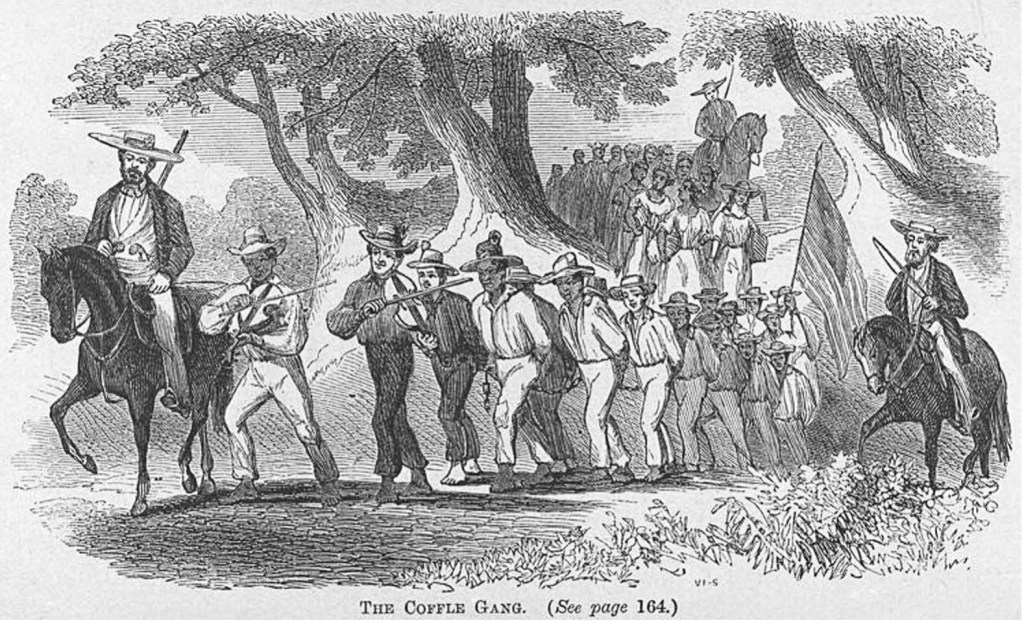
What motivated her to prepare this enduring tie between a mother and a daughter to be sold off to who-knows-where? Was it the groups of the enslaved plodding the dirt roads, the “coffle” gangs, on their way to the auction block? A coffle, sometimes called a platoon or drove, consisted of enslaved people chained together and moved from one location to another by owners or slave traders.
This book tells the story of that frail sack of mementos, passed down through the generations, one family to the next. the vivid testimony to the same hope passed down from one generation to the next.
That cherished sack would keep hope alive for Ashley whatever her future circumstances. The hope in the One who indelibly marked her a person of worth and beloved. Precious in the Lord’s sight.
“Rose would have known this state of instability as the only constant in her life. Yet she found the inner strength to meet a measureless threat with thoughtful action. In this determination to act, Rose represents a population that ‘exercised a degree of courage and will to survive that startles the imagination even now,‘ in the words of the Black feminist theorist Hortense Spillers. Out of the shadows Rose would emerge, bearing the sack as a lifeline and staking a claim for her family’s continuance amid and despite unrelenting change.”[5]
Black mothers lived in a shadowland of constant fear for themselves and their children. And yet, in hope, Rose prepared this visible token of the priceless relationship between a mother and daughter.
This sack is the treasure now passed to the current generation, our generation. Not just to a Black family, but to all of us. It is an American keepsake reminding us of the courage of previous generations, but urging us to be steadfast in keeping the same fire of hope burning. Despite all evidence to the contrary. Will we measure up to the challenge as did Rose? When I consider the fortitude of Rose, I have absolutely no right to give up.
And so we close singing, “There’ll Be Sunshine in the Morning,” God’s Son Shine drenching all our twisted history in Glory. Always propelling us forward towards as the Beloved Community, the hope of the saints down through the corridors of time. Knowing that one day, there’ll be the sunshine of freedom and opportunity, of joy and delight for all God’s children.
That’s my hopey-changey story and I’m sticking to it — for it’s the Gospel Story. Amen.
[1] Wisdom of Solmon 12:19, NRSV.
[2] Roger D. Hodge, The Mendacity of Hope: Barack Obama and the Betrayal of American Liberalism (New York: Harper, 2010).
[3] The Big Dipper, the bowl of which points to the North Star.
[4] Tiya Miles, All That She Carried: The Journey of Ashley’s Sack, a Black Family Keepsake (New York: Ransom House, 2021).
July 19, 2026 – Pentecost 8, Proper 11
“Hopey, Changey People”
The Rev. Dr. John C. Forney
Wisdom 12:13, 16-19; Psalm 86:11-17;
Romans 8:12-25; Gospel: Matthew 13:24-30, 36-43

