
Forney Charities
Improving communities by helping residents, one person at a time.
Gathering gloom and fickle folks

Today the clergy of the Episcopal Diocese of Los Angeles met together by Zoom with our bishops. Bishop John has requested that we not distribute palm crosses, as our usual custom for Palm Sunday. Furthermore, we will not even be gathering as a worshipping community this Palm Sunday! Folks, we are in ecclesiastical lockdown. Need I remind you of the church that recently met for worship in Florida against all common sense. I guess they thought they could “pray away” the virus. The upshot was disastrous – a new cluster of COVID-19 cases.
We will be missing the Renewal of Vows service at St. John’s Cathedral, Easter music, our floral cross Alicia and her helpers always prepare. I’ll miss the Stations of the Cross lead by Deacon Pat. I miss it all, and it sucks! Gathering gloom.
More than that, what really sucks is the growing number of cases and attendant deaths now consuming our nation and the world. It is scenes of exhausted nurses and doctors who’ve done all they could to save a COVID victim, only to helplessly witness another tragic death as the result of their frantic efforts.
Governor Cuomo of New York was pained to inform his citizens that that state only has enough ventilators for six more days until their stockpile is exhausted. No governor should ever have to deliver this sort of news to his or her people. Hearts across America are breaking. Gathering gloom to be sure.
And yet, in some places we frolic about as if it’s eat-drink-and-be-merry time. Let’s have a drink, go to the beach. Many are behaving like the ill-fated passengers aboard that ocean liner in Katherine Anne Porter’s Ship of Fools.[1]
With no national procurement policy, states are bidding up the price of priceless medical equipment, sometimes to over fifteen times the usual. Price gouging in times of emergency used to be punished with heavy fines. Even jail time. I dare not even mention what President Lincoln did to war profiteers. Now, it’s let the good times roll in our sacred free market. There’s a buck to be made. Yes, gathering gloom.
Many who danced about and waved palm branches at Jesus’ entry into Jerusalem would shortly be shouting, “Crucify. Crucify. Crucify,” at his trial later that week. The sky would darken and rain beat down on the sodden stragglers. Gathering gloom, indeed.
And as Bishop John reminded those of us “zoomed in,” God’s resurrecting work is not contingent on our diminished hopes. God’s resurrecting promise may for a time seclude itself in a tomb of our ephemeral emotions and fears. Neither life, nor death, height nor depth, coronavirus nor transient despair shall separate us from the love of God and our faith in the Christ Jesus.
There will be an Easter. Count on it! When Governor Cuomo put out the call for volunteer doctors and nurses this week, an entire relief battalion, 20,000 strong, answered from all corners of America. Easter People, indeed!
Though we not be together for joyous Alleluias, yet an Easter will rise up in our hearts. A spiritual and efficacious Eucharist awaits, though we gaze not upon the elements. Taste and see that the Lord is good. We will persevere as the Holy Feast itself. We are God’s Easter.
May the Lord richly bless you as we move through Holy Week. We long to hear each other’s voices and clasp familiar hands. Peace, my sisters and brothers.
With love and affection,
Fr. John
[1] Katherine Anne Porter, Ship of Fools (New York: Harcourt Brace, 1966)
Dear friends in Christ
April 5, 2020, Palm/Passion Sunday
The Rev. John C. Forney
Matthew 21:1-11, 26:36-27:66
DEAR FRIENDS IN CHRIST
It is most fortuitous that our Gospel lesson for today from John is the story of Jesus raising up Lazarus. Mary attempting to dissuade him from having the stone rolled away from the entrance to the tomb, cautions, “Lord, by this time there will be a stench, for he has been dead four days.”
Our health, our economy, our equanimity – they have all been dead for over four days. There is a great fear about in the land, not of one but of many. Some of us aren’t sure from where our next meal is coming. The vast majority of Americans could not some up with funds to meet a $500 emergency.
These fears are real. And it stinks to high heaven. We needn’t have been so ill prepared. We needn’t have botched this. But where we are, is where we are. And it stinks, especially for those on the margin.
But as Jesus reminds Mary, “Did I not tell you that you would see the glory of God? And friends, that is exactly what we have seen. Early on in the unfolding of this pestilence, a young woman pulled into a supermarket parking lot in Bend, Oregon. As she left her car, she heard someone call out for help from her car. “I walked over and found an elderly woman and her husband. She cracked her window open a bit more, and explained to me nearly in tears that they are afraid to go in the store.”[1] Rebecca Mehra took the woman’s list and money. As she did, the woman, her eyes welling up with tears, explained that she and her husband were in their 80s and very afraid that they would catch the virus.
After Rebecca had returned with the couple’s groceries, the woman told her that they had sat in their car for over forty-five minutes, waiting for the “right person” to come along.
Hold on, now – we’re getting to what my friend Ed Bacon calls a “Glory Attack.”
On arriving back home with her own items, Rebecca told her boyfriend what had happened at the store. He urged her to write this up and send it out on Twitter.
“I know it’s a time of hysteria and nerves, but offer to help anyone you can,” Mehra tweeted as part of the viral thread. “Not everyone has people to turn to.”
By Monday, her story was just about everywhere. Her original post had been retweeted almost 107,000 times and she was featured on cable news and online outlets.[2]
And that, my friends is the full, unadulterated Glory of God!
There’s a lot about this virus that stinks. And some of our bad behavior in the midst of at all reeks with self-centeredness. Like the Fox News host, Ainsley Earhardt, who was so distressed that women couldn’t get their nails done during this lockdown. Woman, get over yourself. There are people who have been evicted, Whole families, living on the street and you’re worried about your nails??? Let’s have a little self-transcendence. This virus is not about you.
But back to Rebecca and that older couple waiting on the kindness of a stranger in a supermarket parking lot.
Beyond the stench of however many days this virus will have us sealed up in our tombs of quarantine, can’t you smell something beyond the rot? Just a little? Can’t you smell something that seems a bit like lilies? Easter lilies, maybe? If so, what you have a whiff of is the Glory of God.
And that’s what we bring in our days of waiting to one another. Who knows how long we may be sealed up in this coronavirus tomb? But I tell you, Easter is a coming. And when we can again see one another’s faces and hold each other close – that will be the best GLORY ATTACK ever.
John
[1] Samantha Kubota, “Young Woman Helps ‘Terrified’ Elderly Couple Get Food, Inspires Others to Pitch In”, Today, Mach 17, 2020.
[2] Op. Cit.
Dear friends in Christ
March 29, 2020
The Rev. John C. Forney
John 11:1-44
Journey without Maps

In 1935 the British writer Graham Greene and his cousin Barbara Greene set off into the heart of Liberia, Africa. As one might imagine, it was a rather harrowing journey with Graham almost dying as he neared its end. His goal was to leave civilization and find “the heart of darkness.” One of the maps he had consulted had a blank, empty space representing the interior of Liberia with the words written across it, “cannibals.” He was forced to rely on local guides and porters to traverse this great unknown. In 1938 he published his notes and memories as a book entitled, Journey Without Maps.
Journey without maps – a most intriguing description of the journey of faith. Maybe most of our journeys – at least the ones that count.
You may remember my childhood friend Dan – yes, the one I got in trouble with for his comment about our balding junior high math teacher, Chrome Dome.
I happened to run into Dan several years later at Cal. State Long Beach. Dan had asked me how things were and did I have much of a love life. Actually, I had broken up with a girl over a couple of years previous and had to admit that I was a little lonely. He invited me to the Methodist student religious club on campus, but I told him that I had had it with the church. Our local church had the most reactionary, egotistical pastor one could imagine. I wasn’t going back. Ever!
His response to my reaction? “Well, we have some mighty fine-looking women who attend.” Throwing aside all scruples, I responded, “Oh? What time do they meet? Where?”
That conversation began a deep dive into the Christian journey I had abandoned when I dropped out of my fourth grade Sunday school class. Soon the campus pastor had introduced me to some of the twentieth century giants of the faith: Bultmann, Tillich, Reinhold Niebuhr and his brother Richard. Also, the great Jewish mystic Martin Buber. Later, that spring break, in Lincoln, Nebraska, I would encounter Martin Luther King, Jr. at a student conference.
That campus fellowship, long, long ago, has been the beginning of a life-long journey. Certainly a “journey without maps.” Now that I’m approaching the end of my journey, I wouldn’t have traded it for anything in the world. In the process I’ve found spiritual meaning that has given shape to my life. I’ve acquired probably more books than our local library. There was that minor detour as an Army medic, stationed in San Francisco. Along the way, I met a wonderful wife and now have two fine sons. One of whom has started me on my new venture to begin an opioid recovery center. Certainly, a journey without maps.
Sometimes, though, a twist of fate opens up a journey we would never have chosen. I read in the paper this morning of the devastation that has overtaken Tennessee as tornadoes swept through the state.
On Tuesday morning 73-year-old Jean Gregory was sleeping soundly in her bed. Suddenly her husband yanked her to the floor and flung himself on top of her as their entire house began to shake. For six, maybe seven minutes the deafening roar blotted out consciousness of her surroundings. Later, when they emerged from the wreckage of their house, they discovered that many of their neighbors had it much worse. Their entire neighborhood of trailers and modest homes was devastated. One tornado that cut a swath of destructor through the middle of the state had remained on the ground for some fifty-five miles, ripping through the center of Nashville. Multiple tornadoes struck elsewhere. For the people of Tennessee, this is indeed a most fearsome journey without maps. Where to pick up the pieces? Ahead are days of shock and numbness as rescuers search the wreckage.
One of the oldest confessions of faith is found in the book of Deuteronomy: “A wandering Aramean was my father; he went down into Egypt and lived there as an alien.” On the day Abraham packed up the station wagon and left with Lot and the rest of the clan, he had not a clue as to where he was going. All he could tell Sarah was that God had told him to pack up and leave this land and your kindred. I’m sure, her thought had been, “What have you been smoking?” He’d said crazy stuff before but this beat all. If ever there was a journey without maps, this was it.
I still remember that call which came around 4:30 in the morning. “Hello, is this John Forney??”
I’m Ed Stanton, the United Methodist Superintendent of Alaska. Are you still wanting to come up to Alaska?” All I could think of was to stammer, “I think I’d better talk to my wife.” And so, began a most wondrous journey without maps.
Today, each of us sitting here in church because of a journey of faith that probably began years earlier. At our age, no one is making us come to church. Those days of fourth grade mandatory Sunday school are long past.
I remember the church planner Lyle Schaller at a conference noting that much of the white he saw from the plane window as they descended into Anchorage was not snow. He said that all the white he saw on the mountains was actually torn up letters of church transfer that people had thrown out the plane windows as they approached the Anchorage International Airport.
Alaska had one of the lowest church attendance rates of any state in the union. In Alaska, no one has a mother or father looking over a shoulder to make sure they don’t miss church. At least if you are an adult, if you’re sitting in a pew, it’s because you wanted to be a part the community of faith. You are there as a result of a journey begun much earlier in life. Even if you came to the faith later in life – it’s voluntary. When your journey of faith began, something drew you in — as had that campus minister and his wife drawn me into that student community of faith. Coming from a pretty dysfunctional family, I came out of the “dark night of the soul.”
In our story of Nicodemus, the gospel of John presents the tale of one who has grown up in the religious community. He is an esteemed scholar and revered teacher. But something is missing in his life. Not wanting to be seen associating with this disreputable rabbi, he approaches Jesus in the dead of night.
An aside – all significant spiritual truths are revealed in the still of darkest night. Always. As with Nicodemus, the spiritual journey is from Darkness to Light. We all begin in darkness. Like Nicodemus, we know nothing. We come in our darkest night. Out of our deepest need.
Nicodemus, attempting to flatter Jesus, acknowledges that the things Jesus is reputed to be doing could only be the result of God’s presence with him. Jesus brushes aside this flattery.
Jesus then tells him the secret. To perceive such things, one must be born from above. That is, one must have a spiritual awakening. Though Nicodemus, is reputed to be a great teacher, he answers, “Huh?”
Jesus tries again, and Nicodemus rebuts him, “How can one already old be born again? Can he reenter his mother’s womb?” As the discussion progresses, it would seem that Nicodemus becomes more obtuse. He understands NOTHING. And he is a such a renowned teacher?
Is this not the beginning of each of our spiritual journeys? From the bare rudiments of faith, from those stories we learned in Sunday school, or at our mother’s knee, we begin a grand journey. Or our venture is still-born, only, perhaps, to be born again later in life. It is always a journey without maps. Sometimes it’s begun with a call at 4:30 in the morning. Sometimes begun with an invitation to a campus religious group that may have some “good-looking women.” Or it may have begin with a spiritual search that begins at midnight. No maps, but always moving towards the Light.
Maybe it was an inchoate summons to pick up and leave familiar surroundings and clan. That’s how the Forneys ended up coming through the Port of Philadelphia in 1767 from Germany. That’s the chance one of my mother’s ancestors took when she up and married a Jewish peddler who had come through a small Iowa town with his wagon of sundries, pots and pans.
However the journey begins, it is not necessarily destiny. When begun in disaster and trauma, people who care can make a difference. We can promote programs that hold out promise for those who have lost their way. We, in the Christian community, can either be part of the problem, mere bystanders, or part of the solution. Christ continually invites us into the Light.
The way I look at it, we’re only here but for the twinkling of an eye. Living to the full, making a difference, means walking with others on their journeys. Sharing the load. Speaking words of wisdom and encouragement. And sometimes warning.
Towards the end of their book Nicholas Kristof and Sheryl WuDunn tell the journey of Drew Goff, son of Ricochet (since deceased), a citizen of Yamhill who had seriously lost his way through alcohol and drugs. Maybe no cannibals, but every bit as perilous a journey.
Sheryl and Nick had kept up with Drew even during the years he had served time in prison. But now he was out on probation and avoiding drugs. Though he had lost custody of his two other children, he was caring for his infant son Ashtyn.
He had been an addict since the age of twelve when he began using alcohol, pot and crank, a cheap form of methamphetamine He swears that though he loved his father, he didn’t want to end up like him. But, like his father, he had been in and out of prison. He had now grown tired of that life – sick and tired. It held nothing for him anymore. No future at all – he had achieved a record of over twenty convictions.
What changed for Drew was a program, “Provoking Hope”. It had given him a foundation of friends who surrounded him with sobriety. He hasn’t touched drugs in over a year – the longest he has been sober since when he was twelve. He now has a relationship with his young son Ashtyn and does not want to jeopardize that. He absolutely loves that little boy. He plays with him, talks with him so he will learn words. Drew reports that the parenting classes he has received through Provoking Hope have made him a decent dad – the sort of dad he didn’t have. He says that he and Ashtyn are now shooting for two hundred words.
Judge Collins, of Yamhill County, who sees many in his court like Drew and Ricochet, empathizes that it is such mentorship that can break the intergenerational cycle of drug use and crime. Programs like Provoking Hope and Friends of the Children can “make a huge difference, because at-risk young people often come from dysfunctional families without a good role model.”[1]
Ricochet had been pushed out of school in the eighth grade by a principal annoyed by his truancy. Years later, his son Drew, was also expelled in the eighth grade. And even when kids like Ricochet and Drew attend class, they often go to weak schools with no access to vocational training. Even with a diploma, many cannot pass the qualifying exam for the armed forces. Without a high school diploma, these young adults are destined for sporadic employment in marginal jobs. Low pay, erratic hours, no benefits, first fired.
This is the challenge before us, America. If we are to be in any sense “Great,” we need to bring along all our people. We cannot keep failing our own. Superintendent Cline of the Yamhill Carlton School district says they are getting more and more kindergarteners whom he would describe as “feral.” One principal says more kids are “biting, screaming, kicking and throwing things.” Superintendent Cline knows what these kids are going through. His father spent three years in the state penitentiary for drug abuse. It was only the military that provided an escape. After his chaotic home life of neglect and abuse, basic training felt like a “vacation.”
Each of us can make a difference, as a teacher, a grandparent, a mentor. I remember going to the “Renewal of Vows” service to which our bishops invite all clergy during Lent. Afterwards, there is often a side meeting for retired clergy. While I usually avoid those things like the plague, I decided one year to attend. There were about forty or so of us in a circle eating our lunch. So many spoke of being bereft of anything meaningful to occupy their days now that they had no sermons to write or parishioners to visit. They were completely at loose ends.
After a dozen or spoke of the emptiness of their lives — I thought, “My God, are there no children to read to? Are there no teachers needing some help in their classrooms? What gives, here?” I wondered if I should pass around a sign-up sheet and put them to work. There are Big Sister and Big Brother organizations just begging for some folks with the training clergy have. Urban re-foresting organizations? The local food bank? Meals on Wheels? Folks, your journey is not yet done. Let’s get to work!
I remember the young people who flocked to the Ninth Ward in New Orleans after Hurricane Katrina. I would imagine that hundreds will now again be heading in droves to Tennessee to join folks like Jean Gregory and her husband. They will need encouragement and accompaniment as, late in life, they embark on a new “journey without maps,” seeking to rebuild from the rubble. Young and old, all are invited. And they will heed the summons. Many of those heading to join the Gregorys and the other victims of this disaster will be people acting out of the best values of their faith traditions. I would hope that some might also be a few of my retired colleagues in the clergy.
The most important journeys we take are “without maps.” Look back at the twists and turns of your life. As in a jazz riff, we are forced to improvise. But if we keep with the beat and mind our step, we seize the blessing to be had. We find a God ever willing to walk, to dance, with us. The journey into neighbor is the journey into God.
That is what my haphazard journey has taught me. It’s not over until it’s over. Friends and guides along the way are essential. Yes, there be dangers ahead. A motto of the twelve-step movement is key: “Make a friend. Be a friend.” And your journey along the way will be blessed – as will another’s journey. Amen.
[1] Nicholas Kristof and Sheryl WuDunn, Tightrope (New York: Knopf, 2020), 239.
Preached at St. Francis Episcopal Mission, San Bernardino
March 8, 2020
Genesis 12:1-4a; Psalm 121; Romans 3:1-5, 13-17; John 3:1-17
First Sunday in Lent
The Rev. Dr. John C. Forney
So, God Can Use Me

I remember walking behind our junior high math teacher who had absolutely no hair. I didn’t think we were that close. Neither did my friend Dan who said something about “Chrome Dome.” Apparently, Mr. Brodeur heard him and the next thing I knew, we were both in big trouble. Him for saying it and me for laughing. Dan’s inappropriate comment got us both a week in after-school detention in his math class. And a stern dressing down. That was back in the good old days when there was actually discipline in school. We knew we had really screwed up. There was no magic “get-out-of-jail-free” card.
Well, as adults we know that there are mistakes that a lot more consequential. There are dire challenges to be faced and there’s no wishing them away. We have a pandemic about to wash up on our shores and we’ve fired or cut back spending for most of the scientists and medical staff at the federal level who could actually help us fight the corona virus. And the other night at a rally, attendees were told that any critique of the effort to fight the corona virus was a hoax. Just a hoax — what the Democrats were making of it. There are only fifteen victims and they are all getting better – except one older woman. Soon there’ll be only two or three. Then none. Nothing to see here, folks. Just move along.
And who’s now in charge of our coordinated national response? A doctor? An epidemiologist? A scientist? No! Who’s now in charge? A politician named Pence who once had substituted his ill-informed judgement for science during the AIDS epidemic in Indiana. That call consigned many young men to death in his state. Rather than consult Indiana’s finest medical staff and epidemiologists, he substituted his own religious prejudices for sound public policy – and people died. This is who’s in charge — the Virus Czar.
This is the Virus Czar under whose watch, crewmembers and passengers coming off the quarantined cruise ship were allowed to fly home with other passengers – all mixed up together. Then, they were all released back into the U.S with no special precautions taken. And now corona virus is popping up all over. Isn’t Pence the guy who said that smoking was not harmful. After all, he reasoned, not everyone who smokes dies. To put him in charge of the Corona Virus Brigade is definitely magical thinking. A stroke of pure genius.
Magical thinking — Jesus rejected it. And so, should we. Gravity always wins. Fame’s not what it’s cracked up to be.
Rush Limbaugh, this week, said that the corona virus is just like a common cold. That’s right — nothing more than a “common cold” blown out of proportion by the media to take down the president. “Now, I want to tell you the truth about the coronavirus. … Yeah, I’m dead right on this. The coronavirus is the common cold, folks.”[1] Listen to that magical thinking and more of us will be just plain dead.
What medical school did he graduate from? With what grades? Contradicting himself seconds later, Rush also asserted the virus was a “bioweapon” created by China in a laboratory. Seigh…
Theology is not magic! That is what the passage from Matthew of the desert temptations would teach. Sure, we would all like bread without labor. Jesus rejects this. “We do not live by bread alone but by every word that proceeds from the mouth of God.” There is no magic.
Faithfulness to the Word of God is life. Not cheap tricks and hokum.
When our two boys were in grade school, we had a wood burning furnace in Alaska that would heat the water for the baseboard heaters upstairs. I would go out to a fellow in the church who operated a portable sawmill. At Norm’s I would get the rounds from the stump end of the tree he could not use, and split them up to burn. The boys would carry them into the furnace room to dry – or at least one boy was up for this.
The other boy? ‘I ain’t carrying no wood,” said our oldest. “That’s okay,” I told him. “Don’t worry about it a bit when the ice sickles are on the inside of the window instead of the outside. We’ll just turn the heat off in your room. No need to carry any wood. Don’t worry about it at all.” After the realization sank in that it could get pretty cold, and no one was going to do his share for him – the next time I saw him, there he was with an armload of wood headed for the furnace room. No magic was going to heat his room.
Ignorance and wish fulfillment are not how God set up the deal. Conspiracy theories and the blame games do not produce bread. They won’t mend our bones should we decide to jump off high buildings. All the kingdoms in the world are not worth the Beloved Community. No magic. No shortcuts. What you sow, you get. Gravity always wins. Sorry, Harry and Hermione.
Magical thinking won’t protect us from folly or ignorance. Conspiracy theories – another form of magical thinking – won’t let us skate through life unharmed.
Real life takes actual work. Jesus taught and healed and prayed. No shortcuts. Real ministry takes work and sacrifice. We had that church, St. John’s, in Anchorage only because those parishioners worked very hard to make it a reality. The first building was an old, unused school house that the guys had bought and moved down the hill from Upper O’Malley Road. I remember Bob and Henrietta, a middle-aged couple who were the back bone of that small congregation. Though they owned a mom-and-pop laundry downtown, and didn’t make a lot – proportionally, they gave much more in time, effort and dollars than many of our well-healed top management oil execs. No magical thinking for Bob and Henrietta. Just a good, sound, wholesome family that loved their Lord and lived their values. Bob was the one who pushed me to get a Korean congregation going. And pushed. And pushed. And we did!
To insist that it is all depends on God is theological fantasy. As the saying goes, “without God, we can’t. Without us, God won’t.” God didn’t skimp in putting together creation, and there are no shortcuts for us either.
Bob and Henrietta were definitely God’s hands at St. John United Methodist in Anchorage, Alaska. Not so much another couple who each earned six figures, yet faithfully put their miserly five dollars in the plate every Sunday. Everyone knew what these two made: he was head of all Health and Human Services for the State of Alaska and she was head of State Personnel. Their salaries were published each year in the paper. And this guy had actually been a pastor! Again, how badly do we really want a church? Or is this only a hobby?
Being a Christian takes a bit of doing. Often, a lot of doing. No cheap grace. The pattern was set at Calvary, at the foot of the Cross.
Forgiveness requires a bit of a death, as well. It’s hard to let go of resentment or justifiable anger. Sacrifice is part of the Lenten journey, if we are honest with ourselves – and with God.
Let me share the story Nicholas Kristof and Sheryl WuDunn tell in their book, Tightrope.[2] They tell the story of Debbie Baigrie, the twenty-eight-year-old daughter of an Orthodox Jewish cantor, who was out celebrating with friends one evening in New York. An acquaintance, who also happened to be at the restaurant, offered to walk her to her car, as this was a somewhat dangerous neighborhood.
As they neared her car, they were approached by a small group of boys, one of which pointed a gun at her face. He demanded that she give up her purse, and before she could react, he pulled the trigger.
The bullet tore through her jaw and passed out her cheek. Bleeding profusely, she managed to stumble down the street, bullets whizzing past, and back into the restaurant.
“Help me!’ she shouted. I’ve been shot! Is my face gone?”[3]
Debbie has since gone through years of painful reconstructive oral surgery. She still can’t eat an apple and her face is permanently scarred.
A few days after the incident, while police were still hunting for the unknown shooter, they happened to arrest a group of boys in a stolen car. As one young boy waited for his mom to pick him up at the station, he matter-of-factly mentioned to an officer, “’You know that woman who was shot in the face the other day?’ he asked. ‘I did that.’” Ian Manuel was the thirteen-year-old gunman.
As you can imagine, the city went ballistic. On one hand, here was a most sympathetic victim, and on the other, Ian, a young thug whose life was going nowhere, a vicious criminal, who had not for a second given a thought about the value of another human life. The papers and other media, branded him as the poster child for all the city’s sociopaths — for all the crime and mayhem which had been terrorizing its citizens. It was Ian’s face!
Though only thirteen, the judge determined to make an object lesson of him and sentenced Ian as an adult. As she pronounced a life sentence without the possibility of parole, the court’s judgement began to register in his mind. “I’m going to die in prison,” he thought.
In prison, Ian was bullied by both prisoners and guards alike. Because he fought back, he spent many weeks in solitary. When uncooperative, he was teargassed and injected with psychotropic drugs.
Growing up in prison, Ian Manuel, one day found himself an ally beyond belief. That day, Debbie answered her phone to hear an operator ask if she would accept a collect call from Ian Manuel.
“Ian who?” she asked.
“Ian Manuel, he told the operator.
Out of morbid curiosity, Debbie accepted the charges.
“I just wanted to wish you a Merry Christmas,” he said, a bit
sheepishly.
“Ian,” she asked, “why did you shoot me?”
“I didn’t know what I was doing,” he said heavily, and there was a long pause. “It was a mistake. It just happened so quickly. I’m sorry.”
Debbie was moved by Ian’s youth and contrition. “I felt guilty,” she recalled. “I felt I had taken his life away. He didn’t kill me but I killed him.”[4]
Debbie was aware that Ian was a kid who had grown up surrounded by violence, drugs, and gangs. He probably never had much of any adult supervision and certainly no school counselor who might have provided support. For Ian, his daily existence was a rerun of Lord of the Flies.
With that call, began a most bizarre, and for Debbie, a life-changing correspondence. Depending on the day and how excruciating the pain, Debbie vacillated between anger and the impulse to forgive. On another day she would think, “He’s just a kid. When you’re thirteen, you do stupid stuff.”
Ian was in prison when he received the news that his mother had died of AIDS. This was one of the absolute worst days in his life there. His only connection on the outside other than Debbie had been cut off.
Then an absolute fluke. Ian had used his time behind bars to read and get an education. Because the guards in the prison would punish their charges by turning the dayroom TV to PBS, Ian happened to hear a documentary, To Be Heard, a program about a poetry class in the Bronx. He began writing poetry in his cell. It became his outlet for expressing his bottled-up emotions.
Sometime thereafter, he also happened to receive a letter from the renowned lawyer and activist, Brian Stevenson, who had started a program, “Equal Justice.” Brian was looking for a juvenile who was serving a life sentence without parole. His lawsuit would argue that such punishment was unconstitutional.
The Supreme Court eventually ruled in favor of Ian, who would be resentenced.
Debbie testified at that resentencing hearing, asking for leniency for Ian.
Reading from Nick’s and Sheryl’s book:
In 2016, after twenty-six years behind bars, Ian was released for time served – and celebrated with Debbie Baigrie. They exchanged hugs. Nobody watching would think that Ian had once shot Debbie; he called her his “guardian angel” and “second mom.” They moved on to an Italian restaurant for a dinner of pizza and soda not far from where he had shot her in 1990.[5]
Being a person of faith requires effort. There’s nothing magical about the wresting with the conflicting emotions that Debbie struggled through. It was costly. Her divorce was partly the result of the bitter arguments she had had with her husband over her reconciliation with Ian.
Jesus refused any conjuring tricks to produce bread. He refused to jump from the temple roof. He realized that all the kingdoms of this world could not compare with the vision he served. Get thee behind me, Father of all Lies. Your way is not the way of God. It will not build the Beloved Community. That will take blood and sweat.
We sang a marvelous gospel song the other night during vespers at Pilgrim Place, “I’m Gonna Live So, God Can Use Me.” In part, it goes:
I’m gonna live so, God can use me
Any where, Lord, any time.
I’m gonna live so, God can use me,
any where, Lord, any time
Let this be our Lenten hymn. This Lent, let us lean into honest, bold, adventurous living so that God might put each of us to some earthly use. For our sakes and for the sake of young men like Ian Manuel. No magic thinking here. Any life worth living is the whole reality show. The key word being “REALITY.” What we do, counts. Any where, Lord. Any time. Amen.
[1] Allyson Chiu, Washington Post, Feb. 25, 2020
[2] Nicholas Kristof, Sheryl WuDunn, Tightrope (New York: Alfred A. Knopf, 2020)
[3] Op cit., 176.
[4] Op cit., 181.
[5] Op cit., 187.
Preached at St. Francis Episcopal Mission, San Bernardino
March 1, 2020
Genesis 2:15-17; Psalm 32; Romans 5:12-19; Matthew 4:1-11
First Sunday in Lent
The Rev. Dr. John C. Forney
Christ, Whose Glory Fills the Skies

Most of our days are lived in the humdrum of just getting through the day. Each day has its share of muck and mire. There’s often enough drudgery to mess up any possibility of joy.
When I returned home from West Virginia, out raising money for House of Hope, here on my desk was a copy of our local newspaper, the Claremont Courier. In the opening pages, is Matthew Bramlett’s column, “Police Blotter.”
This section contains essentially the log of the calls that came into the dispatcher that week with a bit of narrative. On Tuesday, January 21, Officers arrested a certain Michael Turner who had been drunk and disorderly. While in the officer’s patrol car, the suspect kicked out one of the windows in the back seat.
I can just imagine this officer, not only having to deal with such disagreeable folks but now having to waste a bunch of time filling out the paperwork to his car fixed, cleaning up vomit on the floor of his car, and having to calm down from the undeserved verbal abuse from some of our finer citizens he has the honor of hauling into the station. Where’s the Light in all this? Where’s the Glory? Is this the glamor that was depicted on that recruiting pamphlet he read as a senior in high school? Is this mess really what he imagined when he considered a career of “helping people?”
Much of life is in the muck and mire of just getting through the day.
And it must have been so many days of those who were part of the Jesus Movement. It’s not easy living off the land. Sickness from bad food. Aching bones and sore muscles from having slept out in a dusty field in the bitter cold. Thirst. Ridicule from some of the local townspeople. Not easy indeed.
In the church, it’s not all that different. One morning I received a call from our administrator, Faith, about the damage she discovered upon opening up the office. Someone had kicked in the door of the janitor’s supply room. To what purpose?? I have no idea? The men’s room was out of paper towels? Who knows? Some Sundays, just getting out of bed and getting ready is a real chore. Running off the bulletin, going through the phone messages? Having to deal with the county weed abatement notice?? It’s not all glamor and raa-raa enthusiasm. Faith will tell you.
But, as our selection from Matthew’s gospel relates — now and then, some most amazing, glorious events spring forth. Through all the filth and disappointment light breaks forth. Matthew begins, “Six days later.” Later from what? From more wandering and rejection? Through days of busted out windows and the stench of stale vomit? Six days later from curses and insults? Six days later from WHAT???
Six days from dusty roads and parched throats Jesus takes some of his little band of followers, Peter, James and John, up on a high mountain. There they stop to pray.
As they are praying, Jesus’ appearance dissolves into a dazzling radiance. He shimmers and shines like a hundred brilliant suns. He is indeed “Christ of the shining mountains, True and transfigured king.” “Christ, Whose Glory fills the sky.” Then and there he is the true and only light.
And in the midst of it all are Elijah and Moses, talking to Jesus. Elijah and Moses, harbingers of the Messianic age. These two, when they appear, that’s all there is folks. Time’s up. The roll is called up yonder.
The disciples’ minds earlier had been consumed by Jesus’ end. That day the talk on the road had been of Jesus’ coming departure from this world — the deadly confrontation with the powers and principalities of this world, to be accomplished in Jerusalem.
But now this! It’s way, way too much for the three followers, and though they are weighed down with sleep, they manage to see Jesus shrouded in brilliant luminosity with two men.
Dreamily, poor Peter really has no idea of what to make of it all. He is consumed by the experience. He might as well be in paradise. He’s as disoriented as someone coming off a bad LSD trip. He doesn’t know what to say. He’s like a little boy hauled in before the principal, afraid and stammering. So finally, he simply blurts out, “Wow, this is great. Let’s make three tents, one for you, one for Moses, and one for Elijah.” But, of course, he has no idea what he is saying. His incoherence is as bizarre as a tweet coming out of the White House at three in the morning.
These are strictly Old Testament rumblings: the mountain, the cloud, the voice, the luminescence, and Moses and Elijah. The glory of God fully manifest in Jesus as the culmination of revelation.
Spiritually, this is the mountain Moses ascended to receive the Law. Just as Moses entered into the very presence of God – smoke, fire – a luminosity beyond what sight could bear, Jesus shone with that same divine luminosity – the shekinah — the virtual dwelling of God — far beyond anything that might be conjured up in a Steven Spielberg, film, a brilliance no eye could behold.
Zora Neale Hurston, in her 1939 novel, Moses, Man of the Mountain, describes the aftereffects of Moses encounter with God on Mount Sinai. “With flakes of light still clinging to his face, Moses turned to where Joshua waited for him, ‘Joshua, I have laws. Israel is going to know peace and justice.’” [1]
“With flakes of light still clinging to his face.” What an incredible image of the afterglow of a divine encounter. “Flakes of light.” I imagine that this metaphor might describe Jesus and his three disciples as they came off the Mountain of Transfiguration. “Flakes of light” clinging to their faces.
Isn’t this the glow, the beatific aura that envelopes a new mother as she receives her baby from the attending nurse? Isn’t this the glow that hangs over new lovers who have just found one another? Sometimes this luminosity is known by a young person coming down to the altar to make her profession of faith in Jesus Christ as her personal savior.
I’ve seen it at a church service as an alcoholic shared his journey to sobriety and recovery.
But eventually, it is time to leave the mountain. And for what? The alcoholic knows that sobriety and recovery can only be lived as they are given away. That’s the twelfth step. It is back into the swamp of addiction that the man or woman in recovery goes to take the message of hope and sobriety. And as it is given to another, the presence of God – that holy cloud of compassion – envelopes the conversation.
All who have been touched by the glory of Christ have come off the mountain with “flakes of light” still clinging to their faces. In its best moments the Church is adorned with the same “flakes of light.” And the afterglow remains only as it’s passed along.
The same is also the case for our democracy. Those men and women who created this nation seem like larger-than-life figures, so shrouded in legend and myth are they. Much they got wrong. They were human beings confronted by the contingencies and prejudices of their day. But in their finer moments, yes! They come out of Independence Hall with “flakes of light” clinging to them.
You’ve all seen that iconic painting in your grade school history books by John Trumbull of the Declaration of Independence being presented to Congress for signing. Pure myth. But an origin story encapsulating the promise of one of the most radical of new beginnings. A people charts a course from servitude to citizenship. Something astonishingly new in the annals of history. Trumbull got it right. He captured the “flakes of light” of that unique moment.
And we citizens, many generations later, as we give ourselves to the promise of that original vision – we exit that Independence Hall adorned with “flakes of light.” Their original vision has expanded to include the original inhabitants of this continent as well as those brought here in chains. Yes, indeed, “flakes of light.” The guarantee of the promise primordial is the continual expanding promise of liberty. To all.
This past week of reprehensible pardons of the worst of the worst swamp creatures. Men who had cheated and duped their fellows, treasonous scoundrels who have sold out the promise of this nation to a hostile foreign power – I began to doubt that there is any saving legacy of that distant convention at Independence Hall. I grew quite cynical. Is all for sale? Do we have nothing of value to pass along to the next generation?
In the midst of dour gloom, I felt I needed a sanity break. I went over to Barnes and Nobel Booksellers to see if the new book by Robert Reich had hit the shelves.
While I was scanning the “current affairs” shelf, I spotted a book about a Holocaust refugee’s secret mission to defeat the Nazis. Not many escaped those camps to tell about it, let alone to to work against Hitler’s war machine.
As I leaned against the shelves and began reading, I realized that I was definitely in the company of a patriot. The “flakes of light” that clung to Freddy, even through the pages of this book, were restorative to my soul.
The book by Eric Lichtblau, author also of The Nazis Next Door, tells the story of Freddy Mayer, a Eastern European Jewish refugee who immigrated to the United States, fleeing the ever repressive Nazi regime. When the Nuremburg Laws were passed and the Germans invaded Austria, the family knew it was time to get out. Unfortunately, for most Jews, the door was permanently shut shortly after their ship sailed for America.[2]
Practicing American style capitalism, Freddy found that his German training as a Diesel mechanic enabled him to get better and better jobs in his new home. But news from the Old Country continued to haunt him. Only eight months after the family’s arrival, came news of Kristallnacht, the orgy of violence Joseph Goebbels unleashed on the Jewish community. Thousands of businesses, synagogues and homes were destroyed. Over one hundred Jews were killed and the roundup began. Notable industrialists in America like Henry Ford enthusiastically supported Hitler and his program. Colonel Charles Lindberg denounced the Jews, as did the KKK.
After Pearl Harbor and the Declaration of War, thousands of eager young boys rushed off to recruiting stations to defend their country, Freddy among them.
Lady Liberty “had ushered him into the country three years earlier when he fled Nazi Germany, and now she was beckoning him once again – this time to fight for his new homeland.”[3] Unfortunately, Freddy was rejected as being an “enemy alien.”
Eventually Washington realized that it would need every able-bodied man and woman available. Restrictions were eased and Freddy joined up. Though a mechanic, his assignment, in the grand wisdom of the Army, was permanent KP – kitchen police – scrubbing pots and pans.
Out in the California desert, under General George Patton, Freddy was finally able to show his stuff. He volunteered for the “Wildcat” Rangers and rose to “first scout” on training missions. A general whom Freddy had taken “prisoner” in a training exercise, the next day called him in. Not for a reprimand, but to offer him an opportunity to join the OSS – an opportunity for foreign-speaking men from Europe to penetrate enemy lines on secret espionage missions. Freddy would now be working for “Wild Bill” Donovan.
Freddy would later parachute on a moon lit night into Austria as part of a three-person team. Even after capture by the Nazis and after having been savagely tortured, almost losing his life, Freddy agreed to speak with the Gestapo officer in charge of Innsbruck to spare the city. Freddy convinced him that any further resistance was futile. With the Allies were closing in, that despised Nazi officer realized that Innsbruck was completely surrounded. He also realized that this American captive held out his only hope of averting more waste of life. He enlisted Freddy to approach the American lines with a white flag. What could have been a bloody battle costing many lives was averted, and it was Private Freddy Mayer who arranged terms of surrender. What a glorious immigrant!
Looking back, now at ninety-four in his West Virginia cabin, with his trademark shrug (as if to say What’s the big deal?), Freddy remarked to the author, “What more is there to say?”[4]
Freddy was wrong. It was a very big deal. There’s a lot more to say, and that story is not finished.
All those men and women, who were part of the “Greatest Generation,” came back from those battlefields adorned with Flakes of Light from Old Glory, Flakes of Light from that founding vision at Independence Hall.
The idea they fought for, the proposition that each is a person of worth, the idea that no one should be forced to live under the tyranny of an autocrat, is derivative of the shekinah, the dwelling of God, upon the Mount of Revelation.
Freddy and his team of agents, Lt. Colonel Vindman, Ambassador Marie Yovanovitch, and countless unnamed loyal civil servants — those who spoke truth at great personal risk to career and livelihood, are in that hallowed line of patriots, Flakes of Light from 1776 upon their faces.
These citizens have done their constitutional duty. Like Moses, they have come down out of secure government jobs into the muck and mire of the Swamp. They have given testimony to the enduring values we weakly strive to embody – to the vision of a nation under law, ever in the process of perfection. The glory of our highest aspirations and values is transfigured in their service to our nation. Glorious Flakes of Light. These ideals are indeed godly.
Transfiguration is not some biblical oddity of long ago. I see it Sunday after Sunday as faithful followers of our Lord kneel at the rail to receive the Eucharist. I see it in the fresh coat of paint in former Sunday school rooms being prepared for outpatient care for House of Hope – San Bernardino. I see it in those lovely hands preparing a bag of food for a visiting stranger. Yes, the Church of Jesus Christ daily descends into the fray bearing “Flakes of Light” on its face.
By the time I had finished reading about Freddy Mayer — when I glanced down at my watch, I noticed that almost two hours had passed. What a glorious browsing of a bookshelf.
Amen.
[1] Zora Neale Hurston, Moses, Man of the Mountain (New York:HarperCollins, 1991) p. 233.
[2] Eric Lichtblau, Return to the Reich: A Holocaust Refugee’s Secret Mission to Defeat the Nazis (Houghton Mifflin Harcourt: New York, 2019), 27.
[3] Op. cit., 27.
[4] Op.cit., xii
Preached at St. Francis Episcopal Mission, San Bernardino
February 23, 2020
Exodus 24:12-18; Psalm 2; 2 Peter1:1-16-21; Matthew 17:1-9
Transfiguration Sunday
The Rev. Dr. John C. Forney
What Could Possibly Go Wrong?

“It seemed like a good idea at the time.” How many have had this insight after suffering the consequences of a really dumb choice. Or maybe we just didn’t think at all. Obviously, I wasn’t thinking too hard about my academic success while spending late nights in the pool hall. And my grades in physics and calculus were what you may have suspected. After two years in the Army, my thinking improved. By then I definitely knew what I did NOT want to spend the rest of my life doing. I would leave that choice to such honorable men as Col. Vindman and others.
I remember coming back to our construction yard during the time when i was running our family’s contracting business to find some very expensive aluminum scaffolding all crumpled up by the back fence. A crew had been working that day taking off a chimney as part of getting rid of a fireplace at one of our projects. I called the foreman Paul over and asked him what had happened to our scaffolding. He told me that instead of dismantling the chimney brick by brick, they thought it might be easier to just lever the thing up whole and shove it off the roof. “It seemed like a good idea at the time.” And here was four or five hundred dollars of crumpled up scaffolding that the whole thing hit on its way down to the ground. What could possibly go wrong?
After that costly mistake I would ask the crews every morning before they left the yard to consider any plan they might be unsure of. Ask yourselves, I would counsel, “What could possibly go wrong?” Remember Murphy’s Law. If it could possibly go wrong, it most likely will. And remember the corollary to Murphy’s law. “Everything that hits the fan is not equally distributed.” ‘Nough said.
On a more serious note, we all need to be asking that question of ourselves as American citizens. If we disparage the foundations of our democracy, what could possibly go wrong? If we trash the news media, if we neglect to adequately educate our children – if we fail to support those institutions that are bastions of our communitarian life – our churches, and temples, our service clubs, the PTAs and all the rest – what could possibly go wrong? If we jigger the tax code so all the benefits go to the top five percent – what could possibly go wrong? And some businesses like Amazon, Wells Fargo and Google pay hardly anything or nothing at all…? Go wrong???
Plenty, it would seem. We become deadly cynical and give up on democracy.
This is the point of our lesson from Deuteronomy put in the starkest terms: There are the ways of life. There are the ways of death.
As the Hebrews were about to enter the promised land Moses is reputed to have gathered the tribes together and instructed them.[1]
“See, I have set before you today life and prosperity, death and adversity. If you obey the commandments of the Lord, your God that I am commanding you, by loving the Lord your God, walking in his ways, and observing his commandments, decrees and ordinances, then you shall live and become numerous, and the Lord your God will bless you in the land that you are entering to possess.”
“I call heaven and earth to witness against you today that I have set before you life and death, blessings and curses. Choose life so that you and your descendants may live…”[2]
There are ways that lead to life abundant and ways that lead to dissolution, to life squandered. St. Paul, over and over, reminds his community to choose LIFE. You know, the part about love being patient and kind, not boastful.
Now, let me digress for a moment. There’s the false notion some Christians have that the Old Testament being the book of Law. It’s the book of EAT YOUR SPINICH. Or whatever food you detested as a child. For me it was tomato aspic – bluck! AND the New Testament being Gospel — the book of God’s grace and love.
Those who believe this, I would aver, have read neither, Old or New. There’s both gospel and law in the Old Testament as there is gospel and law in the New Testament. In fact, we must understand the law as also a blessing. The purpose of the law in scripture was to retain the blessings of God’s freedom won for us at great price from Pharaoh.
How can we enjoy the benefits of civil society if no one can trust that the weights are not manipulated or that testimony given in court is truthful? It is because, and only because, we have agreed to keep to certain standards and a basic trust in one another that life can flourish. Thus, these basic laws are solely to maintain and secure these blessings to ourselves and our children. That’s the entire purpose of the law – to keep the freedom God has won for us from all that would oppress.
Down through the ages, the understanding of law, or Torah, has changed. Jesus reinterpreted the legal inheritance passed down to him in our lesson from Matthew. When law fails to secure the blessings of God’s providence, we are not under its demands. Seriously, is anyone going to hell from eating shrimp??? St. Paul certainly reinterpreted the law. That is why we have several different injunctions concerning divorce.
The bottom line of our faith is that the glory of God is a woman, a man fully alive. We need a little discipline and self-transcendence to keep this godly gift. That’s the sole purpose of the Law, and that’s why the law is indeed a blessing. The dissolute life is definitely NOT a blessing, though it may feel good at the time.
A Presbyterian clergy friend was telling me the other day how excited he was about the eager youth in his confirmation class. They were really ready to explore in depth the faith they had received as children. Unfortunately, too many Christians are left with a fourth grade Sunday school understanding of the faith. Confirmation classes offer the opportunity to go deeper.
I was taken down memory lane to one of my confirmation classes. I had come into my office a bit late and apologized for my tardiness. And I moved to get the class focused, “Okay, guys, lets get started.” Angie protested, “We’re not all guys.” Before I could say another word, macho Tom interjected, “Well, you’re sure flat enough.” This was definitely NOT what you tell a junior high girl! Angie jumped up in tears and stormed out the door. I quickly followed her as she almost ran into the arms of our associate pastor, who had been coming up the walkway. While Peter took charge of comforting Angie, I returned to the class.
Complete silence. More silence. After I believed that we had taken in what had just transpired, I finally told them that today’s lesson had just changed. Today, the lesson would be about what creates community and what kills community. Slowly, a few began to speak. Finally, Tom said, “I guess I have to apologize,” at which point the entire class like a massive Greek chorus intoned, “YEAH, TOM.”
Set before us are the ways of life and the ways of death. If the operating ethic is solely ME FIRST??? What could possibly go wrong? YEAH, TOM! Set before us are the ways of life and the ways of death. Choose life, Tom.
I found out that later that week Tom had in fact apologized. Angie had accepted his remorse and the following week we gathered back as a group. A summation of what we call the Ten Commandments could be the title of that Aretha Franklin song: R-E-S-P-E-C-T. Respect your life. Respect your neighbor. Respect your community. And above all, respect the Mystery that brought you and everything else into being. That’s the sole purpose of the Law. When we neglect the duty of R-E-S-P-E-C-T what could possibly go wrong? Most likely, everything. Ask Tom.
Robert Fulghum, a Unitarian pastor, wrote a wildly popular book some time ago, All I Really Need to Know I learned in Kindergarten. This is just another iteration of the laws which make for human community. In the pages of that book were common sense guidelines for playing nicely in the sandbox. You remember some of the rules. Law, if you will —
Share everything.
Play fair.
Don’t hit people.
Put things back where you found them.
Clean up your own mess.
Don’t take things that aren’t yours.
Say you’re sorry when you hurt somebody.
Wash your hands before you eat.
Flush.
All of which add up to RESPECT. They are the sort of guidelines that make for kindergarten being a fun place, a good experience. I also found out that it also helps if you can sit quietly in story circle. And keep your hands to yourself. Do these things and kindergarten will be a blessing.
But sometimes folks don’t keep their hands to themselves. Just can’t. Some folks grow up in homes that are so damaging they don’t have a chance of success. In their homes, alcoholism, sexual violation, violence and anger destroy for generations. They are bound to failure as tightly as Ulysses was bound to the mast of his ship.
Nicholas Kristoff and Sheryl WuDunn, a husband-and-wife pair of Pulitzer Prize winning authors, in their new book, Tightrope, tell the stories of Yamhill, Oregon, the small logging community in which Nick grew up. Almost forty percent of those with whom he rode the number six bus to school every day are gone – gone to drugs and alcohol, gone to incarceration, gone to suicide, victims of sexual abuse and family violence, gone to accidents caused by risky behavior, gone to disease from poor lifestyle choices.
Reading through their book, following some of the families, chapter after chapter – depression set in. Lack of employment and poor schools, lives of poor health choices. So many lived lives of desperation. America has ignored these people. The result has been death. The death of a huge swath of our nation.
But in chapter ten, a burst of sunshine floods the pages of their book. Nicholas and Sheryl tell the story of “Women in Recovery.” This is a two-year residential diversion program for non-violent drug offenders. It is a program in Tulsa, Oklahoma, that is helping “shattered people rebuild their lives and families.” Second changes are the ways of LIFE.
In these pages I encountered women and children who, by ordinary odds, would not have had a chance of escaping the fateful trajectories of their lives. Called junkie, they die junkies. But with the blessing of enlightened division programs, many are now taking charge of their lives. They choose LIFE. America, choose LIFE!
In the opening pages of that chapter I was invited to a graduation ceremony of seventeen women of “Women in Recovery.” There they were in their finery with hair and nails done to a tee. No longer called junkies and whores, these women are proud tax payers, productive workers, and moms. They had cheated, lied and stolen from most of the hundred or so in the crowd who came to celebrate their accomplishment. “And in the front row sat a number of the very judges who had sentenced them applauding enthusiastically. They stood proudly to raucous cheers from family members and even police officers who previously had arrested and scorned them.”
The attorney general of Oklahoma was one of the graduation speakers. He called these woman “heroes.”
“I thought we’d be planning a funeral instead,” said one audience member whose younger sister had started using meth at age twelve and was now graduating at thirty-five.[3]
This is what happens when a society chooses the ways of LIFE – chooses the way of a second chance for those bound for failure. It is what happens when women such as these take responsibility for their bad choices and seize the opportunity for LIFE. To conclude:
At the end of the ceremony there was another standing ovation. Then these women themselves shouted, “Thank you, judges,” and gave a return standing ovation to the judges The giddy scene offered a crucial lesson that the rest of the country hasn’t appreciated: there is hope even for people with addictions whom society has given up on—if they get the right help.[4]
Through the hopefulness and the generosity of spirit of those who create and support such programs as Women in Recovery, God offers life abundant. Such programs make the offer real to the drug offenders that society has given up on – choose LIFE.
These women have weighed, through lives of misery and degradation, those two choices. Through the grace of God, they have chosen LIFE — as have the police and drug court judges who are the backbone of Women in Recovery. As has the state of Oklahoma.
Through another innovative program in New York public schools I met a homeless young immigrant from Nigeria, Tani, and his family.
This homeless boy worked his way through an innovative school chess program to take back trophy after trophy to the homeless shelter in which his family was living. Up until then, Tani had never seen a chess board. His chess teacher, looking at Tani’s progress remarked. “One year to get to this level, to climb a mountain and be the best of the best, without family resources…I’ve never seen it.”[5] Tani worked more chess puzzles than his teacher ever remembered any other student doing. Tani won the New York state championship for his age group. That’s God-given freedom to shine like the sun. LIFE!
America, what could possibly go wrong when we deny opportunity to our people? Plenty. We see it in the hollowed-out eyes of those we have given up on.
BUT — here’s what can go gloriously right when we serve up opportunity in huge dollops. Followed with responsibility and respect.
America, choose Life that your inhabitants and future generations may enjoy the blessings of liberty. Choose opportunity! I set before you the ways of life and death. Choose LIFE. Amen.
[1] Deuteronomy 30:15-17, RSV
[2] Ibid, 30:19
[3] Ibid, p. 124.
[4] Ibid.
[5] Nicholas Kristoff, Sheryl WuDunn, Tightrope: Americans Reaching for Hope (Alfred A. Knopf, New York, 2020), chapter 10, “Interventions that Work.”
Preached at St. Francis Episcopal Mission, San Bernardino
February 16, 2020
Deuteronomy 30:15-20; Psalm 119:1-8; I Corinthians 3:1-9; Matthew 5:21-37
Sixth Sunday after the Epiphany
The Rev. Dr. John C. Forney
How Much is Enough?

A snarky old Texan, Jim Hightower, in his retirement runs an amusing podcast, “The Lowdown.” From 1983 to 1991 he served as elected commissioner of the Texas Department of Agriculture. As Commissioner, Jim dealt with not only agricultural issues but also the problems of rural Texas. In that role he saw more than one could imagine of abject poverty. He came to know intimately the lives of those mired in rural poverty.
As an author and podcaster, Jim is the bane of obscene wealth and undeserved privilege. He is a thorn in the side of stand-pat politicians whose only goal is to feed at the public trough and then retire with a silk purse stuffed to the limit with your hard-earned tax dollars.
This week, looking at the ginormous haul of Facebook developer, Mark Zukerberg, he wonders what one might do with the extra $27.3 billion Mark made this past year. Yes, you heard that right – billion with a capital B. Billion, in just one year! Now, nevertheless, whether any democracy can survive when a handful of folks are awash in this sort of wealth to spend to mess with our elections – just what does one do with so much? Besides political ads? How much, in fact, is enough?
You can only buy so many mansions, hunting lodges in Switzerland, Rolls Royces and Picasso paintings. None of this actually trickles down to create jobs. No, it just sits there in a huge pile in some trust fund to waiting to generate even further riches next year because these folks have jiggered the tax code so they need divert only a small portion of this haul to the public good.
What might one buy with even a small slice of this largesse? Jim, in this week’s podcast, highlights the transportation needs of the uber-rich. These multibillionaires have created a boom in maximum-security vehicles. The sort that’s right out of a James Bond double 007 movie set. These vehicles with names like “Black Shark” and “Marauder” feature 700-hundred horsepower engines, full body armor with bulletproof glass. On the roof, you can accessorize this vehicle with gun turrets, and for a little extra, thousand-volt door handles which will electrocute any unauthorized personnel who might be tempted to tamper with your ride in the Walmart parking lot. They are capacious, with room for up to ten fully-equipped bodyguards. All for the low price of over one half a million US smackaroos. That’s what gazillionaires can spend their hard-earned wealth on.
We are told this week that one hundred and sixty some people now own as much as half of all the people now living on the planet. Of course, they would need something like a “Marauder” to fend off the destitute they have cheated and bamboozled on their way up the ladder of success. (They might call it success. It looks more like common tax-dodging criminality). Tell me, how much is enough.
Tell me, exactly how much is enough? Such wealth is beyond the imagining of the average person in the Inland Empire struggling to make it through the week. This poor soul can’t even afford a ticket to that James Bond flick with such fantastic gadgets.
Is it any wonder our youth seek something better, some life that makes a difference? It has been said that God meets us in our extremity. The old spiritual says it all: It’s only when we’re under the boot of Pharaoh that we cry out. “Go down, Moses, way down in Egypt Land; tell old Pharaoh to let my people go.” Well, we seem to be at a final extremity as a society. Just look at what’s happening in Down Under. Australia’s burning up.
The whole bit about Zebulun and Naphtali in today’s readings is about the territory of the two northern tribes of Israel which suffered most from the invasion of the Assyrians 700 years before Christ, when they invaded and burnt down the neighborhood, pillaged, raped and put the population to the sword. There was no Geneva Convention back then, not that we pay that much attention to it now. The rules of war were those of a knife fight – there were no rules! The population of these two tribal areas were like folks of the Ninth Ward of New Orleans after Hurricane Katrina went through – no help was on the way. None ever came, and they never recovered.
So, to say that the “people who sat in darkness have seen a great light, and for those who sat in the region and shadow of death light has dawned” – well, It’s beyond belief. It’s a sick joke. What repent and get ready?
It should not have been surprising that those fishermen, Simon Peter and his associates dropped everything at Jesus’ summons. Not surprising at all that they signed up right then and there on the spot. Don’t worry about the perks and benefits. Here was liberation from the permanent gloom and depression of what then might have been called a dung-hole country, now under the Roman boot. Jesus not only proclaimed a New Day; he did the works of this New Dawning. He went about “healing every disease and every infirmity among the people.”
That is the Good News our people await who live in a land of deep shadows and dark distress – those who live in fearful times. They look to our communities of faith to not only proclaim such Light, but to live such Light.
I’m thinking of the rural Americans whom Jennifer Silva, noted sociologist, writes about in her book on the intersection of the pain of poverty and politics “in the heart of America.”[1]
I’m thinking of Roger and Brenda Adams (not their real names, but fictitious names Jennifer gives them to preserve their anonymity). This couple lives in a delipidated row house that assaults any visitor with an overwhelming stench of fumes from a kitty litter box when one enters. Roger and Brenda are in their early forties and live in constant pain. They report that they have been unsuccessful in getting any medical assistance for their ailments. He suffers from “depression, neuropathy, diabetes, the early stages of congestive heart failure, and obesity.” Brenda has scoliosis, hypothyroidism and PTSD from the abuse she suffered as a young girl in foster care.[2]
They barely “squeak by” on food stamps and the small help they get from SSI due to their five-year old daughter’s Attention Deficit Disorder and Oppositional Defiant Disorder. Due to a “plumbing issue” which resulted in the loss of their older children after a neighbor had complained to child protective services, Roger’s “evil mother” got full custody.
Roger had worked as an EMT for a short time and volunteered as a firefighter until he was fired as his health deteriorated. He now spends most of the time on a recliner after surgery for his spleen. Because of the pain following the operation, he was prescribed opioids from a doctor “infamous for prescribing opioids.” According to Roger, this doctor couldn’t be bothered finding out what was actually wrong with you and doing something about it. He’d just pass out more pills.
For Roger, ask him about the American Dream, and he scoffs. “I think it’s dying.” Roger’s resentment of those he thinks get all the breaks is palpable. “If I had a Confederate flag outside, people would say it was a hate crime, but if I had a gay flag, or an Islam flag, people would celebrate it. Hell, even having an American flag is seen as a hate crime. But that will come down over my dead body.”[3]
Roger sees himself and his family as the backbone of America, standing tall to preserve a way of life based on self-sufficiency, love of country and neighborliness. And all around him, it’s dying. He’s dying. He believes that things have gotten so bad that a “race war is coming.” Roger’s incapacitation he considers a blessing: “God made him disabled just so he ‘wouldn’t be able to go out into the world and start shooting people.’”[4] Roger’s life motto is: “Don’t trust anyone.”
Roger, laying in his recliner, lives in a land of deep darkness – his future, his health, his fears for the country he loves. It is the Rogers and the Brendas, in places of destitution and vanished hopes, who await a Light – some Gospel Light to shine in their deep darkness. At least in the waning of their remaining days. They are the ones we in the church have been commissioned to walk with. To care for.
Just imagine — imagine the relief a visitor from Meals on Wheels or a visiting nurse might bring to Roger’s or Brenda’s depressing day. Just imagine a visit from someone from a nearby church just stopping by to see if they were alright or needed anything. Or just to talk. I imagine they would be every bit as eager for such Light as were those fishermen, Peter and Andrew, James and John, to whom Jesus called. Every bit as eager as the inhabitants of Zebulun or Naphtali, or the residents of the Ninth Ward of New Orleans awash in mold and putrid floodwaters.
And from where comes such help? From where comes such Light? Soon after Katrina struck, thousands of American young people poured into New Orleans. They came on bus and by the carloads. They came because they heard that clarion Gospel call every bit a clearly as did those fishermen on the shores of Galilee. Just as distinctly as have those here at St. Francis working to set up a food pantry and establish an opioid recovery center on our church property. They heard that call every bit as much as the person in recovery who invites a fellow addict to an AA or NA meeting.
Let us pray, that in our waning days God puts us to good Gospel use. That is the inner yearning of every beating heart. As St. Augustine said” “Our hearts are restless until they find their rest in Thee.” Friends, that rest has nothing to do with taking our ease in Zion. It is an active rest. Students who used their Spring Break after Hurricane Katrina, to head on down to New Orleans, reported as never having worked so hard in all their lives as they did those long days in the Ninth Ward, mucking out mud from people’s houses, tearing out moldy dry wall. Yet, they returned back home renewed and spiritually refreshed. They returned as new persons – yes, new in Christ Jesus. The lives they touched, the friends they made — this would become a transformative spiritual adventure that would shape the rest of their lives.
In such young volunteers sent by their churches, the Kingdom is drawing very near. The season of Epiphany is about divinity incarnate in Jesus and in his church. In as much as we dig in to the work given to our hearts and minds, the world sees that very same New Light in the darkness, Light that the darkness cannot overcome. It is in some of the smallest acts of kindness or daring that life opens up to becoming a big thing. I believe such would be the case for Roger and Brenda who many days await some smidgen of Light in their deep darkness. Pray, we in the Church be their Light.
And oh, by the way, cancel my order for a new Marauder. I think God’s found a better use for those funds. Amen.
[1] Jennifer Silva, We’re Still Here: Pain and Politics in the Heart of America (New York: Oxford University Press, 2019).
[2] Ibid, p.31.
[3] Ibid.
[4] Ibid, p.33.
Preached at St. Francis Episcopal Mission, San Bernardino
January 26, 2020
Isaiah 9:1-4; Psalm 27:1, 5-13; I Corinthians 1:10-18; Matthew 4:12-23
Third Sunday after the Epiphany
The Rev. Dr. John C. Forney
The Real McCoy

When Jai and I went to Alaska we quickly learned that there were two sorts of Alaskans: Cheechakoes and Sourdoughs. Cheechakoes were the newbies, those ignorant of custom and survival needs. As you’d guess, Sourdoughs were those who had weathered a few seasons and somehow managed to survive.
We knew of a couple who spent their first year at the University of Alaska, Fairbanks in an unwinterized trailer. These cheechakoes barely survived their first semester. She reported that it was so cold at night she would awaken in the morning to find her hair frozen to the trailer wall next to her pillow. They had to put the canned soup in the refrigerator to keep it from freezing solid – cheechakoes for sure!
The two designations came out of the mining days in the early nineteen hundreds. Now, if one claimed to be a sourdough there was only one test of authenticity. If he didn’t claim with certainty in the next breath that he was going to strike it rich – he wasn’t the Real McCoy. He was a fraud and a fake.
I’ll tell you a story of one of those early miners, Max Hirschberg. Word had come to Dawson City, a staging area during the Klondike Gold Rush in Canada, that a new gold field had been discovered in Nome, Alaska. This was some twelve hundred miles down the Yukon River from Dawson. Word spread like wildfire and the town soon emptied out as every dogsled and other conveyance was bought up by men stricken by gold fever.
Max, however had injured his foot on a broken board with a nail in it and ended up in the hospital with a bad infection. By the time he was finally released in March, there was virtually nothing left in town that would get him down the river to Nome. Anxious to get going before the ice on the Yukon broke up, all Max could find was a bicycle. He loaded all he could carry, fastened it in a pack to the springs of the seat and began peddling down the river, following in the tracks the dog sled steel runners had made in the snow much earlier. When rough shards of ice shredded his rubber tires, he continued on the steel rims.
Some of the Athabascan families in villages along the Yukon would put him up for the night in their dwellings. The big problem was with what Max called “seam squirrels” — probably bed bugs – they were intolerable. To get rid of them, Max reports that he would step naked outside in the below zero wind each morning with his clothes and leave them in a pile on the ice. With the infestation finally frozen, he would then put on his clothes and continue on his way.
After many adventures and misadventures, Max finally made it all twelve hundred miles down the Yukon into Nome on May 19, 1900. Max Hirschberg was the Real Deal. A Sourdough through and through by the time he made it into Nome. We rejoice that he had the good sense before he died in 1964 to tell his story to his granddaughter.
When one reads of Jesus in the Gospel of John, the story we encounter is unlike anything we have in Matthew, Mark or Luke. Jesus in John doesn’t speak as a normal person. John’s gospel uses other language and metaphors to convey to the reader that Jesus is the Real Deal. He’s a gospel sourdough through and through. Light and Life, he is – that’s what the Baptizer is proclaiming. Authentically a chip off the ol’ block of the One who set the stars in the firmament and the planets in their courses. Search no further.
In John’s gospel Jesus makes proclamations. They look more like pronouncements rather than ordinary dialogue. The language John uses to describe Jesus and his mission is stilted and formal. If any of us talked like that, or said these things of ourselves, we would be shunned at best, and at worst institutionalized. This theological approach is what scholars call a “high Christology.” It is exalted explanation in flashing neon lights.
What we have in the Gospel of John is the testimony of the Johannine community as to who Jesus is and why he matters. Jesus is the Lamb of God who takes away the sins of the world. He is the Incarnate Word of God. Jesus is the Bread of Life, the Good Shepherd. In John we don’t have miracles so much as Divine Signs. Yes, the Real McCoy. No Plastic Jesus here.
The question to John the Baptist disciples is still the signal question of the church: “What do you seek?” It is the question to every generation of seekers. “What do you seek?”
What we all seek is a life that matters. A life grounded in what is utterly true and authentic. That is what people seek from the church, because folks even at their wit’s end know in some inchoate way, have some inkling they cannot give words to, that the church, the community founded on Jesus’ love and radical acceptance, ought to have something to fill the empty, aching void of their lives.
In an age of Fake News and cynicism about almost every facet of our national life, we are as much adrift as were those early peoples in a disintegrating Roman Empire. We Americans now live in a society where, with the poet Yeats, we’ve discovered that “the center cannot hold.” The old verities are no more. We’ve been lied to so often, our nation’s awash in intellectual anarchy. As Rudy Giuliani railed to Chuck Todd on “Meet the Press” one Sunday morning, “Truth is NOT truth.” Whatever that means!
Out of this wasteland, they still come asking, is there any ground beneath our feet? Does anything matter anymore? And some still stumble into the church, hoping for a saving word — some loadstar to guide.
And miracle beyond miracle, there are churches of authenticity. Communities of faith that actually live out the message of Our Lord. They find in such communities the a Good Shepherd, the Bread of Life, “Light and Life to all He brings.”
On the Village Green in New Haven Connecticut there are two churches of the same denomination virtually side by side. On his way to church my younger son would pass them both. He and his girlfriend noticed that behind one of the sanctuaries there was a whole crowd of young people and some older folks. What my son discovered was that meals were being served and food distributed for the needy. The next Sunday, that congregation became their church. They had found something that looked like the message of Jesus, an authentic portrayal of the gospel. That is what folks at loose ends seek – authenticity. Something as real as Max Hirschberg. They want to SEE a sermon, not just hear one. Mark Twain is reputed to have said that it would be much easier to believe in the possibility of redemption if the redeemed looked a little more redeemed. This community feeding the homeless out back looked redeemed.
That is what has drawn so many fans, young and old, to Mr. Rogers. He’s the Real Deal. One hundred percent there with the people he encounters. Most people did not know that Mr. Rogers was a Presbyterian pastor. Early on he made the decision to devote his life to children – their fears and inner terrors, and their joys – the full range of their emotional lives.
The reporter, Tom Junod, was notorious for what some considered to be “hit pieces” on a number of celebrities. When Esquire Magazine sent Tom off to do a small piece of just a few hundred words on Fred Rogers for a series on heroes of our time, Tom wondered if Mr. Rogers was for real. What he discovered is captured by the subtitle to his article: “Fred Rogers has been doing the same small thing for a very long time…”[1] What he found over not just that brief interview, but over the weeks and months as their friendship blossomed, Fred Rogers was the genuine article, the Real McCoy.
I would say that if anyone wondered what Jesus might have been like, I believe Fred Rogers showed us a pretty authentic face of Jesus. The respect and kindness he showed to everyone connected with the show, the staff and his young guests – I would like to think this gracious spirit reflected Jesus’ teaching. This is the Jesus who said, “Let the children come to me. Whoever welcomes such a little one welcomes me.”
Tom in his piece which grew to become the full-length feature article for the November issue, tells the story of a teenager with muscular dystrophy who had experienced terrible abuse as a young boy from those who were supposed to have taken care of him. As the boy grew up, he had come to believe that he was so terrible from what he had suffered that no one could like him. Not even God.
The one bright spot in his day was the show, “Mr. Rogers Neighborhood.” Even into his teens he compulsively watched it, whenever it was on. His mother was convinced that Mr. Rogers was the only thing keeping her boy alive.
It so happened through a foundation that it was arranged to have Mr. Rogers visit her boy when he came out to California to visit Koko, the Gorilla, also a fan of Mr. Rogers.
When the boy found out that Mr. Rogers was actually coming to his house, he was overwhelmed. He began hitting himself with his hand because he was so nervous and began hating himself. His mother had to take him to another room to talk to him and let him calm himself. Here Tom continues the story:
Mister Rogers didn’t leave, though. He wanted something from the boy, and Mister Rogers never leaves when he wants something from somebody. He just waited patiently, and when the boy came back, Mister Rogers talked to him, and then he made his request. He said, “I would like you to do something for me. Would you do something for me?” On his computer, the boy answered yes, of course, he would do anything for Mister Rogers, so then Mister Rogers said, “I would like you to pray for me. Will you pray for me?” And now the boy didn’t know how to respond. He was thunderstruck. Thunderstruck means that you can’t talk, because something has happened that’s as sudden and as miraculous and maybe as scary as a bolt of lightning, and all you can do is listen to the rumble. The boy was thunderstruck because nobody had ever asked him for something like that, ever. The boy had always been prayed for. The boy had always been the object of prayer, and now he was being asked to pray for Mister Rogers, and although at first he didn’t know if he could do it, he said he would, he said he’d try, and ever since then he keeps Mister Rogers in his prayers and doesn’t talk about wanting to die anymore, because he figures Mister Rogers is close to God, and if Mister Rogers likes him, that must mean God likes him, too.
When Tom asked Fred Rogers if he had made the prayer request that the boy might feel better about himself, Fred answered back:
“Oh, heavens no, Tom! I didn’t ask him for his prayers for him; I asked for me. I asked him because I think that anyone who has gone through challenges like that must be very close to God. I asked him because I wanted his intercession.”[2]
Fred Rogers gave his viewers a pretty good idea of who Jesus still is for our day – one facet of that divine gem.
Call him Lamb of God. Call him Messiah, Christ. Whenever Jesus is portrayed even in somewhat rough and proximate fashion, Life is kindled. Joy is found. The broken are mended.
There’s a reason we, the church, yes, you and I occupying these pews this morning, are called the Body of Christ. Our only question to those who enter our doors is, “What do you seek?”
Let us pray those who enter our doors find life restored, hope reborn. Do the lame walk, and are the addicted freed of their slavery to alcohol and drugs? Do newcomers find justice flowing like a mighty stream? Do they find Light in their darkness of despair? Even a bit? Are the hungry fed and the homeless housed in dignity? Will they find a Good Shepherd to hold a hand when mentally confused? Is there a sheltering embrace for the wounded and abused? Do we, the church, look even a bit redeemed? That’s what this weary world seeks.
You will encounter such redemption in the authentic Body of Christ, in communities of faith reaching beyond their comfort zones. Such has ever been the mission that has drawn seekers to the Lamb of God. In radical acceptance — sin, alienation – is overcome. Life is restored.
We pray that it might ever be so here at St. Francis, that we continue to grow into the full stature of Christ. May we be the Real Deal of God. The genuine article. Just like loveable Mr. Rogers.
Listen! You may be the only copy of the gospel your neighbor will ever see. Pray we be genuine Sourdoughs on our gospel journey as we travel down the river of life – every bit as much as old Max Hirschberg on his bicycle trip down the Yukon River to Nome, Alaska.
Amen.
[1] Tom Junod, Esquire, November 1998.
[2] Op cit.
Preached at St. Francis Episcopal Mission, San Bernardino
January 19, 2020
Isaiah 49:1-7; Psalm 40:1-12; I Corinthians 1:1-9; John 1:29-42
Second Sunday after the Epiphany
The Rev. Dr. John C. Forney
Star of Wonder, Star of Night

Today is the Epiphany of our Lord. In the Western Christianity we celebrate this event by hailing the arrival of eastern sages who followed the star till it led them to the Holy Family gathered around the manger. That star sits atop many a Christmas tree. It is celebrated in verse and hymn.
And sometimes it’s celebrated in church pageants this time of year. Like the one many, many years ago in a little fishing village in Alaska. The solemnity of the occasion might have been somewhat lacking when the three wisemen fell into a giggling heap upon arriving at the manger.
But the Epiphany of the Lord is far deeper than the hijinks of any bathrobe drama, no matter how cute the cast. The celestial display is to make manifest the glory of God residing in a most ordinary event of a birth to a peasant woman in a nondescript, backwater place. Another child born into poverty was nothing startling or auspicious in and of itself. Yet this most ordinary of events has turned out to be the hinge of history. If you doubt it, look at the effects. In China, of all places! Where are the results of this birth most widely felt? The Protestant Church as represented by unregistered congregations is seeing spectacular growth. Growth that has really rattled its Communist rulers. Why this explosive growth? Because the people who have walked in darkness have seen a true and wondrous Light.
But that Light comes to us in darkest night. As it came to eastern sages in a world torn by imperial rivalries and the rule of the sword. Likewise, it appears to us in our time of deep global darkness.
“A decade wasted,” is how one environmental writer assessed our response to global warming. My friend’s wife, Christine, is presently in Australia. She reports that the entire country seems aflame. Over eight million animals are said to have perished. Entire communities in eastern Australia are now cinders. The loss of human life continues to mount.
Though the sky of Australia is ablaze, it is pitch dark for the planet. And, their prime minister is a climate denier. Just ignore that singed Koala. No need to tie me kangaroo down, Sport. He’s ashes. Nothing to see here, folks. Move along. Move along. But, wait! Now, this is rich — Prime Minister Scott Morrison is seeking to outlaw climate protests in order to protect mining interests. Forget your flipping kangaroo. It’s the economy, stupid.
Temperatures continue to soar elsewhere, 120 degrees Fahrenheit in New Delhi this week. Almost nobody has air conditioning. Wonder how they’re making out!?
O Star of deepest night, reveal some brief sign of hope, we pray. That we may find our way back to our center. Some sign back to sanity.
Chelsea Becker long awaited the birth of a son Zachariah. She would whisper to her youngest, Silas. “Here’s your baby brother,” as Silas would hug her around her stomach.[1] Alone at a friend’s house the twenty-five-year-old Chelsea began to bleed profusely. When her mom arrived, she immediately called 911.
About three hours after arriving at Adventist Hospital, Chelsea gave birth to a stillborn baby. The nurse handed the mom the baby so she could say goodbye. The hospital called the coroner’s office. Two months later Chelsea was arrested for murdering her child. The autopsy had shown toxic levels of methamphetamine in the baby’s blood.
O blindingly radiant Star, pray show forth a little hope, just a smidgen for those hooked on drugs and for their families. Pierce the dreaded night of addiction for those who offer what little solace there is to be had. Show a little love for those with hearts emptied out with grief.
The words of Isaiah seem too facile. Too glib.
“Arise, shine; for your light has come,
And the glory of the Lord has risen upon you.”[2]
“Nations shall come to your light,
And kings to the brightness of your dawn.”
I don’t think so. Proclamations of Hope? National exemplar of moral leadership? The fact is, no nation is capable of such. Israel failed time and again. And when finally winning release from Greek hegemony, their leaders murdered one another in an orgy of mayhem over the following centuries until Rome moved in and conquered what was left.
And what modern nation has bragging rights? Yet God sends the Star of Revelation. Star of Second and Third Chances. “Behold, I make all things new.” Sweet land of liberty, would that it be so!
It always seems to be the little folks who rise to the occasion. Those blessed “nothings” among us who radiate back divine glory and hope.
They are that unnamed nurse who, tears flooding her eyes, handed a dead baby back to its addicted mother for one last touch. They are those neighbors in scorched Australia running before the flames from house to house waking any who might remain. They are those Aussie shelter workers tending to the few rescued animals that made it to their care.
These are the magnificent slivers of light from the Star of Christ’s birth. In and out of fitting season.
“Star of Wonder, Star of Night. Westward leading, still proceeding.”[3] Guide us, guide us we pray for the night is long, the darkness deep and the journey ahead most difficult.
Star of Wonder Star of Light, shine upon the peace makers in America and in Iran. Shine O Star of Light, in skies perilous with drones and bombs — Shine while hearts now rage for revenge. While folly rules by day and ignorance by night — All forethought having taken flight – Shine O Wondrous Star. Shine!
Whisper a word or two of hope to pry open hearts both in America and in Iran. Or shall thou, O Deathstar of Absolute Night, preside over yet more wanton bloodshed in a land already soaked in too much blood? Where does it end? What’s the plan here, O Geniuses of War? Tell us — How does this end?
As always, it falls to the little people, the shepherds in the fields the young too burdened with student debt, to pick up the pieces and carry on with the daily stuff of life. May their hearts be emboldened with a courage not seen from our leaders. Give them arms strong to the task. That’s always how it is, isn’t it?
This Epiphany, we ask for no miracles, no splendid pyrotechnics in the sky. Only barely the light to find our way back home as did those three ancient travelers. The promise, as always, remains — no matter how deep the night or absent familiar landmarks, the residual light from that long-ago Star shall be sufficient. It’s fading glimmer, a true and trustworthy guide.
My wife and I spent part of our New Year’s Eve at All Saints, Pasadena. It has been rumored that on that one night of all nights, when Jesus broke bread and shared the cup, it was bubbly. And so, it is ever Champaign that’s been served at All Saints for Communion on New Year’s Eve in recent memory.
But better than that, however, a former priest on staff at All Saints, Wilma Jacobson, preached the sermon. Wilma was a gift to All Saints by Archbishop Desmond Tutu, who gave her his blessing to leave his staff in South Africa that she might come to America. Of course, the madness in his method was that by sending Wilma Jacobson to the most prominent flagship Episcopal congregation on the West Coast, she would rally American support for the economic boycott against South Africa. That boycott was in fact brought to a successful conclusion and Apartheid finally ended with the election of Nelson Mandela, its first black president. All Saints, Pasadena, ever remains a strong supporter of the Desmond Tutu Foundation’s work.
As South Africa is presently racked by unemployment, crime, and corruption, Wilma heads back. As a white South Afrikaner, she is aware she has little leverage to do much to be of help. But what she can do, she will. That’s the Wilma of generous heart that I have always known. I will very much miss the lilt of her English accent when she leaves us.
In her sermon, Wilma mentioned a web site dedicated to those white South Afrikaners who have committed to remain and do whatever they can to heal the dysfunction of their great nation. The site’s tag is called: #ImStaying You can find it also on Facebook.
Here is the story of one of the faithful, generous souls who have screwed up their fortitude and have pledged their lot with their fellow countrymen and women. It is the story of one white South Afrikaner who’s staying put. These beautiful citizens of that fabled country brightly reflect glimmers of the Christ Star. And what they reveal is hope for the planet – the hope of some simple, decent humanity.
The narrator says that on her drive home she saw a man lugging a suitcase on wheels with crutches. Crossing a bridge, he was struggling mightily as he finally got to the other side. He was tired and obviously ill. She told her kids that she was going to stop and help him.
She rolled down the window and asked the man if she could give him a lift somewhere. His distorted face indicated to her that he was in some real difficulty. He seemed somewhat confused. He handed her a piece of paper saying he was deaf and dumb. She began to speak very slowly and offered him a lift to where he needed to go. He wrote on his paper on a board he pulled from his backpack his destination. She had her son get out of the car and help with his bags. Then she had the man sit next to her with his crutches.
As she drove along, the man kept writing messages to say thank you on his board, and she used the little sign language she knew to say that it was her pleasure. She stopped along the way and got him something to drink and withdrew some money at her bank.
When they got to the taxi station that was his destination, her son carried his suitcase to the cab. As he left, she had tears streaming down her face. She handed him a 400 Rand note in South African money and hoped he would make it home safely.
She later told her kids that there was no way that many people would help a man like this, walking with crutches, with a distorted grimace on his face. Speaking to her children as much to us, she continues:
People need help! We can only do what we can with what we’ve got. I’m just happy that being kind costs nothing and we have the potential to do so much good.
I know that [they] will remember that day in particular for the rest of their lives and I hope it will encourage them to be good to other people. We need to role model this behavior for our kids.[4]
The woman concluded that she again had tears in her eyes as she typed up her story. She thanked #ImStaying for all the positive posts on the site, concluding with the prayer, “May God bless Africa.”
As my friend Jim Strathdee has so marvelously turned a Howard Thurman poem to song!
When the song of the angels is stilled.
When the star in the sky is gone.
When the kings and the shepherds have found their way home.
The work of Christmas is begun!
The work of Christmas has begun. Our work. The work of all the little people, the nobodies, the “least of these” – in whom Christ continues to daily preform the most astounding miracles. Let it ever be so, even here at St. Francis. Amen.
[1] Alex Wigglesworth, “Addicted Moms, Stillborn Babies,” Los Angeles Times, December 2, 2019.
[2] Isaiah 60:1 ff.
[3] John Henry Hopkins, Jr., “We Three Kings of Orient,” The Hymnal 1982 (New York: The Church Hymnal Corporation, 1983) 128.
[4] Anonymous, #imstaying.
Preached at St. Francis Episcopal Mission, San Bernardino
January 5, 2020
Isaiah 60:1-6; Psalm 72:1-7, 10-14; Ephesians 3:1-12;
Matthew 2:1-12
Celebration of the Epiphany
The Rev. Dr. John C. Forney
Herod in His Raging
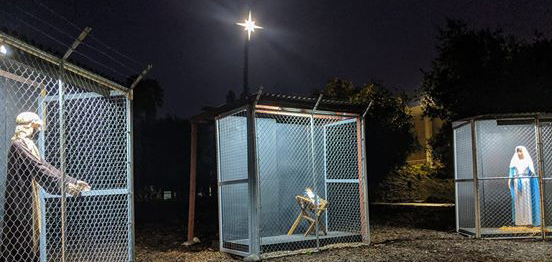
It was a real surprise to pick up the Los Angeles Times the other morning in my driveway. Right there on the front page, above the fold was NOT the traditional Christmas tableau of the Holy Family surrounded by adoring wisemen, camels and the like. NO. Each figure — Mary, Joseph and Jesus – was surrounded by a chain-link wire cage. And Jesus lying separately in a manger wrapped NOT in swaddling clothes, but in an aluminum space blanket.
My friends down the street at the United Methodist Church had made headlines again with another provocative theological statement. No Pat Boone crooning “Silent Night” or Frank Sinatra softly singing “Have Yourself a Merry Little Christmas.” NO! Just the graphic portrayal of the stark realities into which Christ is ever born. Into every Christmas does Herod rage. Babies are snatched from mother’s arms at borders around the world.
And as one might expect, did it ever catch the public’s attention! Police Chief, Shelly Vander Veen has said that she will station two officers on the street near this nativity scene over Christmas Eve and Day to guard against vandalism. Yes, there are some who can’t handle prophetic gospel truth.
Jesus was born into a hostile world. And Christ continues to seek entry into our most resistant world. Folks, delve into scripture very deeply, and you will encounter a most political document. Christ was crucified between two insurrectionists NOT because he preached pablum. His words and actions were a direct threat to the Roman empire. As much a threat as the church is to autocracies today. Herod understood completely the gospel message, and does today as well. The ethic of Christ IS NOT the ethic of Caesar![1]
It is no accident that the Feast of Holy Innocents follows directly upon the angelic hymns of Christmas morn. As the hymn, Coventry Carol, proclaims, “Herod the King, in his raging charged he hath this day, his men of might, in his own sight, all young children to slay.”[2] In Syria, in China, Brazil, and at the U.S border with Mexico – Herod would have his day.
So, outrage? You bet. The message of the United Methodists has reached unconverted hearts. One woman indignantly responded, “I’m never going to attend Claremont UCC again.” Obviously, she hadn’t been there in some while as she was crediting the wrong congregation. United Methodist pastor Karen Clark Ristine, explained in Facebook, that this scene of the Holy Family “takes the place of thousands of nameless families separated at our borders.”
The ethic of those holding power in Herod’s name, that ethic always stands opposed to the teachings of Jesus Christ. The ethic of slaveholding society stands over against that of Christ of the Abolitionists and the Freedman’s Aid Society. Against Caesar Chavez’s struggle for decent wages, deeply rooted in the Christian faith. Against workers standing shoulder to shoulder against the grower intimidation and the use of state sanctioned violence.
I don’t want to destroy any Christmas sentimentalities – well, yes, I do. But only to deepen what t sentiments we might rightly have concerning this most holy day. Christmas is solely about God’s saving action breaking into our torn and destructive world. It is definitely not about Grinches and mistletoe, Alvin and the Chipmunks. Frankly, if I hear “Little Drummer Boy” one more time, I’m going to barf. Give me any day “The Festival of Lessons and Carols” from the BBC – mainlined straight from Kings College, Cambridge, England. PBS will rebroadcast this delight. Give me fresh Christmas tamales. Something real!
So, let’s stick to the story, just as Linus does. Just as Bach does: Yes! “Break Forth O Beauteous, Heavenly Light.” Stick with the story. Yes, a new “light shines and the darkness has not overcome it.”
“Joseph, son of David, do not fear to take Mary your wife, for that which is conceived in her is of the Holy Spirit; she will bear a son, and you shall call his name Jesus for he will save his people from their sins.”[3]
Joseph awoke from his sleep and did as the angel commanded. Might we as well awake from our sleep. For in the dark of night Herod does indeed rage.
“… as the Light of light descendeth from the realms of endless day, that the powers of hell may vanish, as the darkness clears away.”
Let us wake from our sleep. Listen, we are commissioned as radiant sparks of that very same Light. We, that the powers of all that diminishes and destroys, the powers of Hell, may vanish. This is what we celebrate on December, the 25th. I’m talking about nothing less than spiritual warfare. The powers of life arrayed against Herod’s powers of darkness and death. It’s about that old union song, “Which Side are You On?”
John Dominic Crossan notes that Christians have always had two possible responses to Herod: accommodation or resistance – nonviolent resistance as taught by Jesus and his followers down through the ages. As taught by Martin Luther King, Oscar Romero, Nelson Mandela and Desmond Tutu.[4] And just plain folk like you and me who say NO to the operating ethic of “me first, and if anyone else survives, it’s mere coincidence.”
Resistance by simply and humbly exercising our Gospel commission – to give witness in word and deed to the summons to kindle new life into being, to wake the dead — to let the Divine Light shine through daily acts of justice and solidarity. We simply keep on keeping on, reflecting that pure Gospel Light as best we can. And that shall be sufficient.
Resistance has been the message of Koinonia Farm in Americus, Georgia. There, a small group of Christians over the years has lived in inter-racial community, contrary to the Jim Crow ethic of that region. Against KKK threats and violence they have stood in the Light of the Christmas story. By their mere existence, this community has been a rebuke to racism and exclusion. Welcoming all, they continue to be Christ to their neighbors, born this day and every day in Americus, Georgia.
Resistance might be the soft, gentle stand against the mentality of the world that bases one’s worth on usefulness, on wealth,
on status. I tell another story of Pastor Craig Rennebohm, Chaplain to the Homeless in Seattle. He, certainly, in his active ministry, has been Christ of the streets and alleyways to the homeless.[5]
Craig Rennebohm would certainly second the sentiments on Fr. Dean Brackley, S.J., “There is a crucifixion on every corner and a resurrection on every block.” This is definitely the case in any of our large metropolitan areas. Craig Rennebohm has been no small part in many a resurrection on the streets of Seattle.[6]
He tells the story of a fellow who wondered into his downtown Seattle church. A fellow who went by the nickname Breezy. Craig noticed this unfamiliar man in the church lounge one morning at the piano. His clothes were unwashed and a bag of belongings on the floor indicated Breezy was homeless. His hair was disheveled and he, obviously, hadn’t had a shower in a while.
He, actually, wasn’t half bad at the piano. He had a good strong bass rhythm with solid chords. Craig listened for a while then approached the man and introduced himself. Craig had seen Breezy on the streets from time to time. He had a gimpy leg and whenever the sidewalk would become too crowded, he would duck into a doorway. Something was definitely not right with his left leg.
The church would let him come in from time to time and play, and Craig and Breezy began to meet at a close by diner for some eggs, hash browns and coffee. Over the ensuing weeks Craig learned more and more of Breezy’s story. He spoke indirectly of a hospital stay some time ago. He had spent his recent years hitchhiking back and forth across the country.
He spoke of a music contract he had been awaiting to arrive. It was very intricate and most complicated. In Breezy’s mind, this was reality, though it seemed rather grandiose to Craig.
Breezy had been sleeping in one of Seattle’s downtown shelters until it closed — closed even though the weather continued cold and damp. Then he moved around at night from place to place. Craig continued to urge Breezy to have his leg checked out. One day when Breezy could barely walk, he was finally willing to have Craig escort him to a clinic and have a nurse look at it. His problem was diagnosed as cellulitis, a very serious case. With medicines and a prescription for a bed at a shelter, Breezy began to feel better.
In the following days, Craig and Breezy would walk the streets of downtown Seattle talking together. Actually, Craig mostly listened. Craig encouraged Breezy to meet a social worker, Ken, from Health Care for the Homeless. Ken began to join the two of them for breakfast at their favorite diner – and the circle widened by one.
On one morning, shortly after the World Trade Organization met in
Seattle and noisy street protests filled the downtown, the turmoil deeply agitated Breezy. As some extremists began setting fire to Dumpsters and smashing windows, Breezy’s fear and anxiety became palpable. Obviously, all this took Breezy back to a very distressing time in his life. “They aren’t starting again? The riots?” he questioned.[7] For some time afterwards, Breezy remained at a heightened state of alert. Fearful of more of the potential chaos he must have experienced sometime in his past.
As Ken and Craig continued to meet with Breezy in the coming weeks, more and more of Breezy’s story emerged. He began to look upon Craig and Ken as trusted friends. And over the breakfasts a plan was developed. Ken would help Breezy in his applications for various benefits. Though Breezy wouldn’t go to a doctor’s office about his leg, he was okay if a doctor joined the trio at breakfast. After some getting acquainted conversation, Breezy discovered that Doc played a little guitar, more of a hobby than anything else. He invited Breezy to stop by his office when he might be in the neighborhood.
One day, as Craig and Breezy passed Doc’s office, Craig suggested they go in and Breezy agreed. Doc was between appointments and the three chatted for a while, and Breezy agreed to an appointment. An appointment that turned into regular visits. Breezy’s circle widened by yet another.
Ken helped Breezy find an apartment and slowly Breezy formed some friendships with the other residents. His circle continued to grow.
He bought a guitar and the church secretary got him several sets of new clothes. Breezy would hunt the alleys for items of use, or that could be repaired, assembling in his small space a computer he had fixed with a monitor and printer that he was still working on.
Breezy loved Christmas. The previous year he and Ken had driven to an elaborate Nativity scene with children and live sheep. He asked if Craig might come by his apartment for a special blessing as Christmas neared. Shortly before the holiday, Craig and Ken stopped by.
Craig asked if Breezy had some ideas for what he might include in his prayer. Breezy asked for a special blessing for his Christmas tree he had scavenged. Decked out in various ornaments Breezy had come across with a string of colored lights, there it stood. Should Craig include anything else in the prayer? “A home,” he said, “is good.”
“We blessed the tree and Breezy’s home, and prayed for his continued wellbeing and healing from all that weighed upon him and caused confusion in his life. We gave thanks for his special gifts: music and a good heart. And we gave thanks that in this world we need not be alone, but have the help and encouragement of others to find our way.[8]
After the prayer, Breezy took Ken and Craig over to a small table, and turned on the computer he had rebuilt. “It did not work perfectly – and might never.” But Breezy tinkered with it every day.
His delighted grin said a lot. It was one of those moments when Breezy’s soul shone forth unmistakably. His Christmas tree, decorated with castaway treasures from the streets that Breezy had carefully collected, evidenced a coming together, a new iteration of life.[9]
The blessed companionship of Craig, Ken, Doc and Breezy is ever the work of Christmas. That small circle of love will forever remain unbroken. It is of God.
This is work Herod in his raging would never understand, certainly not to expend time and treasure for. Yet it is priceless. It is the gift of Mary and Joseph, who many long years ago, gave birth to it in a lowly manger stall.
This is the gift that lives on in hearts of all who still make pilgrimage to the Christ Child with service and gifts. On the streets, in jails, shelters, in offices — wherever there is need. With hands, minds and hearts, pocket books and credit cards honor is bestowed.
Yes, deck the halls. Raise another cup for Auld Lang Syne. Trim the tree. Welcome friends and family. But never forget: Jesus is the reason for the season. Not so much to adore, but as to follow. Follow, as do those who are companions to the homeless on cold, wintry nights.
My friend Jim Strathdee, drawing on a poem by Howard Thurman, put these sentiments into a wonderful song:
When the song of the angels is stilled.
When the star in the sky is gone.
When the kings and the shepherds have found their way home.
The work of Christmas is begun!
With Tiny Tim, I say, “And God bless us, everyone.” Amen
[1] John Dominic Crossan, God & Empire: Jesus Against Rome, Then and Now (San Francisco, Harper Collins, 2007).
[2] Coventry Carol, 15th Century, The Hymnal 1982: according to the use of the Episcopal Church (New York, Church Hymnal Corp., 1982), 247.
[3] Matthew 1:21-22, RSV.
[4] Crossan, 89.
[5] Craig Rennebohm, Souls in the Hands of a Tender God: Stories of the Search for Home and Healing on the Streets (Boston: Beacon Press, 2008). 65 ff.
[6] Dean Brackley, The Call to Discernment in Troubled Times (New York: Crossroad Pub. Co., 2004).
[7] Ibid, p 67.
[8] Ibid. p. 68
[9] Ibid.
Preached at St. Francis Episcopal Mission Outreach, San Bernardino
Isaiah 7:10-16; Psalm 80:1-7, 16-18; Romans 1:1-7; Matthew 1:18-25
Fourth Sunday of Advent, December 22 2019
The Rev. Dr. John C. Forney
 Forney Charities